Why AI Ad Creative Variations All Look the Same (And How to Fix Them)
Most AI-generated ad creative variations are so similar that they produce meaningless creative test results, wasting budget and delaying winning asset discovery. This guide breaks down why AI defaults to trivial differences, and shares a structured variable-first framework for generating meaningful variations using Seedream 4.5’s reference-based image generation. You’ll walk away with reusable prompt templates and a validation system to make every creative test count.

Table of contents
The hidden cost of lookalike AI ad variations
If you’ve ever generated a dozen AI ad creative variations only to realize they’re all the same ad with a slightly different background shade, you’re not wasting your time by accident. Most AI-generated ad variations are so similar that they produce meaningless creative test results: flat CTRs, no conversion lift, and no clear signal about what actually resonates with your audience.
This isn’t a failure of AI — it’s a failure of how we ask AI for variations. Models like Seedream 4.5 are designed to match your prompt as closely as possible, so if you don’t explicitly define which elements can change (and how much), they’ll default to the smallest, least noticeable tweaks to stay on brief. The fix is a variable-first approach that locks in brand consistency while testing only the factors that actually move performance.
Why AI defaults to trivial ad variations
The problem stems from three common gaps in how most marketers request AI ad variations:
- Prompt ambiguity: Asking for "5 variations of this ad" gives AI no guidance on what to change, so it tweaks low-stakes elements like background grain or light intensity.
- Consistency bias: Image models are trained to produce outputs that match reference inputs closely, so they prioritize similarity over meaningful differentiation by default.
- No test structure: Most marketers generate variations without a clear hypothesis about what will improve performance, leading to random, untestable changes.
The result? You end up with 10 versions of the same ad, and your creative test tells you nothing about how to improve your campaign.
4 high-impact creative variables worth testing
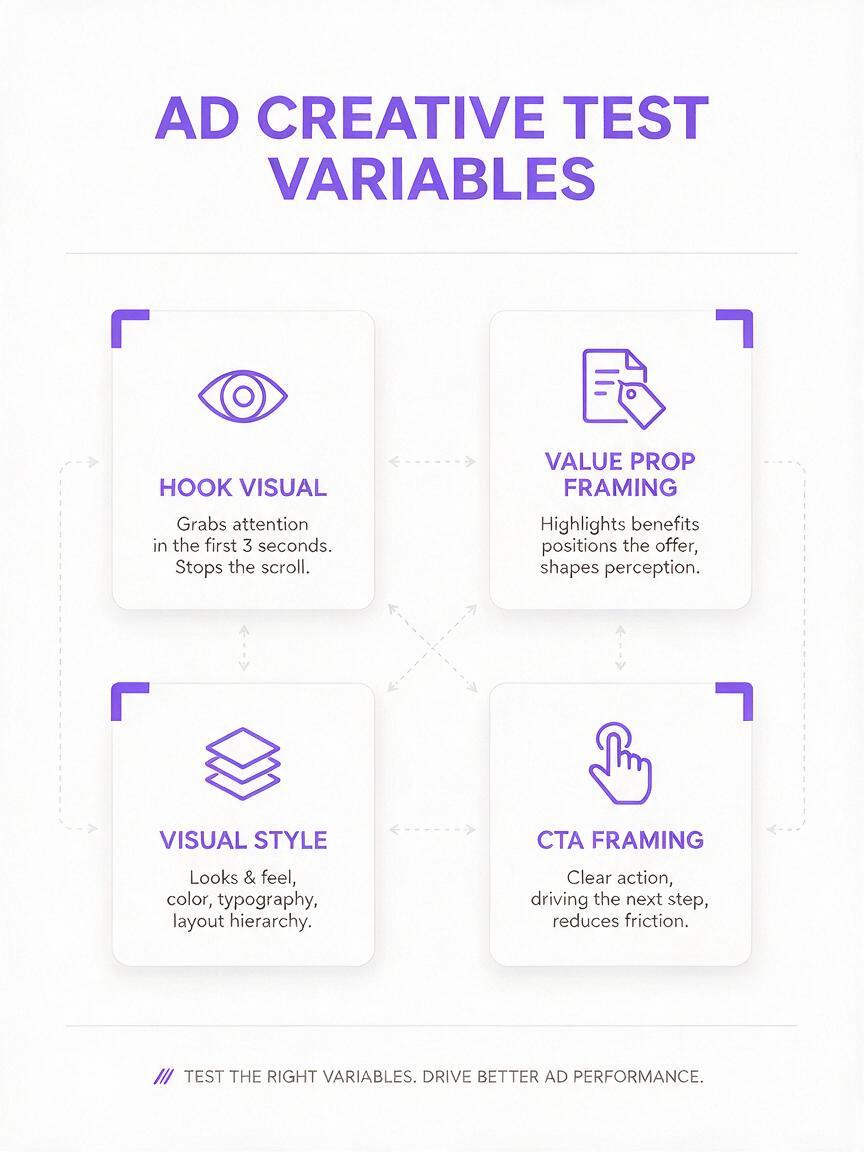
To avoid wasted tests, limit each round of variations to one variable category at a time. This way, you can clearly attribute any performance lift to the change you made. The four highest-impact variables for most performance ad campaigns are:
- Hook visual: The main focal point of the ad (e.g., a problem close-up vs. a product in use vs. a customer testimonial headshot). This is the single biggest driver of scroll-stopping power for social ads.
- Value prop framing: The core benefit you highlight (e.g., "save 20%" vs. "cut 5 hours of work per week" vs. "trusted by 10,000 teams"). Different framing resonates with different audience segments.
- Visual style: The overall aesthetic of the ad (e.g., photorealistic product shot vs. minimalist flat illustration vs. UGC-style casual photo). Style can drastically change who stops scrolling and how they perceive your brand.
- CTA framing: The call-to-action text and surrounding design (e.g., "Start Free Trial" vs. "Get Instant Access" vs. "See How It Works"). CTA wording impacts click-through rate and conversion quality.
Rule of thumb: if you can’t state a clear hypothesis for how a variable will improve performance, don’t test it. For example: "A problem-focused hook visual will increase CTR by 15% because it immediately resonates with our audience’s top pain point."
Lock in consistent elements with reference-based generation
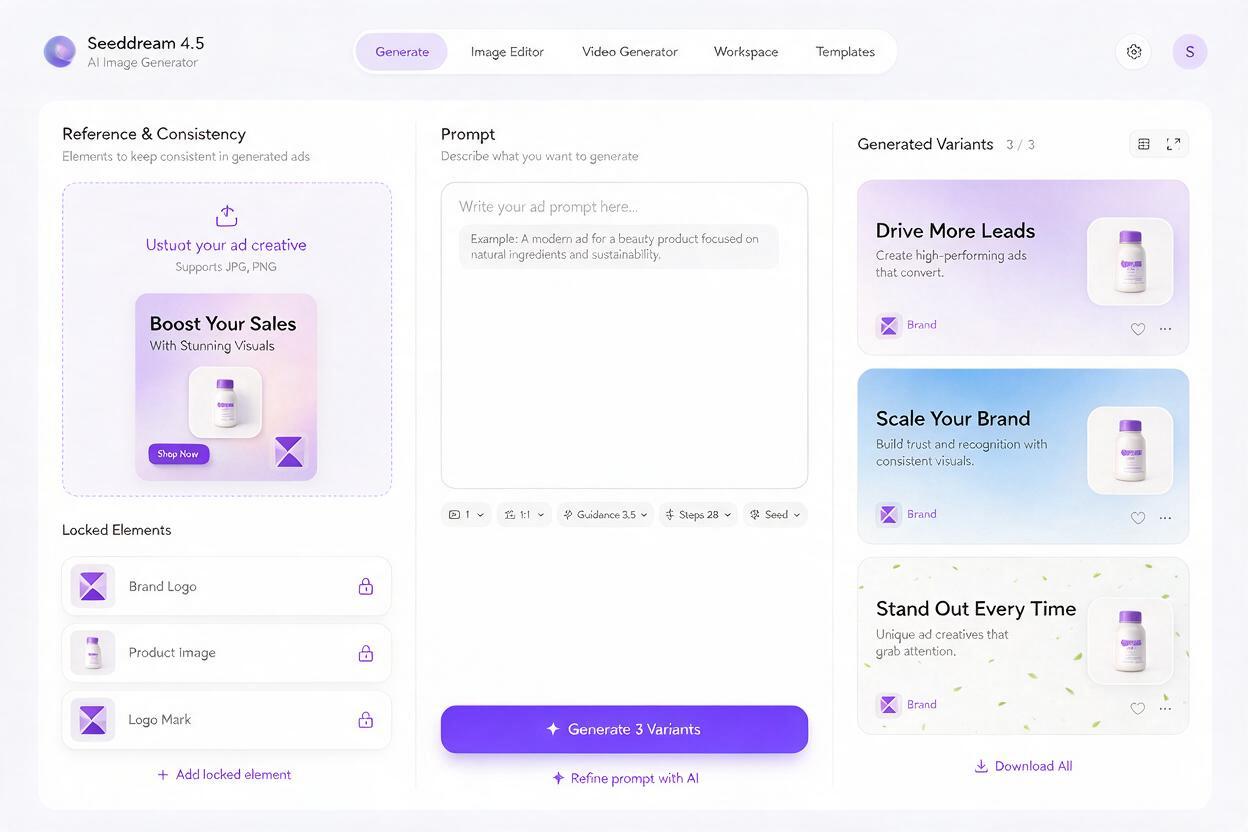
The biggest risk of generating ad variations is breaking brand consistency: wrong logo placement, off-brand colors, distorted product packaging, or misaligned text. Seedream 4.5’s reference-based image generation solves this by letting you lock in core elements from a winning control ad, so you only change the variable you’re testing.
Start with a high-resolution control ad that’s already proven to perform (or a final approved design from your brand team). Upload it as a reference image, and explicitly list every element that must stay 100% consistent in your prompt. This removes ambiguity and prevents AI from making random, unapproved changes.
For best results, include specific details about brand assets, layout structure, and offer accuracy in your consistency list. The more specific you are, the less cleanup you’ll need to do after generation.
You can use a reliable ai image generator with reference support to cut down variation creation time from hours to minutes, without sacrificing brand alignment.
Reusable prompt templates for meaningful Seedream 4.5 variations
Use these prompt templates as a starting point, replacing the bracketed details with your own brand and test information. Each template locks in core consistent elements while changing only one test variable, so your variations are distinct enough to produce valid test results.
Hook visual variation prompt
Reference image: [URL of your control ad]
Keep 100% consistent: brand logo in top left corner, 20% off offer text in bottom banner, #6547e8 accent color, product bottle in bottom right corner, 1:1 aspect ratio, static social media ad layout.
Change only the main hook visual: replace the current office desk scene with a close-up of a person holding their head in frustration while looking at a messy spreadsheet.
Crisp, high-contrast, professional, text fully legible, no distortion.
Value prop framing variation prompt
Reference image: [URL of your control ad]
Keep 100% consistent: brand logo, product image, background gradient, CTA button style, 9:16 aspect ratio, Instagram Reel ad format.
Change only the main headline text and surrounding design: replace "Save 20% Today" with "Cut 5 Hours of Work Per Week" in the same font, size, and color, centered at the top of the ad.
All other elements identical to reference, text sharp and readable, no warping.
Visual style variation prompt
Reference image: [URL of your control ad]
Keep 100% consistent: layout structure, headline text, offer details, CTA text, product shape, brand color palette, 1:1 aspect ratio.
Change only the visual style: reimagine the entire ad in a minimalist flat illustration style, with clean lines and solid color blocks, no photorealistic elements.
All text remains fully legible, brand identity recognizable, layout identical to reference.
After generating each batch, review every variation to make sure only the intended variable changed. If you see unwanted tweaks (like a slightly moved logo or changed button size), add those details to your consistency list and regenerate.
Test this prompt yourself with your own control ad to see how distinct your variations can be when you define clear variables.
Validate variation distinctness before launching tests
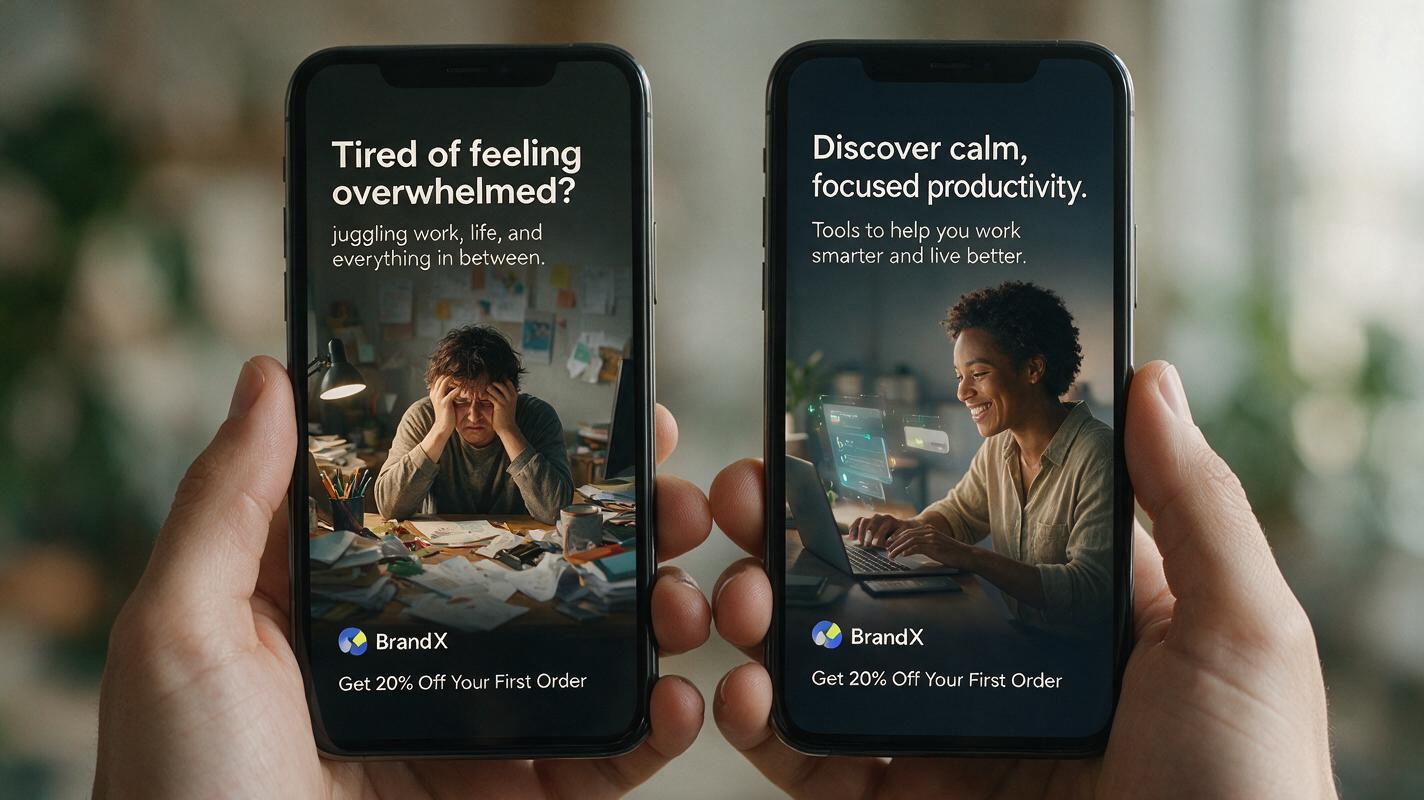
Even with clear prompts, some variations may end up too similar to produce meaningful test data. Before adding any variation to your creative test, run this 2-second check: pull up two variations side by side, glance at them for 2 seconds, then look away. If you can’t name the key difference between them, they’re too similar to test.
For more structured validation, use a simple scoring system:
- Score 3: Clear, obvious difference in the test variable (e.g., hook visual is completely different, no overlap with control)
- Score 2: Noticeable but intentional difference (e.g., headline wording changed but layout and styling remain identical)
- Score 1: Trivial, unplanned difference (e.g., background color is 10% lighter, no meaningful change to the test variable)
Only use variations that score a 2 or 3 in your test. Score 1 variations will waste your ad budget and give you no actionable insights.
Also, make sure each variation is tied to a clear test hypothesis. For example, if you’re testing hook visuals, each variation should represent a different hook type (problem-focused, benefit-focused, social proof-focused) so you can learn which category performs best, not just which random image got more clicks.
Final checklist
- Define one high-impact test variable per round of variations (hook visual, value prop, style, CTA)
- Write a clear hypothesis for how the variable will impact performance
- Use a reference image of your control ad to lock in brand-consistent elements
- Explicitly list every element that must stay the same in your prompt
- Run the 2-second distinctness check on every generated variation
- Only test variations with a clear, meaningful difference from the control
Keywords
ad creative variations, creative testing, ai marketing creative, ai ad generator, seedream 4.5, performance ad creative, ai advertising images