AI Ad Localization: Translate Creatives Without Breaking the Design
Localizing an ad requires more than replacing one language with another. This practical workflow shows marketing teams how to preserve products, layouts, brand cues, and offer meaning while adapting campaign creatives for new markets.
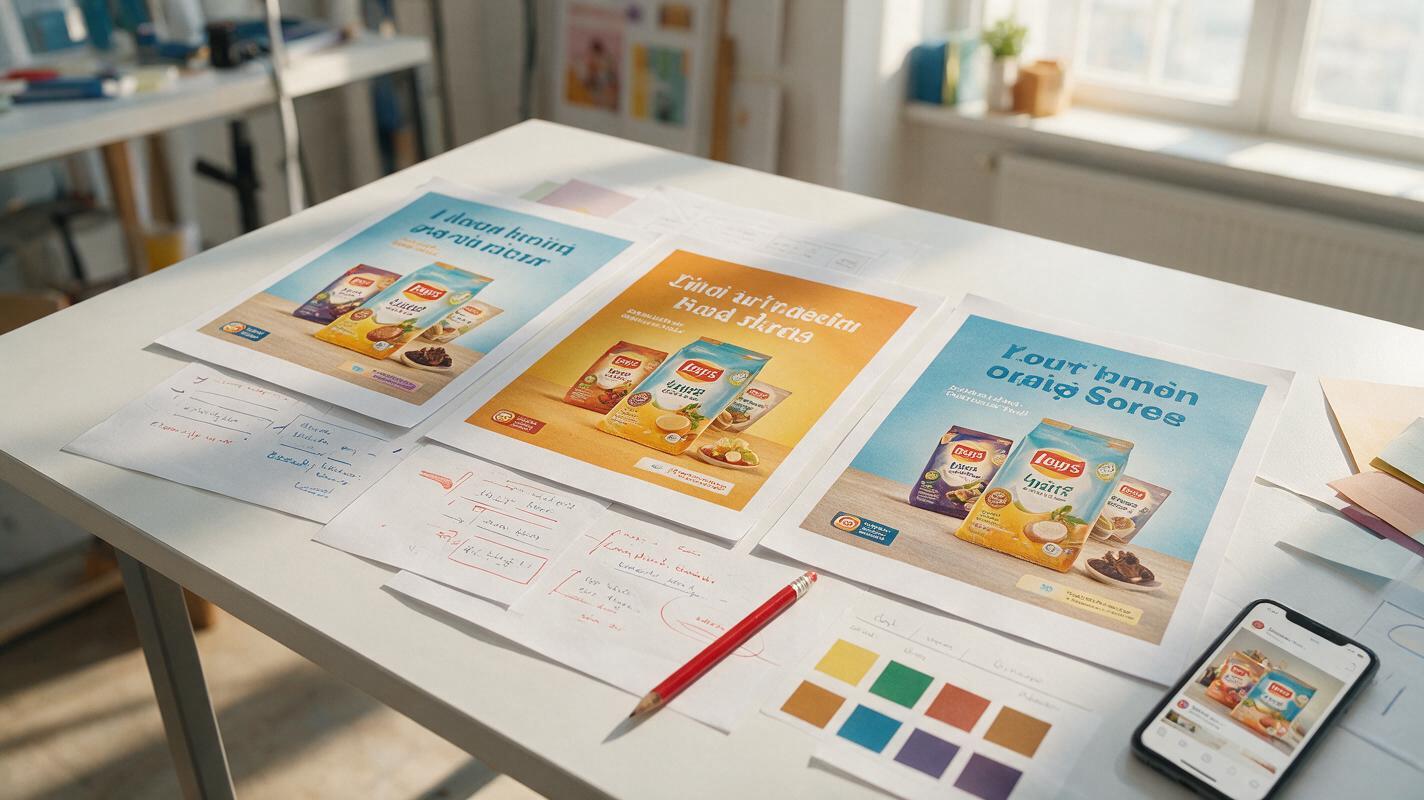
Table of contents
AI ad localization without a full redesign
A translated ad can fail even when every word is technically correct. Longer headlines collide with products, generated lettering becomes unreadable, cultural references lose their meaning, and an image-editing model may quietly change the packaging. The safer approach is to separate translation, background reconstruction, typography, and quality assurance.
This workflow helps performance marketing teams turn one approved campaign creative into localized versions while preserving the visual elements that made the original worth testing.
Step 1 — Lock the creative elements that must not change
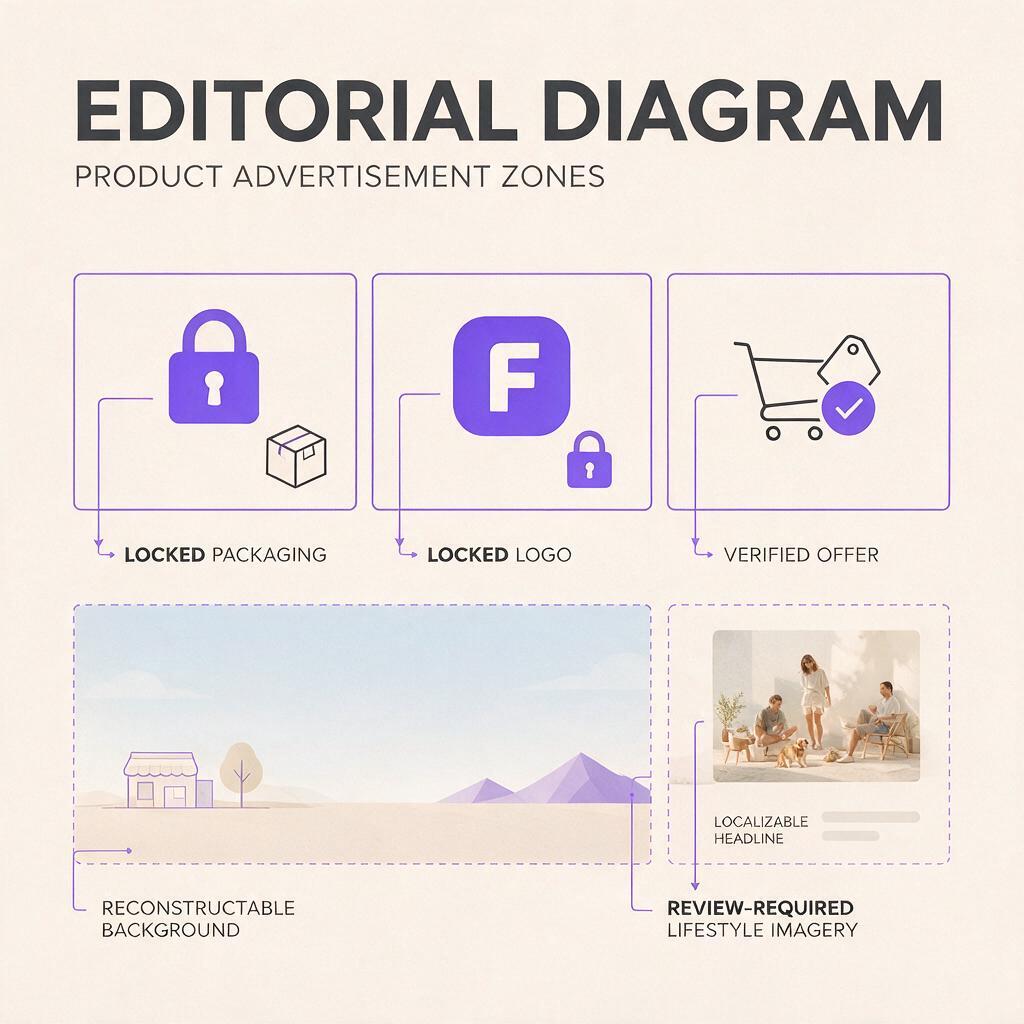
Before editing, classify every element in the source creative. This prevents the model from treating the entire ad as open-ended visual inspiration.
| Element | Default treatment | Reason |
|---|---|---|
| Product and packaging | Lock | Small changes can create an inaccurate product representation. |
| Logo and brand marks | Lock | Generated logos and lettering are unreliable production assets. |
| Offer, price, and terms | Verify manually | Meaning and eligibility may differ by market. |
| Headline and supporting copy | Localize | The message must fit local language and layout constraints. |
| Background behind text | Reconstruct | A clean background is needed before new typography is added. |
| People, props, and setting | Review | Change only when market relevance justifies a new variant. |
Create a short creative lock sheet containing the approved product image, logo file, brand colors, font choices, offer source, and prohibited edits. For regulated or price-sensitive campaigns, assign a named reviewer rather than relying on the creator to approve their own output.
Practical rule: use AI to reconstruct pixels, not to reinterpret facts. Product details, claims, prices, legal text, and logos should come from approved source files.
Step 2 — Prepare translation as ad copy, not literal text
A source headline is usually written around a specific visual space. Literal translation ignores that constraint. Ask the translator or language model for several alternatives organized by message role and approximate length.
- Meaning-first version: preserves the complete proposition.
- Compact version: fits the original headline area.
- Local-performance version: uses natural phrasing and familiar buying language.
- Fallback version: removes nonessential modifiers without changing the claim.
Give the copy system the market, audience, placement, character guidance, brand voice, prohibited claims, and offer conditions. Do not ask it simply to “make this sound native.” That instruction provides no way to judge whether the result remains accurate.
Localize this paid-social ad copy for [market and language].

Source headline: [headline]
Source supporting line: [supporting line]
Audience: [audience]
Offer: [verified offer]
Tone: [brand voice]
Placement: [feed, story, display, or other]
Layout constraint: headline must remain visually compact
Protected meaning: [claim or proposition that cannot change]
Prohibited wording: [restricted phrases]

Return three options:
1. meaning-first
2. compact
3. locally natural

For each option, provide a direct English back-translation and flag any change in meaning.
A native reviewer should assess clarity, tone, implied promises, punctuation, and regional vocabulary. Back-translation is useful for spotting drift, but it does not replace an in-market review.
Step 3 — Remove source text without damaging the artwork
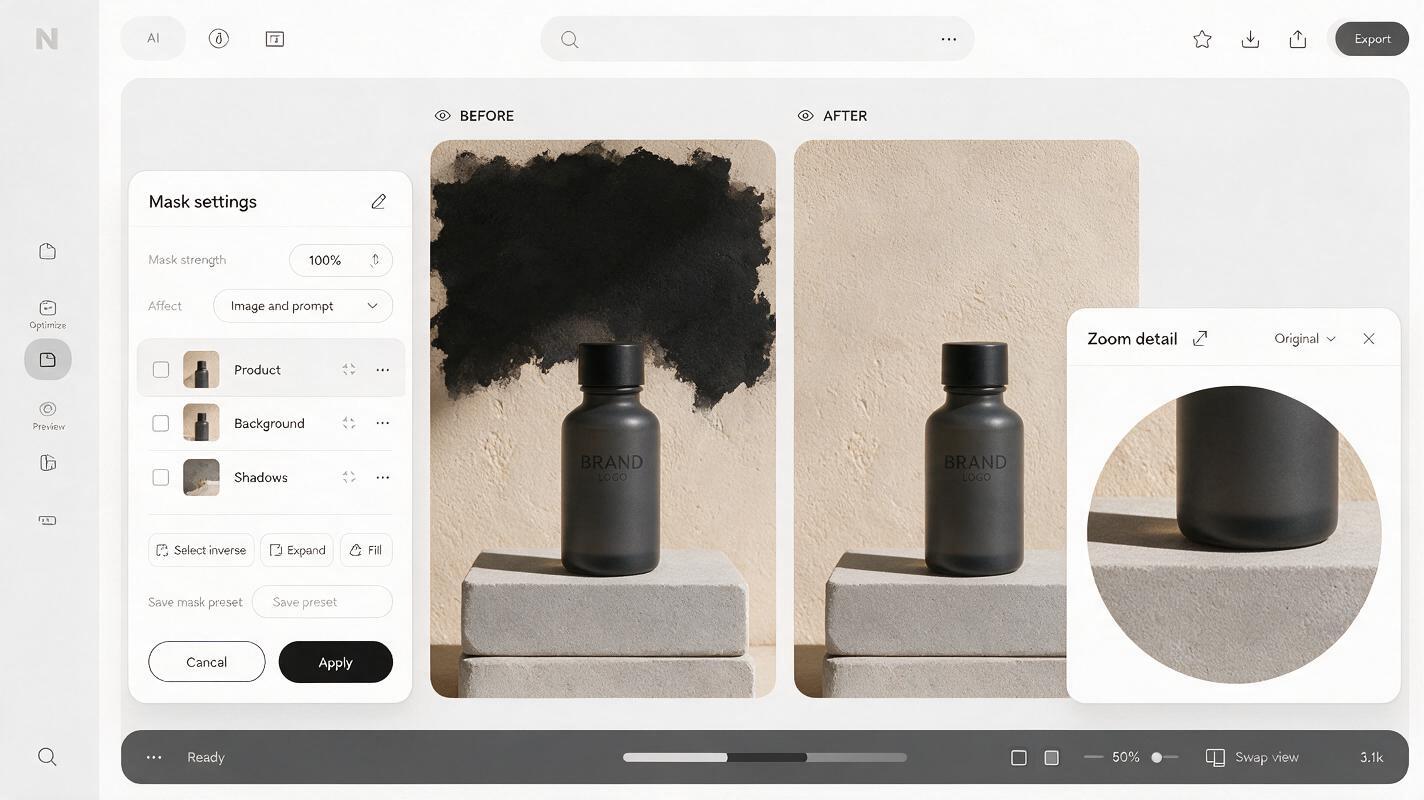
The most dependable production method is to remove the original words, reconstruct the covered background, and typeset approved copy afterward. This avoids asking an image model to produce exact final lettering.
Use an image editor or an ai image generator with editing and reference support. Depending on your available toolkit, that may include GPT Image, Seedream, Nano Banana Pro, or another reference-guided editor. Model access and interfaces can change, so evaluate the actual output rather than choosing by model name alone.
Edit only the masked text region of this advertising image.
Remove all letters, numbers, symbols, and text shadows inside the mask.
Reconstruct the background so it continues naturally through the cleared area.
Preserve the product, packaging, logo, people, lighting, colors, camera angle,
composition, textures, and every unmasked pixel as closely as possible.
Do not add replacement text. Do not redesign the advertisement.
Mask generously enough to include outlines, glow, shadows, and compression artifacts around the old lettering. Then inspect the repaired area at full resolution. Repeating textures, warped edges, and color bands become much more obvious after new copy is placed on top.
Step 4 — Rebuild localized text with safe layout rules
Add the approved translation in a design tool as editable typography. Keep the original hierarchy, but do not force every language into an identical line break.
- Preserve the relative importance of headline, support copy, offer, and call to action.
- Adjust the text box before aggressively shrinking the font.
- Use line breaks that follow natural phrases, not merely available width.
- Check punctuation, diacritics, accented characters, and currency formatting.
- For right-to-left languages, rebuild alignment and reading order deliberately.
- Keep mandatory terms readable at the actual delivery size.
If the compact translation still does not fit, create a layout adaptation rather than compressing the text until it becomes weak. A slightly taller headline zone or repositioned supporting line is usually safer than sacrificing legibility.
Do not flatten too early. Keep copy, logo, product, and disclaimer layers editable until language and compliance reviews are complete.
Step 5 — Generate market-specific visual variants only when needed
Translation and cultural adaptation are different tasks. Do not change the people, setting, food, clothing, colors, or props merely to make the ad look “local.” Unnecessary changes introduce more variables and make performance results harder to interpret.
Create a visual adaptation only when research suggests that the original scene reduces relevance or comprehension. Keep the product and offer constant, then isolate one meaningful visual hypothesis at a time.
Using the supplied ad as the composition reference, create one market-adapted
background variant for [market]. Preserve the exact product appearance, product
position, camera perspective, lighting direction, empty headline zone, logo-safe
area, and overall visual hierarchy.

Change only: [one justified environmental or contextual detail].
Do not add text, flags, landmarks, stereotypes, extra products, or new claims.
The result must look like a realistic paid-social product photograph.
For example, test a more familiar usage environment without changing the product pose, message, and offer. This produces a controlled comparison between translated-only creative and translated-plus-adapted creative.
Step 6 — Run a localization QA gate before launch
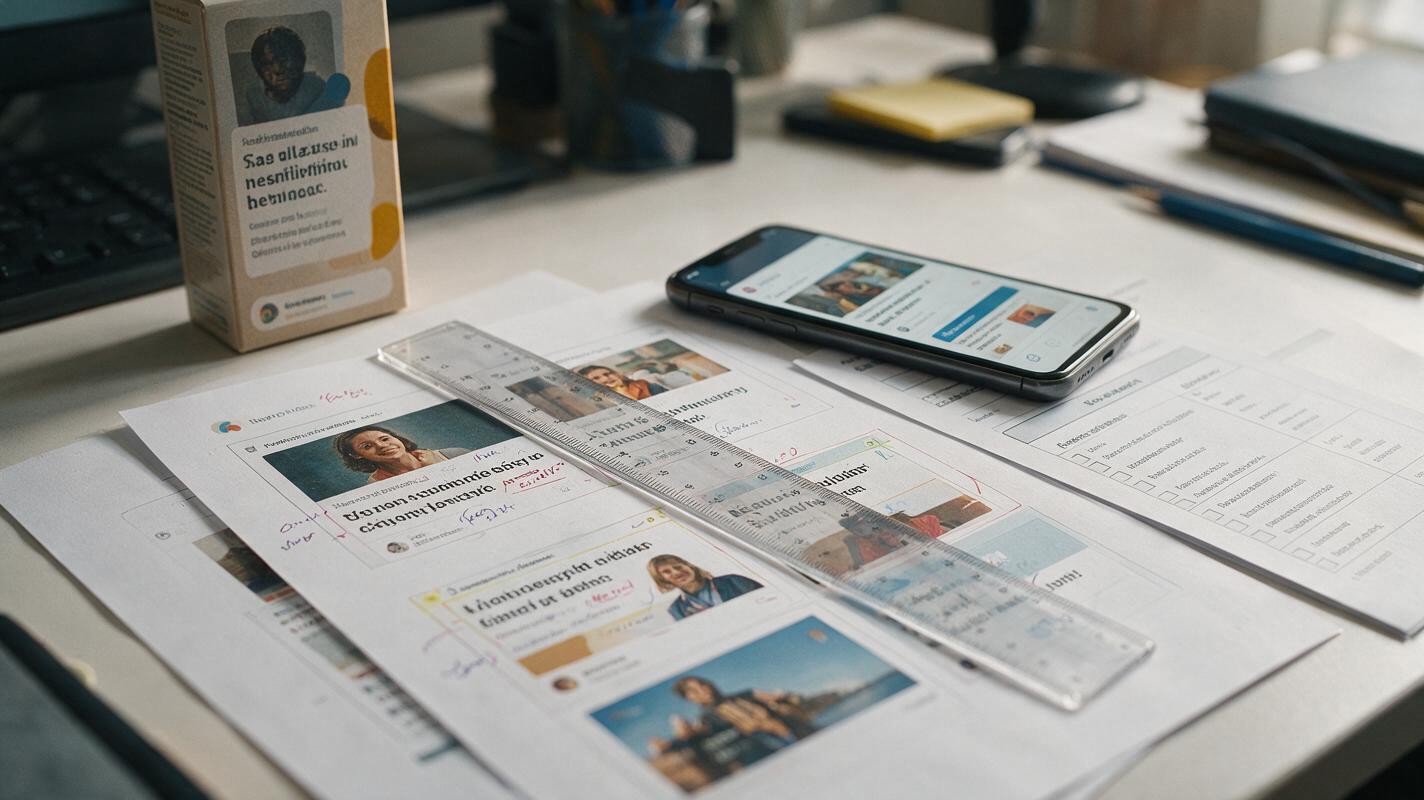
Review the exported ad in context, not only on a large design canvas. A creative may look correct at full size while failing inside a mobile feed.
| QA area | What to check | Owner |
|---|---|---|
| Language | Natural phrasing, spelling, tone, punctuation, and back-translation | Native reviewer |
| Commercial accuracy | Price, currency, discount, availability, dates, and conditions | Market owner |
| Visual fidelity | Product shape, package text, logo, colors, and background repairs | Designer |
| Compliance | Claims, required disclosures, prohibited wording, and local restrictions | Authorized reviewer |
| Placement | Crop, safe zones, legibility, file format, and destination consistency | Campaign operator |
Also compare the creative with its destination page. Language, pricing, product naming, and promotional terms should agree from ad impression to landing-page conversion. A localized ad that leads to an untranslated or contradictory page creates avoidable friction.
When the reconstruction and copy are ready, test this prompt yourself on one low-risk creative before processing an entire campaign library.
Step 7 — Build a controlled creative testing matrix
Do not launch every localized edit as an unrelated asset. Use a naming structure that records the market, copy treatment, visual treatment, placement, and version.
[campaign]_[market]_[language]_[copy-version]_[visual-version]_[placement]

Example structure:
launch_fr-fr_compact_visual-original_feed
launch_fr-fr_local-natural_visual-adapted_feed
A compact initial matrix can compare:
- Control: original market creative where appropriate.
- Variant A: localized copy with the original visual.
- Variant B: alternate localized headline with the original visual.
- Variant C: winning localized copy with one justified visual adaptation.
This sequence helps distinguish a language effect from a visual-relevance effect. Evaluate results against the campaign objective, but also monitor negative feedback, landing-page behavior, and conversion quality. A click-through improvement is not useful if the localized promise attracts the wrong audience.
Final checklist
- Separate locked, localizable, and review-required creative elements.
- Request compact and locally natural copy options with back-translations.
- Remove source text before adding approved typography.
- Preserve products, packaging, logos, offers, and factual details.
- Adapt visuals only when there is a clear market-relevance hypothesis.
- Review language, compliance, visual fidelity, placement, and landing-page consistency.
- Test copy and visual changes as separate variables whenever possible.
- Retain editable files and an approval record for every market version.
Keywords
ai ad localization, localized ad creative, ai advertising images, campaign localization, multilingual ads, creative testing, performance ad creative