AI Character Age Progression Without Losing Identity
A convincing age progression must change anatomy, posture, styling, and life experience without turning one character into several unrelated people. This guide shows comic and webtoon artists how to build identity-safe age variants with Nano Banana Pro, reference anchors, controlled prompts, and continuity tests.
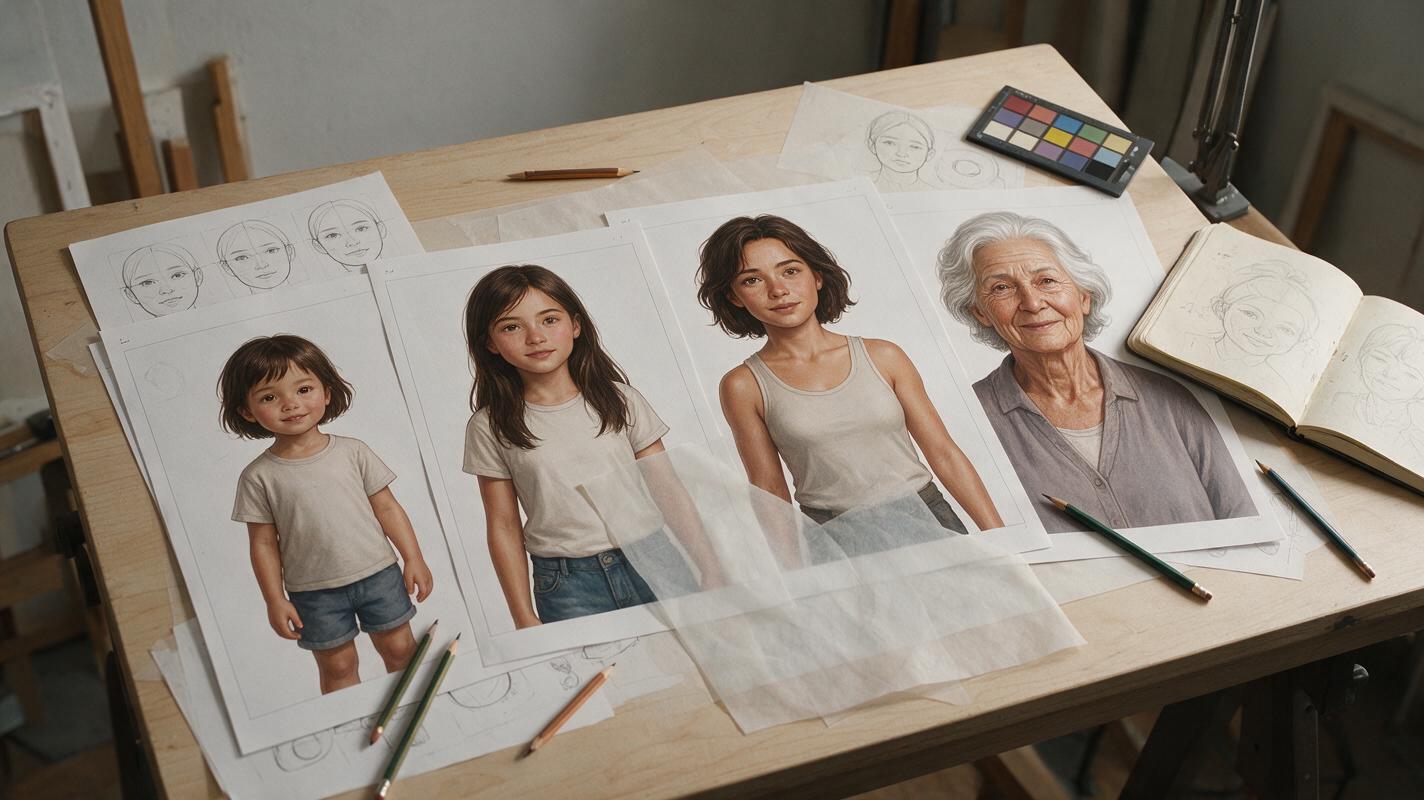
Table of contents
Make One Character Read Clearly at Every Age
The goal is not to generate a child, teenager, adult, and elder who look vaguely related; it is to show the same person changing through time.
AI character age progression often fails in one of two ways. A weak edit preserves the original face so closely that every version looks like an adult wearing a different hairstyle. An aggressive edit changes the jaw, eyes, nose, coloring, costume language, and drawing style until the character becomes someone else.
For comics and webtoons, the solution is to separate permanent identity signals from age-dependent traits. Use nano banana pro to make controlled reference-based variations, but treat each output as part of a designed timeline rather than an isolated portrait.
Define What Time Can and Cannot Change
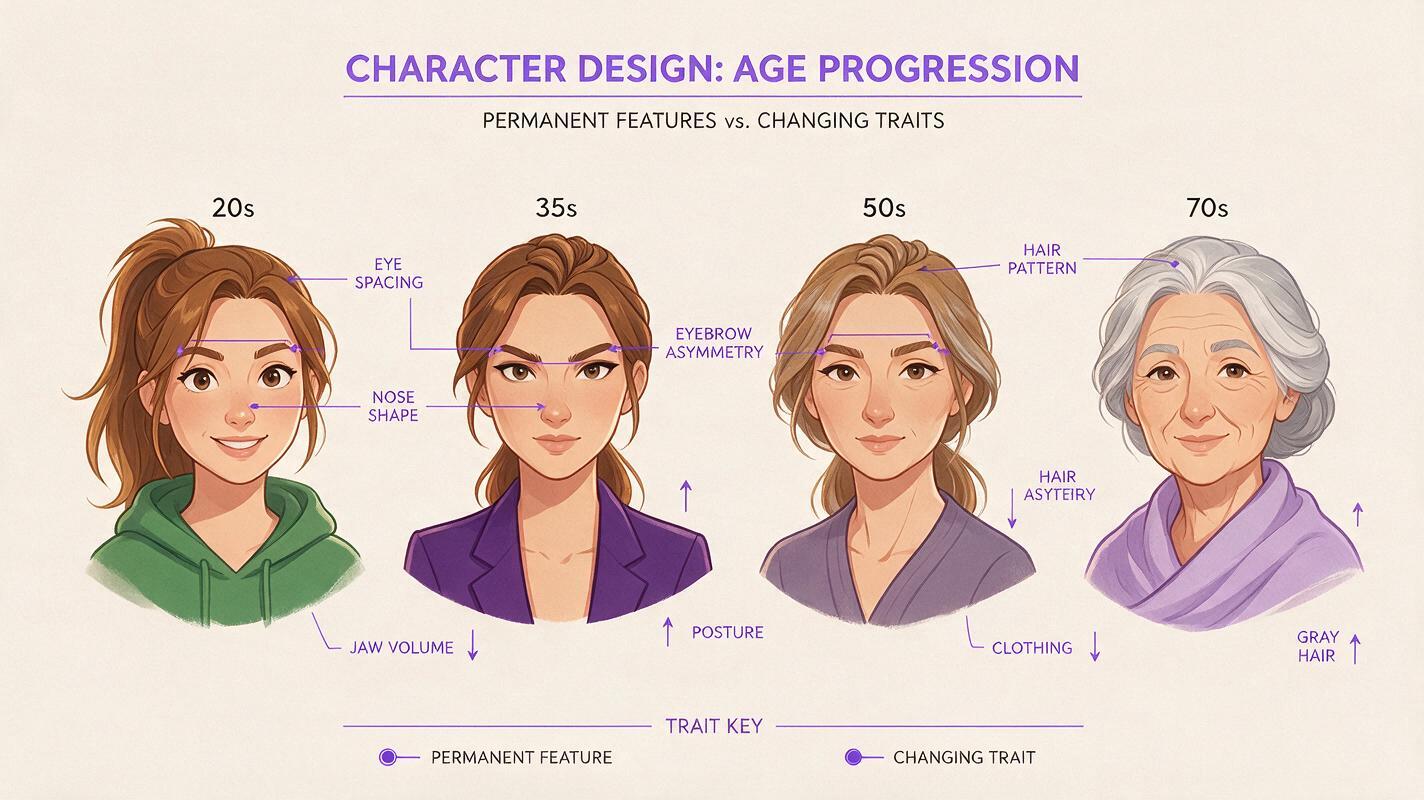
Before generating art, divide the design into two groups. Identity anchors should survive the entire timeline. Age variables should evolve in a deliberate direction.
| Design area | Keep recognizable | Allow to evolve |
|---|---|---|
| Face | Eye spacing, nose family, brow shape, distinctive asymmetry | Facial fullness, jaw maturity, wrinkles, eyelid weight |
| Hair | Hairline logic, curl pattern, signature part | Length, grooming, gray percentage, thinning |
| Body | General proportions and recurring silhouette cues | Height, shoulder width, posture, muscle and weight distribution |
| Wardrobe | Motifs, favored colors, meaningful accessory | Fit, materials, social role, wear and repair |
| Expression | Characteristic smile, frown, or resting gaze | Confidence, restraint, fatigue, emotional history |
Choose three to five anchors that another artist could identify quickly. For example: wide-set amber eyes, a slightly crooked left eyebrow, a narrow nose with a rounded tip, black curls forming a triangular silhouette, and a moon-shaped earring. Do not rely on clothing alone. Costumes change frequently in a story, while facial structure and inherited traits carry identity.
Also decide what happened between ages. An older version shaped by court politics should not age like one shaped by wilderness travel. Narrative history affects posture, grooming, scars, clothing maintenance, and expression.
Build a Neutral Identity Reference
Start from the clearest canonical drawing you have, not necessarily the most beautiful illustration. The best reference has even lighting, a readable three-quarter or front view, a closed or relaxed mouth, unobstructed facial landmarks, and minimal perspective distortion.
If the only available image contains dramatic shadows, flowing hair, or a shouting expression, first create a neutral reference through an ai image generator. Keep the same medium and line treatment as the comic. A polished painted portrait is a poor reference for a flat-color webtoon unless the final panels will use that painted style.
Your compact identity card should include:
- A neutral head-and-shoulders view
- A full-body silhouette in a simple standing pose
- A small palette strip for skin, hair, eyes, and signature colors
- Written notes naming immutable features
- One recurring accessory shown separately if it matters to the plot
Avoid loading the reference with multiple costumes, facial expressions, and camera angles. Too many competing signals can make it unclear which details are mandatory.
Generate Adjacent Ages Before Distant Ones
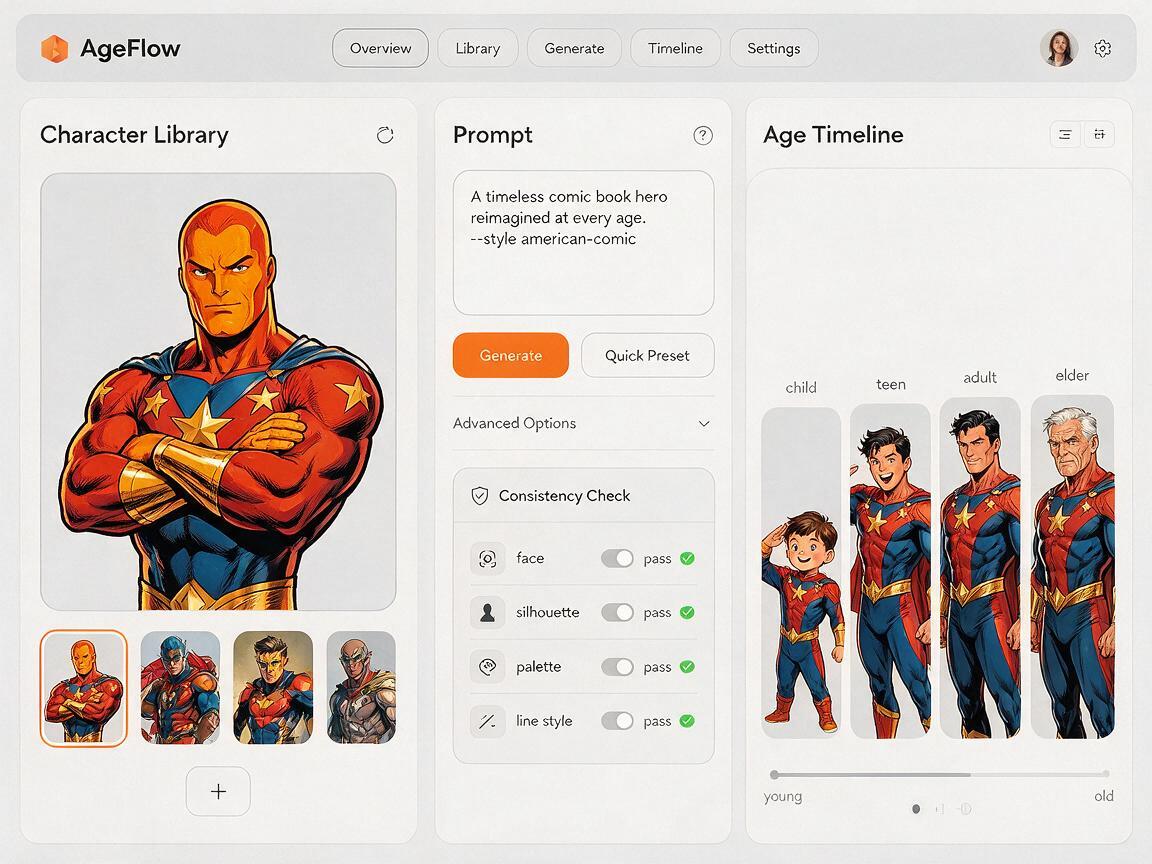
Jumping directly from age 10 to age 70 asks the model to invent decades of structural change at once. Build the timeline through adjacent stages instead: child to early teen, early teen to young adult, young adult to middle age, and middle age to elder.
Each accepted result becomes a bridge reference for the next age. Keep the original identity card present so that small errors do not accumulate unnoticed.
Use the supplied character reference as the same named person at age 15.
Preserve: wide-set amber eyes, crooked left eyebrow, narrow nose with rounded tip,
black triangular curl silhouette, moon-shaped earring, warm brown skin tone.

Age changes: softer jaw, fuller cheeks, slightly larger eye-to-face ratio,
shorter stature, narrow shoulders, tentative posture.

Story state: observant apprentice, practical clothes, carefully repaired cuffs.
Keep the original comic line weight, flat color blocks, and facial proportions.
Neutral three-quarter view, plain background, no additional characters.
Replace vague instructions such as “make younger” with visible anatomical and behavioral changes. For an older version, specify details such as reduced facial fullness, heavier upper eyelids, deeper smile lines, a subtly compressed posture, and silver concentrated at the temples. Avoid requesting every possible sign of age at once; that usually produces caricature.
Use Age-Specific Anatomy Instead of Cosmetic Overlays
Gray hair and wrinkles do not automatically make a convincing elder. Likewise, enlarged eyes and reduced height do not automatically make a believable child. The underlying construction must change.
Child and early-teen versions
- Use softer jaw transitions and fuller mid-face volume.
- Reduce shoulder width and hand size relative to the adult design.
- Shorten the nose carefully without replacing its distinctive shape.
- Keep posture active or uncertain according to personality, not generically cute.
Adult and middle-aged versions
- Clarify bone structure while retaining the established eye and nose relationships.
- Let occupation affect hands, stance, grooming, and garment wear.
- Add subtle asymmetry and fatigue before adding prominent wrinkles.
- Preserve the signature expression even if it becomes more restrained.
Elder versions
- Change facial volume, eyelid weight, neck structure, and posture together.
- Place wrinkles according to repeated expressions rather than covering the face evenly.
- Keep identifiable features visible beneath age changes.
- Avoid automatically making the character frail unless the story requires it.
Continuity rule: age should transform the construction of the character, while identity anchors explain why the audience still recognizes them immediately.
Test Recognition Without Hair and Costume
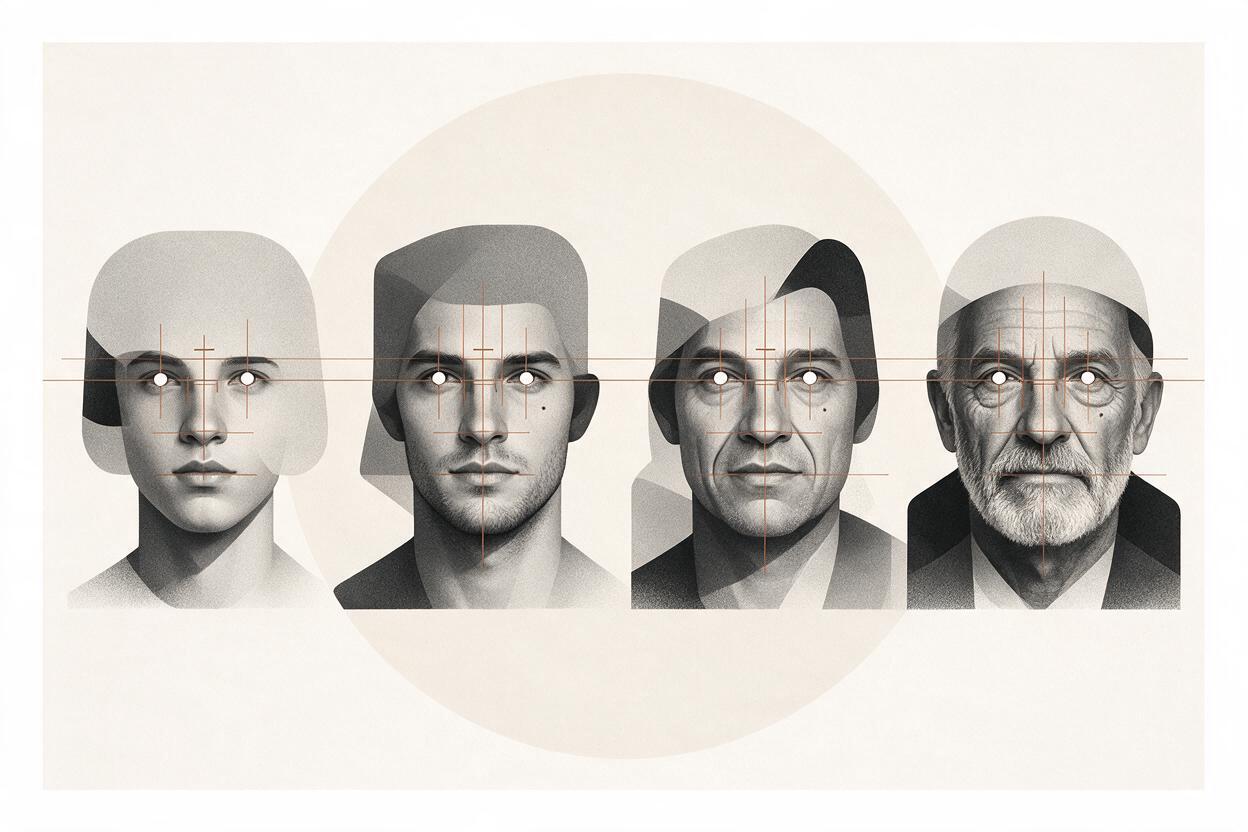
Hair, accessories, and costume can conceal identity drift. Run a simple recognition test by temporarily reducing every age variant to grayscale head crops. Cover the hair and compare only the eyes, brows, nose, mouth, cheek structure, and characteristic asymmetry.
Ask these questions:
- Does the eye spacing remain part of the same facial family?
- Does the nose mature rather than become a different nose?
- Does the mouth retain its characteristic width and resting shape?
- Does facial asymmetry persist in the correct direction?
- Would the character remain recognizable without the signature accessory?
Then compare silhouettes at equal displayed height. This reveals whether a younger version has adult shoulders, whether an older version has been shortened arbitrarily, or whether body proportions change unpredictably between generations.
Repair Drift Without Regenerating the Whole Design
If one feature fails, edit only that region. Full regeneration can repair a nose while changing the eyes, costume, line weight, and silhouette. Local corrections preserve accepted decisions.
| Failure | Likely cause | Targeted correction |
|---|---|---|
| Younger version looks unrelated | Too many facial landmarks changed together | Restore eye spacing, nose family, and eyebrow asymmetry from the adult reference |
| Elder looks like an adult with wrinkle stickers | Surface aging without structural change | Edit cheek volume, eyelids, neck, and posture before refining wrinkles |
| Every age has identical posture | Identity was confused with pose | Vary stance according to confidence, health, role, and story experience |
| Style becomes more realistic over time | Age language overwhelmed medium instructions | Restate line weight, cel shading, palette limits, and simplification level |
| Costume becomes the identity | Weak facial anchors | Test neutral clothing and repair permanent facial relationships |
Keep corrected variants in a single timeline sheet. Comparing them side by side is more reliable than approving each image in a separate session.
Turn the Timeline Into a Production Character Sheet
A useful age-progression sheet should help you draw scenes, not merely display attractive portraits. Arrange the approved variants from youngest to oldest at a consistent scale. Add the canonical age, height, posture note, current role, costume era, and visible life events beneath each figure.
Include one repeated expression across all ages, such as a skeptical side glance or crooked smile. This creates a strong identity test because the emotional behavior remains recognizable while facial anatomy evolves.
For a webtoon with flashbacks, add color-script notes for every period. Childhood scenes might use sun-faded fabrics, while the present timeline uses colder formal clothing. These cues help readers understand time changes without depending entirely on captions.
Once the sheet is stable, use it as the reference for future panels rather than regenerating the character from a text description. If you want to compare several treatments before committing, try these models for free with the same identity card and age brief.
Final Checklist
- Separate permanent identity anchors from age-dependent traits.
- Use a neutral canonical reference with readable facial landmarks.
- Generate adjacent age stages instead of one extreme jump.
- Describe anatomy, posture, and life history rather than requesting generic aging.
- Check identity without hair, costume, color, or accessories.
- Repair only the drifting feature whenever possible.
- Approve the entire timeline side by side before using it in panels.
- Store final variants in a production sheet with age and continuity notes.
Keywords
ai character age progression, consistent character ai, nano banana pro, character sheet ai, comic character design, webtoon character, comic prompts