Why AI Comic Crowds Look Cloned—and the Prompt Fixes That Work
AI-generated comic crowds often repeat faces, poses, clothing and spacing until a busy scene looks copied and artificial. This guide uses Flux prompts, crowd hierarchy and targeted repair passes to create varied background characters without sacrificing panel readability.
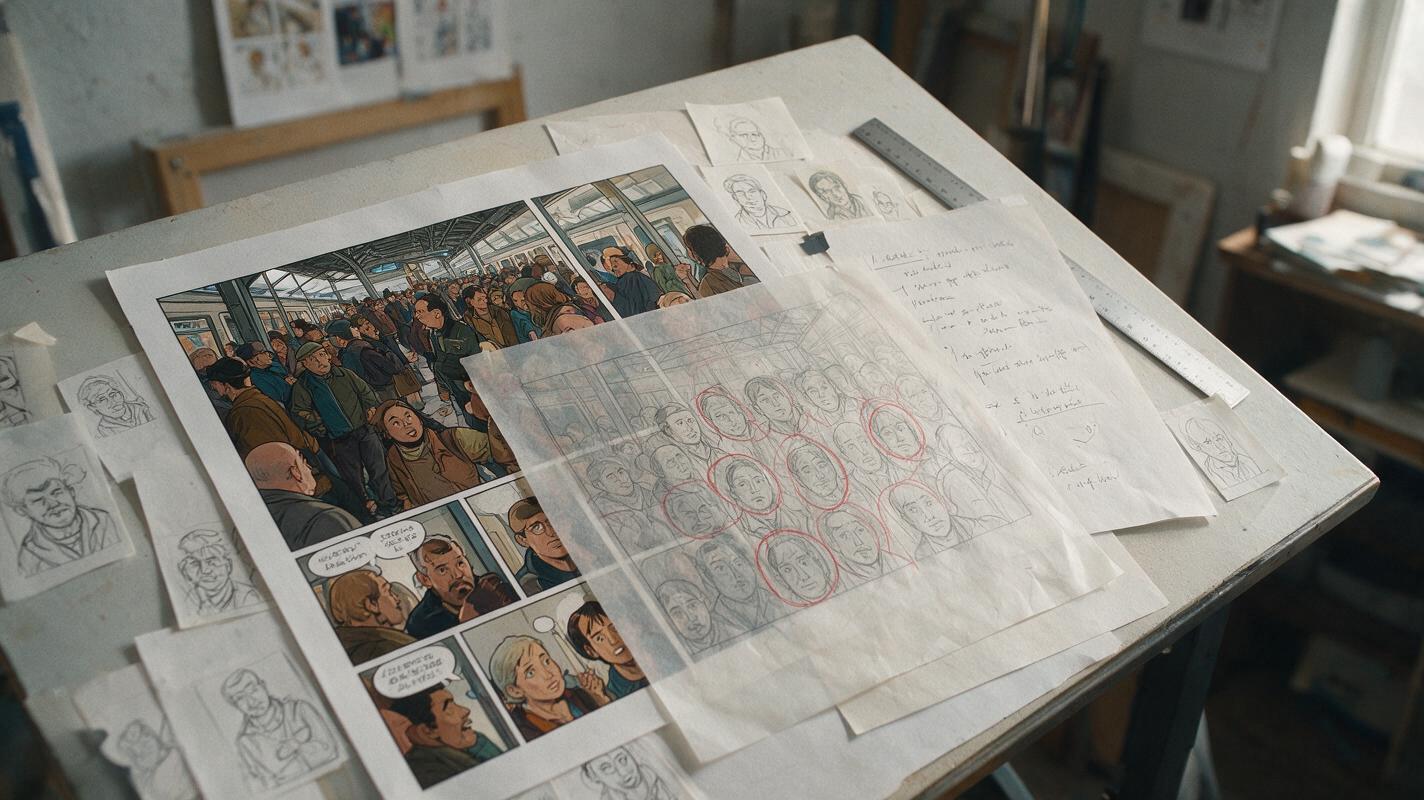
Table of contents
Build a crowd that supports the panel instead of filling it with clones
A convincing comic crowd does not require twenty individually designed characters. It requires controlled variation, clear depth groups and a visual hierarchy that keeps attention on the story. When every background figure receives the same prompt weight, AI tends to repeat faces, poses, outfits and spacing. The fix is to describe the crowd as an organized composition rather than a list of random people.
This workflow uses Flux for the initial scene, followed by selective regeneration where repetition remains obvious. A practical ai image generator workflow can handle the visual volume, but the artist still decides which figures matter, which become silhouettes and where detail should disappear.
The core rule: direct the model's attention unevenly. Define the focal characters precisely, describe supporting groups broadly and reduce distant people to readable shapes.
Why generated crowds repeat the same person
Prompts such as busy station full of diverse people sound reasonable, but they provide little information about spatial organization. The model must invent the number of figures, their scale, their relationship to the camera and the amount of detail assigned to each person. Repetition becomes an efficient way to satisfy the request.
Four problems commonly appear in comic and webtoon panels:
- Identity cloning: several figures share the same face, hair or costume.
- Pose cloning: everyone stands at the same angle with similar arm positions.
- Spacing patterns: heads form an evenly distributed grid instead of natural clusters.
- Attention competition: background extras become as sharp and colorful as the protagonist.
Adding more adjectives rarely solves these problems. Words such as varied, unique and diverse express an intention, but they do not tell the model where each type of variation belongs.
Divide the panel into crowd roles
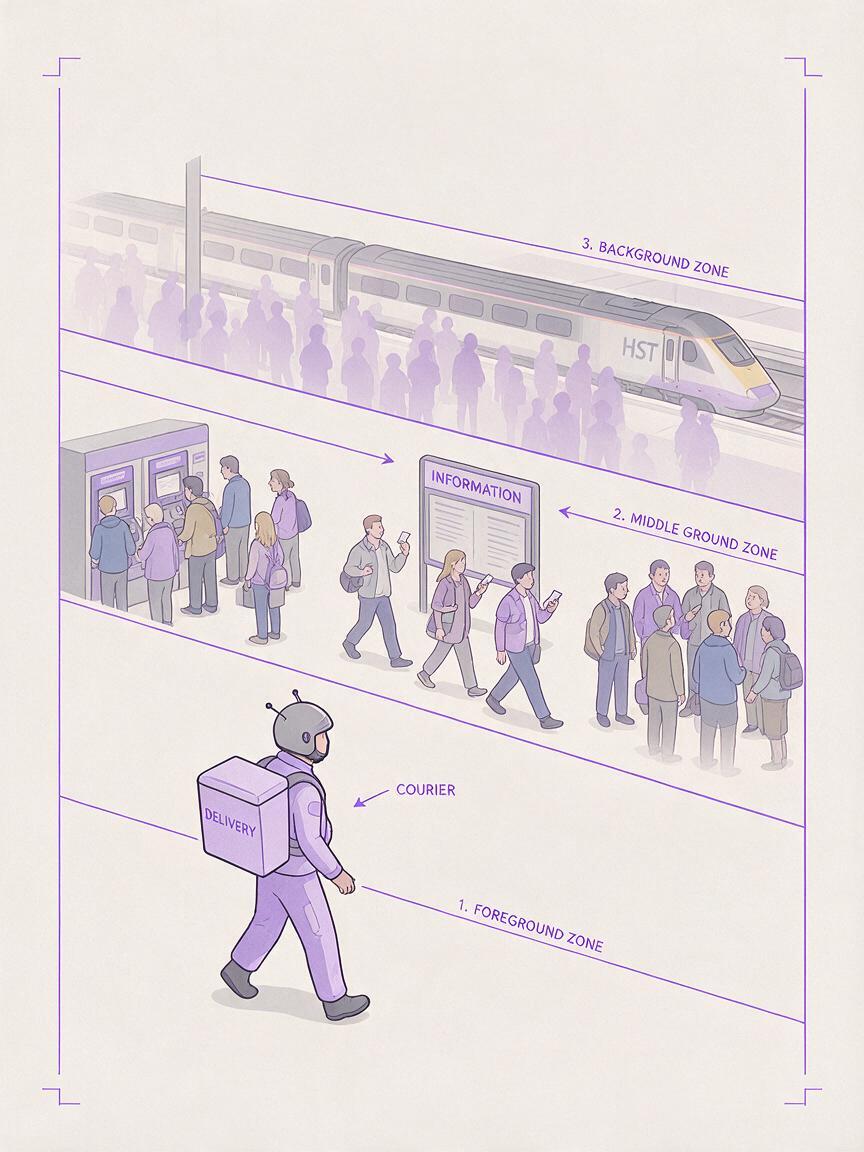
Before writing the prompt, separate the scene into three visual roles. This prevents every extra from receiving equal detail.
| Role | Purpose | Useful description |
|---|---|---|
| Focal group | Delivers the story beat | Named poses, expressions, costumes and positions |
| Supporting clusters | Shows activity and social context | Small groups with different actions and directions |
| Atmosphere layer | Creates scale and depth | Partial bodies, silhouettes, softened faces and overlaps |
For example, a protest panel might feature one speaker and two listeners in the focal group. Supporting clusters could include reporters, sign holders and people arguing near a barricade. The atmosphere layer could be a compressed band of distant heads and signs.
This hierarchy also protects readability. If the protagonist occupies the lower-right foreground, keep the strongest contrast and cleanest facial detail there. Crowd figures can overlap one another, but they should not create tangents through the protagonist's eyes, mouth or hands.
Prompt spatial groups instead of generic diversity
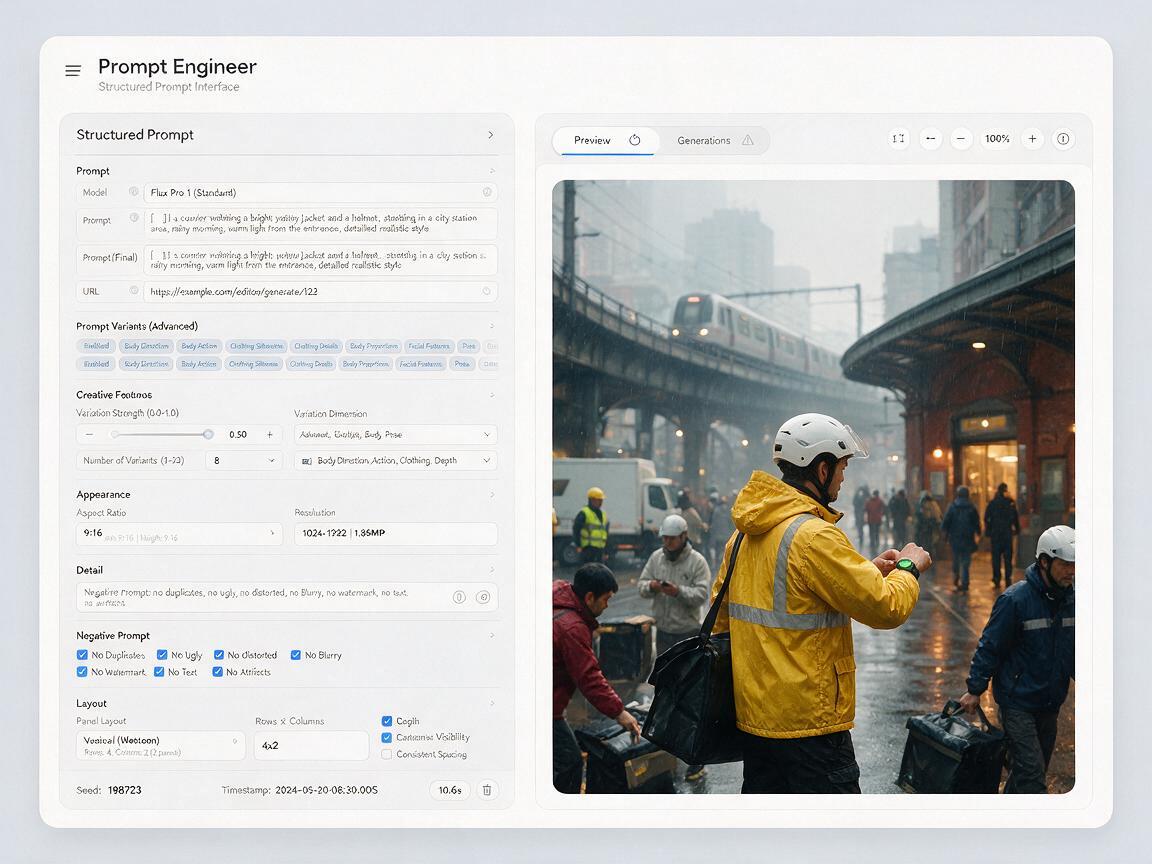
A reliable Flux prompt describes the panel from large composition to small variation. Start with the camera and focal action. Then place two or three crowd clusters in specific depth zones. Finish with style, value structure and exclusions.
Vertical webtoon panel, eye-level medium-wide view inside a crowded commuter station. In the right foreground, a young courier in a yellow rain jacket stops and looks over her shoulder, clearly separated from the crowd. In the middle ground, three distinct clusters: two office workers hurrying left while talking, a parent crouching beside a child near a ticket machine, and two students facing each other beside a pillar. In the far background, compressed overlapping silhouettes and partial heads, faces simplified by distance. Uneven spacing, varied body orientation, different heights and clothing shapes, natural occlusion. Strongest contrast on the courier, restrained colors and softer detail in the crowd, clean graphic comic linework, readable vertical composition. Avoid repeated faces, mirrored poses, evenly spaced heads and identical outfits.Notice that the prompt does not ask for a fixed number of fully rendered strangers. It assigns actions to a few clusters and allows distant figures to become atmosphere. During text to image generation, this creates stronger structural guidance than asking for twenty unique people.
Variation categories that produce visible differences
Choose differences that remain legible at panel size. Tiny facial details may disappear, while silhouettes and gestures survive reduction.
- Body direction: facing left, turning away, bending, seated or crossing the frame.
- Action: checking a phone, carrying boxes, pointing, speaking or waiting.
- Silhouette: long coat, backpack, umbrella, wide trousers or cropped jacket.
- Height and scale: adults, teenagers and a seated figure distributed across depth.
- Occlusion: figures partly hidden by pillars, signs, furniture or other people.
Avoid loading one prompt with long catalogs of ethnicity, hairstyles, accessories and colors. Excessive lists can make every figure visually loud. Select a few high-impact differences and distribute them among named groups.
Use occlusion to make the crowd feel natural
Real crowds are not collections of isolated full-body figures. People overlap, enter from the frame edge and disappear behind objects. These interruptions make a scene feel populated while reducing the amount of anatomy the model must resolve.
Useful crowd-shaping phrases include:
- foreground shoulder crossing the lower-left corner
- partial figure cropped by the right edge
- overlapping heads at varied heights
- lower bodies hidden behind benches
- distant faces reduced to minimal marks
- irregular gaps between small social groups
Occlusion should still respect the story. Do not place a random foreground head over an important reaction, hand gesture or prop. Treat the crowd as a framing device that channels the eye toward the focal beat.
Repair repeated extras without regenerating the panel
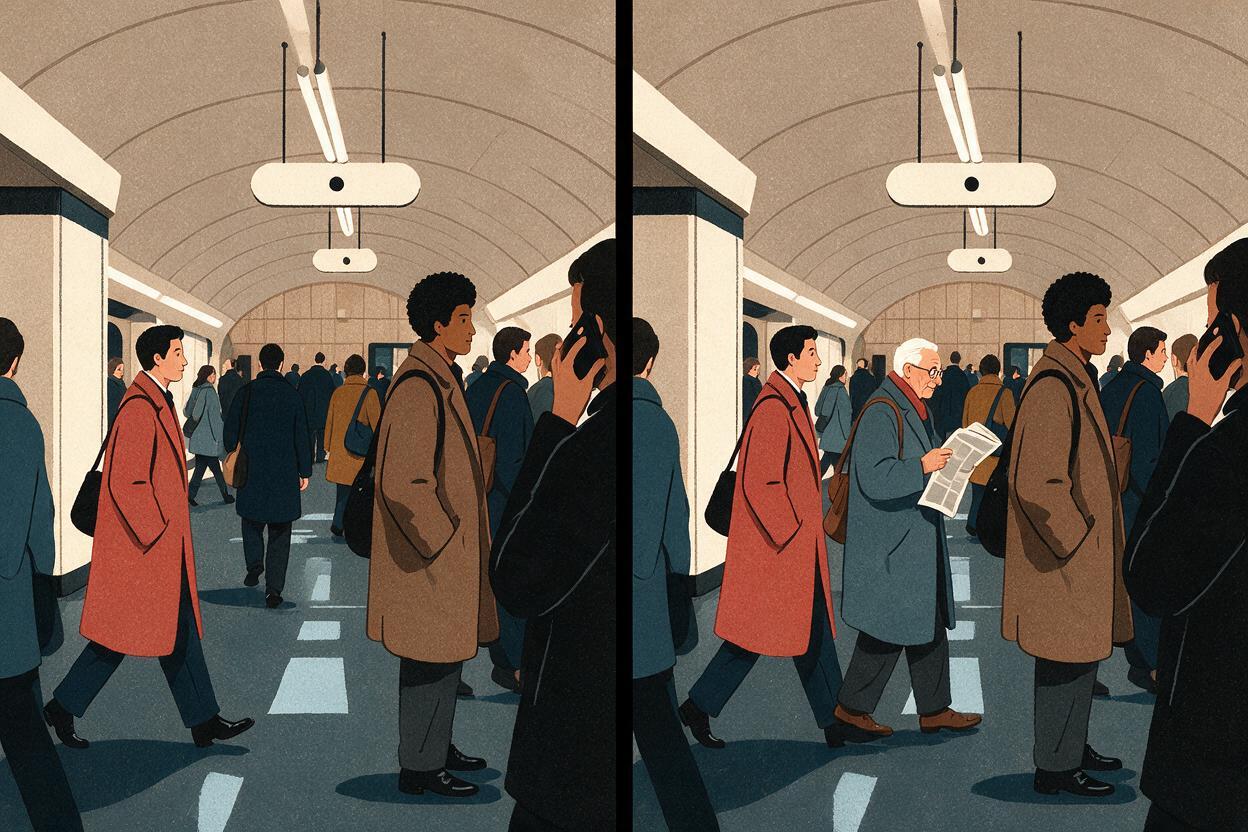
Even a strong composition may contain two nearly identical faces or duplicated jackets. Regenerating the entire scene risks changing the protagonist, camera angle and environment. Instead, mark only one duplicate for localized editing.
Give the replacement figure a new action and silhouette rather than requesting a vague change:
Replace only the selected background figure. Create an older commuter in a loose dark cardigan, body turned three-quarters away from the camera, one hand holding a folded newspaper. Keep the original position, scale, lighting, line weight, perspective and surrounding overlaps. Do not alter the courier, station architecture or neighboring figures.If two figures share a pose, change the less important one. If several heads form a grid, remove one figure or push it behind another instead of adding more detail. Empty pockets and overlaps often improve a crowd more than another generated person.
Prioritize repairs readers will actually notice
- Duplicates beside the focal character
- Repeated faces in the middle ground
- Identical bright clothing shapes
- Mirrored gestures or parallel limbs
- Minor repetition in distant silhouettes
The final category may not need correction. At normal reading size, distant repetition can merge into texture. Spend repair time where cloning disrupts the panel's story or creates an obvious visual rhythm.
Keep recurring extras consistent only when the story needs it
Not every crowd member should become a recurring character. Over-designing disposable extras increases continuity work without improving the scene. Reserve stable identity details for figures who speak, influence the action or return in later panels.
For a recurring extra, save a compact reference containing:
- front or three-quarter face view
- dominant hair shape
- one recognizable costume feature
- approximate height beside the protagonist
- one sentence describing their narrative role
Everyone else can be defined through temporary scene roles such as impatient passenger, vendor stacking fruit or student filming the event. This produces purposeful variation without turning crowd management into a full cast-design project.
Test the crowd at final reading size
A crowd can look impressive when enlarged and confusing inside a phone-width webtoon panel. Reduce the image to its intended display size and check the focal character first. You should recognize the main action before inspecting any individual extra.
Then evaluate the panel in grayscale. If background clothing creates stronger contrast than the protagonist, lower its value range or saturation. If the crowd becomes a flat wall, introduce depth through overlap, scale changes and softer distant edges rather than adding random blur everywhere.
Finally, inspect the panel beside the panels before and after it. A dense crowd scene often reads better when adjacent panels are quieter. Visual storytelling depends on contrast between moments, not maximum detail in every frame.
Final checklist
- Give the protagonist the sharpest detail and strongest contrast.
- Organize extras into focal, supporting and atmospheric roles.
- Assign different actions and body directions to visible clusters.
- Use crops, overlaps and environmental objects to break repetition.
- Repair duplicated figures locally instead of regenerating the scene.
- Preserve identity only for extras who return or affect the story.
- Review the result at final comic or webtoon reading size.
Once your crowd roles and composition are defined, try these models for free and compare several variations before committing to detailed repairs.
Keywords
ai comic crowds, comic crowd prompts, Flux prompts, manga crowd scenes, background characters, comic AI generator, visual storytelling AI