Why AI Cosmetic Texture Swatches Look Like Food—and How to Fix Them
AI-generated cream, gel and serum swatches often resemble frosting, syrup or melted plastic instead of real cosmetic formulas. This guide provides Seedream 4.5 prompt patterns, physical texture cues and an acceptance test for creating more believable beauty product texture images.
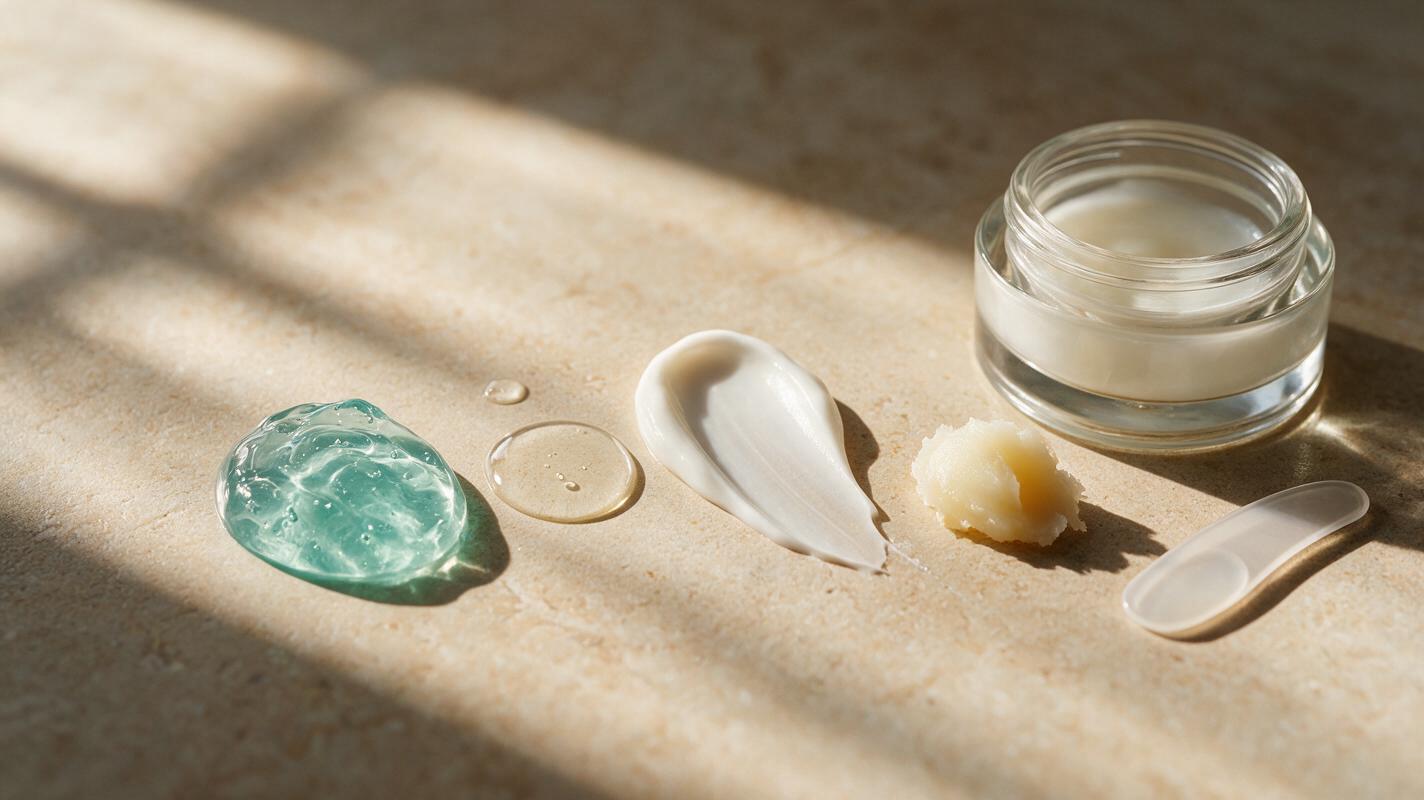
Table of contents
Make cosmetic textures look formulated, not edible
A realistic cosmetic swatch must communicate viscosity, spread, finish and scale in a single frame.
When those physical cues are missing, a moisturizer becomes cake frosting, a serum resembles cooking oil and a gel looks like molded plastic. Adding the word “photorealistic” rarely solves the problem because it describes the rendering style, not the formula’s behavior.
The better approach is to prompt the material as a cosmetic formulator or tabletop photographer would describe it: how it holds its shape, how thinly it spreads, where light catches the surface and what remains at the feathered edge. For this task, seedream 4.5 can be used to generate a complete texture study or develop variations from a reference product image.
The central rule: describe evidence of the texture instead of relying on category words such as “luxurious cream” or “glossy serum.”
Read the failure before rewriting the prompt
First identify which material signal is wrong. A swatch can be beautifully lit and still misrepresent the product if its height, flow or surface finish contradicts the real formula.
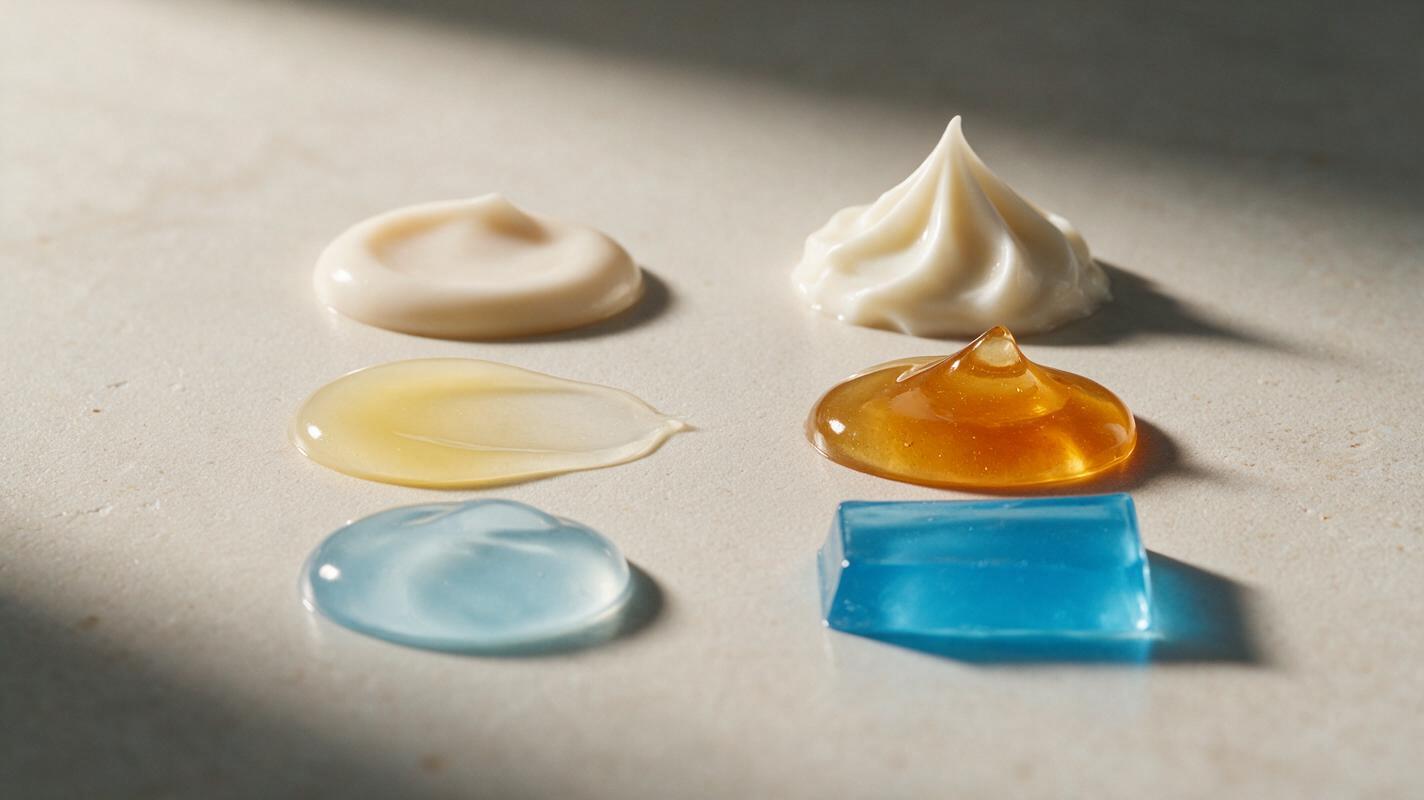
| Visible failure | What the image implies | Prompt correction |
|---|---|---|
| Tall peaks with sharp tips | Whipped frosting or meringue | Specify a low-profile cream swipe with softly collapsed ridges |
| Perfectly clear, rigid mound | Acrylic, glass or hard candy | Add slight internal diffusion, soft edges and gentle surface tension |
| Thick amber pool | Honey or cooking syrup | Request a lightweight facial serum with a shallow, controlled spread |
| Mirror-like opaque streak | Molten plastic or paint | Define the intended finish: dewy, satin, balm-like or softly matte |
| Oversized droplets | Macro food advertising | State physical scale and include a cosmetic spatula or jar rim |
| Identical repeated ridges | Computer-generated geometry | Ask for subtle pressure variation and naturally imperfect edges |
Do not correct every possible defect at once. If the serum looks too thick, revise its flow and depth before changing the lighting, background or composition. Isolating one material problem makes it easier to see whether the new instruction worked.
Build the texture from physical evidence
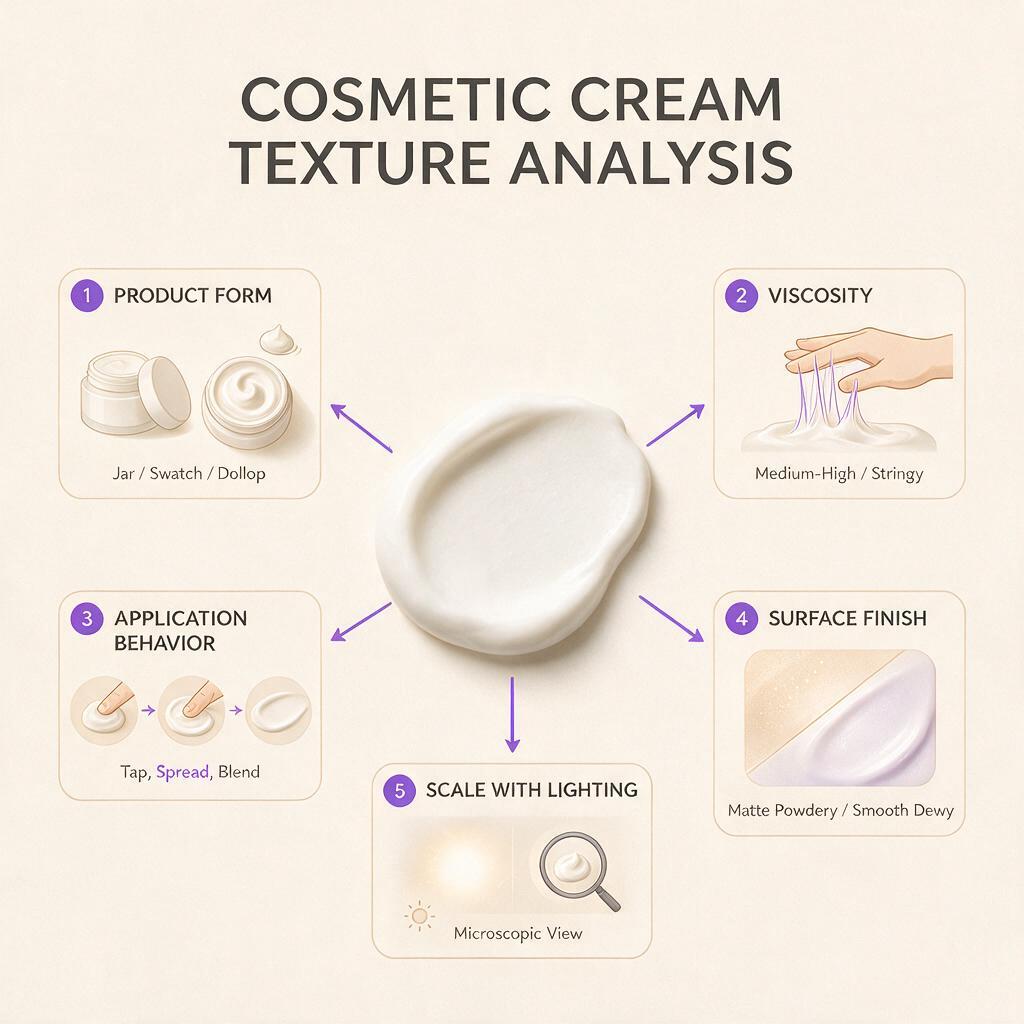
A reliable prompt separates the formula into observable properties. Use five types of information:
- Product form: gel moisturizer, cleansing balm, silicone primer, clay mask or milky essence.
- Viscosity: fluid, lightweight, cushiony, dense, elastic or slow-settling.
- Application behavior: dragged by a spatula, pressed with a fingertip, dispensed as a bead or spread into a thin veil.
- Surface finish: wet, dewy, satin, pearlescent, softly matte or translucent.
- Scale and lighting: life-size swatch, macro tabletop photograph, broad diffused light and restrained highlights.
This structure gives an ai image generator concrete visual relationships to render. It also makes prompt troubleshooting more precise: if the texture is correct but the highlight looks synthetic, only the finish and lighting language needs adjustment.
Editorial macro cosmetic product photograph of [PRODUCT FORM],
shown as [APPLICATION SHAPE] on [SURFACE].
The formula is [VISCOSITY] with [EDGE BEHAVIOR],
a [SURFACE FINISH] and [OPACITY OR TRANSLUCENCY].
Life-size scale, broad diffused studio light, restrained highlights,
subtle natural variation from real application pressure.
No food styling, no frosting peaks, no syrup strands,
no rigid plastic appearance, no oversized droplets.
Keep the product form and physical behavior compatible. A “lightweight watery serum” should not also form a tall sculpted peak. A dense cleansing balm may hold a curved spatula mark, but it should not look like transparent glass unless that appearance matches the actual product.
Use prompt patterns matched to the formula
Gel moisturizer with soft surface tension
Photorealistic editorial macro photograph of a translucent aqua gel moisturizer,
spread into a low curved swipe on a pale stone cosmetic tray.
Cushiony water-gel consistency with soft surface tension,
slightly diffused interior, rounded feathered edges and tiny natural variations.
Fresh dewy finish with one restrained highlight, life-size scale,
broad diffused daylight, accurate skincare campaign photography.
No hard acrylic shape, no glass sculpture, no candy appearance.
If the gel becomes a solid object, reduce words such as “crystal,” “flawless” and “sculptural.” Replace them with softer evidence: a slightly settled center, rounded perimeter and faint internal diffusion.
Facial serum without the honey effect
Close editorial product photograph of a lightweight facial serum,
dispensed as one small shallow drop beside a clear glass skincare bottle.
Fluid low-viscosity formula spreading gently at the perimeter,
near-clear appearance with faint pearly diffusion, not amber.
Soft overhead studio light, controlled reflection, true cosmetic scale,
clean warm-neutral background, realistic tabletop photography.
No honey thickness, no syrup strand, no cooking oil styling.
A serum is more believable when the prompt controls depth and spread. “Shallow drop” and “gently spreading perimeter” are more useful than “beautiful liquid,” which leaves the material behavior undefined.
Barrier cream with collapsed ridges
High-detail macro beauty photograph of a rich white barrier cream,
applied in one short spatula swipe on a matte ceramic surface.
Dense cushiony emulsion with softly collapsed ridges,
a rounded start point and a thin feathered finishing edge.
Natural satin finish, subtle moisture at the highest ridge,
soft side lighting and realistic life-size proportions.
No piped frosting, no whipped-food peaks, no chalky paste.
The phrase “softly collapsed ridges” prevents the exaggerated peaks associated with food photography while preserving enough structure to communicate richness.
Cleansing balm with a realistic scoop mark
Premium cosmetic still life showing a pale peach cleansing balm
inside an open round jar with one authentic spatula scoop removed.
Smooth semi-solid balm with a curved compression mark,
slightly softened edges and a subtle waxy satin sheen.
Accurate jar scale, gentle window light, restrained highlights,
clean editorial skincare photography with visible material weight.
No ice cream texture, no butter curls, no melted plastic.
For jar products, the removed scoop is often more informative than a detached decorative smear. It shows how the formula responds to pressure while keeping the product context visible.
Protect packaging while changing the swatch
When a campaign frame contains both packaging and texture, treat them as separate visual zones. Preserve the bottle or jar as the fixed reference, then request changes only to the surrounding formula.
A practical editing instruction is:
Keep the supplied jar, lid, proportions, material color and label placement unchanged.
Replace only the texture swipe to the right of the jar with a low-profile cream swatch.
Use softly collapsed ridges, a satin finish and a thin feathered edge.
Match the existing light direction and contact shadows.
Do not redesign, duplicate, rotate or obscure the packaging.
Generate a small set of controlled variations rather than changing the container, background and texture together. One version might test a lower swatch; another can test a softer highlight. This keeps creative review focused on the formula instead of introducing unrelated packaging differences.
Compare outputs with a simple acceptance grid
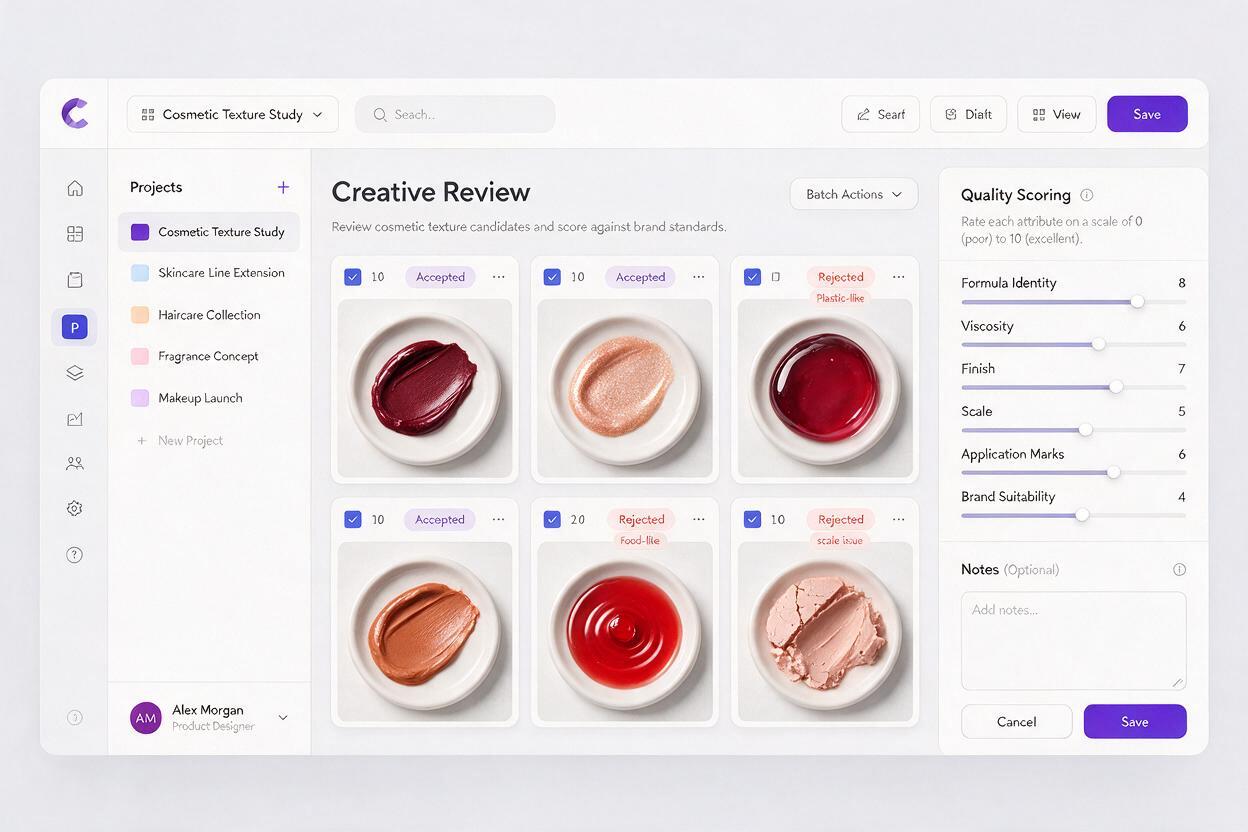
A convincing image should pass more than a general “looks good” review. Inspect each candidate at full size and score the material independently from the art direction.
| Check | Accept when | Reject when |
|---|---|---|
| Formula identity | The material immediately reads as the intended cosmetic type | It could be mistaken for food, paint, resin or glass |
| Viscosity | Height, spread and edge behavior agree | A watery formula holds an impossible rigid form |
| Finish | Highlights support dewy, satin or matte positioning | Every surface has a plastic mirror shine |
| Scale | The swatch relates naturally to the jar, spatula or tray | Droplets and ridges appear several times too large |
| Application marks | Pressure creates subtle, plausible irregularity | Ridges repeat with mechanical symmetry |
| Brand suitability | The texture supports the real product claim and campaign mood | The image exaggerates richness, clarity or gloss |
Save the accepted prompt beside the final image, including the exact product form, finish and scale language. That record becomes a reusable material specification for future campaign crops and backgrounds.
Refine one variable at a time
If the result remains unconvincing, shorten the prompt and return to the physical contradiction. Use targeted revisions such as:
- Too edible: lower the profile, collapse sharp peaks and remove decorative piping language.
- Too plastic: soften the outline, diffuse the interior and reduce hard specular highlights.
- Too oily: reduce the reflective pool and request a controlled satin or fresh-skin finish.
- Too thick: add a shallower center, wider perimeter and low-viscosity flow.
- Too perfect: introduce slight pressure variation without adding mess, bubbles or debris.
- Wrong scale: place the swatch beside a real cosmetic tool or package component.
Once the material reads correctly, reintroduce campaign details such as ingredient props, colored backdrops or dramatic shadows. Texture accuracy should be established before styling complexity.
Final checklist
- Name the exact cosmetic form rather than using “beauty texture.”
- Define viscosity through height, spread and settling behavior.
- Describe the edge, not only the center of the swatch.
- Choose one intentional finish: dewy, satin, pearlescent or matte.
- Include a scale reference when macro framing could exaggerate the formula.
- Keep packaging fixed while testing texture variations.
- Reject any image that implies food, plastic, resin or an inaccurate product claim.
Ready to build a texture study for your own formula? try this prompt for free and change only the product form, viscosity and finish fields first.
Keywords
ai cosmetic texture, cosmetic texture swatches, Seedream 4.5 prompts, beauty product image, skincare product photography, AI beauty generator, cosmetic product photography