How to Build a Cold Open for an AI Microdrama
A strong AI microdrama cold open presents a visible disturbance, one meaningful clue, and an unanswered decision before exposition begins. This tutorial turns that structure into vertical shot cards, controlled anchor frames, and short video units that can be revised without regenerating the entire scene.
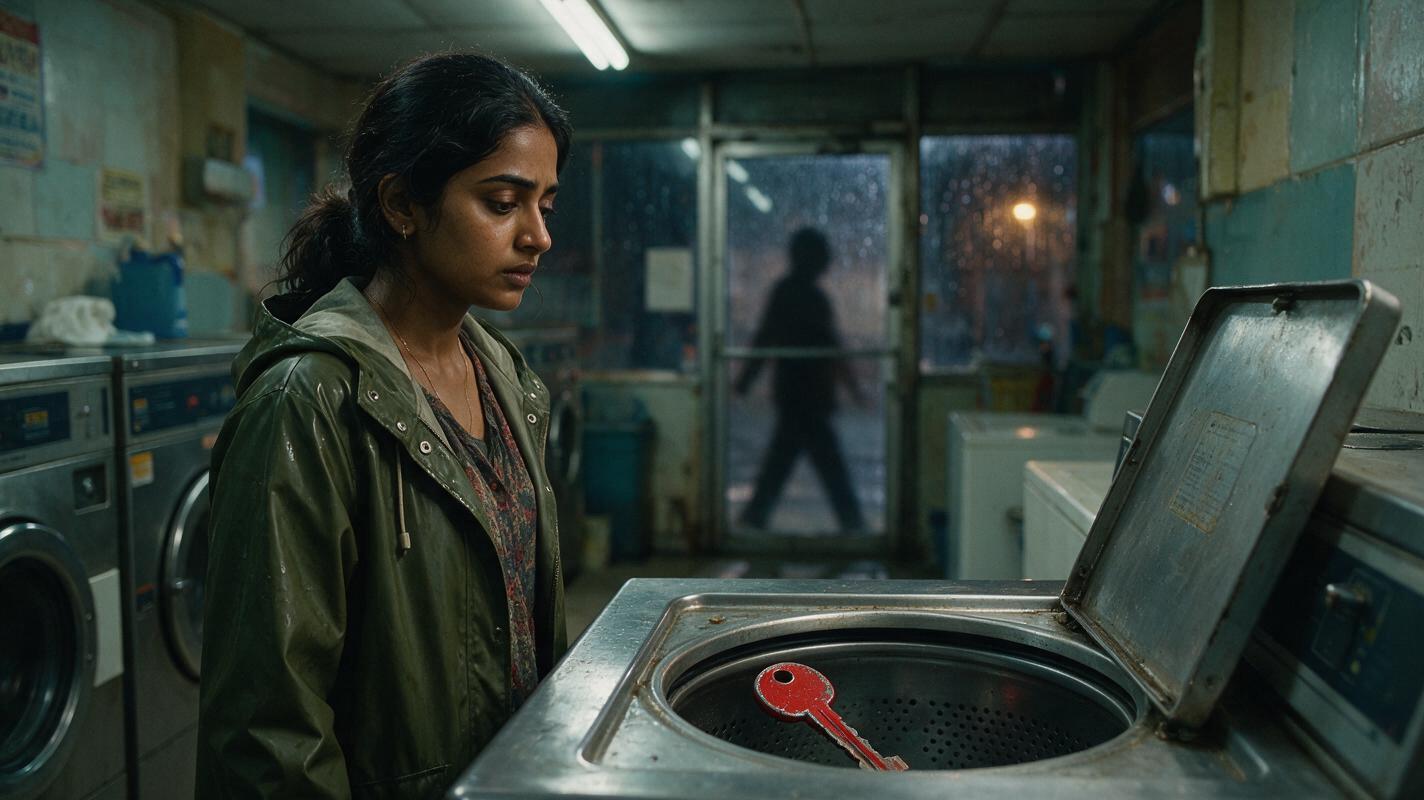
Table of contents
Build the question before explaining the story
The most reliable AI microdrama cold open is a compact chain of disturbance, evidence, and unanswered choice. Show something that should not happen, prove that it matters, and cut before the character can resolve it.
This tutorial uses a fictional vertical drama about Mara, a night-shift laundromat attendant who discovers a red enamel key inside a machine she knows was empty. The workflow is suitable for a first episode or an episode recap replacement because it establishes a narrative question through visible actions rather than dense exposition.
A cold open does not need to explain the premise. It needs to make the viewer ask one precise question that the episode can answer.
Step 1 — Write a payoff-first cold-open contract
Begin with the episode payoff, not the opening image. Write the fact that will become meaningful later, then decide what incomplete fragment of that fact can appear now.
For the laundromat story, the later payoff is: Mara's missing sister hid a storage key in machine 17. The opening should not reveal the sister, the storage unit, or the reason for hiding it. It only needs to establish that Mara recognizes the key and that someone may be watching her.
Use this prompt with an ai script generator to reduce a longer episode premise to one playable question:
You are structuring the cold open of a vertical AI microdrama.

Episode payoff: [state the fact revealed later]
Protagonist: [name, immediate objective, emotional state]
Recurring object or clue: [describe it precisely]
Available location: [one controllable location]

Create a 15-25 second cold open with exactly three visual beats:
1. A normal action is interrupted.
2. A physical clue proves the interruption matters.
3. The protagonist must choose whether to investigate.

Withhold names, backstory, and explanations that are not visually necessary.
End one second before the choice is completed.
Return: beat purpose, visible action, required prop state, reaction, and cut point.
The result should produce a single question, such as: Why is Mara afraid of a key found in an empty washer? If the outline produces several unrelated questions, remove clues until one dominates.
Step 2 — Lock the character and evidence before staging
A cold open depends on immediate recognition. If Mara's face, coat, or key changes between shots, the audience spends attention resolving continuity instead of following the mystery.
Create a compact reference packet containing:
- Identity constants: age range, facial structure, hair, eyebrow scar, and earrings.
- Wardrobe constants: olive raincoat, charcoal sweater, dark trousers.
- Evidence constants: a small old-fashioned key with a chipped red enamel head.
- Location constants: worn tile floor, stainless machines, cool fluorescent ceiling light, and rain-dark windows.
Generate the neutral character sheet before producing dramatic frames. Do not add cinematic shadows, gestures, props, or facial expressions; they make identity comparison harder.
Copy and recreate visual:
Photorealistic three-panel character reference sheet of the same fictional 29-year-old South Asian woman named Mara, shoulder-length wavy black hair, oval face, warm brown skin, small scar through the left eyebrow, small silver hoop earrings, olive raincoat over a charcoal crew-neck sweater, dark straight-leg trousers and plain black shoes; front view, exact left side view, and exact back view arranged evenly from left to right; neutral posture, arms relaxed and fully visible, calm expression in the front panel; MANDATORY CAMERA: eye-level full-body orthographic-style reference views with consistent 70mm lens appearance; MANDATORY LAYOUT: landscape 16:9, three equal panels, identical scale and lighting, neutral light-gray seamless studio background; realistic fabric texture and anatomy, no text, no labels, no logo, no interface, no extra people, no handheld objects.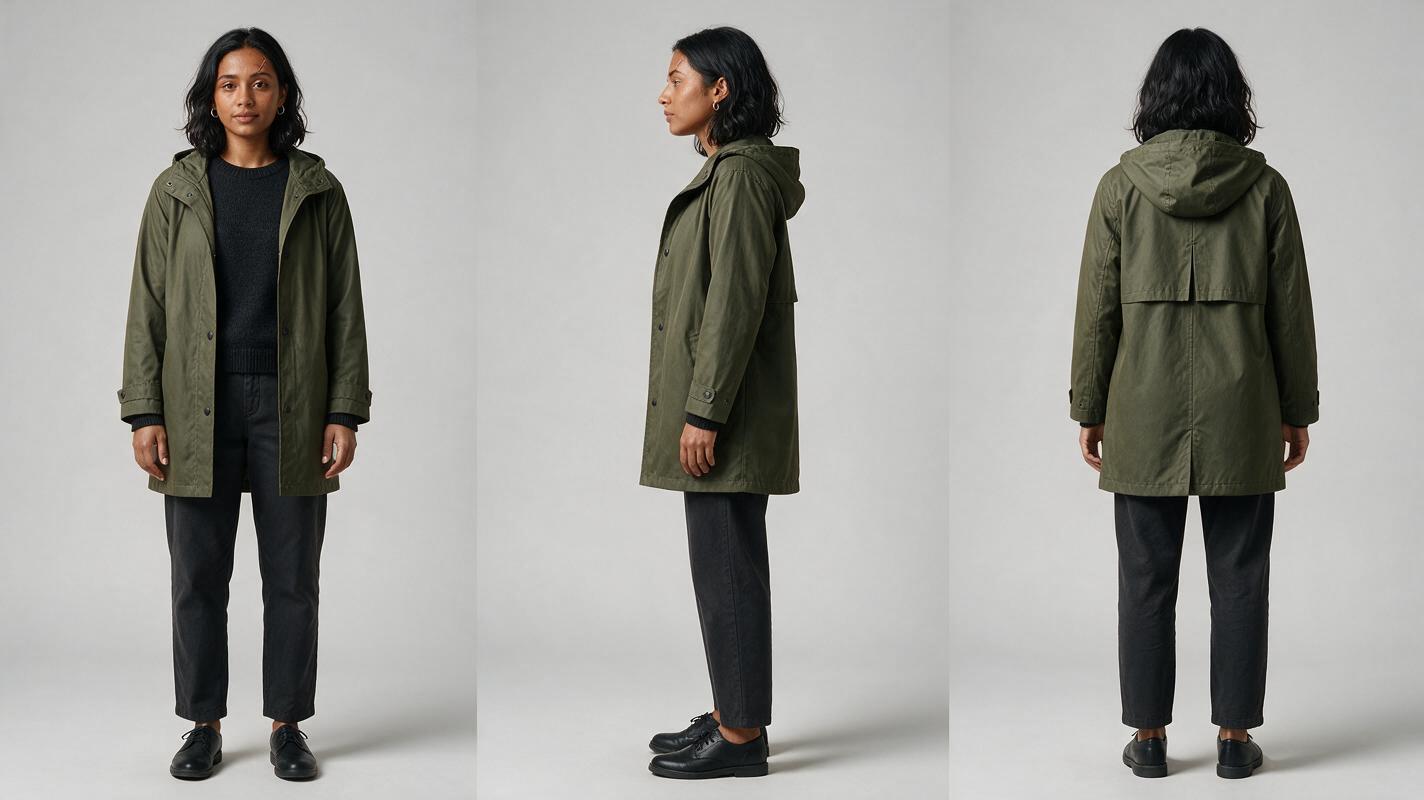
Step 3 — Design three escalating visual beats
Each beat must change the viewer's understanding. Repeating Mara looking worried from three angles adds coverage but not story.
| Beat | Visible event | New information | Cut condition |
|---|---|---|---|
| Disturbance | A supposedly empty washer stops by itself. | The normal routine has been interrupted. | Mara reaches for the door. |
| Evidence | The red key rests inside the empty drum. | The interruption is deliberate or connected to her past. | She recognizes the key. |
| Unanswered choice | A human shadow crosses the rainy entrance. | Someone may still be nearby. | Mara turns toward the door but has not opened it. |
Make the clue readable through composition rather than dialogue. The key needs a clean silhouette and contrasting color. Mara's reaction should be specific: her hand stops before touching it, her breathing tightens, and her attention shifts toward the entrance.
Copy and recreate visual:
Cinematic editorial-realism triptych showing three sequential cold-open frames in the same lived-in neighborhood laundromat at night: left frame, Mara in an olive raincoat freezes as a stainless front-loading washer stops unexpectedly; center frame, close insert of a small old-fashioned key with a chipped red enamel head resting alone inside the wet metal drum; right frame, Mara turns toward a rain-streaked glass entrance as an indistinct human shadow passes outside; MANDATORY CAMERA: left frame eye-level medium-wide 35mm, center frame macro insert 85mm, right frame true three-quarter medium close-up 50mm; MANDATORY LAYOUT: landscape 16:9 divided into three equal cinematic frames with consistent cool fluorescent lighting, worn tile floor and stainless machines; no text, no labels, no logos, no interface, no duplicated character, no visible brand marks.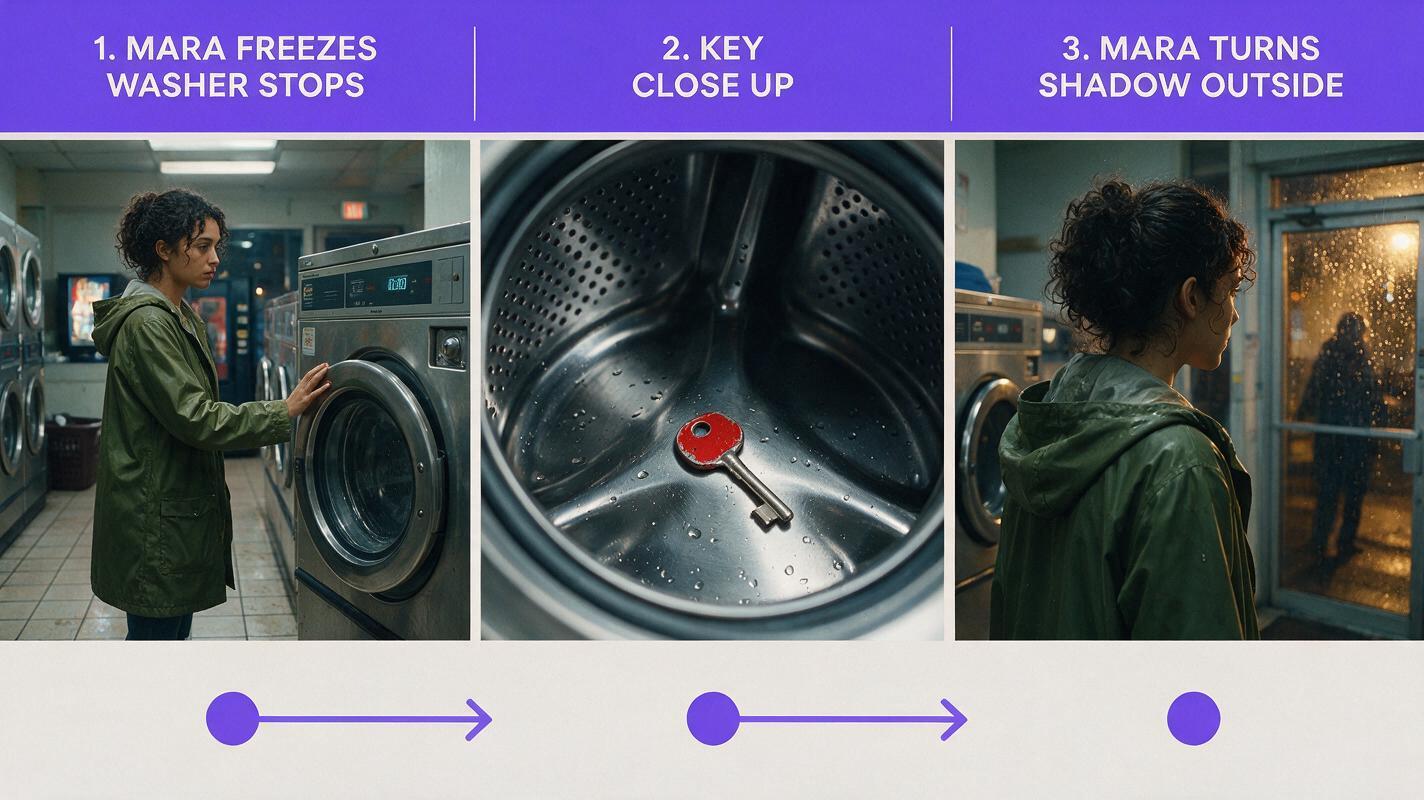
Step 4 — Convert each beat into a vertical shot card
A vertical drama video gives each prop and face less horizontal space, so every shot card should identify one dominant story subject. Avoid framing Mara, the entire washer bank, the key, and the entrance as equally important in a single composition.
Use a fixed shot-card format:
SHOT ID: CO-01
STORY PURPOSE: Establish the impossible machine stop
FORMAT: 9:16 vertical
SUBJECT PRIORITY: Mara first, machine door second
START FRAME: Mara folding a towel beside machine 17
ACTION: Machine stops; Mara freezes; towel remains in her hands
END FRAME: Her eyes settle on the machine door
CAMERA: Locked medium shot, eye level, no push-in
CONTINUITY: Olive coat closed; key not visible yet
EDIT HANDLE: 12 clean frames before and after the action
AUDIO CUE: Machine hum cuts to room tone
Keep physical actions bounded. “Mara freezes and looks left” is easier to control than “Mara panics, drops everything, runs across the room, opens the washer, grabs the key, and confronts a stranger.” Split that larger performance into editable units.
Step 5 — Generate the boundary frames before motion
Create the start and end frame of every shot before animating. These boundary frames verify identity, prop state, screen direction, and composition at the points where the edit must connect.
For the key reveal, produce three stills:
- The closed washer before Mara touches it.
- The readable key insert inside the drum.
- Mara's recognition reaction with the key still off-screen.
Do not ask a video model to invent the key during a continuous door-opening action. Introduce it through a controlled insert, then return to Mara's reaction. This preserves the clue even if hand interaction is imperfect.
If you prefer to compare multiple generation paths while keeping script, reference, and video work connected, try these models for free after the boundary frames have been approved.
Copy and recreate visual:
Photorealistic side-by-side continuity comparison from a fictional laundromat drama, both panels showing Mara reacting beside the same stainless washer; left panel intentionally demonstrates failure with altered facial proportions, missing eyebrow scar, different coat color and a duplicated red key near her hand; right panel shows the corrected result with the same oval face, warm brown skin, left-eyebrow scar, silver hoop earrings, olive raincoat and exactly one chipped red enamel key visible only inside the open washer; MANDATORY CAMERA: matching eye-level true three-quarter medium shots with a 50mm lens in both panels; MANDATORY LAYOUT: landscape 16:9 split evenly into two unlabelled panels, identical cool fluorescent laundromat lighting and background geometry; realistic anatomy, no text, no labels, no logos, no software interface, no brand marks.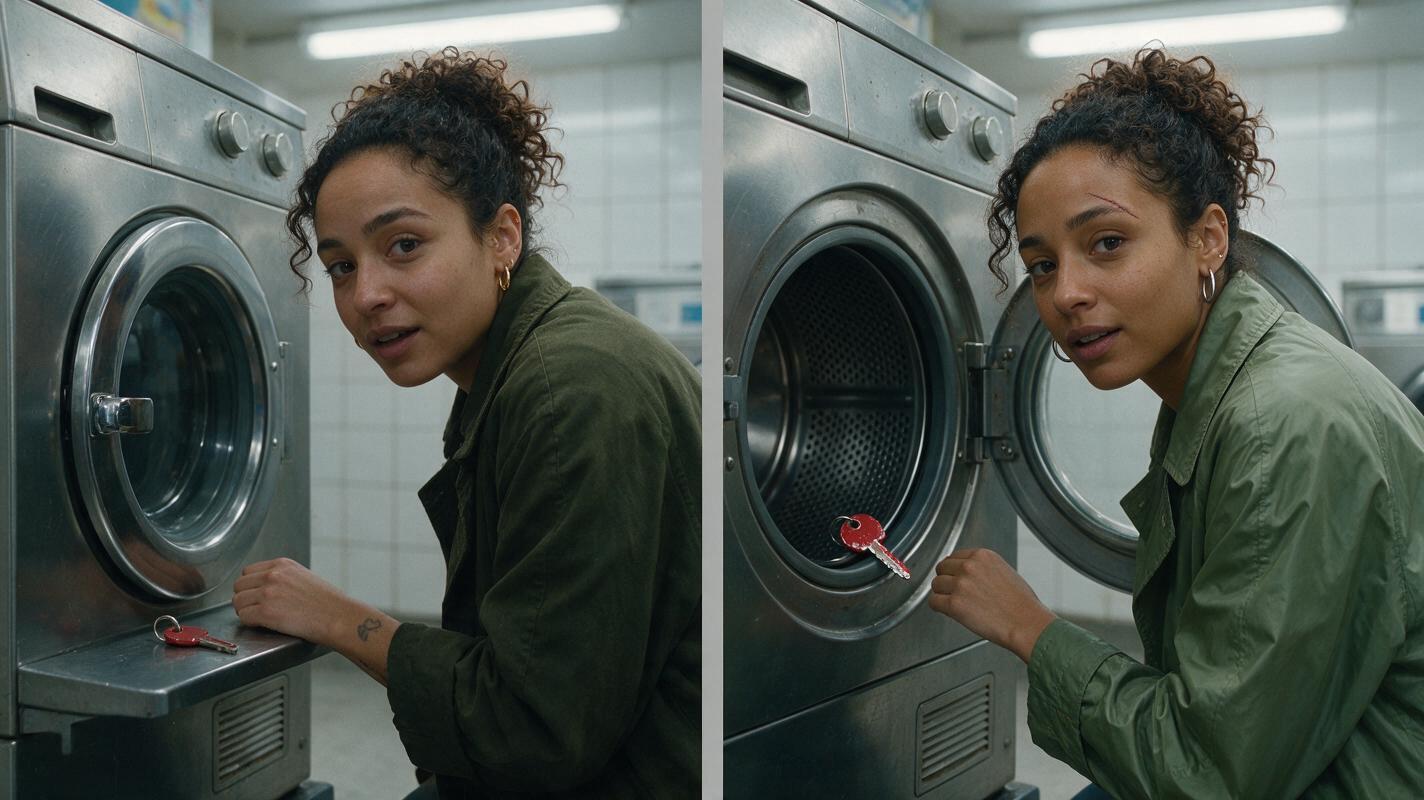
Step 6 — Animate one story change per clip
Animate from approved stills with reference image to video. Give each clip one primary motion and keep background behavior subordinate.
- Machine-stop clip: the drum slows; Mara notices.
- Recognition clip: Mara's hand pauses; her eyes tighten slightly.
- Shadow clip: one soft shadow crosses the door; Mara turns toward it.
A useful motion prompt specifies what must remain still:
Preserve Mara's facial identity, eyebrow scar, hairstyle, earrings and olive raincoat exactly. The washer drum slows to a stop. Mara remains beside the machine, then shifts only her eyes toward its door and freezes. Locked camera, no zoom, no camera orbit, no wardrobe change, no extra people, no duplicated objects, no speaking, no exaggerated expression. End with Mara holding still for the edit.Build tension with sound before adding dialogue. The washer hum can stop abruptly, leaving rain, fluorescent buzz, and a distant metal click. If a line is necessary, make it recognition rather than explanation: “No. Not that key.”
Step 7 — Test the cold open without context
Review the sequence once without audio and once with audio but no subtitles. A successful cut should communicate four facts:
- Mara was performing a normal task.
- The machine behaved unexpectedly.
- The red key means something to her.
- She suspects another person is nearby.
If viewers cannot identify the clue, enlarge or isolate the insert. If they notice the key but not Mara's recognition, lengthen the reaction rather than adding exposition. If the shadow feels like a random horror effect, connect it to her decision by cutting directly from the moving shadow to her hand withdrawing from the key.
End the cold open on withheld action: Mara reaches toward the entrance lock, hears the washer door move behind her, and turns. Cut before the source is shown. The following scene can then supply context without weakening the initial question.
FAQ
How long should an AI microdrama cold open be?
Use the shortest duration that clearly presents the disturbance, clue, and unresolved choice. Let story changes determine length rather than forcing a preset number of seconds.
Should the opening include dialogue?
Only when dialogue changes the interpretation of a visible event. A recognition fragment can help, but a paragraph explaining the character's history usually delays the hook.
Can the cold open use more than one location?
Yes, but a single location is easier to control and often creates a cleaner causal chain. Add another location only when the contrast itself supplies essential information.
How does this fit a short drama from script workflow?
Extract the later episode payoff, reveal one incomplete piece of evidence, and design the opening around the protagonist's reaction. The rest of the script can then explain or complicate that evidence.
Sources
- StudioBinder: What Is a Cold Open?
- Adobe: How to Make a Shot List
- Blackmagic Design: DaVinci Resolve Training
Final checklist
- The opening creates one dominant narrative question.
- Every shot introduces new information rather than duplicate coverage.
- The recurring character has an approved three-view reference sheet.
- The clue has a fixed design, location, and visibility state.
- Each vertical shot has one dominant story subject.
- Start and end frames are approved before motion generation.
- Each clip contains one primary performance change.
- The final cut ends before the decisive action is completed.
Keywords
AI microdrama, AI short drama, AI series video, AI short film generator, short drama from script, vertical drama video