AI Music Prompts for Classroom Memory Songs With Clear Lyrics
Create short classroom memory songs that keep essential vocabulary audible instead of hiding it beneath dense music. This practical prompt framework covers lyric structure, arrangement choices, pronunciation checks, instrumental versions, and classroom-ready exports.
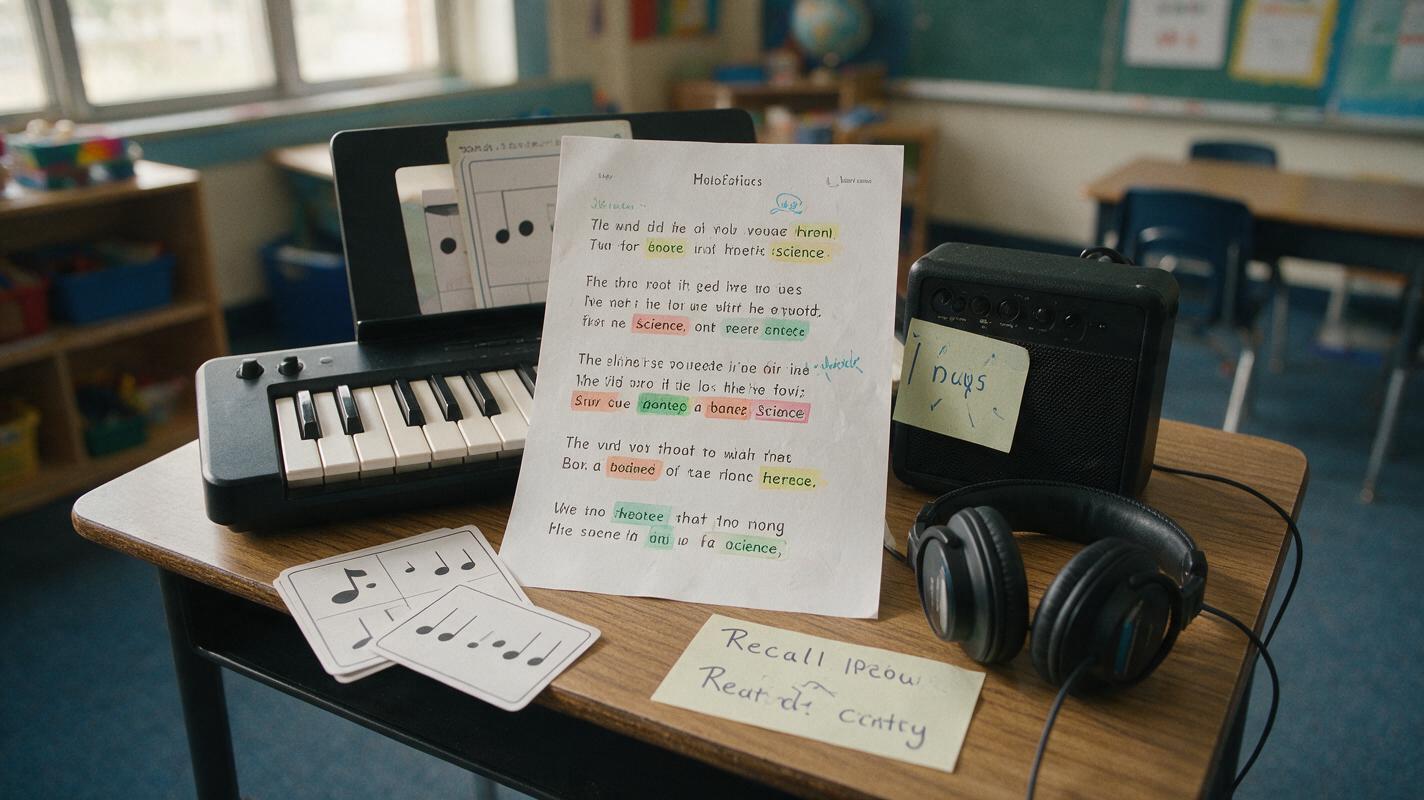
Table of contents
Create a memory song learners can actually understand
A classroom memory song fails when its key words are rushed, mispronounced, or buried beneath loud instruments. The solution is not simply to request an “educational song.” You need to control lyric density, tempo, vocal delivery, arrangement, repetition, and the exact information learners must remember.
This prompt method helps teachers and course creators produce short songs for vocabulary, formulas, process sequences, safety rules, and revision activities. It also separates creative generation from factual review, so a catchy result does not quietly teach the wrong content.
Reduce the lesson to one recall target
Start by deciding what learners should be able to retrieve after hearing the song. One track should usually serve one tightly defined purpose: naming the stages of a cycle, recalling a short formula, pronouncing a vocabulary set, or remembering the order of a procedure.
A broad request such as “write a song about photosynthesis” gives the model too much freedom. A more useful brief identifies the required terms and the relationship between them.
Recall target: Learners can state that plants use light energy to convert carbon dioxide and water into glucose and oxygen.
Before generating music, create a protected fact list:
- Required terms: light energy, carbon dioxide, water, glucose, oxygen.
- Required relationship: inputs are converted into products.
- Forbidden simplification: plants obtain food directly from soil.
- Audience: specify age range, language level, and prior knowledge.
- Target duration: choose a practical length for the activity rather than requesting a complete pop song.
Keep this list beside the final transcript. Musical quality cannot compensate for a missing term or an inaccurate relationship.
Write lyrics for listening, not silent reading
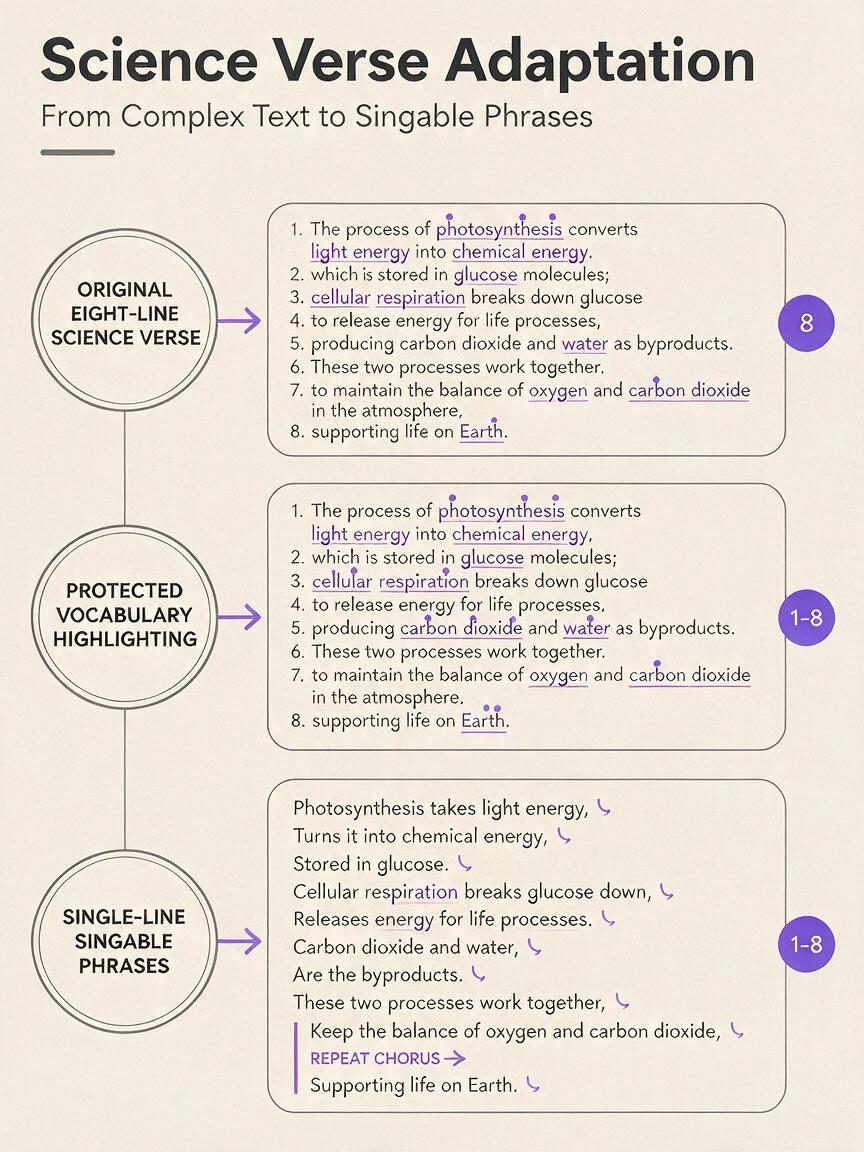
Lyrics that look concise on a page can become unintelligible when sung. Long technical phrases, adjacent multisyllabic words, and several new ideas in one line force the singer to rush.
Draft the lyric as short spoken phrases first. Read each line aloud at a steady pace and mark the words that must remain distinct. If you cannot say a line comfortably in one breath, divide it.
| Weak lyric choice | Why it causes trouble | Clearer alternative |
|---|---|---|
| Several facts packed into one verse | Important terms pass too quickly | Give each fact its own short line |
| A different chorus every time | Learners cannot anticipate the recall cue | Repeat one stable chorus |
| Rhymes that alter terminology | Accuracy is sacrificed for sound | Protect the correct term and relax the rhyme |
| Dense instrumental gaps | The activity becomes longer without adding practice | Use brief pauses for repetition or response |
For younger learners or language learners, repeat the target phrase unchanged. Variation may make a song feel more sophisticated, but stable wording supports rehearsal.
Build the prompt around vocal intelligibility
Open ai music generator only after the factual brief and lyric sheet are ready. Describe the learning function before the genre. Then specify the voice, tempo, arrangement, structure, and exclusions.
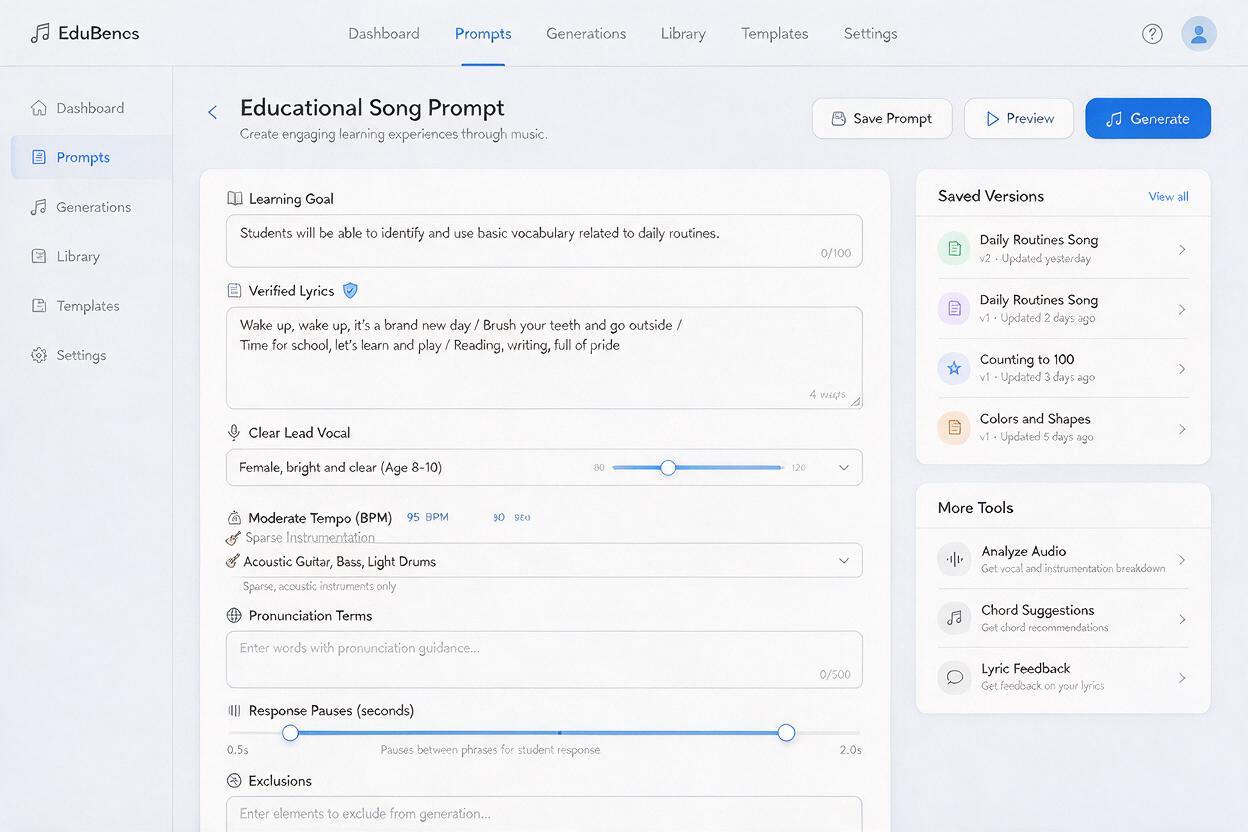
Create a short educational memory song for learners aged [AGE RANGE].

Learning goal:
Learners should remember [ONE PRECISE RECALL TARGET].

Use these lyrics exactly:
[PASTE VERIFIED LYRICS]

Performance:
- one clear lead vocal
- careful pronunciation of [TARGET TERMS]
- moderate, steady tempo
- brief pause after each target phrase
- repeat the chorus with identical wording

Arrangement:
- light percussion
- simple bass line
- one restrained harmonic instrument
- no competing vocal layers during key terms
- no long instrumental introduction

Style:
[GENRE OR MOOD], friendly and age-appropriate, not theatrical

Avoid:
- improvised lyrics
- altered technical terms
- rapid delivery
- heavy reverb
- loud fills beneath the target words
- spoken advertisements or unrelated phrases
The phrase “use these lyrics exactly” is an important constraint, but it is not a guarantee. Always transcribe what you actually hear and compare it with the approved lyric sheet.
Choose arrangements that leave space for words
Genre labels alone do not control clarity. Two tracks described as upbeat pop can differ greatly in vocal speed, instrumentation, and pronunciation. Describe the arrangement in functional terms.
- Vocabulary practice: sparse beat, repeated melody, and a pause after each word.
- Process sequence: one musical phrase per action, with a stable pulse that preserves order.
- Formula recall: slow melodic contour, minimal ornamentation, and clear verbal grouping.
- Safety rule: firm lead vocal, restrained accompaniment, and no humorous sound effects that weaken the message.
- Course recap: short verse for context followed by a repeated summary chorus.
Requesting “high energy” can unintentionally encourage faster delivery and busier accompaniment. If energy is useful, pair it with limits such as “steady moderate tempo,” “sparse arrangement,” and “no instruments masking the lead vocal.”
Add response space for active recall
A memory song becomes more useful when learners do something with it. Build predictable gaps into the structure so they can supply a term, repeat a phrase, or complete a sequence.
Structure:
- two-bar instrumental count-in
- lead voice sings the question
- two-second response gap
- lead voice gives the correct answer
- learners repeat the complete line
- chorus returns after three questions
Do not leave the duration of a response gap to chance. Listen with a timer and confirm that the silence is long enough for the intended answer. A single vocabulary word requires less time than a formula or procedural sentence.
For assessment, prepare two versions: a complete teaching track and a practice track with selected words omitted. Keep the melody and timing identical so learners are tested on recall rather than adapting to a new arrangement.
Correct pronunciation before polishing the mix
Names, scientific terms, abbreviations, and unfamiliar vocabulary deserve a dedicated pronunciation pass. Listen for changed syllables, misplaced stress, swallowed endings, and words that blend into the next line.
If a term is unclear, try these corrections one at a time:
- Place the word at the beginning of a line rather than in the middle.
- Shorten the words immediately before and after it.
- Add a comma or line break to create phrasing space.
- Request slower, careful articulation for that line.
- Spell out an abbreviation if learners need to hear the full phrase.
- Regenerate only the affected section when the tool permits sectional work.
Do not change a correct technical term merely to force a rhyme. Adjust the surrounding lyric or abandon the rhyme instead.
Heavy reverb and doubled vocals can make a polished track harder to understand. Evaluate the song through ordinary classroom speakers or a typical learner device, not only through headphones.
Review the song as learning content
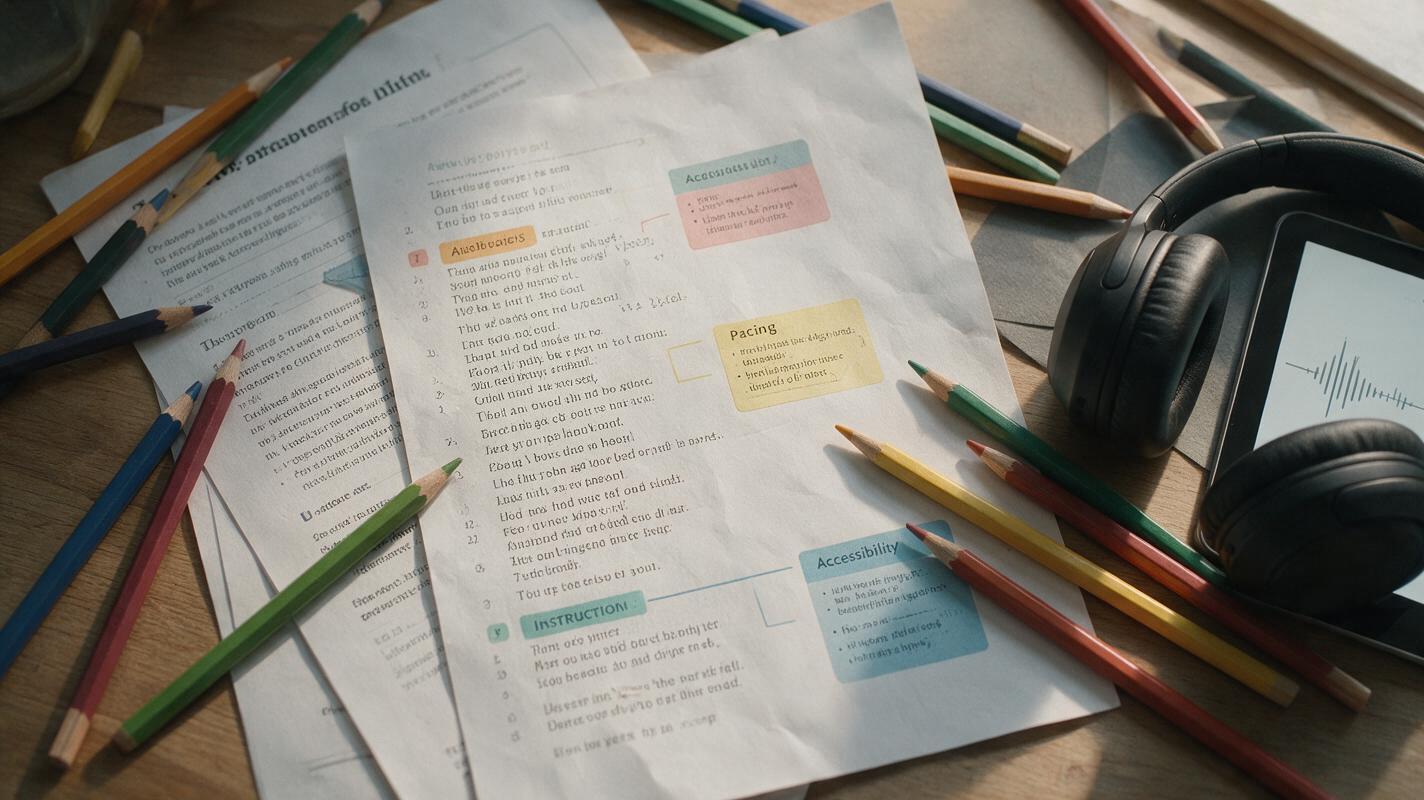
Conduct separate content, audio, and accessibility reviews. Combining them into one casual listen makes subtle errors easier to miss.
| Review pass | Questions to ask |
|---|---|
| Accuracy | Are every required term and relationship correct? Has any exception been lost? |
| Audibility | Can a listener identify each target word without reading captions? |
| Pacing | Are response gaps long enough? Does any line feel rushed? |
| Instruction | Does the track tell learners when to listen, repeat, or answer? |
| Accessibility | Are lyrics or a transcript available? Is the activity still usable without audio? |
| Context | Does the style suit the learners and avoid stereotypes or distracting imitation? |
Ask a colleague unfamiliar with the draft to write down the key terms after one listen. Their transcription reveals masking and pronunciation problems that the creator may overlook after repeated playback.
Export versions for teaching, practice, and reuse
Keep the verified lyrics, prompt, generated audio, transcript, and revision notes together. Export a full-vocal version for initial teaching, a reduced-vocal or gap version for retrieval practice, and an instrumental version only when learners will perform the words themselves.
Captions should reflect the words actually present in the final audio. If regeneration changes a line, update the transcript rather than reusing an earlier lyric sheet. For course platforms, provide a plain-text transcript near the player and avoid making the song the only route to essential information.
Once your fact list and lyric sheet are ready, try this prompt for free and compare several generations for clarity before choosing the catchiest version.
Final checklist
- The song has one precise recall target.
- Every required fact and technical term has been verified.
- Lyrics use short lines that can be sung without rushing.
- The prompt protects wording and requests a clear lead vocal.
- Instrumentation remains quiet beneath essential terms.
- Response gaps are measured rather than assumed.
- Pronunciation has been checked on ordinary playback equipment.
- The final audio has matching lyrics or a transcript.
- A non-audio alternative communicates the same essential content.
Keywords
ai music prompts, classroom memory songs, educational songs, clear song lyrics, learning content, course audio, ai music generator