AI Music Prompts for 15-Second Product Ads With Clear Voiceover
Use these AI music prompts to create short product-ad soundtracks that reinforce the hook without competing with narration. The framework helps performance marketers control energy, instrumentation, transitions and endings across multiple creative-test variants.
Table of contents
Make the soundtrack support the sale
The best music for a 15-second product ad does not demand attention from the voiceover—it directs attention toward the hook, demonstration and call to action.
Generic prompts such as “upbeat advertising music” often produce tracks that are too busy, too dramatic or too slow to develop. A performance ad needs tighter instructions: an immediate opening, controlled space for speech, a useful transition and a clean ending that editors can cut without awkward decay.
This prompt framework is designed for growth marketers producing paid-social demos, offer ads, app promotions and retargeting creatives. It uses an ai music generator to create several strategically different soundtracks rather than several nearly identical songs.
Define the job of the music before choosing a style
Start with the ad’s communication problem, not a genre. Music can perform at least four different jobs in a short campaign creative:
- Stop the scroll: create an immediate rhythmic or tonal cue under the first visual.
- Support comprehension: maintain a restrained bed beneath spoken benefits or captions.
- Signal a transformation: make a before-and-after reveal feel more consequential.
- Land the offer: resolve cleanly when the price, trial or call to action appears.
Assign one primary job to each generation. Asking a track to feel disruptive, luxurious, playful, emotional and unobtrusive at the same time usually produces an unfocused result.
Creative-testing rule: keep the video edit, voiceover and offer constant while changing only the soundtrack strategy. Otherwise, you cannot tell whether music affected the result.
Build prompts around the ad timeline
A useful music prompt describes what should happen across the actual edit. For a 15-second ad, divide the track conceptually into three zones: hook, proof and resolution. You do not need frame-perfect musical timing, but the prompt should tell the generator where the energy changes belong.
| Ad zone | Creative purpose | Music instruction |
|---|---|---|
| Opening | Support the visual hook | Begin immediately with a recognizable pulse; avoid a long intro |
| Middle | Leave room for demonstration and speech | Use sparse instrumentation and stable energy |
| Ending | Emphasize the offer or CTA | Add a small lift followed by a clean, decisive finish |
Use this adaptable base prompt:
Create a 15-second instrumental track for a paid-social product ad.
Purpose: support a clear voiceover and a fast product demonstration.
Opening: start immediately with a concise rhythmic hook; no fade-in or long intro.
Middle: keep the arrangement sparse and steady, leaving space for speech.
Ending: add a subtle lift for the offer reveal, then finish with a clean resolved hit.
Mood: [mood].
Instrumentation: [two or three instruments].
Energy: [low, medium or high], controlled rather than cinematic.
Avoid: vocals, spoken words, dense melodies, dramatic drops and long reverb tails.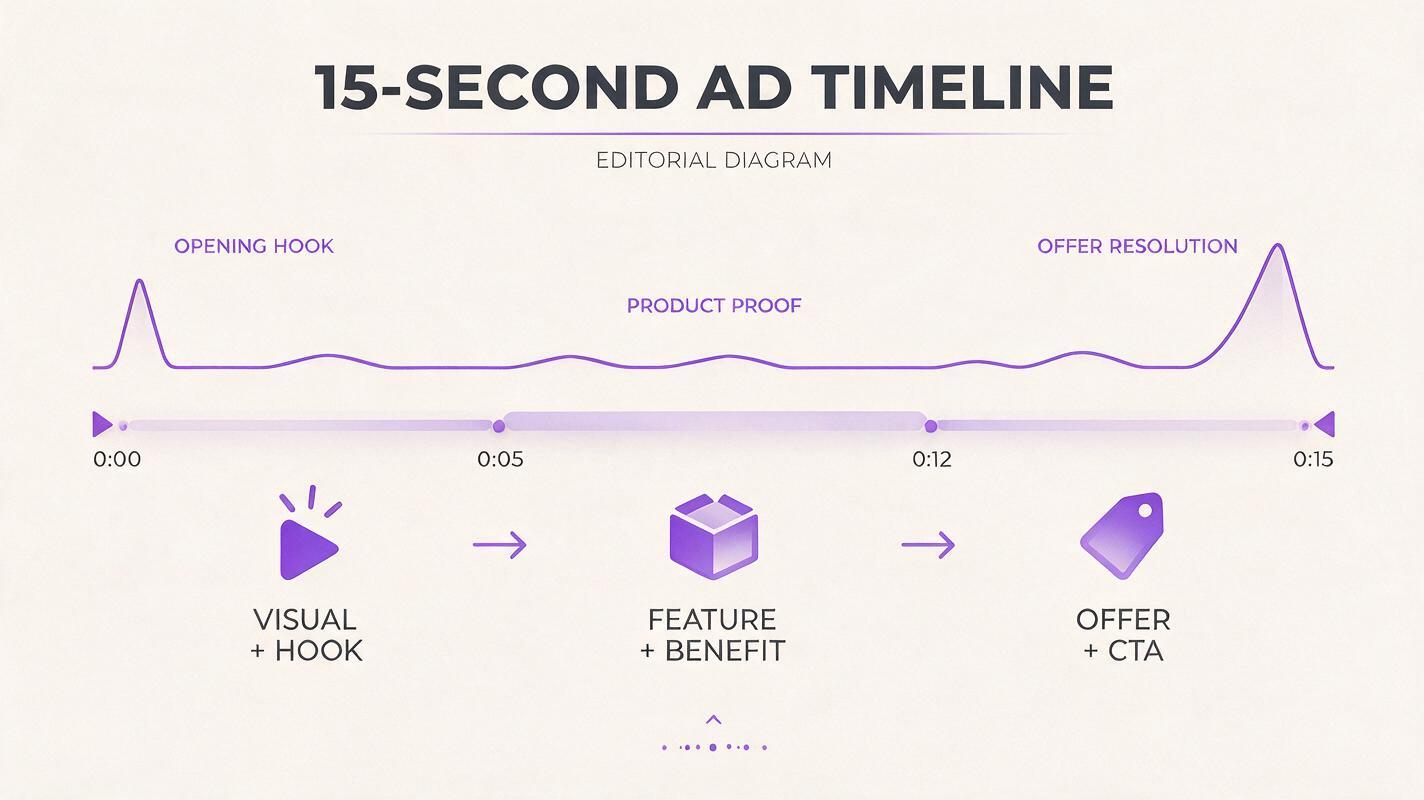
Choose an audio angle that matches the buying message
The same product can need different music depending on why someone should buy it. These prompts create distinct strategic angles that are suitable for controlled tests.
Fast utility demonstration
Use this when the ad proves that a product saves time, removes friction or completes a task quickly.
Create a concise 15-second instrumental bed for a fast product demonstration.
Use crisp light percussion, muted plucks and a simple modern bass pulse.
Start on the first beat with no introduction. Keep the melody minimal so a voiceover remains fully intelligible.
Add a small upward transition near the final product result and end with one dry, confident hit.
The mood is efficient, clear and satisfying—not frantic, comedic or futuristic.
No vocals, hand claps, alarm sounds, heavy sub-bass or extended ending.
Premium product reveal
Choose a restrained arrangement when the creative relies on materials, finish, packaging or considered design.
Create a refined 15-second instrumental soundtrack for a premium product reveal.
Use warm low percussion, soft tactile clicks and a restrained tonal texture.
Open immediately but quietly, leaving generous space for narration.
Build subtle anticipation through the product close-ups, then add a polished tonal resolution beneath the final brand and offer frame.
The mood is confident, modern and precise rather than dramatic or sentimental.
Avoid vocals, busy arpeggios, orchestral swells and aggressive impacts.
Problem-to-solution transformation
This version supports ads that show frustration first and relief after the product appears.
Create a 15-second instrumental cue for a problem-to-solution product ad.
Begin with a sparse, slightly tense two-beat pattern for the problem scene.
At the product reveal, shift into a warmer, smoother rhythm without a huge drop or volume jump.
Keep the center frequencies uncluttered for continuous voiceover.
Finish with a short optimistic resolution aligned with the final call to action.
No vocals, exaggerated comedy, cinematic trailer drums or long fade-out.
Direct-response offer ad
For price-led or limited-offer messaging, prioritize forward motion and a decisive finish instead of an elaborate melody.
Create a 15-second instrumental bed for a direct-response offer ad.
Start instantly with a bright, controlled rhythmic pulse.
Maintain steady momentum beneath spoken product benefits and on-screen pricing.
Introduce one brief accent when the offer appears, then finish cleanly under the call to action.
Use compact percussion, a simple bass pattern and one light tonal motif.
The mood is energetic and credible, not chaotic or childish.
Avoid vocals, sirens, festival drops, complex solos and excessive bass.
Protect voiceover clarity at the prompt level
Do not rely only on lowering the music volume during editing. A quieter track can still mask speech if its busiest sounds occupy the same perceptual space as the narrator.
Prompts for voice-led ads should request:
- Sparse melodic movement rather than a continuous lead melody.
- Limited instrumentation instead of a full, dense arrangement.
- Controlled transitions without sudden impacts under important words.
- No vocals or vocal-like chops that compete with spoken language.
- Short ambience and reverb so the mix does not become cloudy.
Once the music direction works, combine it with a concise ai voiceover and review the complete ad on both headphones and a phone speaker. Listen specifically to the product name, numerical claims, price and call to action. If any of those become harder to understand, simplify the soundtrack before changing the narration.
Generate contrast, not cosmetic variations
A useful test batch changes the music’s functional hypothesis. Switching from one similar synth patch to another rarely creates a meaningful learning opportunity.
| Variant | Variable being tested | Keep constant |
|---|---|---|
| Rhythmic utility | Whether faster pulse improves hook energy | Voiceover, edit, offer and volume target |
| Minimal premium | Whether restraint increases perceived quality | Voiceover, edit, offer and volume target |
| Transformation cue | Whether a tonal shift strengthens the product reveal | Voiceover, edit, offer and volume target |
| Near-silent control | Whether music contributes at all | Voiceover, edit and offer |
The near-silent control matters because some ads perform better when product sounds, speech and captions carry the creative. AI makes generating music easy; it does not make music mandatory.
Review the track against the actual edit
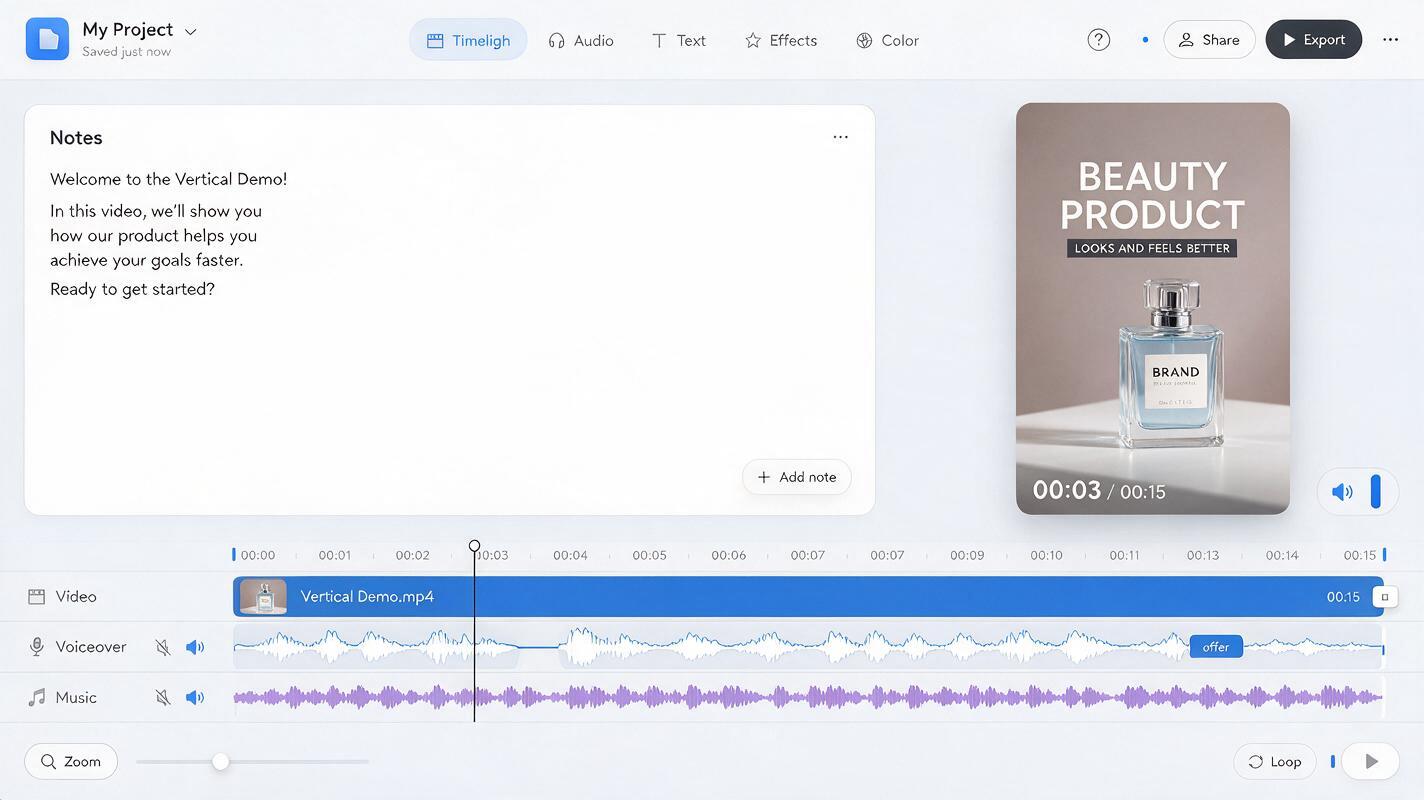
Never approve ad music in isolation. Place each candidate under the same final video and inspect the moments that carry commercial meaning.
- Does the track begin quickly enough for the opening visual?
- Can every voiceover line be understood without effort?
- Does the product reveal receive support without becoming melodramatic?
- Is the offer accent noticeable but not distracting?
- Can the ending be cut cleanly at 15 seconds?
- Does the track still work when the ad is watched at low volume?
If a track is close but too crowded, revise the prompt rather than adding vague language such as “make it better.” Specify the defect:
Regenerate the same overall direction with fewer melodic notes, lighter percussion and no accent beneath the spoken product name. Preserve the immediate opening and clean final hit.If the ending feels unfinished, request a short resolved stop rather than a fade. If the opening is slow, explicitly prohibit an intro and ask for the main pulse on the first beat.
Match measurement to the soundtrack hypothesis
Evaluate music as part of the ad, not as an artistic preference. The relevant metric depends on the job assigned to the soundtrack.
- Hook-focused music: compare early-view retention or the platform’s closest available short-view metric.
- Demonstration support: examine progression through the proof section and downstream click behavior.
- Offer emphasis: compare qualified response, conversion rate or cost per acquisition rather than audio engagement alone.
- Premium positioning: review conversion quality alongside direct-response efficiency.
A winning track should help the commercial message work. It does not need to be the version the team finds most musically interesting.
Final checklist
- Give the soundtrack one primary communication job.
- Describe the opening, middle and ending in the prompt.
- Request sparse instrumentation when narration carries the sale.
- Generate strategically different angles, not cosmetic remixes.
- Include a near-silent control when testing music’s contribution.
- Review every candidate under the final voiceover and edit.
- Reject tracks that obscure the product name, offer or CTA.
- Measure performance against the original soundtrack hypothesis.
Ready to produce a focused test batch? try these models for free and generate distinct soundtrack directions from the prompts above.
Keywords
ai music prompts, product ad music, 15-second ads, performance ad creative, ai music generator, voiceover ads, creative testing