How to Build Clear Flashbacks in an AI Short Drama
A flashback should reveal one decisive fact without making viewers decode the timeline. This tutorial shows how to lock the present-day anchor, design a restrained visual grammar, create transition frames, and return cleanly to the main scene.
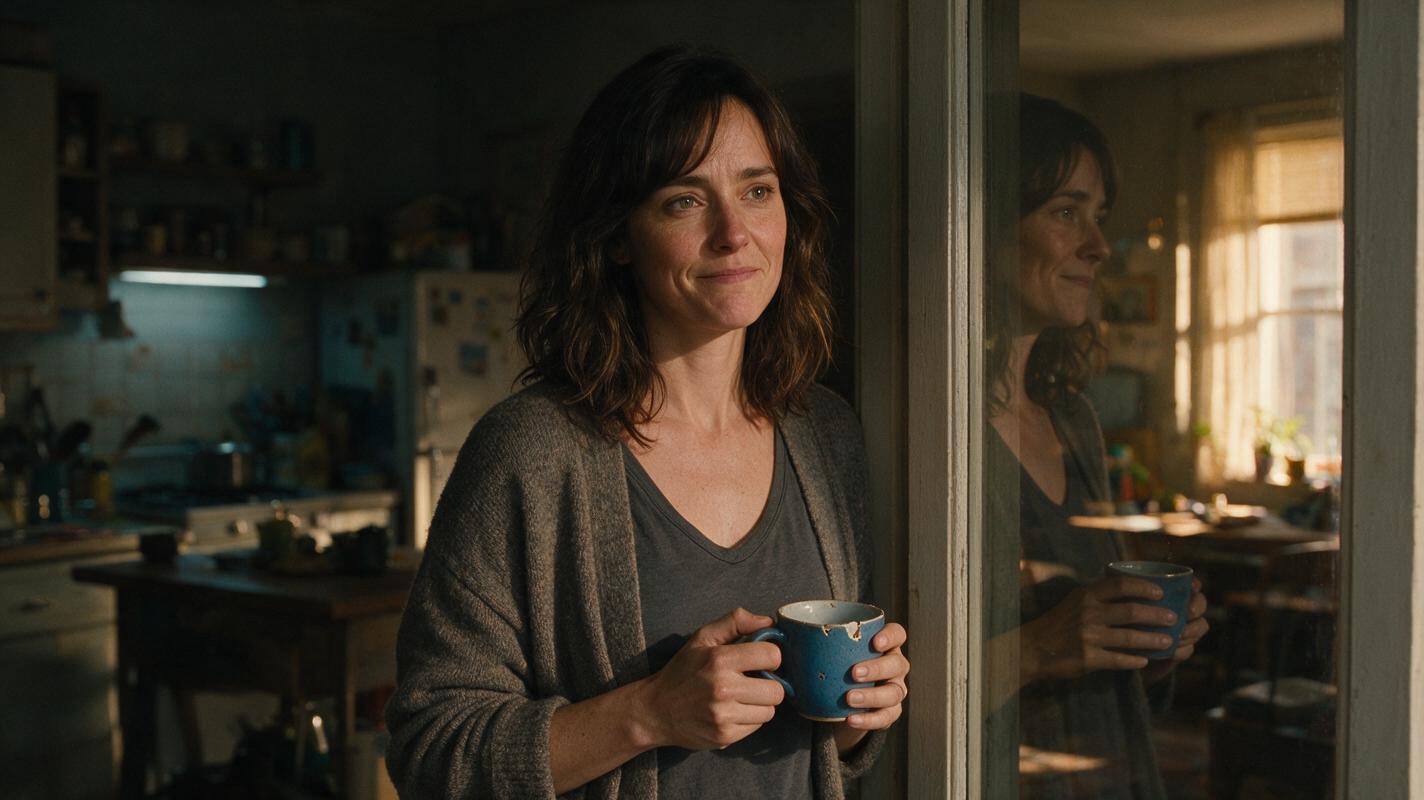
Table of contents
Make the timeline clear before making the flashback beautiful
A successful flashback changes what the audience understands while preserving where and when the current story is happening.
The safest production method is to treat the flashback as a compact evidence sequence, not a second miniature movie. Lock the present-day image, reveal only the past event needed for the scene, and design the return frame before generating motion.
Practical rule: if the audience needs several shots to identify that the story has entered the past, the transition is already too ambiguous.
Step 1 — Lock the present-tense anchor
Begin with a stable image that tells viewers where the character is now. This anchor should contain a recognizable face, location feature, prop, and emotional state.
For this example, Mara is standing in her present-day kitchen with a chipped blue cup. Touching the crack triggers a memory of the night her sister dropped it. The flashback must preserve Mara's identity while changing only the justified timeline variables.
- Present location: cool, dim apartment kitchen at night.
- Trigger: Mara touches the crack in the cup.
- Past location: the same kitchen in warm afternoon light.
- Revealed fact: the sister deliberately dropped the cup after reading a letter.
- Return condition: Mara releases the cup after understanding that the break was intentional.
Create a reference sheet before producing either timeline. The face, hair, height, and body proportions should remain unchanged unless the script explicitly establishes an age difference. An ai image generator can create the identity anchor, but every later prompt should reuse the same reference rather than redescribe the character from memory.
Reusable character-sheet prompt
Photorealistic three-panel character reference sheet of the same woman, Mara, age 29, oval face, dark brown eyes, shoulder-length black hair with a center part, small silver stud earrings, charcoal knit sweater and dark trousers. Show exact front view, exact left-side profile, and exact back view as three evenly spaced full-body panels. MANDATORY CAMERA: eye-level orthographic character-reference framing, 70mm lens appearance, no perspective distortion. MANDATORY LAYOUT: landscape 16:9, front / side / back order, neutral standing pose, arms relaxed, neutral light-gray seamless background, soft even studio light. Preserve identical face, body proportions, hair, clothing, and accessories in all panels. No text, labels, logos, interface elements, extra people, props, or decorative graphics.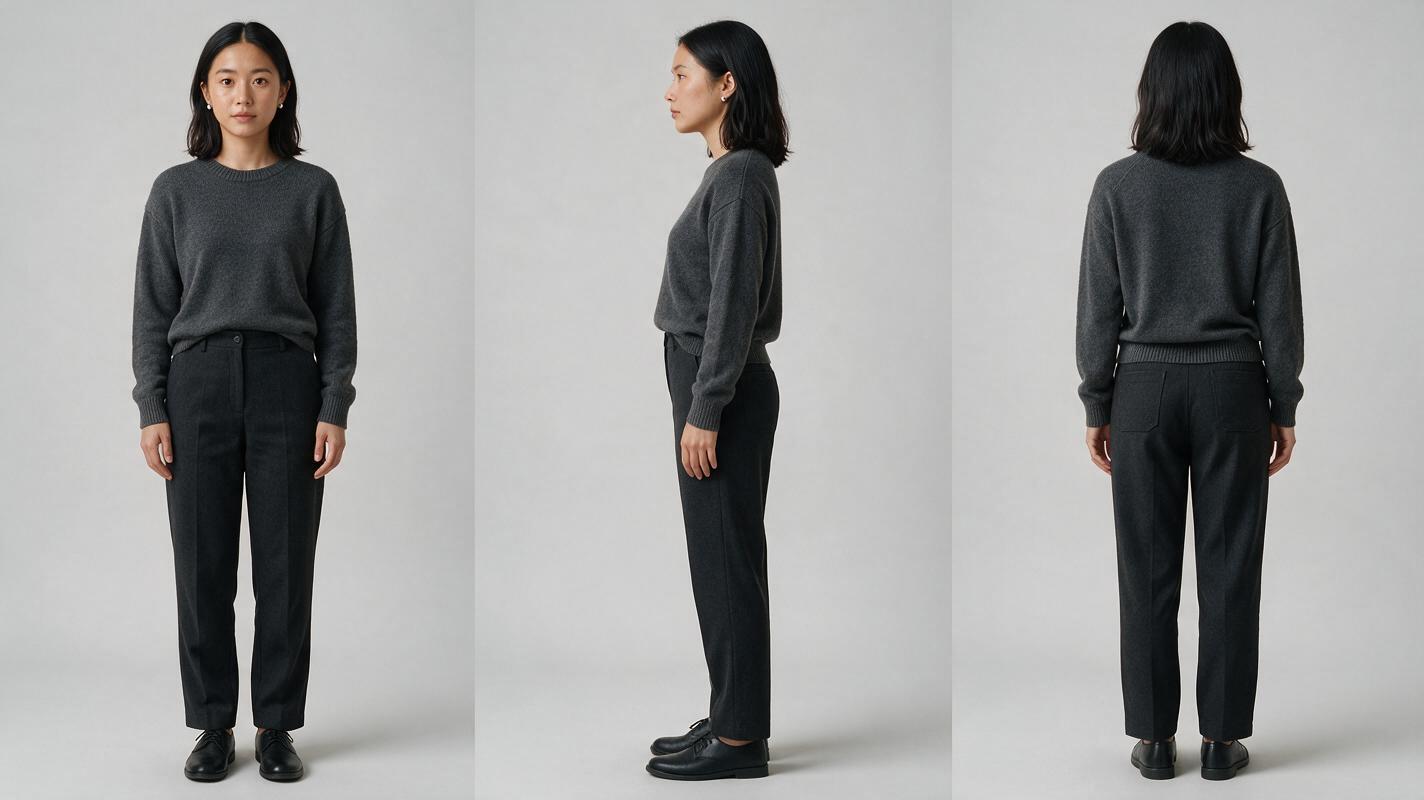
Step 2 — Reduce the memory to evidence beats
When adapting a short drama from script, internal recollection often becomes too long on screen. Convert the memory into visible facts that change the present-day decision.
| Beat | Visible information | Story function |
|---|---|---|
| Trigger | Mara's thumb finds the cup's crack | Connects the present prop to the memory |
| Orientation | The intact cup sits beside a sealed letter | Establishes the past without exposition |
| Action | The sister reads the letter and grips the cup | Links her emotion to the object |
| Revelation | She deliberately lets the cup fall | Changes the meaning of the damage |
| Return | Present-day Mara removes her hand | Shows that her interpretation has changed |
Do not add childhood montages, unrelated dialogue, or decorative location shots unless they alter the decision in the present. A compact AI microdrama flashback usually becomes clearer when each shot carries one new fact.
Step 3 — Give the past one controlled visual grammar
A flashback does not need a heavy sepia filter. Inconsistent faces, costumes, and architecture will look like generation drift rather than an intentional timeline change.
Hold identity and location geometry constant. Change a small group of coordinated signals instead:
- Light: cool night in the present; warm afternoon in the past.
- Prop state: cracked cup now; intact cup then.
- Set dressing: opened mail now; sealed letter then.
- Camera behavior: static present; restrained handheld memory.
- Sound: room tone now; distant traffic and a wall clock then.
The contrast should be recognizable even if the shots are viewed without captions or dialogue.
Reusable timeline-comparison prompt
Create a photorealistic two-frame cinematic comparison of the same lived-in apartment kitchen and the same woman. LEFT FRAME: present day at night, cool window light, Mara in a charcoal knit sweater holding a chipped blue ceramic cup, opened envelope on the counter, tense restrained expression. RIGHT FRAME: past afternoon, warm natural sunlight, identical room geometry and identical Mara, intact blue cup beside a sealed cream envelope, quieter anticipatory expression. MANDATORY CAMERA: matched eye-level true three-quarter view from the kitchen doorway, 40mm lens appearance, identical camera height and composition in both frames. MANDATORY LAYOUT: landscape 16:9 split into two equal cinematic frames with a narrow neutral gap. Preserve face, hair, body proportions, wardrobe, cup design, cabinets, counter, and door positions. No text, labels, logos, UI, duplicate characters, blended faces, or fantasy effects.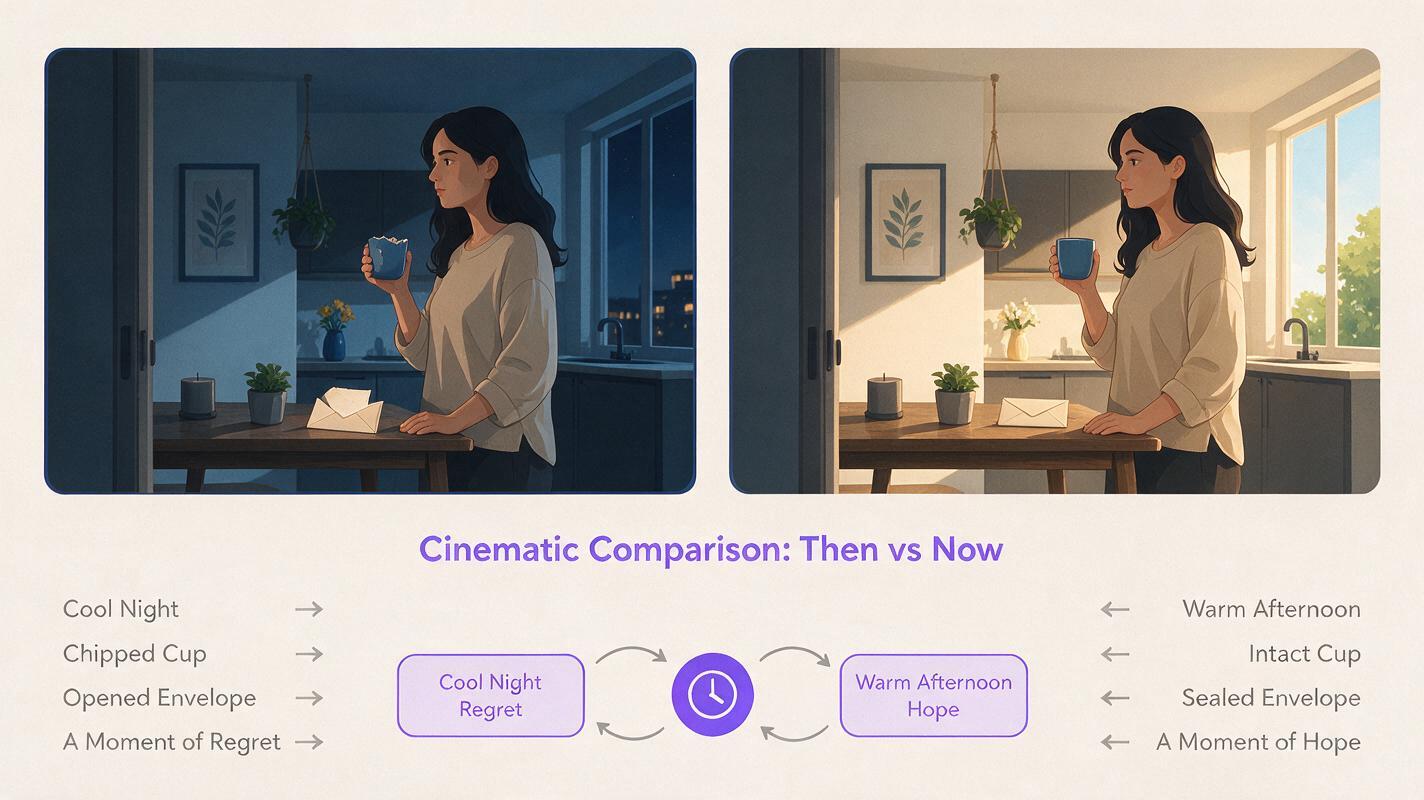
Step 4 — Build matching boundary frames
The entrance and exit are easier to control when they share a visual hinge. Here, the hinge is Mara's thumb touching the crack.
Generate three still frames before animation:
- The present-day hand touching the damaged cup.
- The past version of the same composition with the cup intact.
- The present-day return frame with the hand moving away.
Keep the cup in the same screen position across the first two frames. The lighting and object condition can change at the cut, but the shared geometry tells the eye that the two moments are connected.
A sudden white flash, blur tunnel, or dissolving face is not required. A direct cut can feel more confident when the object, hand position, and framing provide continuity.
Step 5 — Animate bounded actions, not the whole memory
Generate each beat as a separate short shot. Trying to produce the touch, timeline transition, letter reading, cup drop, emotional reaction, and return in one clip creates too many opportunities for identity and prop drift.
For controlled movement, use image to video from approved anchor frames. Assign one dominant action to each clip:
- Present: thumb traces the crack while the rest of the body remains still.
- Past setup: the sister slides the letter from the envelope.
- Past reaction: her eyes stop on one line and her grip tightens.
- Revelation: her fingers release the cup into an off-screen fall.
- Return: Mara pulls her hand away and looks toward the doorway.
Reusable motion prompt
Mara holds the blue ceramic cup close to her chest. Her thumb slowly traces the existing crack once, then stops. Her breathing becomes shallow and her eyes lose focus as she remembers something painful. MANDATORY CAMERA: locked eye-level medium close-up, true three-quarter facial view, 50mm lens appearance, no zoom, no orbit, no reframing. Keep face, hairstyle, sweater, hands, cup shape, crack pattern, background geometry, and lighting unchanged. One continuous restrained action. No speaking, no duplicate fingers, no new damage, no object morphing, no extra people.Show the cup leaving the sister's fingers, then cut to the sound of impact or a separate floor insert. Asking one generation to render a full fall, shatter, and reaction can make the object state difficult to control.
Step 6 — Design the return before animating
The return should complete the thought started by the trigger. If the flashback begins on physical contact with the cup, return to a changed version of that contact rather than cutting to an unrelated wide shot.
Use a three-frame handoff:
- Last past frame: the sister's empty hand hangs over the counter.
- Bridge frame: match the hand position with present-day Mara's hand beside the cup.
- Return frame: Mara withdraws her hand and chooses what to do next.
This structure makes the memory causal: trigger, evidence, revised understanding, action. It also gives an AI series video a clean point from which the episode can continue.
Reusable return-sequence prompt
Create a three-frame photorealistic cinematic sequence showing a flashback return through matched hand geometry. FRAME ONE: warm afternoon past, a woman's empty right hand suspended above a kitchen counter after releasing an intact blue cup out of frame. FRAME TWO: transitional matched composition, the same hand position beside a chipped blue cup as warm light gives way to cool night light. FRAME THREE: cool present-day kitchen, Mara withdraws her hand from the chipped cup and looks toward the dark doorway with new resolve. MANDATORY CAMERA: locked eye-level close shot, true side three-quarter angle, 55mm lens appearance, identical camera position and counter geometry in every frame. MANDATORY LAYOUT: landscape 16:9 contact sheet with three equal frames and narrow neutral gaps. Preserve character identity, hand anatomy, cup design, counter edges, and screen direction. No text, logos, UI, extra hands, duplicate characters, face blending, motion streaks, or abstract transition effects.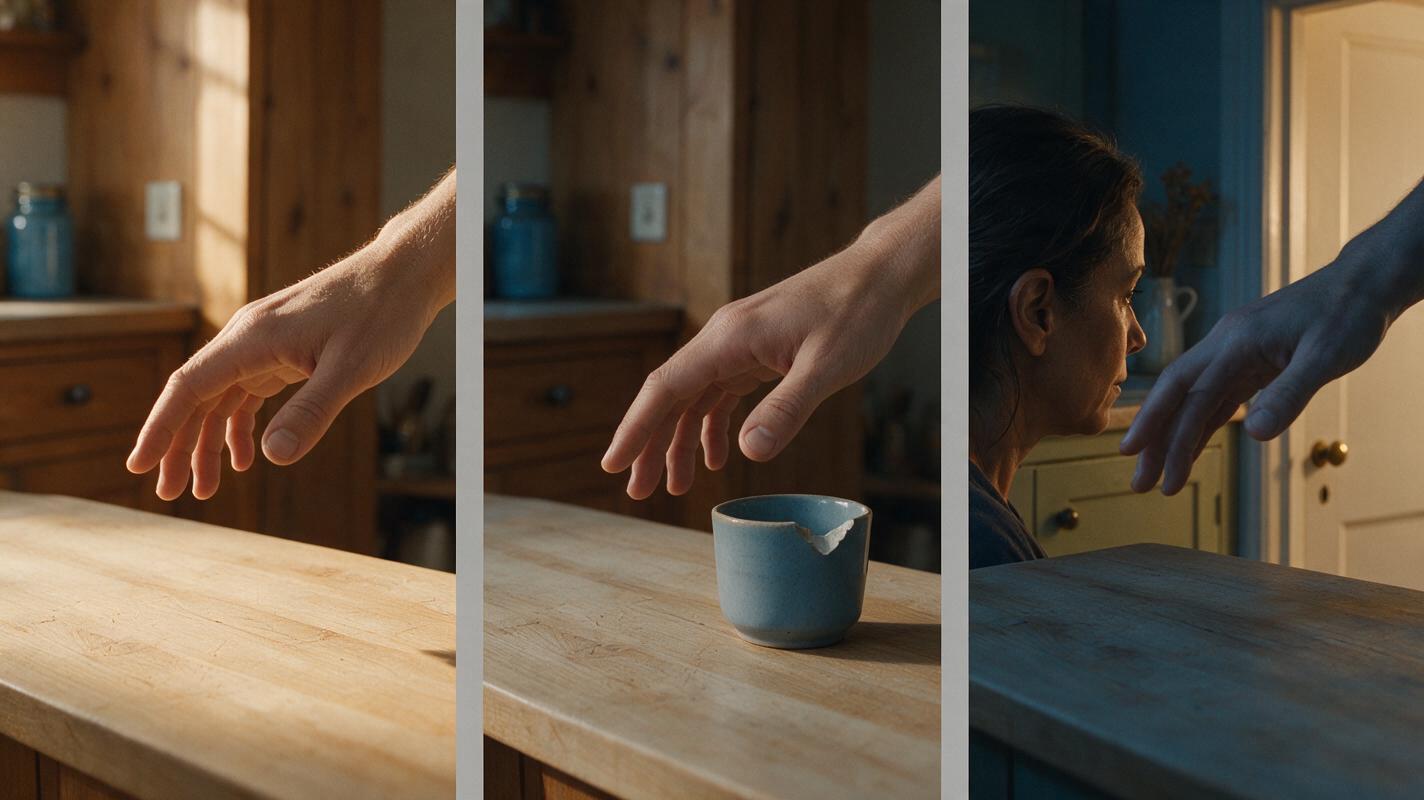
Step 7 — Test temporal clarity in the vertical edit
A vertical drama video has less horizontal context, so small environmental differences may disappear after reframing. Keep the timeline signals near the central story column: face, hand, cup, letter, and key light direction.
Run three review passes:
- Silent pass: can a viewer identify the entrance, revelation, and return without dialogue?
- Grayscale pass: do composition and prop state still separate the timelines when color is removed?
- Boundary pass: compare only the frames immediately before and after each temporal cut.
If the silent pass fails, strengthen the intact-versus-cracked prop state or the matched action. If only the grayscale pass fails, the design may rely too heavily on warm and cool color grading. If the boundary pass fails, regenerate the transition frames rather than rebuilding the entire sequence.
Once the anchor frames are approved, try these models for free and compare which motion result best preserves the hand, cup, and face through the transition.
FAQ
Should every flashback use a different color grade?
No. Color can support the distinction, but prop state, lighting direction, sound, camera behavior, and matched framing should also carry the timeline change.
How long should an AI short drama flashback be?
Use the shortest sequence that reveals the necessary fact and changes the present-day decision. Count evidence beats rather than targeting an arbitrary duration.
Can the character wear different clothes in the past?
Yes, when the story establishes a meaningful time gap. Create a separate wardrobe reference for that timeline and avoid changing the face, body proportions, hairstyle, and clothing simultaneously.
What if the flashback contains two characters?
Establish each identity separately, keep them in distinct screen zones, and avoid making both perform complex actions in the same generation. Reaction shots and inserts can carry the emotional exchange more reliably.
How do I show a flashback inside another episode?
Reuse the original anchor frames when possible. If the remembered event gains new information, preserve the established camera angle and environment before adding the new evidence shot.
Final checklist
- The present-day location, prop, and emotional state are clear before the memory begins.
- The flashback reveals one fact that changes a current decision.
- Character identity and location geometry remain stable across both timelines.
- Past and present differ through coordinated visual and sound signals.
- Entrance and return frames share a deliberate visual hinge.
- Each generated clip contains one bounded action.
- The transition remains understandable in a silent 9:16 review.
- Any failed boundary is repaired locally instead of regenerating the full scene.
Keywords
ai short drama, ai microdrama, ai series video, short drama from script, vertical drama video