What AI Video Tools Are Suitable for Creative Agencies?
The best agency setup is usually a governed tool stack rather than one AI video platform. This buying guide compares production, automation, brand-control, and collaboration options, then shows how to validate them with a client-safe AI short drama pilot.

Table of contents
Choose an agency stack, not one all-purpose tool
The most suitable AI video tools for creative agencies combine four capabilities: controllable visual production, clear commercial terms, repeatable team workflows, and efficient delivery at campaign volume. No single platform is automatically strongest in every area.
A practical stack might use one system for governed brand assets, another for cinematic generation, an API service for automation, and an editing or design platform for review and delivery. For an ai short drama, the buying decision must also account for recurring characters, episodic continuity, dialogue, vertical framing, and revision costs.
Short answer: Adobe Firefly is worth evaluating for brand governance, Runway for production-oriented generation, Google Veo on Vertex AI or Luma API for programmable pipelines, and Canva Enterprise for brand packaging and team delivery. A multi-model workspace is useful during pilots because it prevents an agency from committing to one model before testing real client scenes.
Match the tool to the agency responsibility
Begin with the work the agency has agreed to deliver. A social campaign, episodic AI microdrama, product visualization, and localized video package create different procurement risks.
| Tool or service | Strongest agency role | Useful when | Verify before purchase |
|---|---|---|---|
| Adobe Firefly | Governed brand asset development | The client prioritizes enterprise administration, Adobe workflows, and brand-controlled generation | Eligible indemnification terms, custom-model availability, regional access, and plan-specific limits |
| Runway | Cinematic generation and production experimentation | Directors need to test shots, motion, references, and alternative treatments | Workspace permissions, storage, support, export terms, and current enterprise controls |
| Veo on Vertex AI | Cloud-managed generation and automation | A technical team needs an API-oriented pipeline within Google Cloud | Model availability by region, quotas, pricing, data governance, and output restrictions |
| Luma API | Programmable image-to-video and video generation | The agency is building generation into an internal production service | Rate limits, commercial terms, retention policy, concurrency, and current model access |
| Canva Enterprise | Brand packaging, review, and campaign adaptation | Non-specialist teams need templates, approvals, and distributed delivery | AI feature availability, administration, asset permissions, and whether specialist generation remains necessary |
Feature availability and contract language change. Treat this table as a shortlist, then confirm the current plan, region, license, privacy terms, and support commitments directly with each provider.
Build a client-safe pilot around one recurring character
Do not evaluate tools with unrelated spectacle shots. Use a miniature version of the intended campaign: one recurring character, one branded location, one important prop, two camera angles, and one revision request.
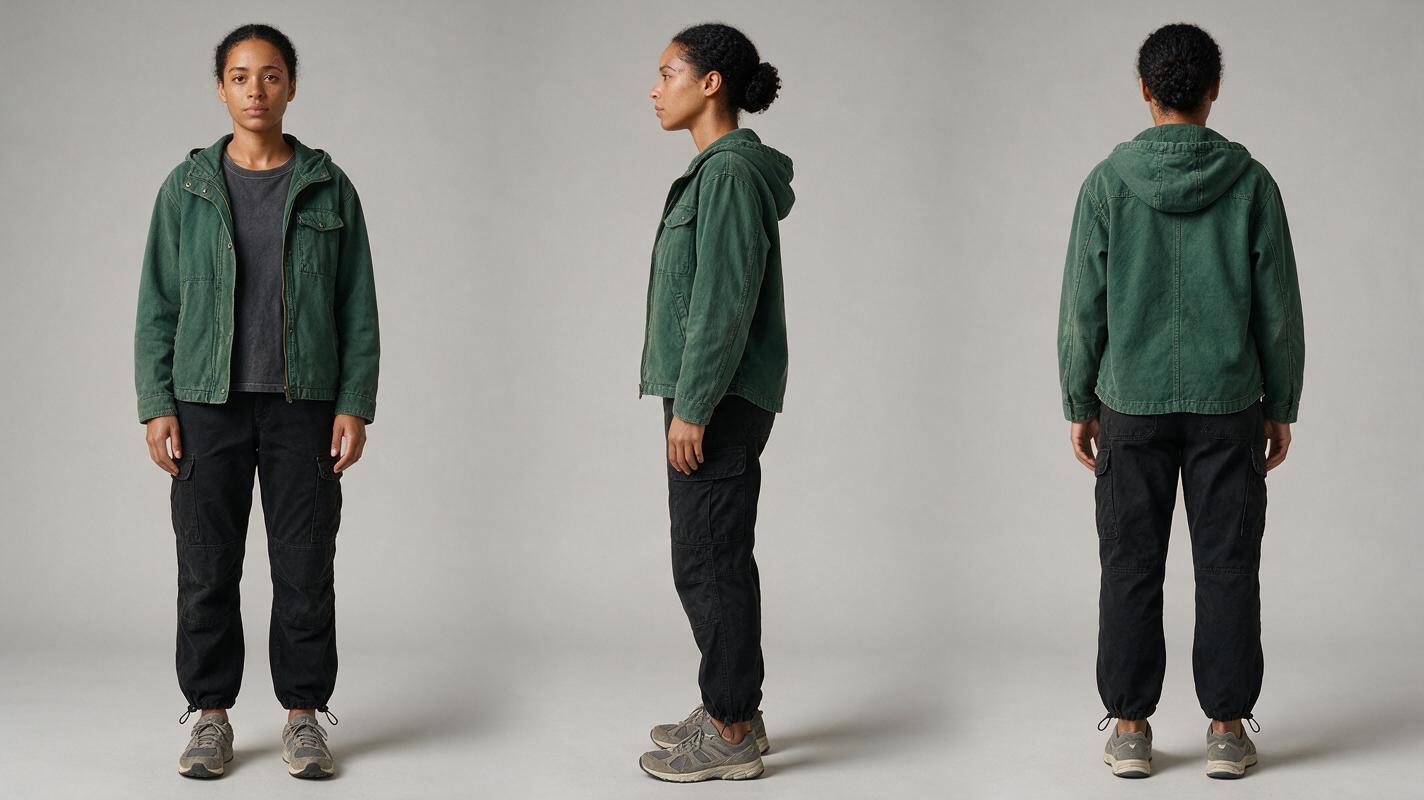
For example, test a vertical drama scene in which Mara, a bicycle courier, enters a neighborhood repair shop carrying a damaged package. The scene exposes identity drift, wardrobe continuity, hand-and-prop interaction, location stability, and dialogue coverage without requiring an entire episode.
Reusable visual prompt — character reference sheet:
Photorealistic three-panel character reference sheet of the same fictional woman, Mara, a 29-year-old bicycle courier with an oval face, warm brown skin, dark brown eyes, a small scar through the left eyebrow, and tightly curled black hair tied in a low bun. She wears a faded forest-green courier jacket over a charcoal T-shirt, straight black utility trousers, and worn gray sneakers. Show exact front, left-side profile, and back views at matching scale with identical clothing, hair, age, and facial structure. Neutral expression, arms relaxed, no props. MANDATORY CAMERA: eye-level orthographic character-reference framing with minimal perspective distortion. MANDATORY LAYOUT: three evenly spaced full-body panels in one landscape 16:9 frame. Neutral light-gray seamless studio background, soft diffused lighting, realistic skin and fabric, no text, no logos, no interface elements.Generate the character sheet before motion tests. Every shortlisted tool should receive the same reference, scene description, aspect ratio, shot duration, and motion instruction. This makes differences easier to diagnose.
Run one agency-grade pilot instead of a beauty test
The pilot should follow the path of a real assignment rather than rewarding the most attractive first render. Give each tool the same production package:
- Creative brief: audience, emotion, platform, forbidden imagery, and delivery format.
- Reference packet: approved character sheet, location frame, wardrobe facts, prop state, and palette.
- Shot request: framing, action, duration, camera behavior, and dialogue timing.
- Revision request: change one story fact while preserving everything else.
- Delivery request: export the approved result and record the settings, references, and usage status.
Reusable visual prompt — approved location anchor:
Cinematic editorial-realism establishing frame of a small lived-in neighborhood bicycle repair shop at late afternoon, scratched wooden service counter on the right, organized hand tools on a pegboard, two repaired bicycles hanging at the rear, narrow aisle through the center, rain-speckled street window on the left, warm practical pendant lights mixed with cool window light. Include no people so the frame can serve as a reusable location reference. MANDATORY CAMERA: true three-quarter view from the entrance at standing eye level, 28mm lens equivalent, straight vertical lines. MANDATORY LAYOUT: landscape 16:9 master frame with clear foreground, midground, and background depth; preserve an uncluttered central performance area. Photorealistic film still, believable wear, restrained color grade, no text, no logos, no UI.Score the result on production consequences rather than taste alone. Did the character remain recognizable? Could the director request a closer angle without changing the face? Did the prop stay in the correct hand? Could the team reproduce the shot after a client note?
A one-stop, multi-model environment can shorten this evaluation because the same brief can be tested across different generation approaches. At this point, agencies can try these models for free before opening an enterprise procurement process. The objective is not to select the prettiest isolated clip; it is to identify the most controllable route to approval.

Inspect licensing and brand safety at the contract level
“Commercial use” is not a complete agency licensing answer. The account owner should review the actual terms associated with the selected plan and document the result for each client.
- Who owns or may use the uploaded script, references, footage, and outputs?
- Can customer inputs or outputs be used for model training?
- Are confidentiality, retention, and deletion controls appropriate for unreleased campaigns?
- Does any indemnification apply to the selected plan, region, workflow, and output type?
- Are generated assets marked or accompanied by provenance information?
- Can the agency demonstrate permission for every uploaded face, voice, logo, product image, and style reference?
- Do subcontractors and client reviewers require separate seats or permissions?
Brand-safe production is a process, not a filter. It requires approved references, prohibited-content rules, human review, rights documentation, and a record of which output entered the final edit.
Design the batch pipeline before negotiating volume
Volume pricing matters only after the agency understands what consumes volume. Count exploratory generations, failed continuity attempts, client revisions, alternate aspect ratios, localization, lip-sync passes, and final upscales—not merely the number of delivered clips.
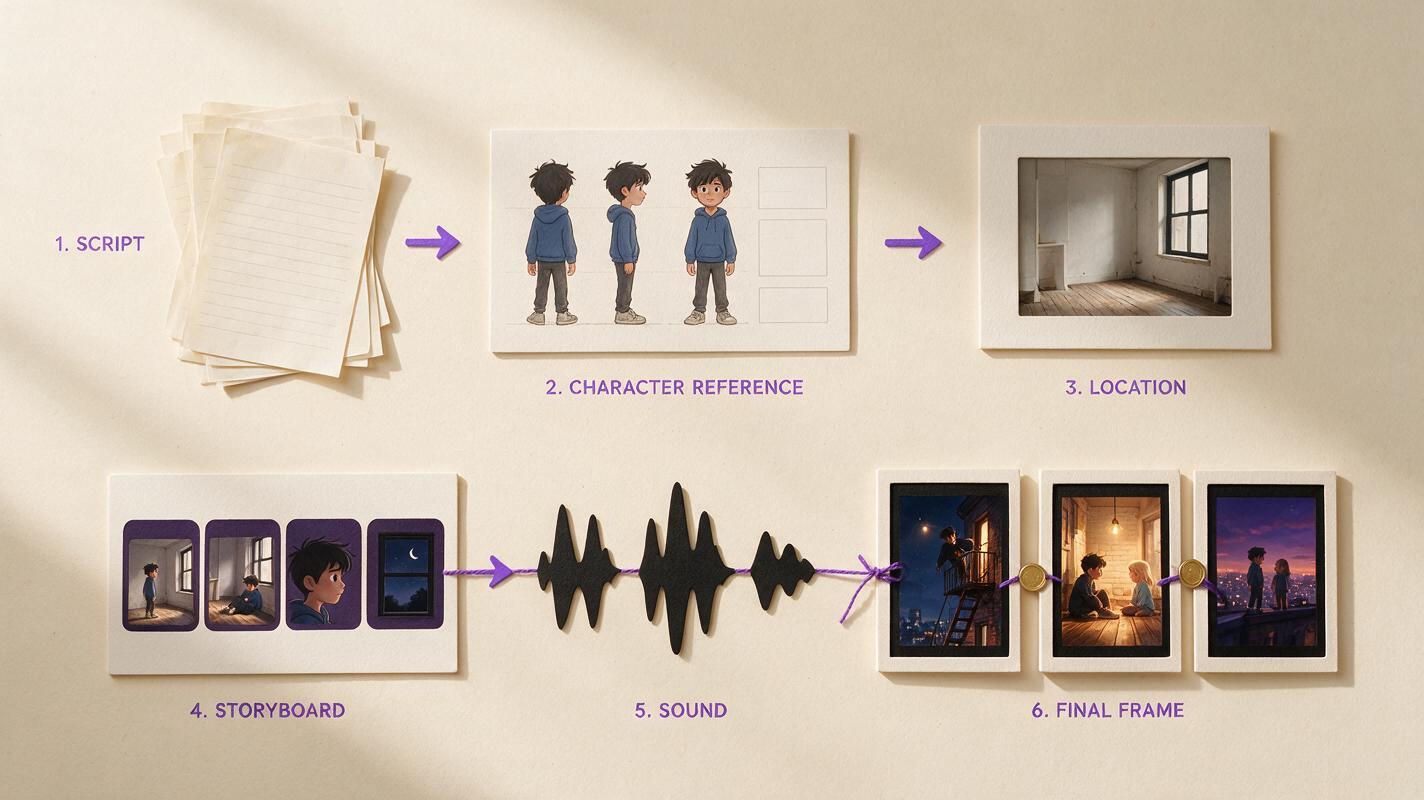
A reliable batch short drama production pipeline uses approval gates. Scripts are locked before reference generation; recurring assets are approved before motion; anchor frames are approved before full coverage; and final exports are separated from experiments. An ai video generator should enter the pipeline only after its responsibility and fallback route are clear.
Reusable visual prompt — neutral batch pipeline diagram:
Top-down editorial photograph arranged as a neutral production pipeline using physical objects only: a stack of blank script pages, a printed three-view character photograph, a printed empty-location film frame, four sequential cinematic shot thumbnails, a strip of audio waveform represented by raised black paper shapes, and three finished vertical video frames. Connect each group with simple purple thread and small unmarked circular approval tokens. MANDATORY CAMERA: exact overhead 90-degree view with no perspective tilt. MANDATORY LAYOUT: wide landscape 16:9 composition flowing clearly from left to right with six separated stages and generous negative space. Soft daylight, off-white tabletop, realistic paper texture, no readable text, no logos, no software UI, no brand marks.Ask vendors for a quote based on the pilot’s measured workload. Useful questions include:
- Are charges based on seats, credits, compute time, output length, resolution, API calls, or a combination?
- Can unused capacity roll over, and are failed jobs charged?
- What concurrency and rate limits apply during campaign peaks?
- Are development, preview, and final-generation workloads priced differently?
- Can usage be separated by client, team, or cost center?
- What support response and service commitments are available?
Require a workflow that survives handoffs
Agency work moves among strategists, writers, art directors, producers, editors, legal reviewers, and clients. A suitable tool must fit those handoffs without exposing confidential work or losing the recipe behind an approved shot.
At minimum, preserve a production record containing the prompt, model, generation date, reference assets, aspect ratio, output version, reviewer, rights status, and final-edit location. If the platform does not maintain all of this, store the missing information in the agency’s approved project system.
Keep experimentation and delivery separate. Directors may need broad access to test visual options, while account and client teams should see only reviewed outputs. Final delivery folders should never become prompt-testing areas.
FAQ
Is one AI video tool enough for an agency?
It can be enough for a narrow service, but mixed client work usually benefits from a stack. Generation, governance, automation, review, audio, and delivery often require different strengths.
Which option is best for an AI microdrama?
Choose the option that performs best on recurring identity, shot revision, image references, vertical framing, and episodic asset reuse. Test those requirements with one short pilot rather than relying on a general showreel.
Should an agency prioritize an interface or an API?
An interface is practical for director-led experimentation and small teams. An API becomes more valuable when the agency needs automated variants, client-specific queues, repeatable metadata, or integration with internal systems. Many agencies need both.
How should agencies compare volume pricing?
Measure the full pilot workload, including rejected generations and revisions, and request quotes against that usage pattern. Comparing only the advertised unit price can hide the cost of retries, concurrency limits, storage, and specialist labor.
Can AI-generated footage be delivered to clients without human review?
That is risky. A reviewer should inspect identity, product accuracy, prohibited content, intellectual-property concerns, disclosure requirements, continuity, audio, and technical delivery before client release.
Sources
- Adobe Firefly for Enterprise
- Runway Enterprise
- Google Cloud: Generate videos with Veo on Vertex AI
- Luma Dream Machine API
- Canva Enterprise
Final checklist
- Define the tool’s production responsibility before comparing features.
- Test one recurring character, controlled location, prop interaction, and revision.
- Confirm current commercial terms, privacy controls, and regional availability.
- Calculate volume from total attempts and revisions, not final clips alone.
- Require reproducible generation records and permission-based team access.
- Separate experimental outputs from client-approved delivery assets.
- Keep a fallback model or manual repair path for critical shots.
Keywords
ai short drama, ai microdrama, ai short film generator, ai drama generator, ai series video, batch short drama production, vertical drama video