AI Anime Expression Sheet Prompts That Keep Faces Consistent
Create an anime character expression sheet without changing the face, hairstyle, costume, or drawing style between cells. This guide provides a reference-first Nano Banana Pro workflow, reusable prompts, and practical checks for catching identity drift.
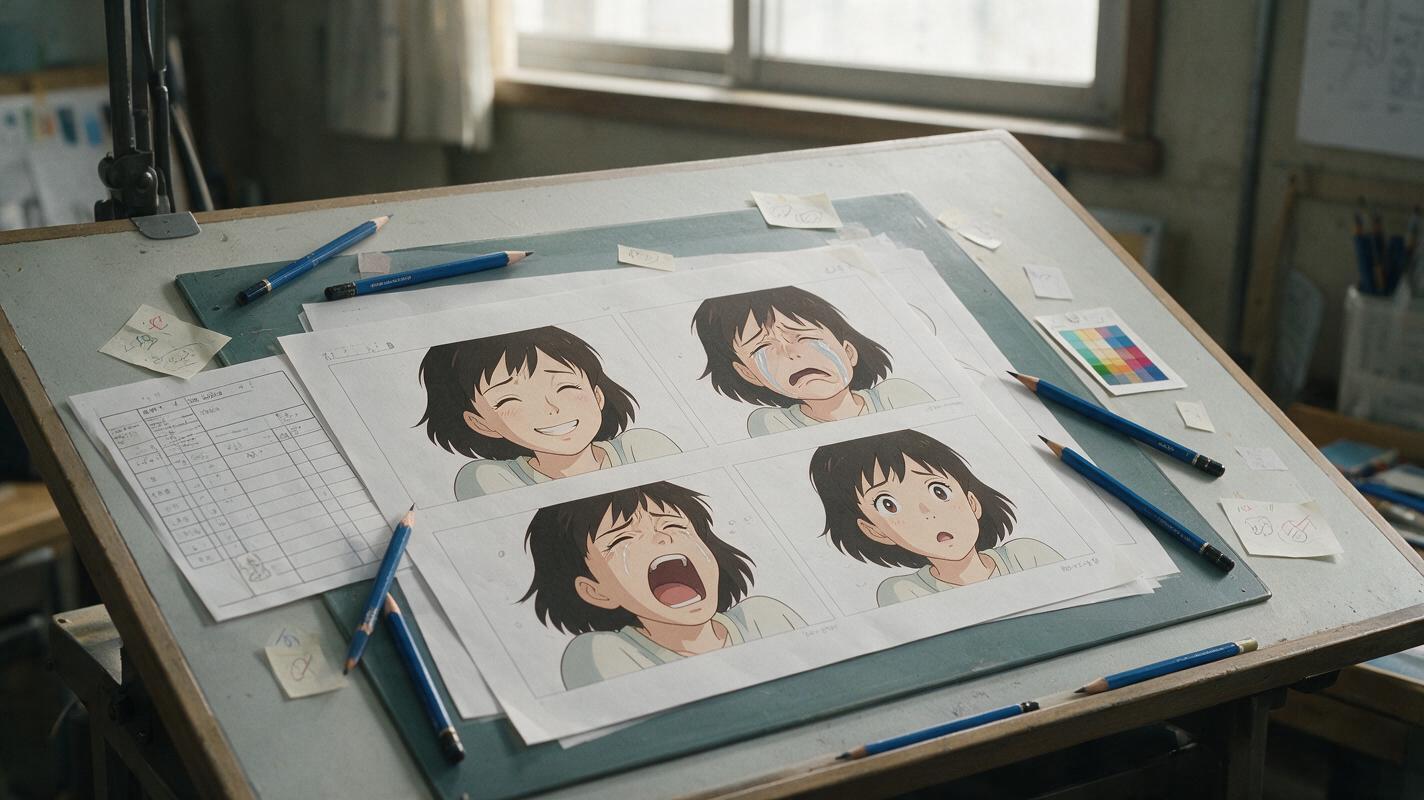
Table of contents
Build an Expression Sheet Without Redesigning the Character
An AI-generated expression sheet can fail even when every individual face looks attractive. The eye spacing changes, the bangs move, the jaw becomes narrower, or an angry expression suddenly resembles a different character. The solution is to treat the sheet as a controlled acting study built from one approved identity—not as a collection of unrelated portraits.
This workflow uses nano banana pro with a character reference, a fixed visual specification, and expression prompts that describe facial movement rather than asking the model to reinterpret the character. The result is a sheet that can support manga panels, storyboards, visual novels, model sheets, and animation planning.
The core rule: identity remains fixed while only the acting variables change.
Choose a Reference That Clearly Defines the Face
Start with one clean, approved image rather than several references with conflicting proportions. A front-facing or slight three-quarter portrait usually provides the most useful information about the eyes, brows, nose, mouth, jaw, hairline, and accessories.
The reference should have:
- A neutral or restrained expression
- Both eyes visible and unobstructed
- A clearly readable hair silhouette
- Even lighting without strong colored shadows
- Enough resolution to show iris, eyelash, and accessory details
- No hand, speech bubble, particle effect, or foreground object covering the face
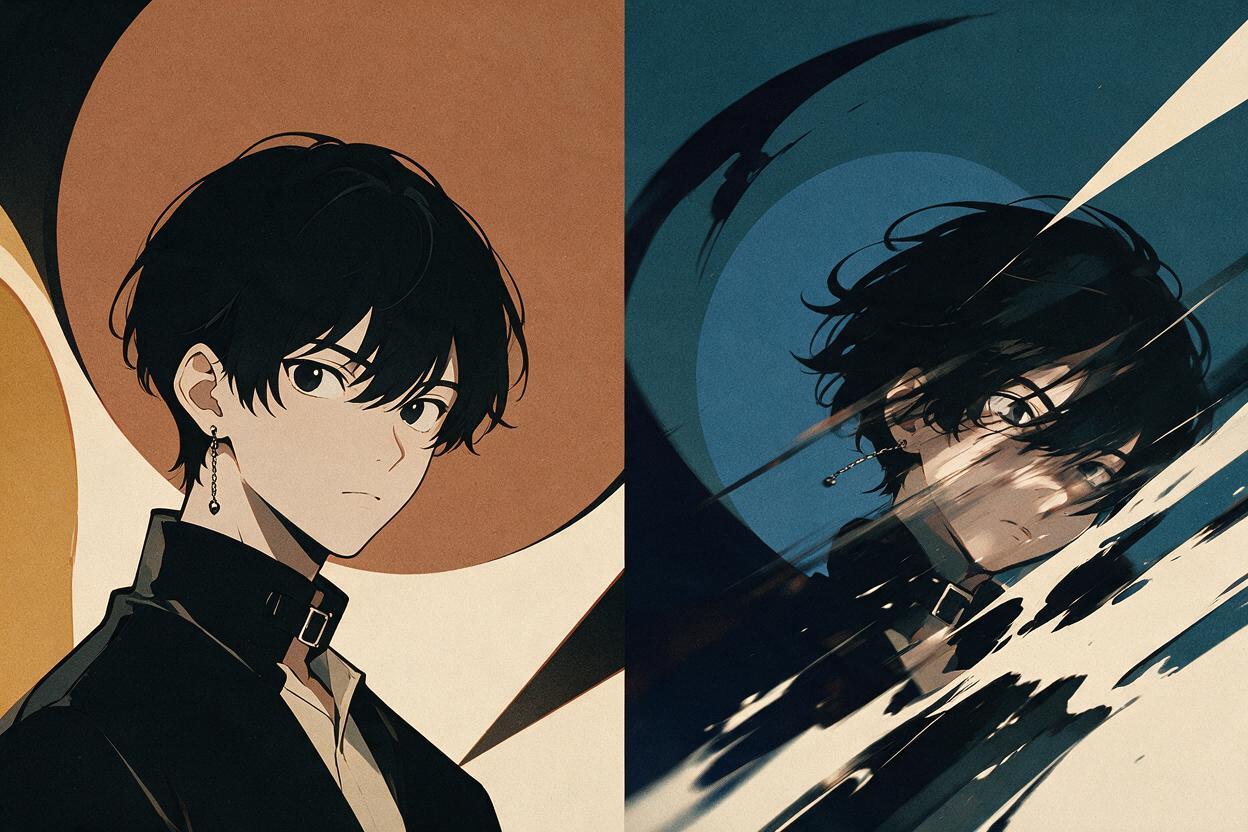
Avoid using a dramatic action frame as the only identity reference. Foreshortening, motion blur, extreme perspective, and open-mouth shouting can make it difficult to determine the character's neutral proportions.
Write an Identity Lock Before Naming Expressions
An expression label such as angry or surprised leaves too much open to interpretation. Before describing emotion, record the character traits that must survive every cell. This identity lock should be short enough to repeat without introducing contradictions.
Same character in every cell.
Preserve the exact face shape, eye size and spacing, iris design, eyebrows,
nose placement, mouth width, ears, hairline, bangs, side locks, hairstyle,
hair color, skin tone, costume collar, earrings, and line-art style.
Do not beautify, age, redesign, or change the camera angle.
Use specific visual facts instead of vague praise. “Two triangular hair gaps above the left eyebrow” is more useful than “beautiful detailed bangs.” “One gold hoop earring on the right ear” is more reliable than “fashionable accessories.”
If the character came from an ai image generator, save the original image and the identity lock together. They form the canonical package for later illustrations, storyboard frames, and animation inputs.
Describe Facial Mechanics, Not Just Emotional Labels
The most controllable prompts explain what the brows, eyelids, pupils, cheeks, jaw, and mouth are doing. This keeps the request focused on acting while reducing the chance that the model will invent a new face.
| Expression | Useful facial mechanics | Common drift risk |
|---|---|---|
| Joy | Cheeks lift, lower eyelids rise slightly, mouth corners move upward | Eyes become a different shape or disappear completely |
| Anger | Inner brows lower, upper eyelids tighten, jaw sets, lips compress | Jaw grows wider and eyebrows become thicker |
| Fear | Brows lift and draw together, upper eyelids open, lower lip tenses | Iris size, face length, and hairstyle change |
| Disgust | Nose subtly wrinkles, one mouth corner lifts, eyes narrow unevenly | Asymmetry alters the underlying facial structure |
| Sadness | Inner brows rise, gaze lowers, mouth corners fall gently | The character becomes younger or gains oversized watery eyes |
| Shock | Eyes open wider, pupils remain consistent, jaw drops vertically | Mouth becomes too large and stretches the entire lower face |
Strong emotions do not always require maximum deformation. For animation-ready material, a moderate expression often preserves identity better and leaves room for an animator to push the pose later.
Use a Grid Prompt With Controlled Variables
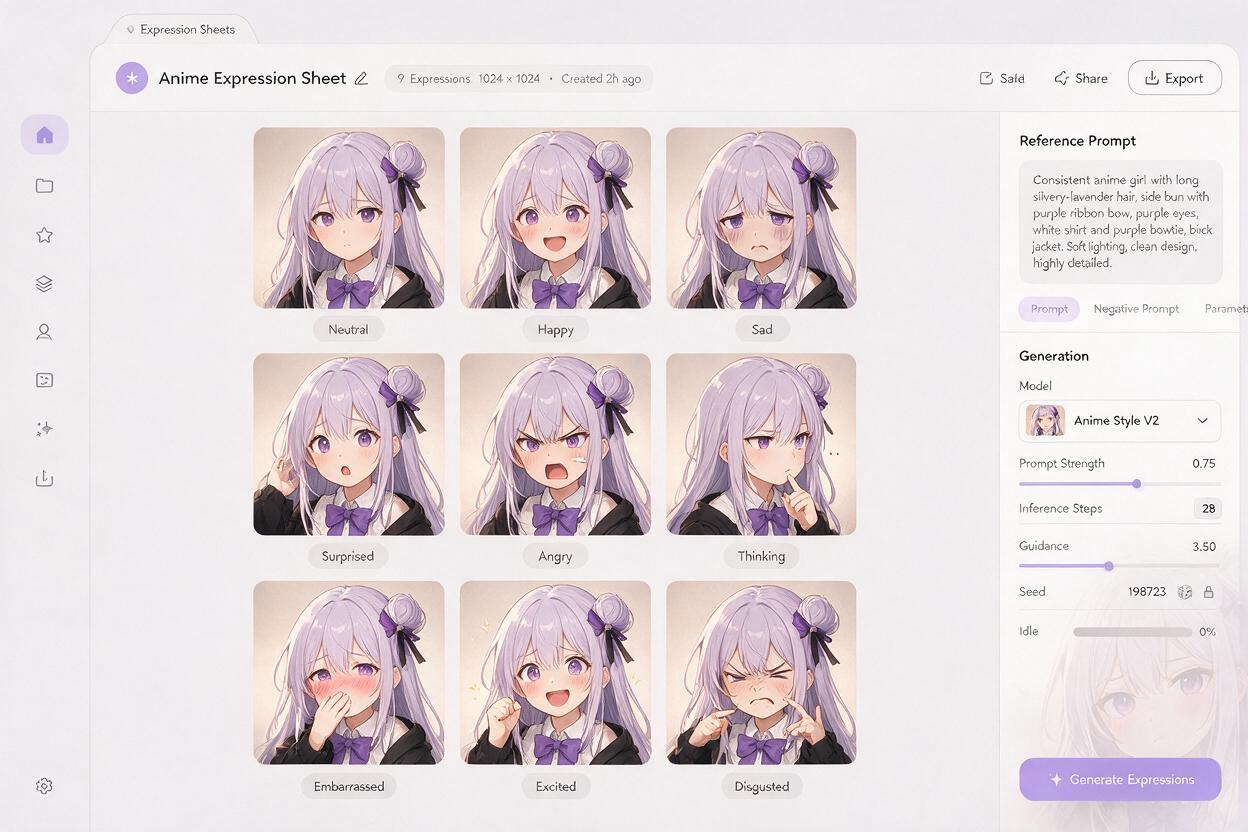
A contact sheet makes differences easier to compare, but the grid itself needs constraints. Ask for equal cell sizes, one repeated camera angle, consistent lighting, and no decorative elements crossing cell boundaries.
Create a clean 3-by-3 anime character expression sheet using the supplied
character reference as the fixed identity source.

Every cell shows the same head-and-shoulders framing, front three-quarter view,
neutral camera height, identical hairstyle, costume, accessories, proportions,
line weight, colors, and lighting.

Expressions by cell:
neutral; small genuine smile; restrained laughter;
concern; sadness; controlled anger;
fear; surprise; determined resolve.

Change only the facial acting and minimal head inclination.
Keep eye spacing, iris design, jaw shape, mouth width, bangs, hair volume,
and costume collar unchanged. Plain light background, equal margins,
no labels over the face, no extra characters, no duplicated facial features.
Generate a restrained first pass. If the nine-cell request produces drift, reduce the batch to three related expressions. A neutral face, small smile, and restrained laugh form one useful group; concern, sadness, and fear form another. Smaller groups give the model fewer simultaneous transformations to solve.
Build Expression Families From a Neutral Anchor
Expressions are easier to control when they progress from a stable anchor. Instead of jumping directly from neutral to extreme rage, create an acting family with increasing intensity.
Controlled anger family
Produce three matched portraits of the referenced anime character:
restrained irritation, controlled anger, and intense anger.
Preserve the same facial anatomy and head angle in all portraits.
Increase emotion through brow compression, eyelid tension, nostril tension,
and jaw pressure. Do not enlarge the jaw, thicken the neck, alter the eyes,
expose excessive teeth, or change the hairstyle.
Sadness family
Produce three matched portraits of the referenced anime character:
quiet disappointment, visible sadness, and near tears.
Keep the same iris pattern, eye size, nose, jaw, mouth width, bangs, and costume.
Build intensity through the inner eyebrows, softened eyelids, lowered gaze,
and subtle lip tension. Tears appear only in the final portrait.
Comedy reaction family
Create three escalating comedic reactions for the same anime character:
mild confusion, flustered disbelief, and exaggerated comic shock.
Preserve recognizable identity and costume in every image.
Stylization may increase, but retain the canonical hair silhouette, eye color,
face outline, signature accessory, and line-art language.
The comedy family can tolerate more graphic exaggeration, but it should still preserve several identity anchors. Hair silhouette, color blocking, signature accessories, and recognizable eye design can keep a simplified reaction face connected to the original character.
Separate Head Motion From Facial Acting
Expression sheets become harder to evaluate when each cell also changes perspective. A tilted head can alter apparent eye height, jaw width, ear position, and bang placement even when the underlying design is correct.
For a facial acting sheet, keep head rotation within a narrow range. Build a separate turnaround for front, profile, three-quarter, and rear views. Combining expressions and full rotations in one generation asks the model to solve two continuity problems at once.
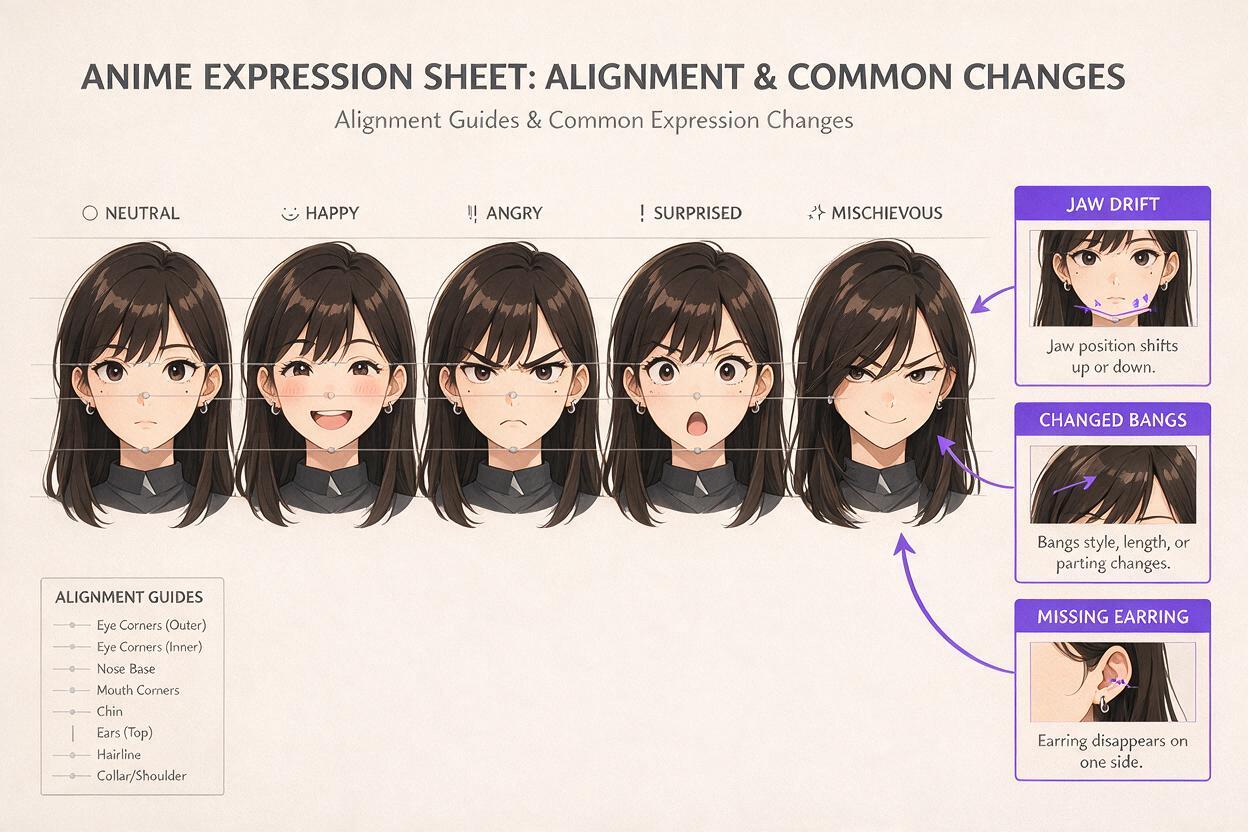
If a cell feels wrong, compare the neutral landmarks first: outer eye corners, nose base, mouth corners, chin, ears, hairline, and collar. Evaluate the emotion only after those landmarks match.
Repair the Weak Cell Instead of Regenerating Everything
A strong sheet may contain one weak result: perhaps the angry face has a different chin, or the surprised face loses an earring. Do not discard eight usable cells. Crop or select the faulty cell and request a localized correction using the approved neutral portrait and neighboring cells as references.
Repair only the selected expression cell.
Match the character identity shown in the neutral reference and adjacent cells.
Restore the canonical jaw width, iris pattern, left bang shape, right-ear hoop,
and costume collar. Preserve the current controlled-angry expression,
composition, background, lighting, and line-art style.
Do not modify any other cell.
Correct one category at a time. First repair anatomy and identity, then hair or accessories, and finally minor color or line inconsistencies. A long repair request that changes every detail can replace the original problem with several new ones.
Check Consistency at Thumbnail and Close Range
Inspect the finished sheet at two scales. At thumbnail size, the same character should remain recognizable through silhouette, color distribution, hairstyle, and costume shape. At close range, verify facial landmarks and small canonical details.
Use this comparison order:
- Face structure: jaw, chin, cheek width, ear height, and nose placement
- Eyes: spacing, iris color, highlights, lashes, and pupil proportions
- Hair: hairline, bang divisions, side locks, volume, and parting
- Costume: neckline, collar shape, fasteners, trim, and accessories
- Rendering: line weight, shadow hardness, palette, and highlight style
- Acting: whether the expression reads without changing identity
Overlaying a low-opacity neutral face on each cell can reveal hidden drift. The features do not need to occupy identical coordinates when muscles move, but structural landmarks should remain plausible.
Prepare the Sheet for Animation and Storyboarding
Once approved, export individual expressions at matching dimensions. Keep transparent versions if the faces will be composited into dialogue boards, visual novel sprites, or limited-animation shots. Use simple filenames such as character-neutral, character-concerned, and character-angry-medium.
Also retain the full contact sheet. It gives collaborators a shared acting vocabulary and helps prevent inconsistent requests such as “make the character more emotional” without defining the intended intensity.
When an expression will become an animated shot, choose the nearest approved cell as the starting image. Motion generation should add blinking, breathing, gaze movement, and mouth action without redesigning the face already established here.
Final Checklist
- Use one clean, approved identity reference.
- Write fixed facial, hair, costume, and style traits before adding emotion.
- Describe brows, eyelids, cheeks, jaw, and mouth mechanics.
- Keep camera angle, framing, lighting, and background consistent.
- Generate related expression families when a large grid drifts.
- Separate facial acting studies from character turnarounds.
- Repair individual cells instead of regenerating a successful sheet.
- Inspect silhouette consistency and close facial landmarks.
Ready to build a reusable acting reference for your character? try this prompt for free and begin with a neutral portrait plus three restrained expressions.
Keywords
anime expression sheet, consistent anime character, anime character consistency, Nano Banana Pro, anime AI generator, character reference sheet, anime face prompts