Why AI Anime Hair Motion Melts—and How to Keep It on Model
AI-generated anime hair often stretches, fuses, or changes shape when a character moves. This guide explains how to use Kling with restrained motion prompts, stable source art, and targeted repairs to animate hair while preserving the original character design.
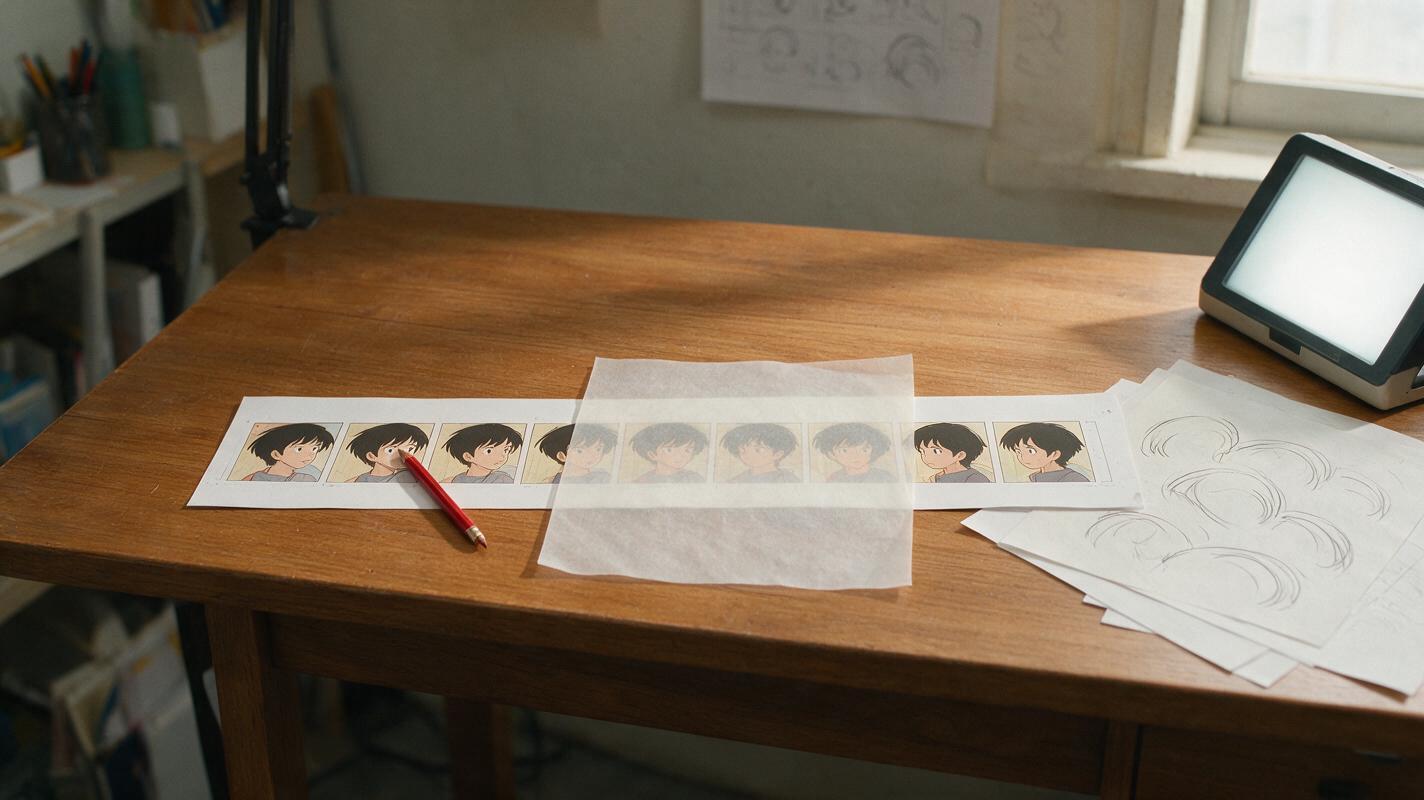
Table of contents
Keep Anime Hair Moving Without Redesigning the Character
Your anime character turns toward the camera, but the hairstyle does not follow. Bangs melt into the forehead, side locks change length, and carefully drawn spikes become soft ribbons. The problem is rarely solved by adding more visual detail to the prompt. Stable hair animation depends on a readable source image, a restrained motion plan, and clear separation between rigid hair masses and flexible tips.
This troubleshooting workflow uses Kling for image to video, but the underlying method applies to most reference-based video models. The goal is not physically perfect hair simulation. It is a short anime shot in which the hairstyle remains recognizable from beginning to end.
Why anime hair melts during AI animation
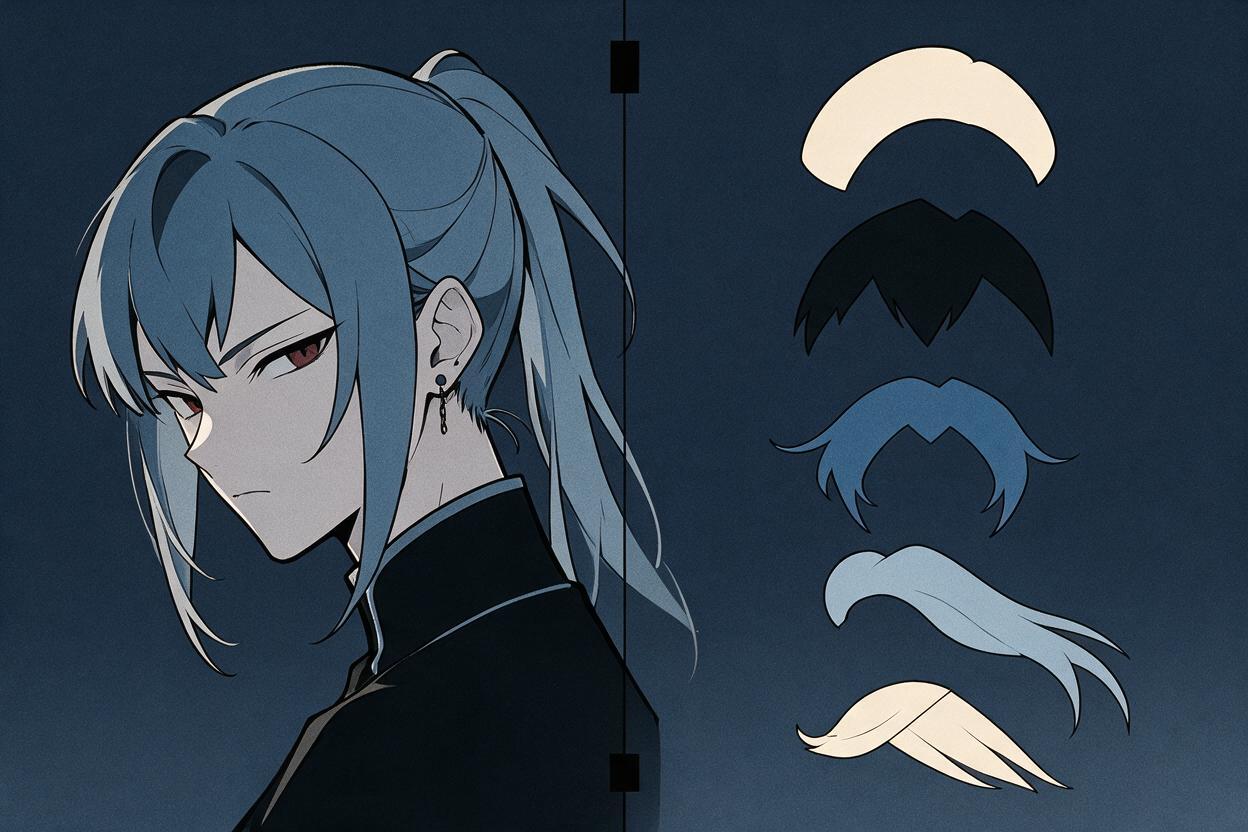
A hairstyle that looks simple to a viewer may contain several competing structures: bangs crossing the face, spikes forming the silhouette, side locks overlapping the neck, and back hair disappearing behind the shoulders. A video model must infer which shapes belong together and how each one should respond to movement.
Hair drift becomes more likely when the prompt requests several large actions at once. A head turn, body rotation, strong wind, moving camera, blinking eyes, and flying hair all compete for the same frames. The model may preserve the general impression of “anime hair” while losing the exact design.
| Visible failure | Likely cause | Safer correction |
|---|---|---|
| Bangs merge with the eyebrows | Face movement and fringe movement overlap | Reduce head rotation and request minimal fringe motion |
| Hair grows between frames | Loose prompts such as “flowing dramatically” | Define fixed length and movement at the tips only |
| Spikes become rounded | Strong wind affects the entire silhouette | Keep major spikes rigid and move smaller strands |
| Side locks swap position | Ambiguous overlap around the cheeks and neck | Use a cleaner reference or repair the overlap before animation |
| Hair and background blend together | Similar values or busy texture behind the silhouette | Increase edge contrast in the source image |
Choose a source image with separable hair masses
Start with artwork that makes the hairstyle easy to parse. A three-quarter portrait often works better than a full profile because both the face and the outer hair silhouette remain visible. Keep the character large enough that individual locks are not reduced to a few pixels.
A strong source image should have:
- A complete outer silhouette: avoid cropping the top spikes, ponytail, or long back hair.
- Clear value separation: dark hair should not disappear into a dark wall or jacket.
- Readable overlaps: show whether each side lock sits in front of or behind the shoulder.
- Consistent line weight: blurry edges encourage the model to reinterpret strand boundaries.
- A neutral starting pose: extreme foreshortening makes length and attachment points harder to preserve.
Useful rule: if you cannot trace the major hair masses quickly at thumbnail size, the video model will probably struggle to keep them stable in motion.
Before generating video, repair tangencies where bangs touch eyelashes, hair tips meet clothing seams, or a ponytail blends into the background. Even a narrow strip of contrasting color can clarify which object should move independently.
Divide the hairstyle into rigid and flexible zones
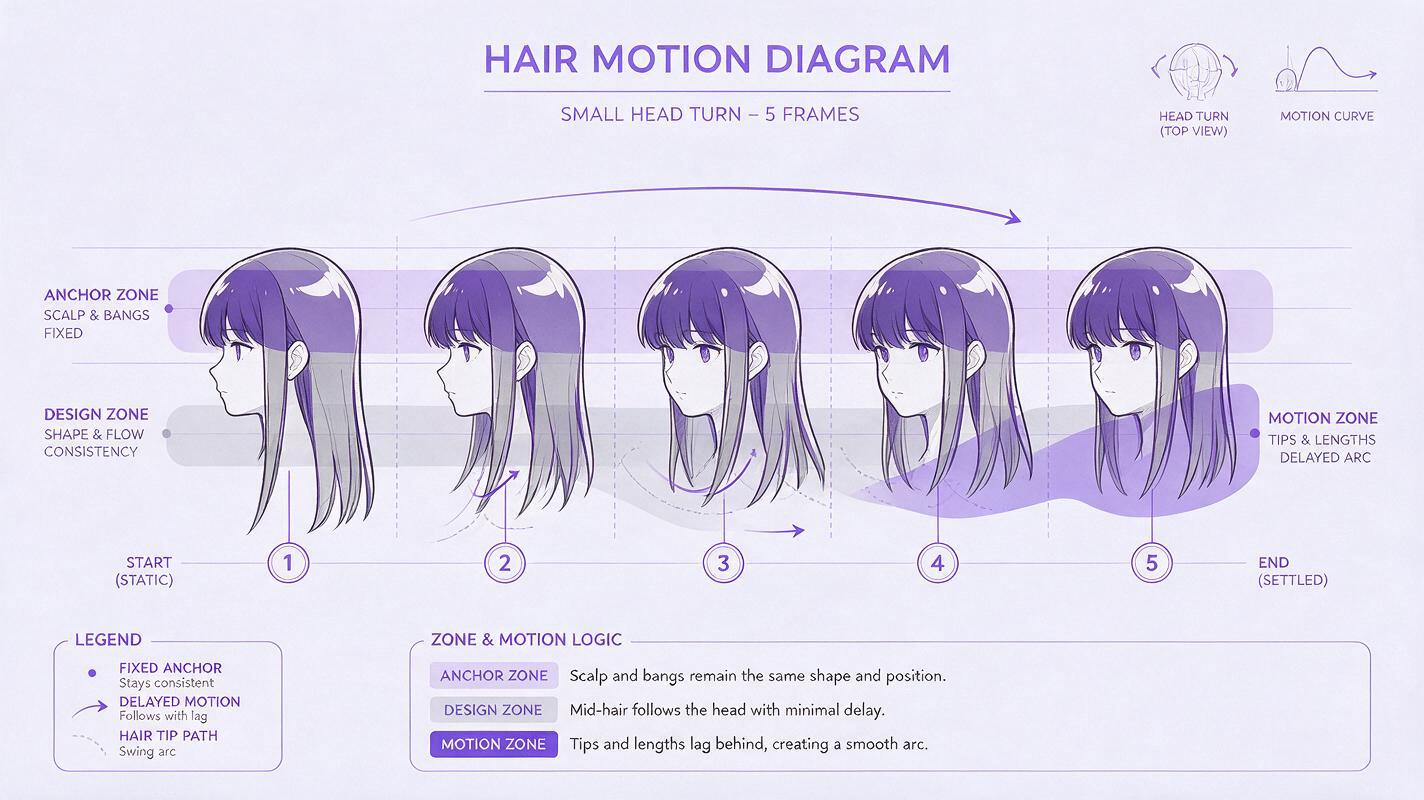
Do not treat the whole hairstyle as one soft object. Anime designs often depend on graphic shapes that should remain almost rigid. Identify three functional zones before writing the prompt:
- Anchor zone: roots, crown, hairline, and attachment points that should remain locked to the head.
- Design zone: signature bangs, large spikes, buns, braids, or loops that define the character.
- Motion zone: loose tips, small flyaways, ribbon ends, and the bottom section of long hair.
The anchor and design zones preserve identity. Most visible secondary motion should occur in the motion zone. For long hair, allow a gentle delayed sway through the lower third rather than bending the entire length from the scalp.
This division also improves artistic direction. “Hair moves in the wind” is open-ended. “Roots and bangs remain fixed while the lower ponytail trails slightly behind the head turn” gives the model a hierarchy.
Write motion as layered physics, not a beauty description
A useful Kling prompt describes the character action first, the hair response second, and the locked elements last. Keep the shot short and assign only one dominant action.
Anime close-up, fixed camera. The character slowly turns their head a few degrees toward camera. The hairstyle keeps the exact original silhouette, length, color, bangs, side locks, and pointed tips. Only the loose hair ends show a small delayed sway, settling naturally after the head stops. Face, eyes, costume, line art, and background remain unchanged. Restrained 2D anime motion, no dramatic wind.The phrase “delayed sway” establishes cause and effect: the head moves first, then the flexible ends follow. The stability instructions identify what must not be redesigned. This is more useful than filling the prompt with style adjectives such as “beautiful,” “cinematic,” or “highly detailed.”
For a wind shot, define direction and intensity without asking for constant turbulence:
Static anime portrait with a light breeze moving from screen right to screen left. Small flyaway strands and the lower hair tips drift gently in one direction, then ease back slightly. The crown, bangs, facial framing locks, and main hairstyle silhouette remain fixed. No hair growth, no new strands, no face deformation, no camera movement.Negative instructions can reinforce the boundary, but they cannot rescue an overloaded action. If the first test still changes the design, reduce head movement, wind strength, or camera motion rather than adding a longer list of prohibitions.
Control one source of motion per test
Generate diagnostic tests before attempting the final shot. First test the character with a fixed camera and no wind. Then test wind on a static character. Only combine the actions after both versions preserve the hairstyle.
| Test clip | Character action | Hair action | What it reveals |
|---|---|---|---|
| Identity test | None | Minimal tip movement | Whether the model can hold the original design |
| Head-motion test | Small turn or tilt | Delayed lower-strand sway | Whether roots remain attached correctly |
| Wind test | None | Low-amplitude directional drift | Whether the silhouette survives secondary motion |
| Combined shot | One restrained action | Previously tested response | Whether the motions can coexist |
Review the first, middle, and final frames rather than judging only playback. A clip can feel smooth at normal speed while hiding a one-frame spike mutation or a side lock that briefly crosses the eye.
Match hair response to the character action
Different actions need different secondary motion. Reusing a generic flowing-hair prompt makes the character appear underwater or exposed to wind that does not affect anything else in the scene.
Small head turn
Keep the bangs close to the face. Let long hair trail by a fraction of the head movement and settle after the turn. Avoid a full side-to-side swing.
Sudden stop
The head and torso stop first. A ponytail or long back section can overshoot once, then return toward rest. One readable follow-through is safer than repeated oscillation.
Upward jump
Hair may lag downward during acceleration and lift slightly near the apex. Preserve attachment points and avoid asking every strand to move separately.
Light environmental breeze
Use low-amplitude movement in small flyaways, ribbons, and tips. If the background contains grass, curtains, or particles, make their direction agree with the hair.
Repair local failures instead of regenerating the shot
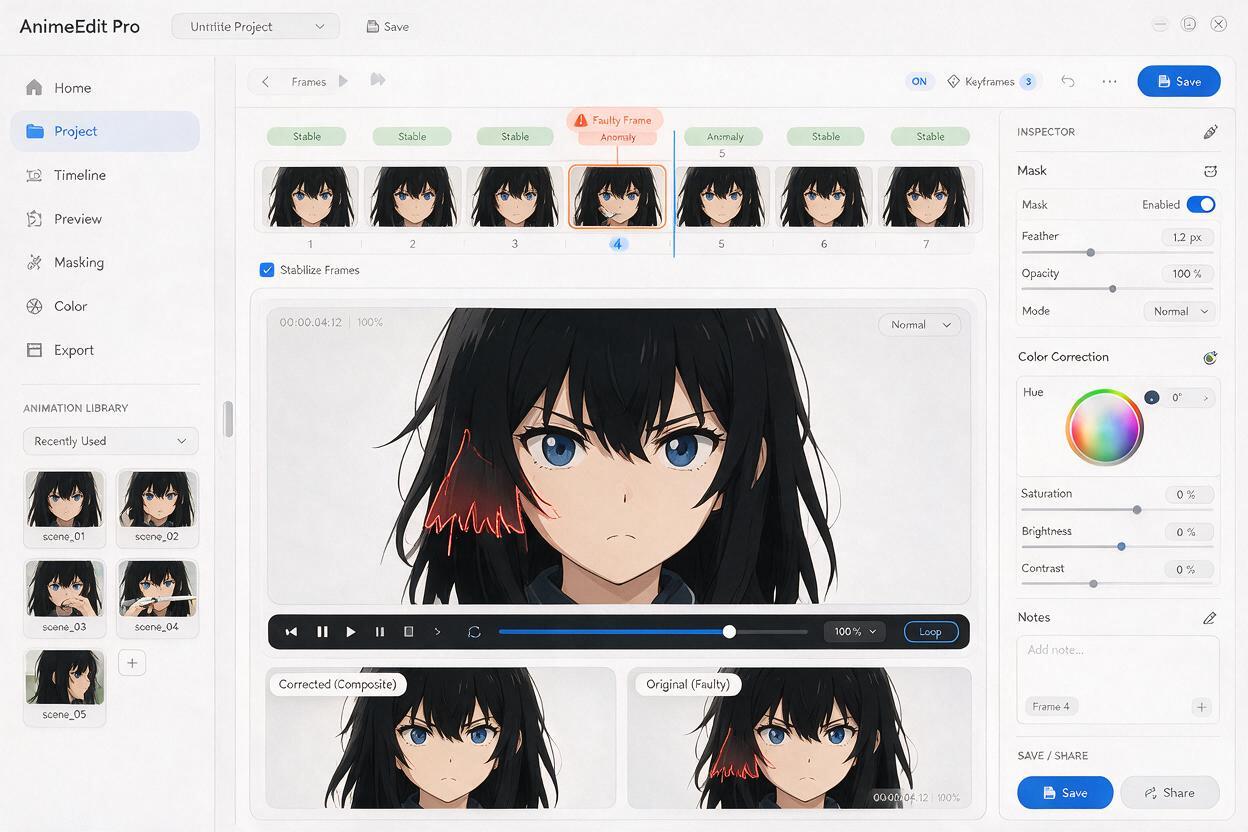
If most of the clip works, do not discard it because of a brief hair defect. Locate the first unstable frame and determine whether the error is limited to the hair, extends into the face, or changes the entire silhouette.
- Single-frame wobble: replace or interpolate the damaged frame using neighboring stable frames.
- Melting bangs: redraw the fringe and forehead boundary on the affected frames.
- Changing hair length: create a mask around the tips and composite a corrected pass over the original clip.
- Unstable face and hair together: return to the source image and simplify the head motion.
- Incorrect wind direction: regenerate the motion pass with one explicit screen direction.
For difficult shots, separate the production into two passes: a stable character pass with minimal hair movement and a secondary pass focused on hair tips or accessories. Composite only the useful moving region. This preserves the face and costume while allowing more freedom in the flexible areas.
Final checklist
- The complete hairstyle silhouette is visible in the source image.
- Hair edges are clearly separated from the face, costume, and background.
- Roots and signature design elements are treated as rigid zones.
- The prompt contains one dominant character action.
- Hair movement follows that action with a small delay.
- Camera movement and strong wind are not competing with the character.
- The first, middle, and final frames preserve length, color, and attachment points.
- Local defects are repaired instead of forcing a full regeneration.
Once your source art and motion hierarchy are ready, try these models for free and compare short restrained tests before generating the final anime shot.
Keywords
anime hair animation, animate anime image, anime image to video, Kling anime, character consistency, 2D animation AI, anime motion prompts