Anime Opening Song Prompts for Intros, Battles, and Reveals
Create anime opening music that supports character reveals, fight cuts, title cards, and emotional turns instead of producing a directionless track. These reusable prompts and beat-mapping methods help anime creators generate music with a clear arc and translate it into an editable opening sequence.
Table of contents
Create Music That Gives Every Opening Shot a Purpose
An anime opening song needs more than energy. It must leave room for the protagonist reveal, cast montage, conflict escalation, title card, and final visual hook. A vague request for “epic anime music” often produces a track with no useful edit points. The prompts below define musical progression, contrast, vocal character, instrumentation, and ending behavior so the result can guide an actual opening sequence.
Write the song prompt as an editing brief: describe where the track begins, how it develops, what changes at the climax, and how the final phrase resolves.
Build the Song Around Visual Editing Beats
Begin in ai music generator with a visual plan rather than a genre label alone. You do not need every shot finished, but you should know the major events that the song must support.
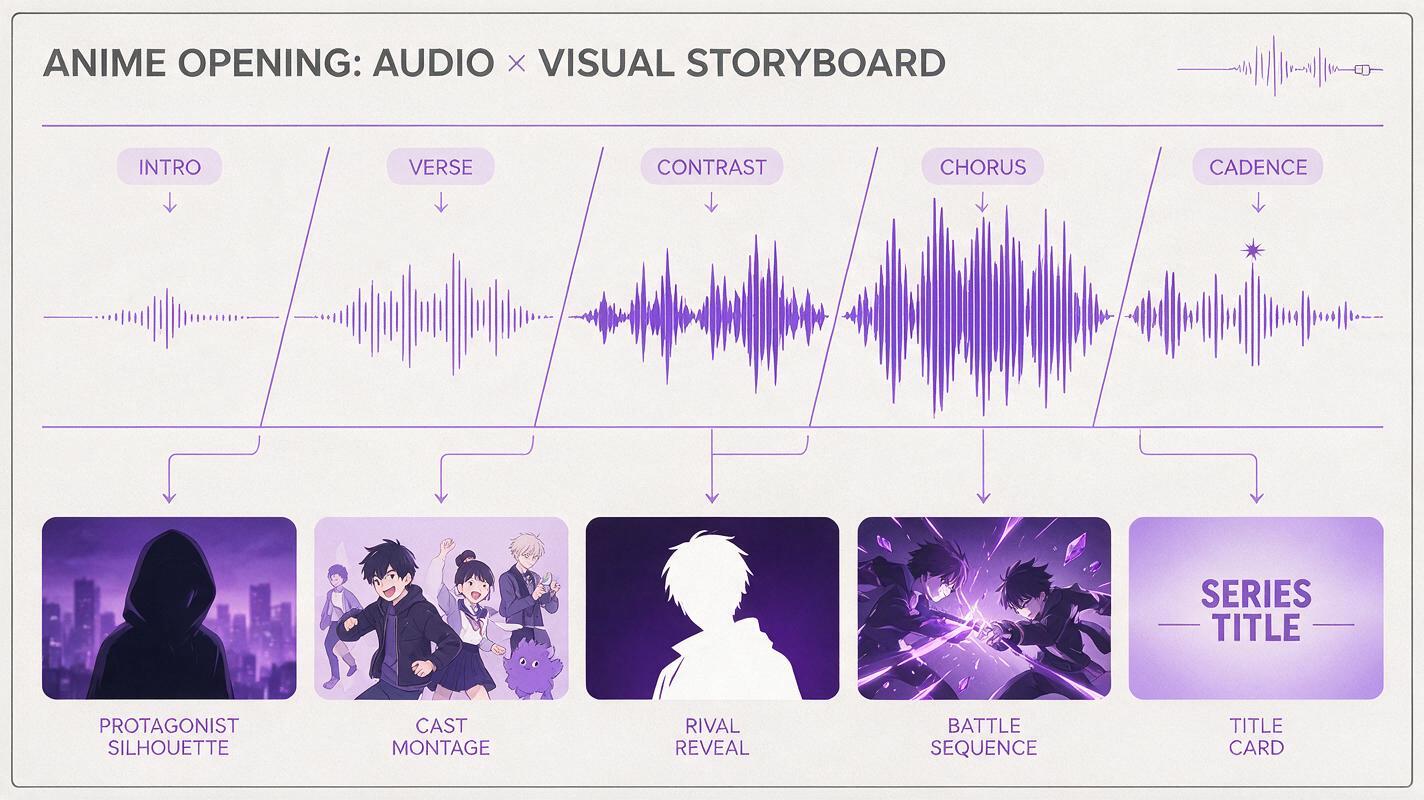
A practical opening arc might contain a restrained introduction, an accelerating character section, a contrasting emotional phrase, a large chorus, and a decisive ending. These are creative regions, not mandatory timestamps. Adjust their length to match your intended edit.
| Music region | Possible visual function | Useful prompt language |
|---|---|---|
| Opening phrase | World, symbol, silhouette, or protagonist close-up | Restrained entrance, isolated motif, immediate identity |
| Rising verse | Supporting cast and everyday setting | Gradual rhythmic build, added layers, forward momentum |
| Contrast passage | Rival, memory, loss, or hidden threat | Brief harmonic tension, reduced percussion, darker texture |
| Main chorus | Fight montage, transformation, or team reveal | Full arrangement, memorable lead line, strong downbeats |
| Final cadence | Logo, hero pose, unresolved antagonist, or episode title | Clean final accent, sustained finish, no long fade |
Give the generator one dominant direction. Combining orchestral battle music, soft bedroom pop, jazz fusion, metal, chiptune, and traditional instruments in a single short prompt usually weakens the hierarchy. Choose a primary genre, then add one contrasting color with a clear purpose.
Use a Prompt Structure That Controls the Arc
A useful song prompt can be assembled from six components: narrative role, primary genre, tempo feel, instrumentation, structural progression, and ending behavior. Lyrics or vocal qualities can be added only when the opening genuinely needs them.
Create an original anime opening theme for [story premise or emotional conflict].
Primary direction: [genre and energy].
Tempo feel: [driving, restrained, urgent, swinging, half-time, accelerating].
Instrumentation: [three to five defining elements].
Structure: begin with [opening texture], build through [development], briefly contrast with [emotional change], then reach [chorus character].
Editing cues: clear accents for [character reveal, impact montage, title card].
Ending: [hard stop, sustained chord, final drum accent, unresolved note].
Avoid: [unwanted mood, excessive intro, weak fade, constant intensity].
Replace abstract praise words such as “amazing” or “cinematic” with audible behavior. “Percussion enters after the isolated guitar motif” gives the model a more concrete relationship than “make it incredibly epic.”
Reusable Anime Opening Song Prompts
Heroic action opening with a clean chorus lift
Create an original high-energy anime opening theme about a young fighter choosing courage despite fear. Use driving rock as the primary direction, with bright electric guitar, tight live-style drums, melodic bass, and a restrained orchestral layer. Begin with a short recognizable guitar motif, add percussion quickly, and build through an urgent verse. Insert a brief lower-intensity passage suggesting doubt, then launch into a wide, triumphant chorus with clear downbeats for team attacks and character reveals. Finish with one decisive ensemble accent rather than a fade. Avoid nonstop maximum intensity and avoid an overly long instrumental introduction.Supernatural mystery with an unsettling reveal
Create an original anime opening theme for a supernatural mystery set in a quiet coastal town. Use dark electronic pop with pulsing bass, dry percussion, distant piano notes, and a fragile lead vocal texture. Start sparse and controlled, introduce an irregular rhythmic detail as the cast appears, then remove most percussion for a short memory-like passage. Return with a tense chorus that feels larger but not heroic. Leave space for a hidden figure reveal and end on a suspended tone followed by a sharp final hit. Avoid cheerful major-key resolution and avoid dense instrumentation throughout.Magical transformation with elegant momentum
Create an original transformation-anime opening with graceful momentum rather than aggressive battle energy. Combine luminous synth pop with harp-like plucks, crisp percussion, warm strings, and a soaring melodic lead. Open with a sparkling motif suitable for a magical object close-up, then add rhythmic layers as each character is introduced. Build toward a bright chorus with evenly spaced accents for transformation poses and costume details. Include a brief emotional bridge that suggests friendship under pressure. End with a rising flourish and a clean logo accent. Avoid childish novelty sounds and avoid chaotic tempo changes.Mecha launch sequence with mechanical precision
Create an original anime opening theme for rival pilots defending an orbital city. Use precise electronic rock with syncopated drums, distorted low guitar, metallic percussion, and a bold synthesizer lead. Begin with a compact mechanical pulse, then add layers in clearly separated stages as the hangar activates. Create strong rhythmic accents for cockpit close-ups, machine assembly, launch, and the first aerial maneuver. Shift briefly into a spacious emotional phrase for the pilots' personal conflict, then return to a forceful final chorus. End with a short engine-like rise and a hard musical stop. Avoid muddy low frequencies and avoid an extended ambient intro.Melancholic ensemble opening for a character drama
Create an original anime opening theme for an ensemble drama about friends growing apart after graduation. Use intimate alternative pop with clean guitar, soft piano, warm bass, restrained drums, and expressive wordless vocal layers. Begin with a solitary motif and gradually introduce the full arrangement as separate characters appear in disconnected locations. Let the chorus feel open and emotionally unresolved rather than victorious. Add one quiet break for an empty classroom or abandoned meeting place, then return with a fuller final refrain. Finish on a sustained chord with one small piano answer. Avoid melodramatic orchestration and avoid a sudden heroic climax.Villain-centered opening with controlled menace
Create an original anime opening theme told from the perspective of a calculating antagonist. Use elegant industrial orchestration with low strings, measured electronic percussion, prepared-piano textures, and a restrained choral layer. Begin with a slow, confident motif, not an explosive attack. Increase tension through repeating rhythmic figures while leaving clear spaces for symbolic objects and surveillance imagery. Build to a chorus that feels inevitable and powerful rather than frantic. Add one deceptive calm passage before the final reveal. End with a clipped chord and a single lingering metallic sound. Avoid horror stingers, random noise, and heroic brass fanfares.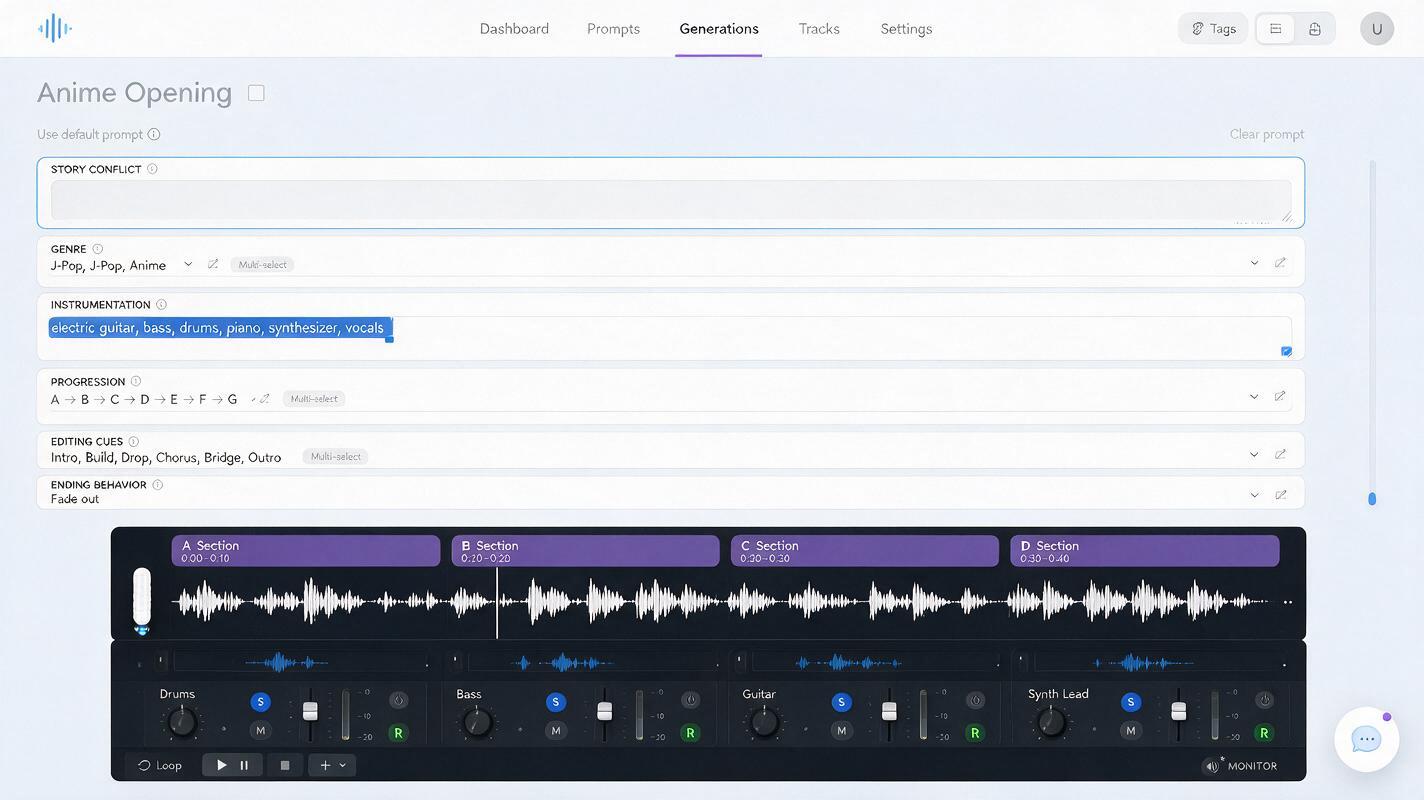
Keep Lyrics Editable and Original
If the tool supports vocal generation, describe the lyrical function before requesting detailed words. Decide whether the song should communicate resolve, longing, rivalry, secrecy, or another central idea. A crowded story summary usually produces crowded lyrics.
- Choose one point of view: protagonist, ensemble, narrator, or antagonist.
- Define the chorus idea: one emotional statement that can return clearly.
- Control verbal density: ask for shorter phrases when fast montage cuts need breathing room.
- Request singable sounds: open vowels and sustained syllables can support long hero shots.
- Avoid imitation: do not request the voice, melody, or signature style of a living performer or a specific copyrighted song.
When words are not essential, generate an instrumental or wordless-vocal version first. It is easier to evaluate the structure when unfamiliar lyrics are not competing for attention.
Turn the Track Into an Opening Cut Plan
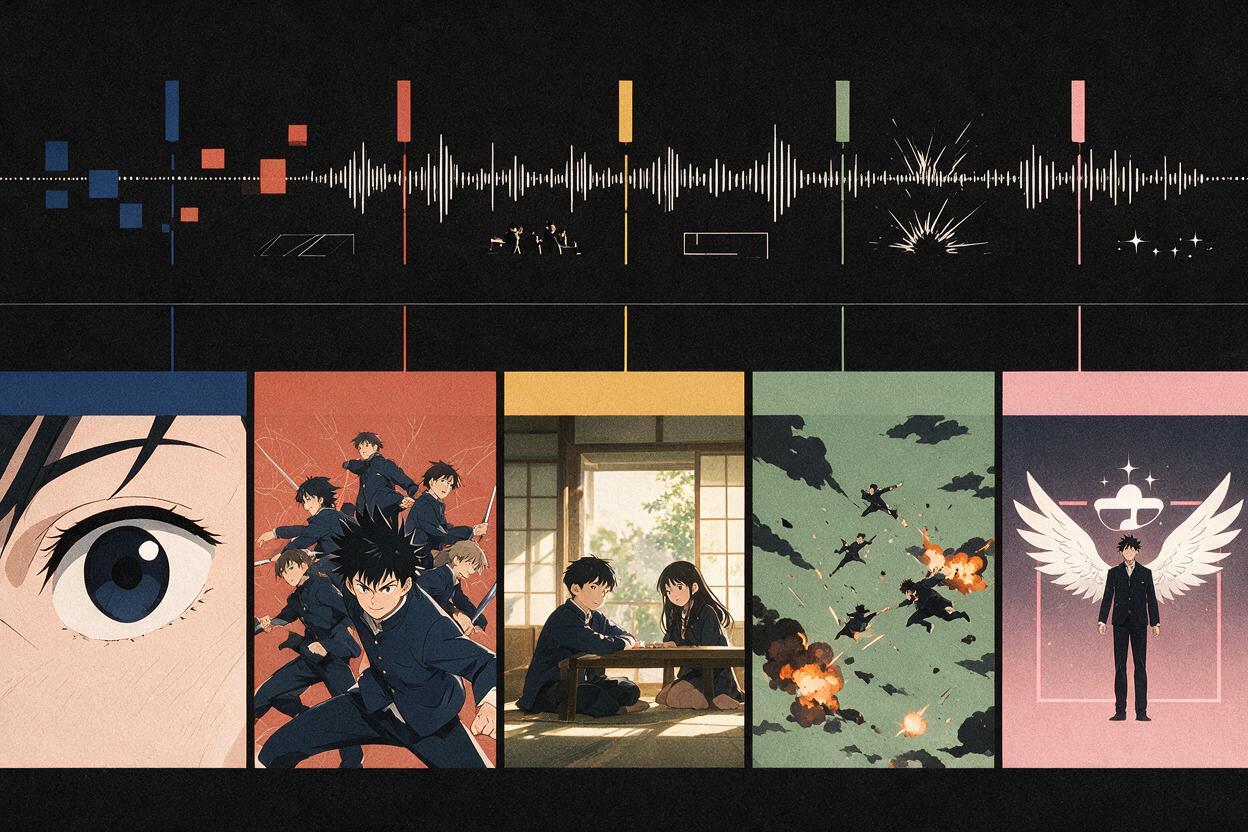
After choosing a track, listen for musical changes rather than cutting every shot to every beat. Mark the first entrance of a new instrument, percussion dropouts, melodic peaks, chorus arrival, and the final accent. These larger events make stronger anchors than constant rapid cutting.
Translate those anchors into ai storyboard panels before generating motion. Start with the irreplaceable shots: protagonist introduction, cast grouping, rival reveal, signature action, emotional contrast, title card, and final image. Transitional shots can then connect those anchors without carrying too much narrative information.
| Audio event | Strong visual match | Common mistake |
|---|---|---|
| Isolated opening motif | Symbol, eye close-up, empty location | Showing the entire cast immediately |
| First percussion entrance | Movement begins or setting changes | Using a random impact with no story value |
| Brief musical reduction | Memory, vulnerability, or antagonist clue | Maintaining the same visual intensity |
| Chorus downbeat | Transformation, launch, team pose, major attack | Spending the peak on an establishing shot |
| Final accent | Logo, decisive pose, or unresolved reveal | Adding another weak shot after the ending |
For generated animation, make several short clips around these anchors instead of asking one long generation to perform the entire opening. Separate clips give you more control over character consistency, action readability, and cut timing.
Diagnose a Track That Still Feels Generic
If the first result sounds polished but does not support the visuals, identify the missing function before rewriting everything.
- No memorable entrance: request a short isolated motif before the full arrangement.
- No useful climax: specify what changes at the chorus, including added instruments and stronger rhythmic accents.
- Constant intensity: add a reduced contrast passage before the main peak.
- Weak ending: replace “dramatic finish” with a sustained chord, hard stop, or final ensemble hit.
- Wrong emotional tone: remove conflicting adjectives and name the character’s exact emotional position.
- Difficult to edit: request clearer section changes and fewer simultaneous layers.
Regenerate only after changing a specific musical instruction. Repeating the same broad prompt is unlikely to solve a structural problem.
Final Checklist
- The prompt names the opening’s story conflict or emotional purpose.
- One primary genre controls the arrangement.
- The introduction creates an identifiable visual entry point.
- The music contains contrast before its largest section.
- The chorus has clear accents for major character or action shots.
- The ending supports a logo, final pose, or reveal without an accidental fade.
- The lyrics remain original and use one consistent point of view.
- The selected track has been mapped to storyboard anchors before animation begins.
When the brief, song arc, and visual anchors agree, the opening feels designed rather than assembled. try these models for free and adapt one prompt to your own cast, genre, and final reveal.
Keywords
anime opening song prompts, ai music generator, anime opening, anime music video, anime storyboard, opening theme music, ai anime video