How to Keep the Same AI Video Character in Mirror Shots
Mirror shots can make one AI video character appear to have two different faces. This tutorial uses a three-view character sheet, a locked mirror composition, and targeted frame checks to keep the person and their reflection consistent.

Table of contents
One character, two visible faces
A mirror shot asks an AI video model to depict the same person twice at once: in the room and in the reflection. The safest approach is to approve both appearances in one still frame before generating motion.
This tutorial follows a fictional character, Mara, as she pauses at a bathroom mirror and then leaves the room. Her reflection must match her face, clothes, pose, and position—not become a second character. You can prepare the approved stills with an ai image generator, then use them as references wherever your chosen video tool accepts images.
Cover visual prompt — Copy and recreate:
Photorealistic cinematic editorial photograph, landscape 16:9. A fictional woman in her early thirties stands at a slightly worn bathroom mirror in a believable apartment at morning; her real three-quarter profile and her reflection are both visible, with matching dark chin-length hair, charcoal jacket, and natural posture. Soft window light, toothbrush and folded towel in the background, restrained film color. MANDATORY CAMERA: eye-level three-quarter view from behind and to the woman's left; show the mirror surface and its physical edges. One person and one optically plausible reflection only. No text, logos, screens, interfaces, or brand marks.Step 1 — Lock the face before designing the reflection
Write down features that should survive a change in angle: facial proportions, hairline, hairstyle, and a small distinguishing detail. For Mara, use a narrow oval face, dark brown eyes, chin-length black bob, a notch in her left eyebrow, and a charcoal jacket. Keep age, hairstyle, and jacket unchanged throughout this shot.
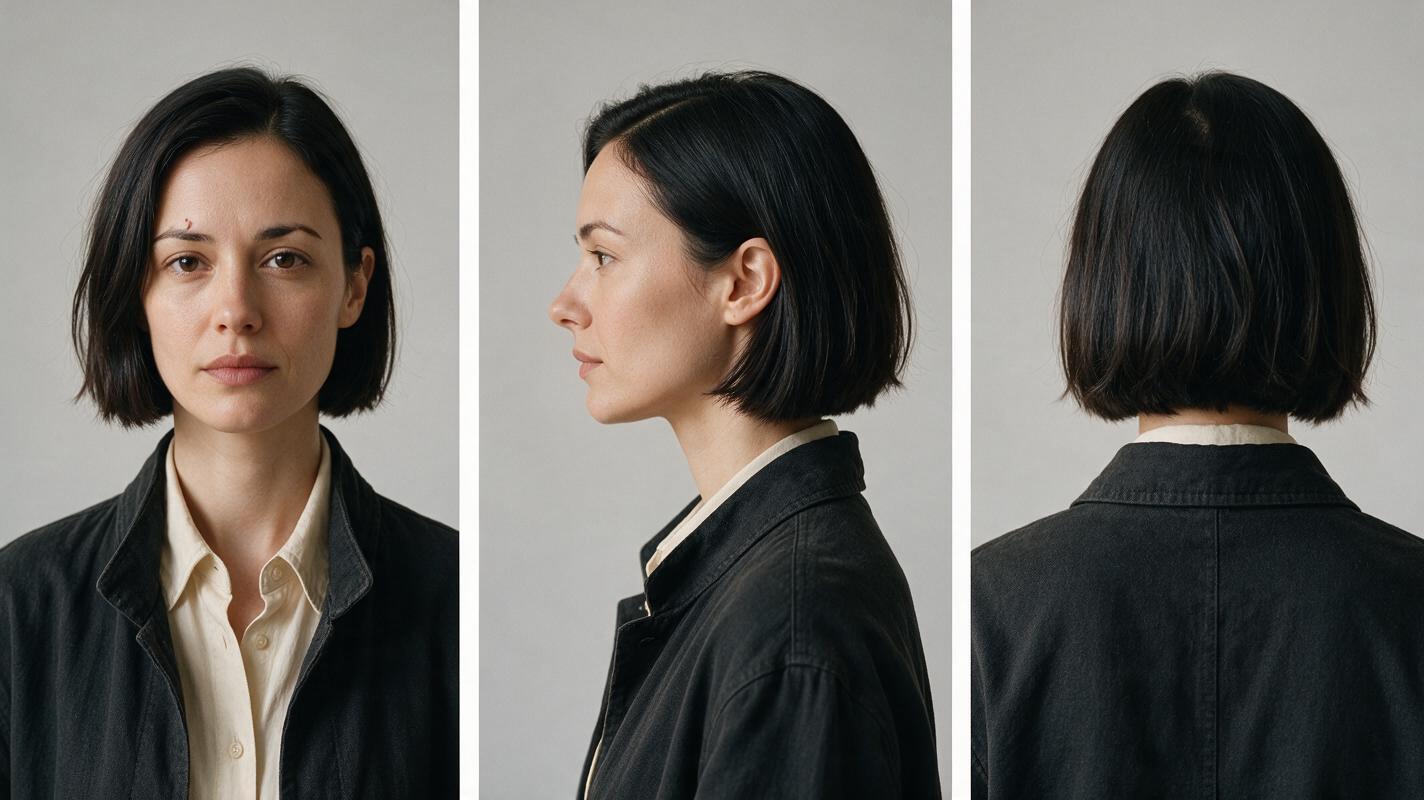
Make a three-panel character sheet showing front, side, and back views of the same person. Approve it before making the bathroom scene. If the sheet itself changes facial structure between panels, a mirror shot will compound the problem.
Visual prompt — Three-view character sheet:
Photorealistic three-panel character reference sheet of one fictional woman, Mara, early thirties, narrow oval face, dark brown eyes, chin-length straight black bob, subtle notch in her left eyebrow, charcoal jacket over a cream shirt. Landscape 16:9, neutral light-gray seamless background, consistent soft studio light and scale. MANDATORY LAYOUT: exactly three evenly spaced full-height views of the same character, front view on the left, true left-side profile in the center, back view on the right. Neutral expression and relaxed arms; identical clothing and hair length in all views. No mirror, extra people, text, labels, logos, or interface elements.Character sheet template: Name and approximate age; face shape and eye shape; hair color, cut, and part; two stable distinguishing features; fixed outfit; front, left-side, and back views; one approved master image. Record which side a feature belongs to anatomically, rather than describing only where it appears on screen.
Step 2 — Approve the person and reflection in one still
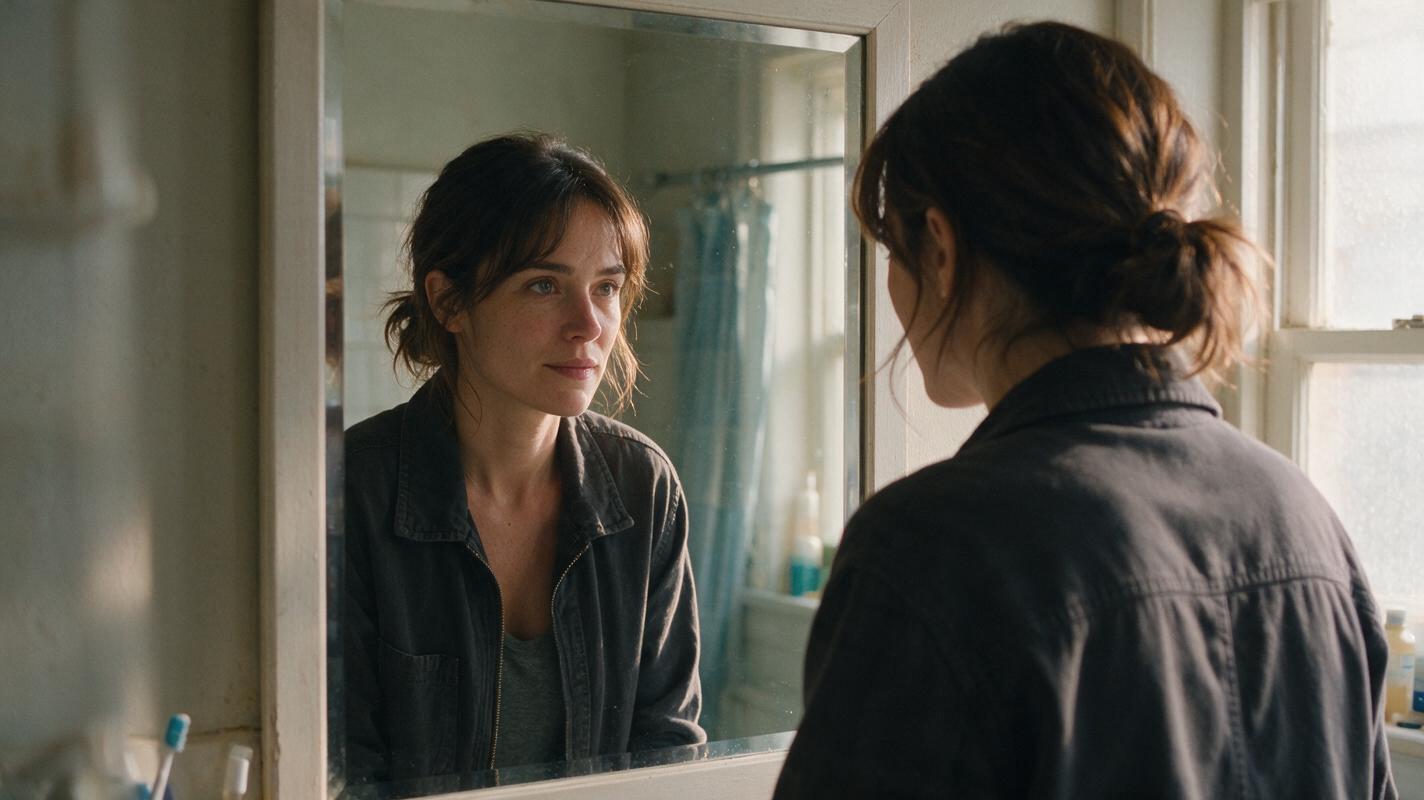
Build the bathroom image with the character sheet as your identity reference. Choose a camera position where the real person and reflection have readable faces, and keep the mirror frame visible. That frame establishes where the reflected image belongs and helps you judge whether its angle is plausible.
Check the still before animating it. Mara should have the same jaw, hair, and clothing on both sides of the glass. A reflection reverses the viewer's apparent left and right, so an eyebrow notch may appear on the opposite side of the picture. That alone is not identity drift. An added notch, a new hairstyle, or a reflected head turned independently is.
Visual prompt — Approved mirror composition:
Photorealistic cinematic editorial still, landscape 16:9, lived-in apartment bathroom with a framed wall mirror, pale tile, folded towel, and soft morning window light. Mara stands facing the mirror: narrow oval face, dark brown eyes, chin-length straight black bob, subtle notch in her anatomical left eyebrow, charcoal jacket over a cream shirt. Show her real three-quarter profile and a physically plausible reflected face with matching identity, outfit, head angle, and hand position. MANDATORY CAMERA: fixed eye-level medium shot from behind and slightly to Mara's left, mirror edges fully visible; no camera tilt. Exactly one real person and one reflection, no independent second person. No text, logos, screens, or UI.Save the approved sheet and mirror still separately. The sheet answers who is she?; the still answers where is she, and what does the mirror show? For a subsequent hallway shot, make a new scene still from the same character sheet rather than using the reflected face as the sole identity reference.
Step 3 — Add only motion the mirror can follow
Use the approved mirror still as the starting image for image to video if that option is available in your workflow. Ask for a small action first: Mara lifts one hand toward her collar, pauses, and lowers it. Keep the camera fixed. A large turn, moving camera, and fast hand gesture introduce several continuity problems at once.
Copyable motion prompt:
Animate the supplied approved still as one continuous, restrained bathroom shot. Mara slowly raises her right hand to straighten the collar of her charcoal jacket, pauses, then lowers it. Her mirror reflection follows the same action with physically plausible reflected timing and position. Preserve the approved face shape, black bob, cream shirt, jacket, bathroom layout, mirror frame, and soft morning light. MANDATORY CAMERA: locked eye-level medium shot, no zoom, orbit, or cut. One person and one reflection only; no new objects, face changes, extra limbs, or independent reflected movements.Review the opening, the moment her hand reaches her collar, and the final frame. Those frames reveal most pose and identity errors. For multi-shot continuity, compare the final clear view of Mara with the first clear view in the hallway shot before editing the clips together.
Step 4 — Fix the reflection, not just the face
A mirror failure often comes from scene geometry or motion instructions, not an insufficiently detailed face description. Compare the problem frame with the approved still and change the smallest cause you can identify.
| What you see | Likely cause | Practical fix |
|---|---|---|
| The reflection has a different jaw or haircut. | Identity was inferred separately in the mirror. | Return to the approved still; keep the same character sheet attached where supported. |
| The reflection moves its hand independently. | The prompt treats it like a second actor. | Use one simple gesture and explicitly require physically matched reflected motion. |
| A second person appears beside the mirror. | The composition does not clearly separate person, glass, and reflection. | Show the mirror edges and specify one person and one reflection. |
| A facial mark appears on the wrong anatomical side. | Screen-left was confused with the character's left. | Check against the front-view sheet and a plausible reflected view before regenerating. |
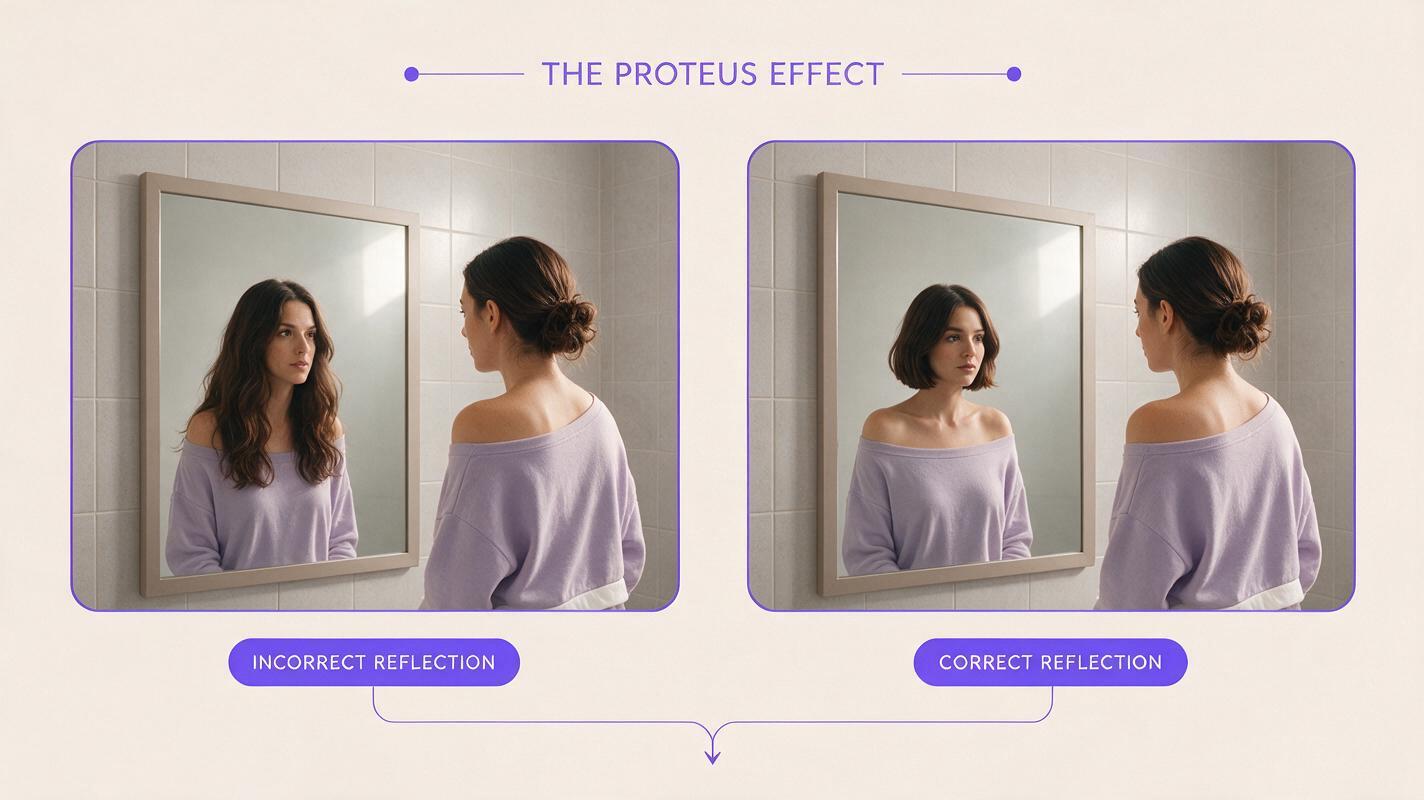
Visual prompt — Side-by-side failure and correction:
Neutral, photorealistic two-panel comparison image, landscape 16:9, showing the same framed apartment bathroom mirror and the same fictional woman, Mara, under matching soft morning light. MANDATORY LAYOUT: two equal side-by-side cinematic frames with identical fixed eye-level camera position. Left frame illustrates a visible failure: Mara's reflection has a noticeably different jawline and longer hair while her real figure retains a chin-length black bob. Right frame illustrates the correction: real figure and reflection share the same narrow oval face, chin-length black bob, charcoal jacket, pose, and plausible mirror alignment. One real person and one reflection per panel. No labels, arrows, text, logos, UI, or brand marks.Use the comparison as a diagnostic example, not as an identity reference: the flawed panel deliberately contains the wrong face. If a clip drifts only after Mara turns, shorten the action or approve a new still at the turned angle before generating the next segment.
Final checklist
- Approve one photorealistic front, side, and back character sheet.
- Approve a mirror still that shows the person, reflection, and mirror edges together.
- Describe anatomical features separately from their apparent screen position.
- Start with a locked camera and one small, reflected gesture.
- Check the opening, peak action, closing frame, and next shot's first clear face.
When your sheet and mirror composition are ready, try these models for free with the same approved references and compare the resulting frames before committing to a longer scene.
FAQ
Why does the eyebrow notch switch sides in the mirror?
The reflected view changes its apparent position on screen. Judge whether the notch remains attached to the same anatomical eyebrow, rather than requiring it to stay on the same side of the image.
Should I use the mirror frame as the reference for every later shot?
No. Reuse the character sheet for identity, then approve a new scene still for each distinct camera angle or location. The mirror still is most useful for this particular composition.
What if the face stays consistent but the reflection lags?
Simplify the action and keep the camera locked. If the timing still fails, generate a shorter segment or choose an edit that does not hold both faces on screen during the gesture.
Sources
- Encyclopaedia Britannica: Reflection | Definition, Types & Laws — background on physical reflection.
Keywords
character consistency, character reference, consistent character across scenes, multi-shot, keep the same face across video