How to Keep the Same Character Across AI Video Dream Sequences
A dream sequence can change a video's setting and visual mood without changing its protagonist's face. This tutorial uses a three-view character sheet, paired scene references, and cut-point checks to preserve identity across the transition.

Table of contents
Keep the dream strange—not the character
A dream sequence works best when viewers recognize the person entering it, even as the world around them changes.
The practical approach is to approve the character's identity before designing either scene, then build two connected shots: a waking-world frame and a dream-world frame with matching facial structure, hairline, and a recognizable clothing detail. Animate those approved frames separately and inspect the transition. This tutorial uses Mara, a fictional night-shift librarian, and a corridor that becomes an empty seaside arcade.
Cover visual prompt (copy and recreate):
Photorealistic editorial film photograph, landscape 16:9. A woman in her early thirties with olive skin, a narrow oval face, dark brown eyes, a small crescent-shaped scar beside her left eyebrow, and a chin-length dark brown bob stands at the threshold of a lived-in library corridor. Beyond the doorway, the corridor opens impossibly onto an empty seaside arcade at dawn. She wears a charcoal coat with one brass lapel pin. MANDATORY CAMERA: eye-level medium three-quarter view, 50 mm lens perspective, face clearly visible. Natural mixed interior and dawn light; believable architecture; no text, logos, screens, interfaces, or extra people.Step 1 — Approve one identity before changing the world
Generate a ai image generator reference sheet first. Judge it as a casting document, not as a finished scene: the front, side, and back views must depict the same person, clothing, hair length, and distinctive marker. If the three views disagree, regenerate the sheet before making scene images.
Use this compact character sheet template for every subsequent prompt:
CHARACTER: Mara, fictional night-shift librarian
IDENTITY LOCK: early thirties; olive skin; narrow oval face; dark brown eyes; small crescent-shaped scar beside left eyebrow; straight, chin-length dark brown bob; consistent nose bridge and jawline
WARDROBE LOCK: charcoal coat; small brass pin on left lapel
MAY CHANGE: lighting, expression, pose, location, background atmosphere
MUST NOT CHANGE: facial proportions, scar position, hair length, coat or pin
REFERENCE: attach the approved three-view sheet to every still-image request
The scar and pin are useful checks, but neither substitutes for the face. A new face with a correctly placed pin is still a continuity failure.
Visual prompt (copy and recreate):
Photorealistic three-panel character reference sheet of the same fictional woman, Mara, in front, true side profile, and back views, in that left-to-right order. Early thirties, olive skin, narrow oval face, dark brown eyes, small crescent-shaped scar beside her left eyebrow, straight chin-length dark brown bob, charcoal coat with a small brass pin on the left lapel. Neutral expression and relaxed posture; consistent proportions, hairstyle, and clothing in all three panels. MANDATORY CAMERA AND LAYOUT: landscape 16:9, three equal full-body panels, eye-level camera, even soft studio lighting, neutral light-gray seamless background. No text, labels, logos, UI, props, or extra people.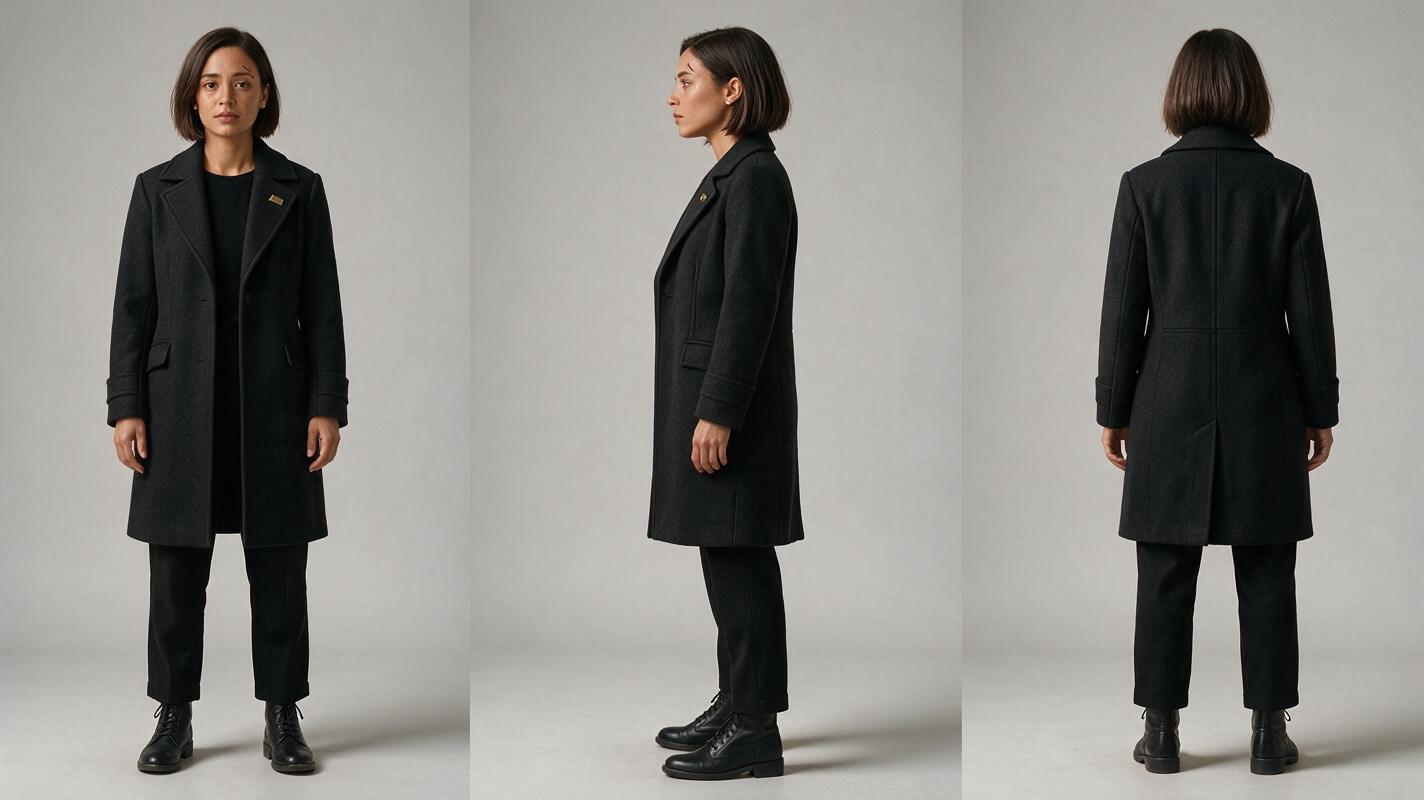
Step 2 — Pair the waking and dream storyboard references
Make two approved stills before attempting motion. In the waking frame, Mara pauses beside a library doorway. In the dream frame, she stands at the matching point of an empty seaside arcade. Keep her face at a comparable size in both compositions so you can assess identity without confusing a camera-distance change for a facial change.
Carry over one physical action: Mara's left hand reaches toward the doorway in the first frame and remains raised in the second. Keep the coat and pin visible. Change the location, color, and atmosphere deliberately; do not ask the model to redesign Mara to fit a more fantastical aesthetic.
Continuity rule: Treat the dream as a change of environment, not a new character-design brief.
Save both stills as storyboard references. If the dream still changes her jaw, scar position, or hairline, correct the still now. Motion will make a bad reference harder to diagnose, not easier.
Visual prompt (copy and recreate):
Cinematic editorial-realism diptych, landscape 16:9, two equal side-by-side scene frames featuring exactly the same fictional woman, Mara, matching the supplied approved character sheet. Left frame: she pauses in a lived-in library corridor at night, left hand raised toward a doorway, charcoal coat and brass left-lapel pin visible. Right frame: she holds the same pose inside an empty seaside arcade at dawn; damp stone paving and shuttered stalls create a believable dreamlike location. Preserve her olive skin, narrow oval face, dark eyes, left-eyebrow crescent scar, chin-length dark bob, and facial proportions in both frames. MANDATORY CAMERA: matching eye-level medium three-quarter views with 50 mm lens perspective and the face at the same scale. Film-style natural light, no text, labels, logos, UI, or extra people.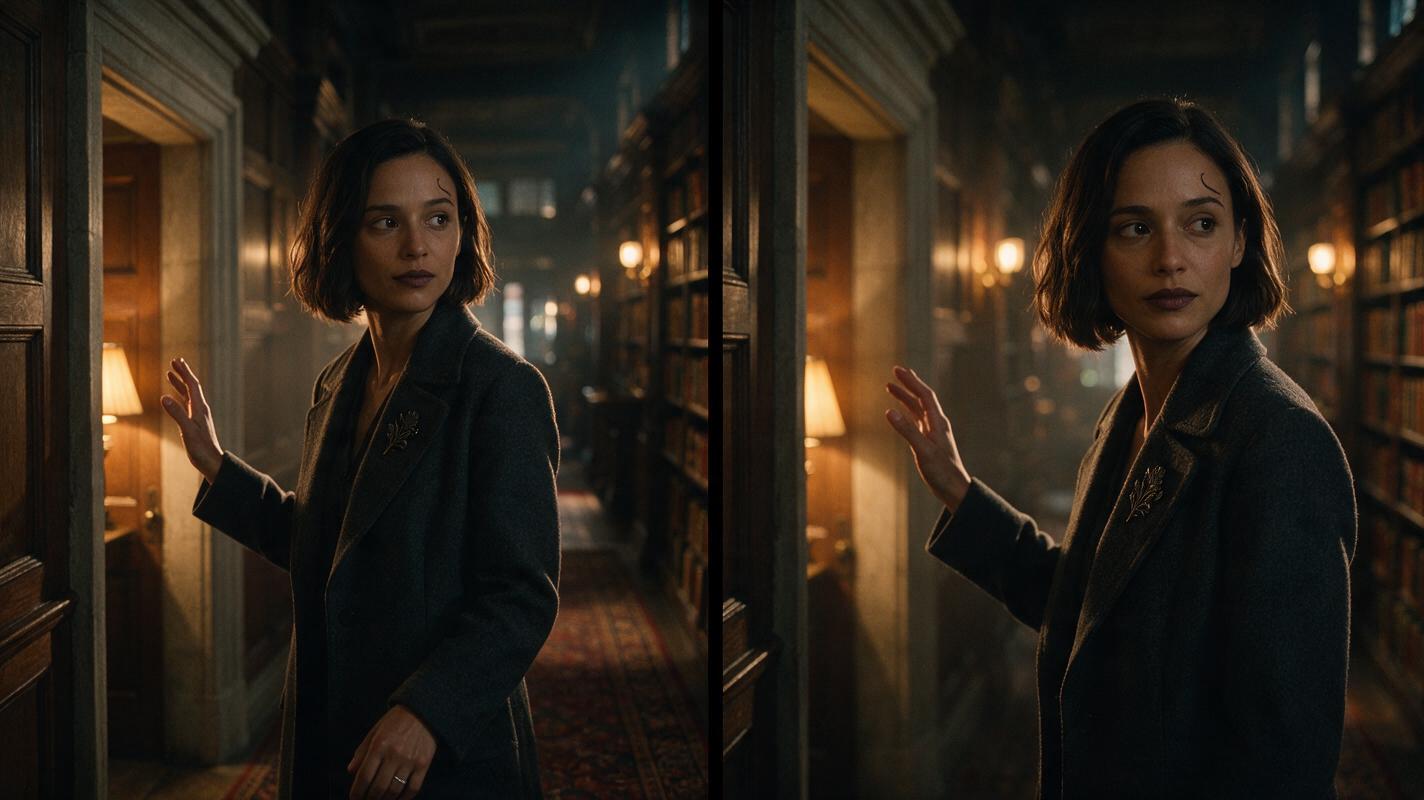
Step 3 — Animate the transition without re-casting Mara
Use the approved waking still as one shot's starting image and the approved dream still as the next shot's starting image. An image to video workflow lets you describe the motion separately from the character's appearance. Keep each motion request narrow: a hand approaches the doorway; then a hand lowers as Mara looks across the arcade.
Copy this shot prompt, attach the corresponding approved still, and replace the bracketed motion:
Use the attached approved scene still as the visual reference. Animate Mara without redesigning her. Preserve her facial proportions, left-eyebrow scar, chin-length dark bob, charcoal coat, and brass left-lapel pin. Keep one Mara in frame. Motion: [Mara slowly raises her left hand toward the doorway / Mara lowers her left hand and looks across the arcade]. MANDATORY CAMERA: steady eye-level medium three-quarter view, no orbit, no sudden zoom, face readable throughout. Preserve the scene's existing lighting and setting. No added people, text, logos, or interfaces.Keep the waking and dream shots distinct in the edit rather than relying on a complex single-shot metamorphosis. That gives you a clear place to check the last visible waking frame against the first visible dream frame. If you need a softer transition, edit the cut after both shots pass the identity check.
Step 4 — Check the cut where identity is most vulnerable
Pause on the final clear frame before the cut and the first clear frame after it. Compare Mara's eye spacing, nose bridge, jawline, scar position, hairline, coat collar, and brass pin. Then play a few seconds on either side at normal speed. A still-frame match can conceal a brief face change during movement.
| What goes wrong | Likely cause | Targeted fix |
|---|---|---|
| Dream Mara has a different face | The dream prompt described a new person instead of reusing the approved reference. | Regenerate the dream still with the sheet attached; lock facial structure before animating. |
| The scar switches sides | A mirrored or reversed reference was used. | Check left and right in the approved frame; avoid mirroring the scene still. |
| The face looks right at the cut but changes mid-shot | Motion introduces an uncontrolled angle or expression. | Shorten the motion and request a steadier, face-readable camera view. |
| Two Maras appear in the arcade | The location prompt implies a reflection or background figure. | Remove reflective staging and specify exactly one person in frame. |
Fix the earliest asset that contains the error. If the dream still is wrong, do not keep regenerating its video clip; repair the still and animate again.
Visual prompt (copy and recreate):
Wordless editorial illustration showing a side-by-side identity check for one fictional woman, Mara. Left half: a waking-library frame beside a dream-arcade frame where the dream version visibly has an altered jawline and misplaced eyebrow scar. Right half: the same two locations with Mara's face, scar, chin-length dark bob, charcoal coat, and brass left-lapel pin consistently matched. MANDATORY LAYOUT: landscape 16:9, four equal cinematic frames arranged as two pairs, faces at matching scale, clear visual comparison without arrows, labels, borders, UI, logos, or text. Believable locations, restrained natural colors, no extra people.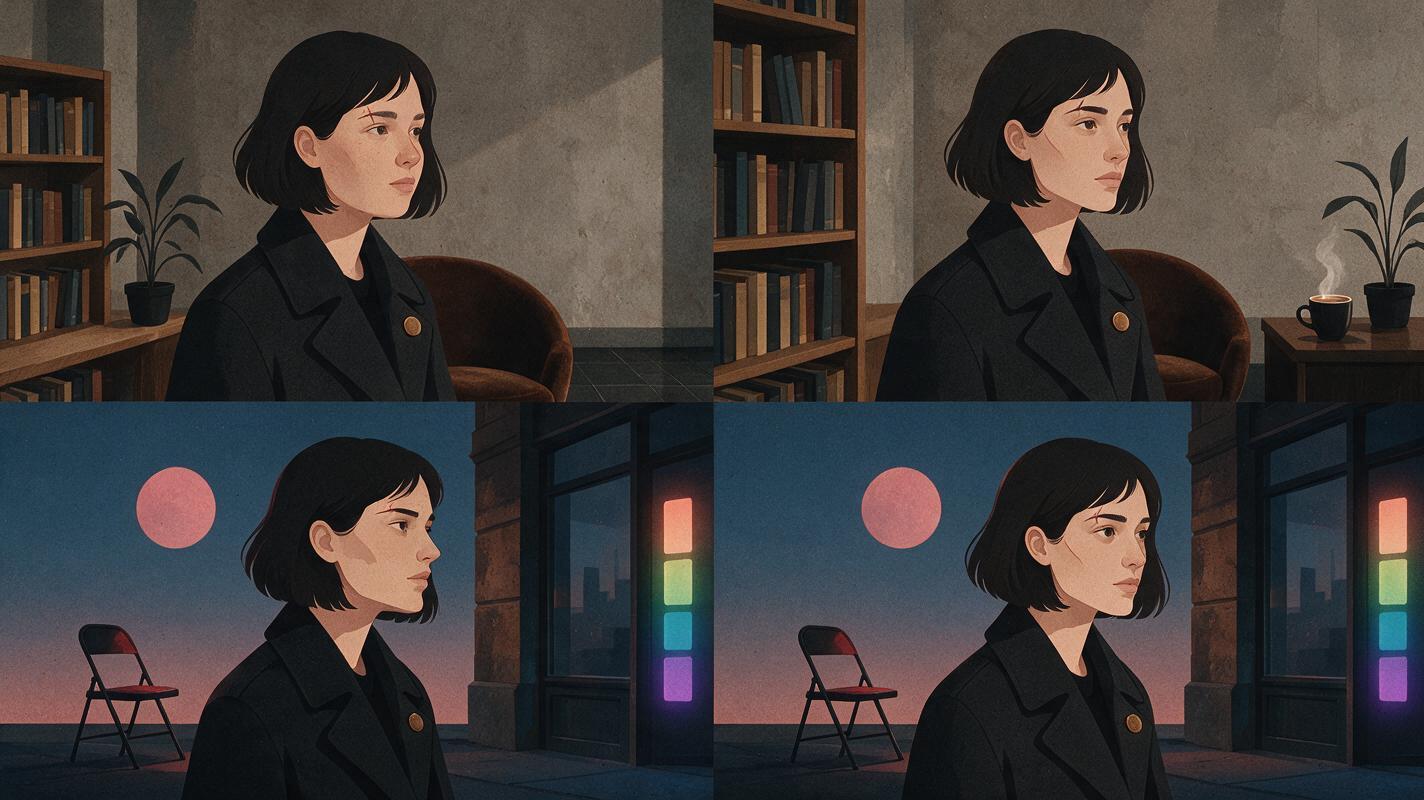
FAQ
Can the dream change Mara's clothing?
Yes, but make that an explicit story event. First approve a new wardrobe reference that preserves her face and another recognizable marker. Do not introduce an unplanned costume change at the same cut where the location changes.
Should the character sheet appear in the finished video?
No. It is a production reference for generating and checking scenes. The audience sees the approved shots, not the sheet.
What if the dream uses a different visual style?
Keep the identity sheet unchanged and create a separate style reference for the environment. Check facial proportions in the resulting still before animation; a style instruction should not silently become a new-face instruction.
Final checklist
- Approve a consistent front, side, and back character sheet.
- Match face scale and a carried pose across waking and dream storyboard stills.
- Animate from approved stills with restrained, face-readable motion.
- Inspect both cut-boundary frames and the movement around them.
- Repair the first incorrect reference rather than repeatedly regenerating later clips.
Ready to build your own transition? try these models for free with the sheet and shot prompts above.
Keywords
character consistency, consistent character video, consistent character across scenes, character reference, storyboard reference, ai character design, keep the same face across video