Turn Customer Reviews Into Social Proof Ads With AI
Learn a controlled workflow for turning verified customer reviews into social proof ads without inventing claims, losing message clarity, or invalidating creative tests. The article includes review-selection criteria, reusable Nano Banana Pro prompts, layout guidance, and a testing matrix for performance marketers.
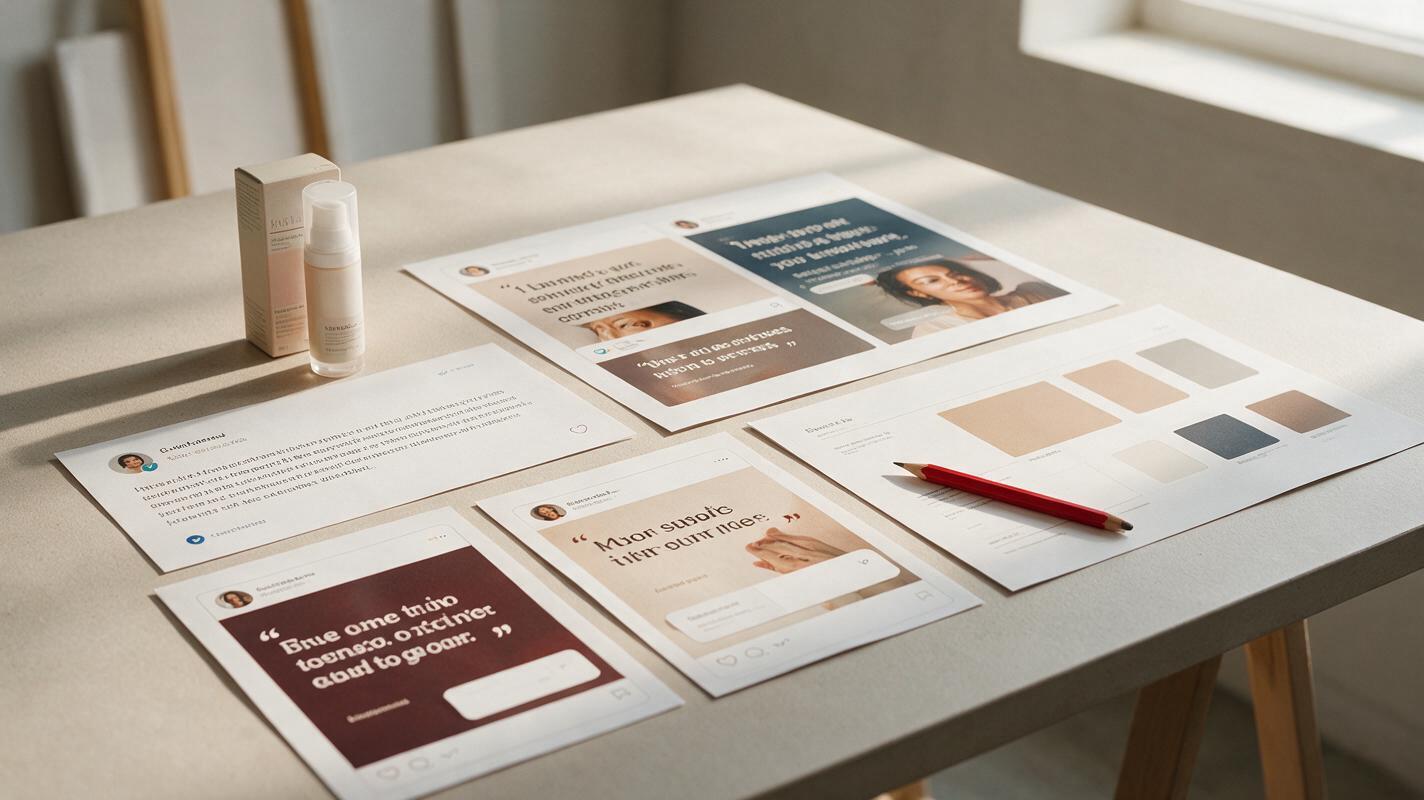
Table of contents
Turn verified review language into testable ad creative
The best customer review ads do not simply paste a five-star quote onto a product photo. They isolate one believable customer outcome, make it readable in under two seconds, and connect it to a visual that reinforces the same message.
Generative AI can accelerate the visual exploration, but it should not rewrite the evidence. The source review, product details, rating context, and required disclosures must remain controlled by the marketing team. Use AI to explore compositions and campaign variations—not to manufacture customer sentiment.
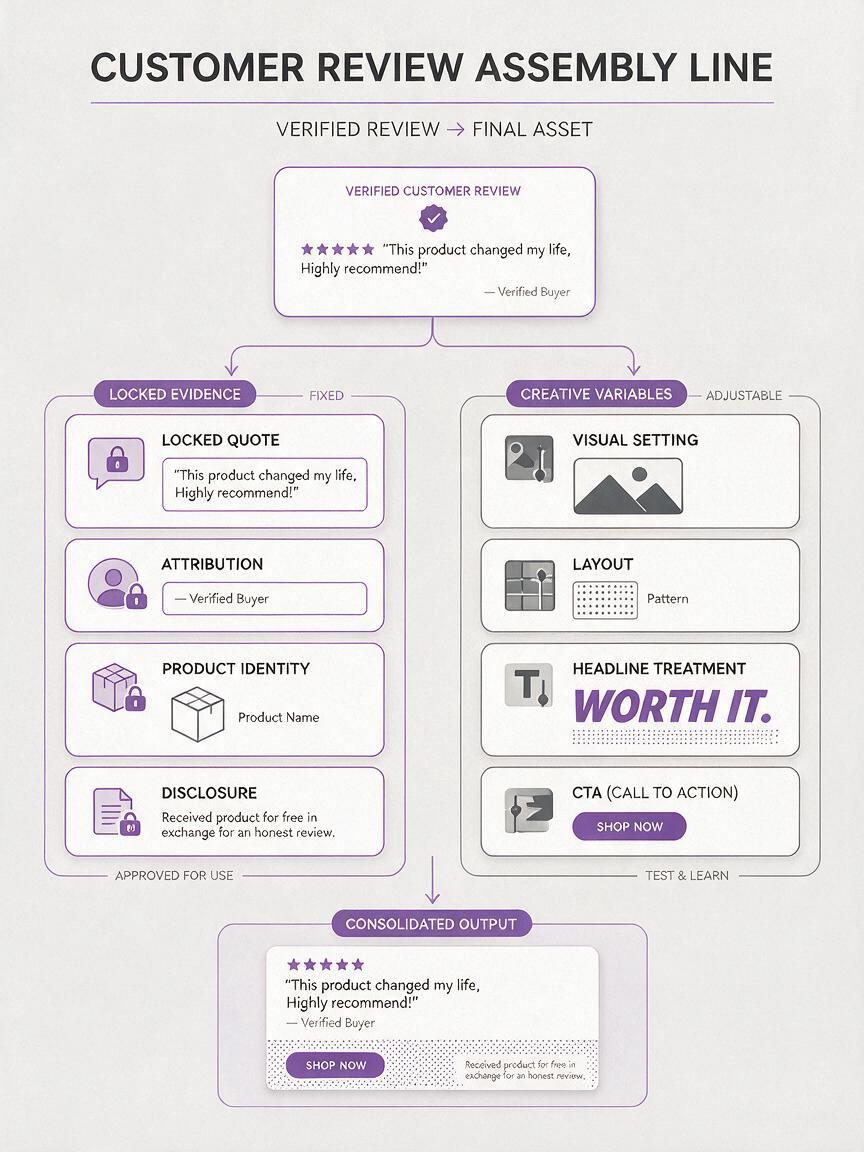
Treat the verified review as locked source material. Everything around it can become a creative variable.
Choose reviews that can carry an ad
A detailed review is not automatically effective advertising copy. Social proof ads need a line that communicates one specific result without requiring the viewer to read a paragraph of context.
Start with reviews your business is permitted to use. Preserve the original record, including where it appeared, when it was collected, and whether an incentive was involved. Then evaluate each candidate against four criteria:
- Specificity: The review describes a recognizable benefit, situation, or improvement.
- Comprehension: The key idea still makes sense when shown in one or two short lines.
- Product connection: The visual can demonstrate or support the stated experience.
- Claim safety: The language does not create an unsubstantiated guarantee when removed from its original context.
“Love it!” may be authentic, but it gives a performance marketer little to test. A line such as “The weekly report now takes me ten minutes instead of an hour” contains a situation, an outcome, and a potential visual story. Before using that line, confirm that your records support the testimonial and that its presentation complies with applicable platform and advertising requirements.
Build a locked review brief before generating visuals
Create a compact brief that separates immutable facts from creative variables. This prevents a model—or a hurried editor—from quietly changing a customer statement into a stronger claim.
| Brief field | Lock or vary? | Example |
|---|---|---|
| Verified review text | Lock | Exact approved quotation |
| Attribution | Lock | Approved first name, initials, or anonymous label |
| Product identity | Lock | Approved product image, color, and packaging |
| Disclosure | Lock | Required incentive or results qualifier |
| Visual context | Vary | Desk, kitchen, commute, gym bag |
| Quote position | Vary | Top card, split layout, lower panel |
| Supporting headline | Vary carefully | Benefit label that does not alter the testimonial |
| Call to action | Vary | Learn more, shop now, see the product |
Do not ask the model to “improve” or “make the review more persuasive.” If shortening is necessary, have a human approve the edit and use ellipses or other formatting where required. Never combine fragments from different customers into one apparent quotation.
Generate the scene without asking AI to typeset the final ad
Use nano banana pro to explore reference-led scenes, product context, and composition options. Supply an approved product reference and request deliberate empty space for the quote. Generate the visual foundation first; add final review text, attribution, logo, disclosure, and CTA in your design tool afterward.
This division matters because generated typography can introduce misspellings, altered wording, inconsistent logos, or unreadable disclosure text. The model should create the scene and hierarchy—not become the system of record for advertising copy.
Create a vertical 4:5 paid social advertising scene using the attached approved product reference.

Customer outcome to communicate visually: [OUTCOME]
Usage context: [REALISTIC SETTING]
Audience: [AUDIENCE]
Composition: product clearly visible in the lower-right third, natural supporting props, uncluttered background, generous high-contrast empty area in the upper-left for a short customer quote.
Lighting: natural commercial photography, believable shadows, realistic materials.
Brand direction: [COLORS AND MOOD].
Preserve the product's shape, color, proportions, and packaging details.
Do not generate text, ratings, logos, badges, watermarks, or interface elements.
If the product cannot be shown in use without creating an implied claim, choose a contextual still life instead. For example, a time-saving software review can be supported by an organized workspace, while the verified quote provides the actual evidence. The image should reinforce the message without pretending to document the customer who wrote it.
Create three distinct social proof concepts
A useful creative batch changes the communication mechanism, not just the background color. Build concepts around different ways of processing the same approved evidence.
Quote-first concept
Make the review the largest element. Use a restrained product scene and a short supporting label such as “From verified customers” only when that label is accurate. This direction is suitable when the wording itself contains a vivid result.
Outcome-first concept
Lead with a concise, substantiated benefit headline, then use the customer quotation as supporting proof. Keep the headline outside quotation marks so viewers do not mistake marketing copy for the customer’s exact words.
Product-first concept
Give the product most of the frame and place the testimonial in a compact review card. This approach is useful for retargeting audiences that already understand the problem but need additional confidence before buying.
An ai image generator can produce several scene directions quickly, but each direction should answer a distinct test question. If every variant uses the same headline hierarchy, product scale, and quote treatment, the batch is cosmetic rather than diagnostic.
Use prompts that isolate one creative variable
Once a promising composition is selected, preserve its product placement, camera angle, lighting, and copy area. Change only the variable being tested.
Using the approved base composition and product reference, create three controlled variants.

Keep unchanged:
- product scale, position, shape, color, and packaging
- camera angle and crop
- lighting direction
- empty quote area
- overall brand palette

Change only the usage context:
A. calm morning desk
B. busy shared workspace
C. evening home office

Do not add text, people, logos, badges, ratings, or extra products.
Other valid single-variable tests include:
- Quote-first versus product-first hierarchy
- Customer outcome versus pain-point framing
- Five-star symbol versus no rating symbol, when the rating is accurate and authorized
- Close product crop versus wider context
- Direct CTA versus low-commitment CTA
Avoid changing the quote, visual setting, headline, CTA, and product crop simultaneously. You may find a winning ad, but you will not know what caused the improvement.
Assemble the final ad with a readable hierarchy
Import the selected scene into your design system and rebuild every textual element using approved brand fonts. A practical reading order is:
- Customer outcome or exact quotation
- Product and visual evidence
- Attribution and disclosure
- Call to action
Check the creative at actual feed size rather than only on a large design canvas. If the quotation requires effort to read, shorten it through an approved editorial process or select a stronger source review. Do not solve excessive copy by shrinking the attribution or disclosure until it becomes functionally invisible.
Also inspect whether decorative rating icons accidentally overstate the evidence. A five-star graphic can imply a specific rating, aggregate score, or platform source. Use it only when the representation is accurate and supportable.
Test concepts against funnel stage
The same review should not automatically run across every audience. Match the evidence to what the viewer still needs to believe.
| Audience | Primary doubt | Recommended concept | Useful metric |
|---|---|---|---|
| Cold prospecting | “Is this relevant to me?” | Outcome-first | Hook rate or click-through rate |
| Engaged visitor | “Will it solve my problem?” | Quote-first | Landing-page view or product-page engagement |
| Cart or trial retargeting | “Can I trust the decision?” | Product-first with proof card | Conversion rate or cost per acquisition |
Evaluate downstream quality, not only clicks. An aggressive quotation treatment may attract attention while creating a mismatch with the landing page. Keep the cited benefit, product framing, and offer consistent after the click.
Catch failures before launch
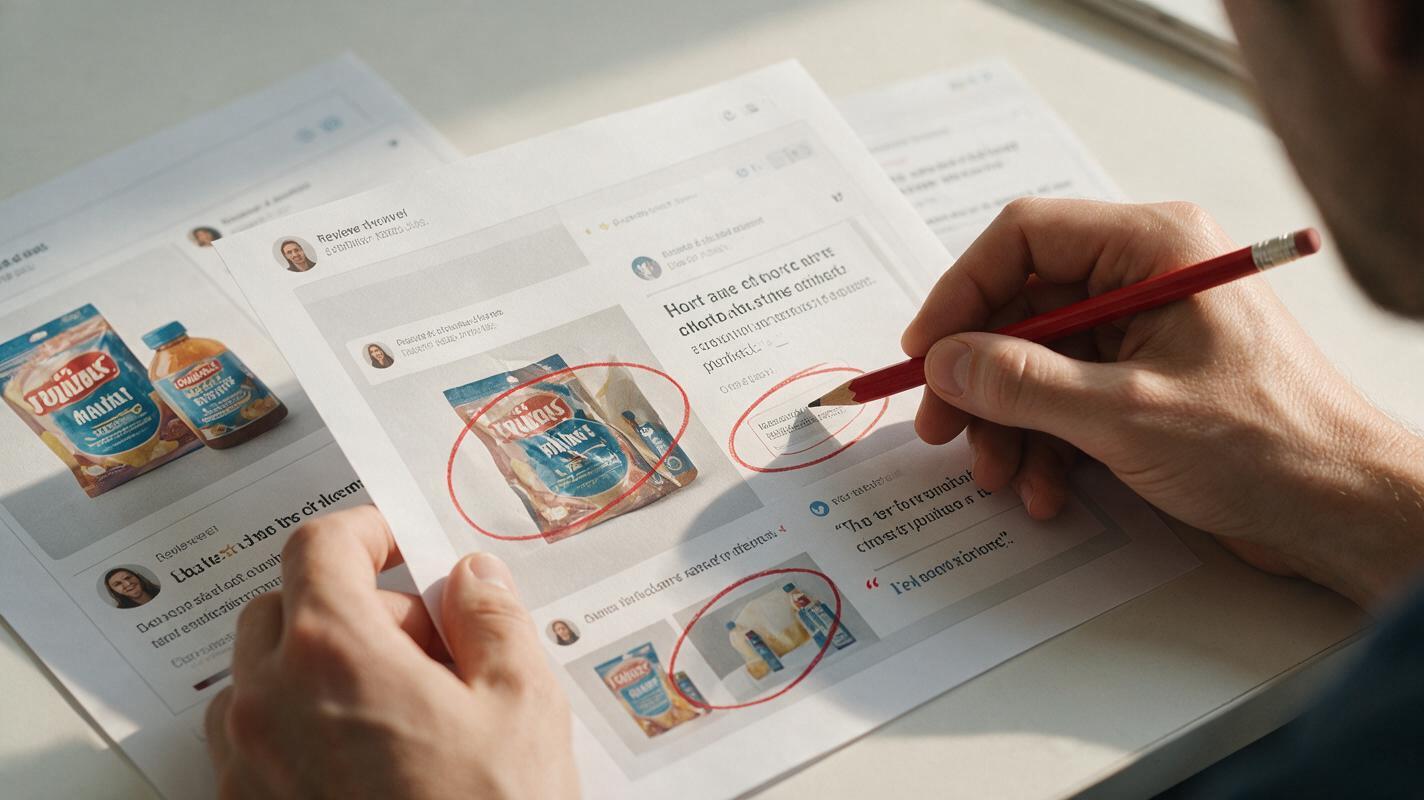
- Invented specificity: The generated concept adds numbers, time savings, or customer details that never appeared in the approved source.
- Composite testimonial: Several reviews have been blended into one statement attributed to one person.
- Identity implication: A generated person appears to be the real reviewer without permission or clear context.
- Unreadable disclosure: Required information is technically present but too small, low-contrast, or brief to understand.
- Product drift: Packaging, interface details, or physical features differ from the item customers will receive.
- Test contamination: Too many creative elements change between variants to identify a causal lesson.
If the ad would become misleading when separated from the campaign brief, it is not ready to publish.
Final checklist
- Confirm that the review is authentic, documented, and authorized for the intended use.
- Keep the approved quotation, attribution, product identity, and disclosures locked.
- Use AI for scene generation and composition exploration rather than final testimonial typography.
- Separate customer words from marketer-written headlines visually.
- Test one meaningful creative variable at a time.
- Review product accuracy, readability, claim context, and post-click consistency.
- Save each source review and approval record with the exported creative.
When your review brief and product references are ready, try these models for free and generate the first controlled visual directions for your campaign.
Keywords
social proof ads, customer review ads, AI ad generator, performance ad creative, ad creative variations, Nano Banana Pro, creative testing