How to Turn First-Person Novel Narration Into an AI Story Video
Learn how to adapt first-person narration into filmable actions, subjective images, storyboard frames, and controlled AI video clips. This tutorial focuses on preserving a narrator’s emotional perspective without illustrating every sentence literally.
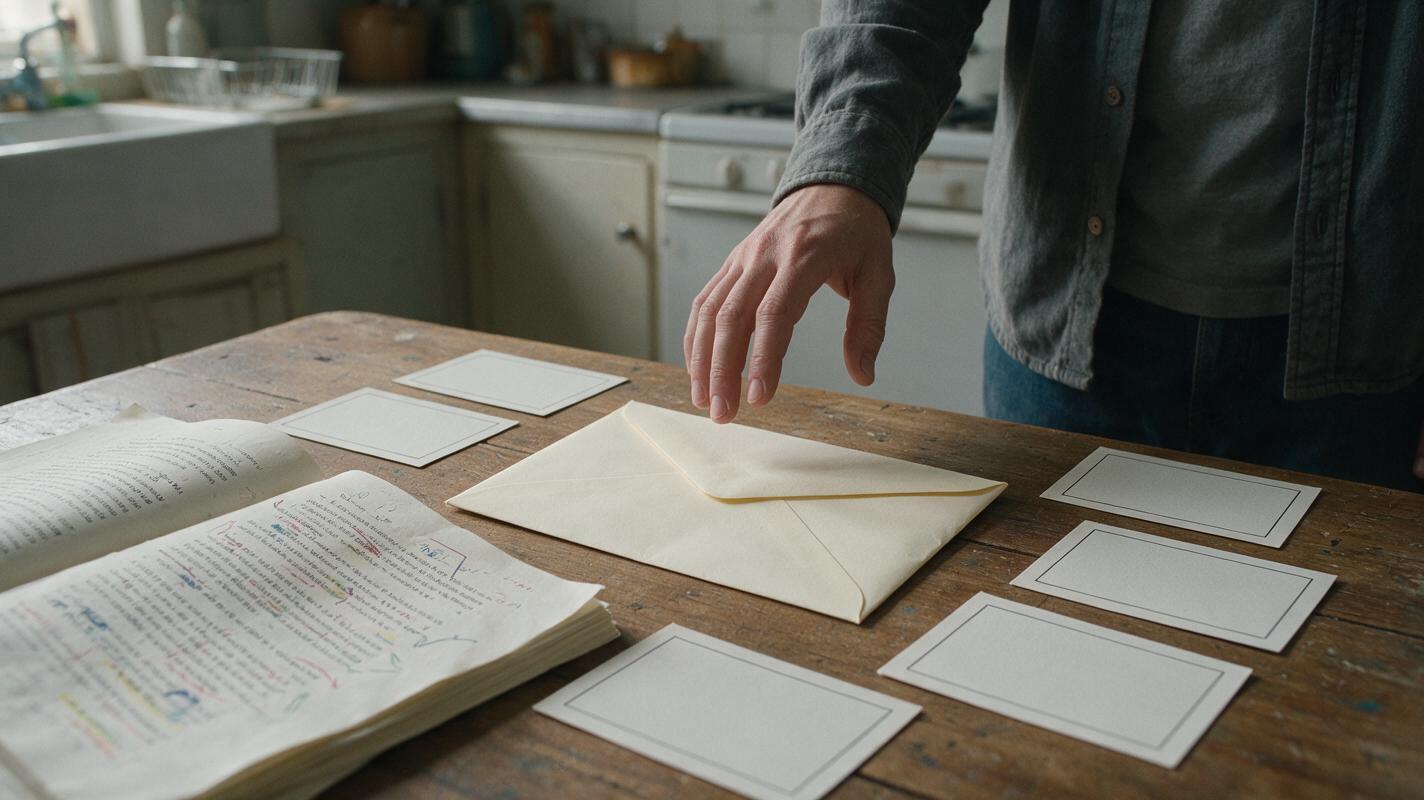
Table of contents
Turn inner monologue into screen action
The key to adapting first-person fiction is to show evidence of the narrator’s thoughts instead of asking AI to visualize the thoughts themselves.
A novel can spend an entire paragraph inside a character’s mind. A video cannot photograph an abstract belief, memory, or suspicion directly. It needs behavior, objects, environments, reactions, and carefully chosen subjective images.
This novel-to-video workflow converts interior prose into a short visual sequence while preserving the narrator’s point of view. It is especially useful for mystery, romance, psychological drama, and literary fiction in which the character’s interpretation matters as much as the visible event.
Use voiceover to retain the narrator’s language. Use images to reveal what the narrator notices, hides, avoids, or misunderstands.
Step 1 — Select one dramatic unit
Do not begin by feeding an entire chapter into an AI story video generator. Choose a compact passage built around one immediate change: a discovery, decision, interruption, arrival, or realization.
For example, consider this original passage:
By noon, I had convinced myself not to open the letter. That was the lie I preferred. Every sound in the hallway seemed like Mara coming to ask whether I had read it.
The passage contains a usable dramatic unit because the narrator wants to avoid the letter while anticipating another character’s arrival. The physical situation can be staged in one room, and the tension can escalate through sound and behavior.
Before adapting a passage, identify four elements:
- Present action: What is physically happening now?
- Private interpretation: What does the narrator believe or fear?
- Pressure: What could force the narrator to act?
- Change: What is different at the end of the moment?
For the example, the present action is waiting beside an unopened letter. The private interpretation is that Mara may confront the narrator. Footsteps supply pressure. The change occurs when the narrator decides to hide, open, or destroy the letter.
Step 2 — Translate thoughts into visible evidence
Separate the prose into internal statements and filmable evidence. The evidence does not have to explain the thought completely. It only needs to let the audience infer it.
| Interior prose | Visible evidence | Possible shot |
|---|---|---|
| I had convinced myself not to open it. | The envelope has been moved repeatedly but remains sealed. | Close-up of the envelope in several disturbed patches of dust. |
| That was the lie I preferred. | The narrator reaches for it, stops, and withdraws. | Tight shot on hovering fingers. |
| Every sound seemed like Mara. | The narrator reacts to pipes, floorboards, and distant footsteps. | Subjective view toward the apartment door. |
Look for evidence in four practical categories:
- Behavior: hesitation, repetition, concealment, checking, rehearsing, or avoidance.
- Objects: a worn photograph, unopened message, missing key, packed bag, or untouched meal.
- Environment: an empty chair, a narrowing corridor, gathering storm clouds, or a room left unnaturally tidy.
- Perception: a sound amplified by anxiety, a face glimpsed incorrectly, or an ordinary object framed as threatening.
Use this prompt to produce options without rewriting the whole story:
You are adapting first-person fiction for the screen.

Passage:
[PASTE PASSAGE]

Identify each internal thought, assumption, memory, or emotion. For each one, propose three pieces of visible or audible evidence:
1. a character behavior,
2. an object or environmental detail,
3. a subjective perception.

Keep every idea filmable in one location. Do not add dialogue, exposition, new characters, or facts not supported by the passage.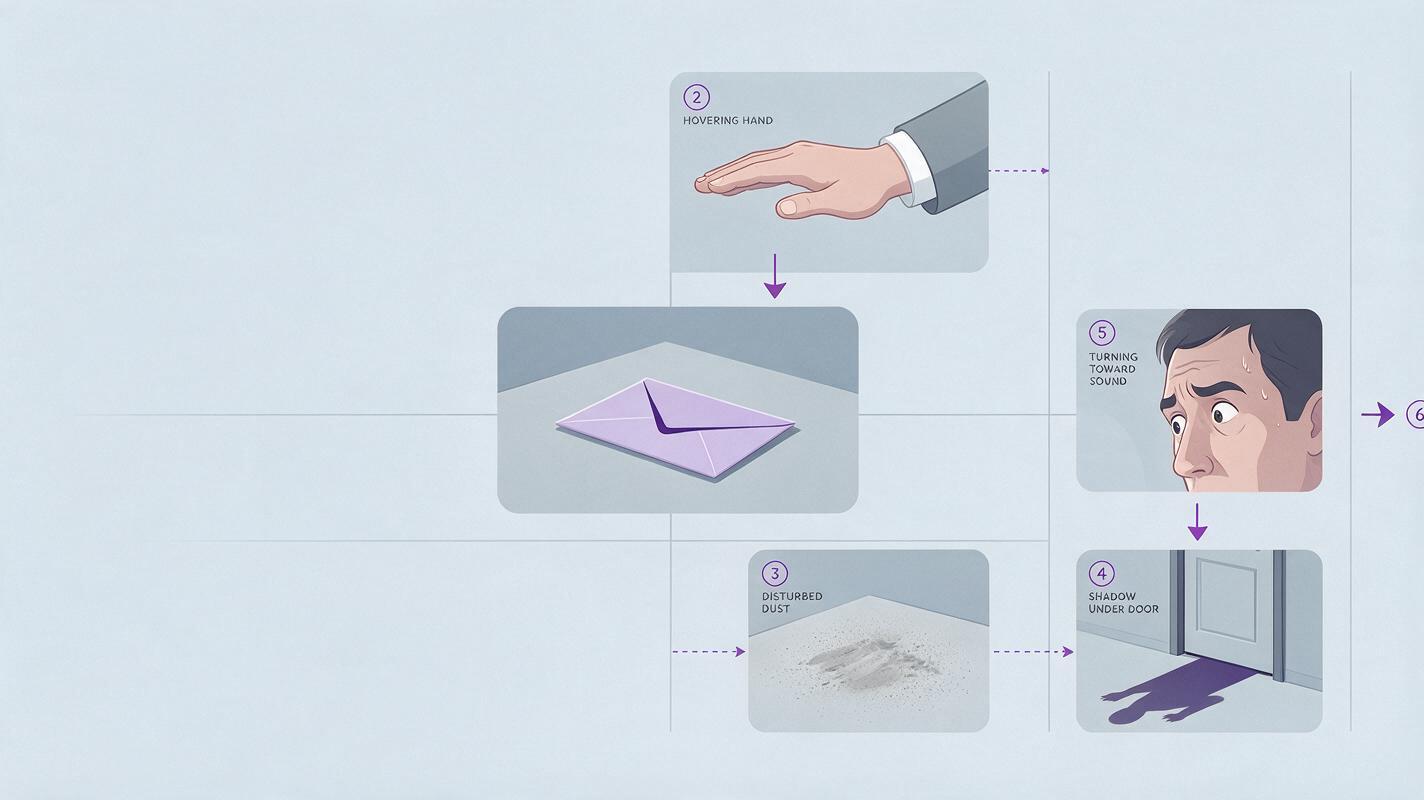
Step 3 — Decide what stays in voiceover
Voiceover is not a failure to visualize the story. In first-person adaptation, it preserves the narrator’s phrasing, attitude, and unreliable interpretation. The problem arises only when narration and image communicate exactly the same information.
Divide the passage into three treatment types:
- Keep: Distinctive lines that reveal personality or interpretation.
- Compress: Explanations that can become a shorter bridge between images.
- Replace: Concrete actions already visible on screen.
For the sample scene, “That was the lie I preferred” is worth keeping because it expresses self-awareness. A sentence explaining that the letter is unopened can be removed if the seal is clearly visible.
A useful relationship is commentary plus evidence rather than description plus duplication:
| Weak pairing | Stronger pairing |
|---|---|
| Voiceover: “I did not open the letter.” Image: unopened letter. | Voiceover: “That was the lie I preferred.” Image: fingers almost breaking the seal. |
| Voiceover: “I was nervous.” Image: nervous face. | Voiceover: “The hallway had never been this loud.” Image: character freezing at a minor floorboard creak. |
Step 4 — Build a subjective camera grammar
First-person prose does not require every shot to imitate the character’s literal eyesight. Instead, create a repeatable visual grammar that keeps the audience close to what the narrator notices.
Combine three kinds of coverage:
- Observational shots establish the character and room clearly.
- Subjective inserts isolate details receiving unusual attention.
- Reaction shots show how perception changes the character’s behavior.
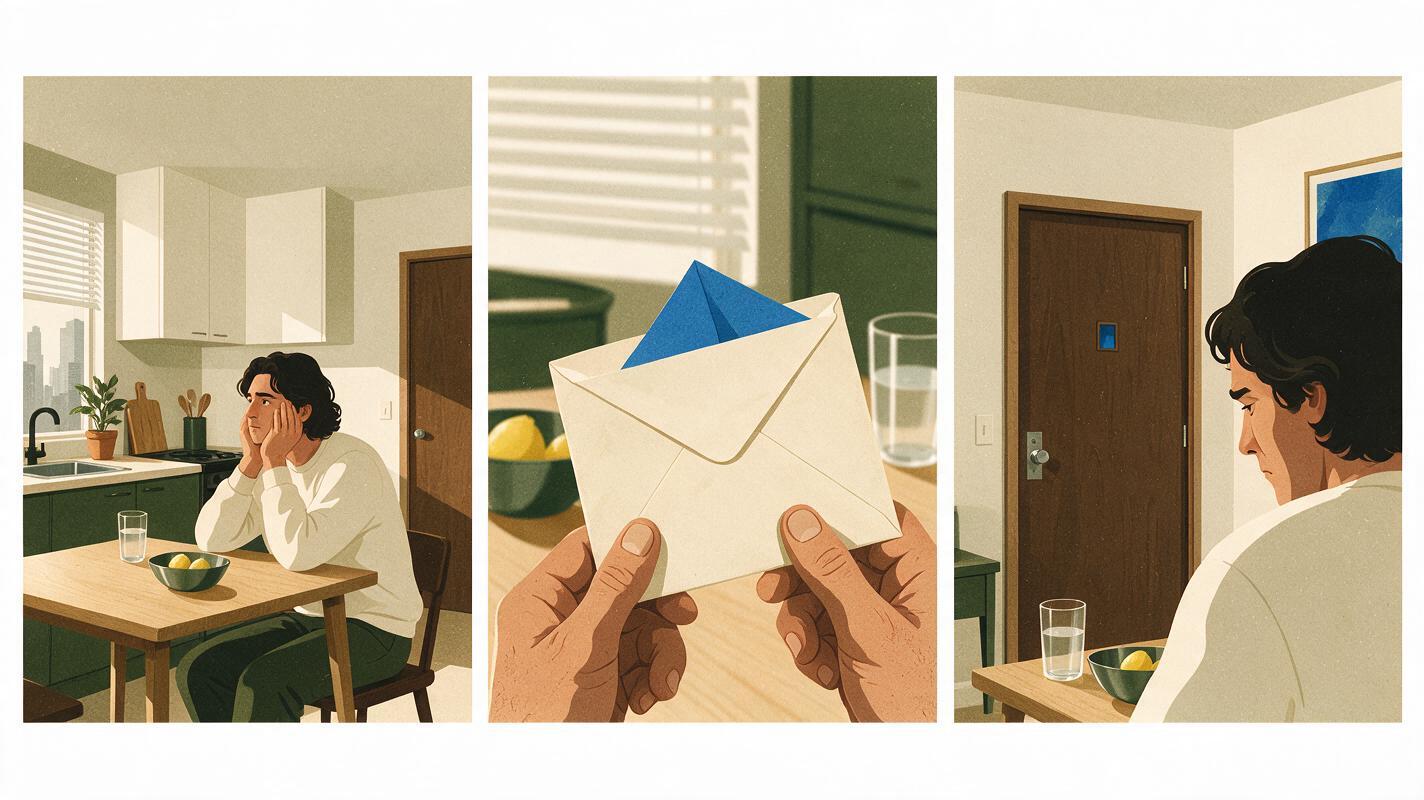
A balanced sequence might move from a medium shot of the narrator at a table, to an insert of the letter, to a view of the door, and back to a close reaction. This creates subjectivity without making the entire scene a first-person camera simulation.
Reserve distorted imagery for moments when the prose supports it. A shallow focus shift, obstructed frame, or slight push toward the door may communicate anxiety. An unrelated dream montage may introduce symbolism that the source passage never implied.
Subjective filmmaking controls attention. It does not automatically mean surreal imagery, handheld movement, or literal point-of-view shots.
Step 5 — Turn the passage into an AI storyboard
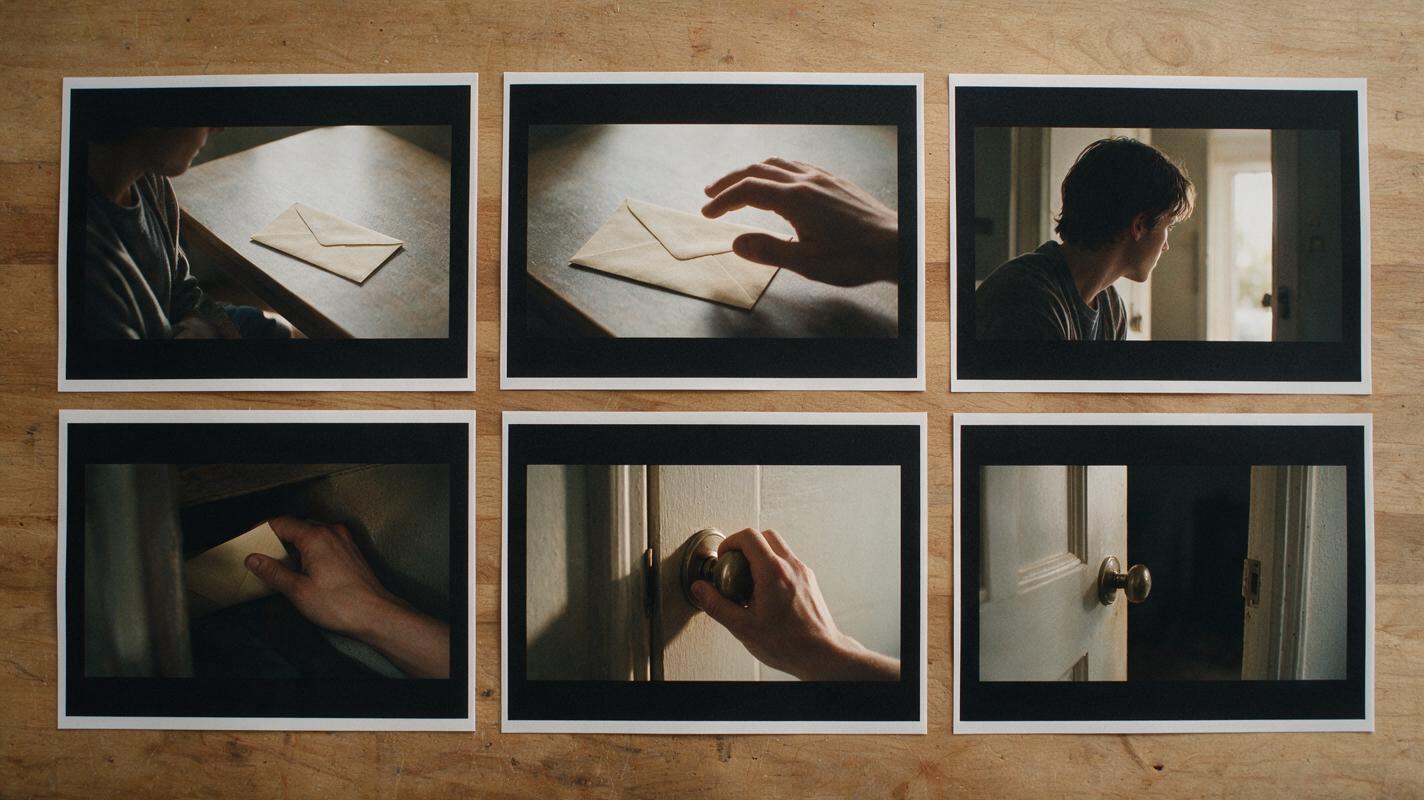
Now convert the evidence into a short board. Each frame should have one editorial purpose and one visible change. For the letter scene, a six-frame progression could be:
- Establish the narrator alone at a kitchen table with the sealed letter.
- Show fingers approaching the envelope and stopping.
- Isolate the intact seal and creased paper.
- Shift attention toward the apartment door after a distant sound.
- Show the narrator hiding the letter as footsteps become clearer.
- End on the doorknob beginning to move.
Use this prompt when you want to turn a script into an AI storyboard while keeping the adaptation restrained:
Create a six-frame storyboard for a quiet psychological drama.

Source passage:
[PASTE PASSAGE]

Narrative objective:
[DESCRIBE THE CHARACTER'S IMMEDIATE WANT]

For each frame provide:
- editorial purpose,
- shot size and camera position,
- visible character action,
- important object or environmental detail,
- emotional change from the previous frame,
- intended final composition.

Preserve one location, one time of day, consistent wardrobe, and consistent object placement. Use subjective inserts only for details the narrator notices. Do not visualize abstract thoughts as floating symbols, text, or fantasy imagery.
Read the proposed board without the original passage. If the visible sequence has no rising pressure, revise the actions before generating polished frames. At this high-intent stage, you can test the converted scene in a script-to-video workspace and compare whether the board still communicates the conflict without explanatory text.
Step 6 — Convert storyboard frames into controlled clips
An AI clip maker needs motion instructions, not another summary of the story. Describe what changes during each shot and where the shot should end. Avoid packing several emotional beats into one generation.
For example:
Quiet apartment kitchen at overcast noon. A tense adult sits at a wooden table beside a sealed cream envelope. Medium close shot from table height. The character slowly reaches toward the envelope, pauses with fingertips just above the paper, then pulls the hand back into their lap. The envelope remains sealed and stationary. Restrained natural performance, subtle breathing, locked camera, realistic daylight. End with the hand fully withdrawn.The prompt establishes the opening composition, one action, environmental continuity, camera behavior, and a clear endpoint. The next clip can begin from that endpoint rather than asking the model to invent an unseen transition.
Generate important reaction shots separately from object inserts. This gives the edit room to shorten hesitation, extend suspense, or let voiceover bridge two images. It also prevents a single clip from attempting a hand movement, facial reaction, camera move, sound cue, and prop interaction simultaneously.
Step 7 — Edit narration against discovery
During editing, place narration according to when the audience should understand the thought—not necessarily where the sentence appeared in the novel.
Try three timing relationships:
- Narration before image: The line creates expectation, and the image confirms or contradicts it.
- Narration over image: The voice reframes an ambiguous behavior as it happens.
- Narration after image: The audience sees the action first, then hears the narrator admit what it meant.
For “That was the lie I preferred,” placing the line after the hand withdraws gives the action a second meaning. Placing it before the movement makes the audience wait to see the lie demonstrated. Both are valid, but they create different dramatic rhythms.
Keep ambient sound active beneath the voice. A hallway footstep, radiator knock, paper crease, or restrained breath can make the narrator’s attention tangible. If every sound is equally loud, however, the audience loses the hierarchy of perception.
Final checklist
- The selected passage contains one immediate dramatic change.
- Every internal statement has at least one visible or audible clue.
- Voiceover adds interpretation instead of describing the image.
- The storyboard alternates context, subjective detail, and reaction.
- Each generated clip contains one principal action.
- Props, wardrobe, lighting, and screen position remain consistent.
- Narration timing supports discovery, contradiction, or admission.
- The finished scene remains understandable with the voiceover temporarily muted.
FAQ
Should a first-person novel become a literal first-person video?
Usually not. Literal point-of-view footage can be useful for a brief discovery or inspection, but continuous first-person framing removes access to the narrator’s facial reactions. A mixture of observational shots, subjective inserts, and reactions is more flexible.
How much narration should remain?
Keep lines that carry voice, judgment, irony, or information the images cannot express. Remove narration that merely identifies visible actions or objects. Read the sequence aloud and cut any line whose absence does not change the audience’s understanding.
Can memories be included in the storyboard?
Yes, when the memory changes the present decision. Give it a clear visual boundary through location, lighting, composition, or transition, and keep it brief enough that the current scene remains the dramatic anchor.
What if the AI storyboard looks too literal?
Replace emotion labels with observable evidence. Instead of requesting “a guilty woman,” describe her turning a framed photograph face down before answering the door. Specific behavior generally provides a more useful frame than an abstract emotional instruction.
Sources
Keywords
novel to video, ai story video generator, ai storyboard generator, create ai video from script, turn a script into an ai storyboard, ai clip maker, ai movie maker
Decision: PUBLISH — The article addresses a distinct first-person adaptation problem with an actionable, continuity-aware workflow.