Why AI Anime Blinks Warp the Eyes—and How to Fix Them
AI-generated anime blinks often distort eye size, lashes, eyebrows, or facial identity because the model tries to morph the entire eye continuously. This troubleshooting guide shows how to prepare blink-safe artwork, prompt Vidu for controlled eyelid motion, and repair unstable phases without regenerating the whole shot.
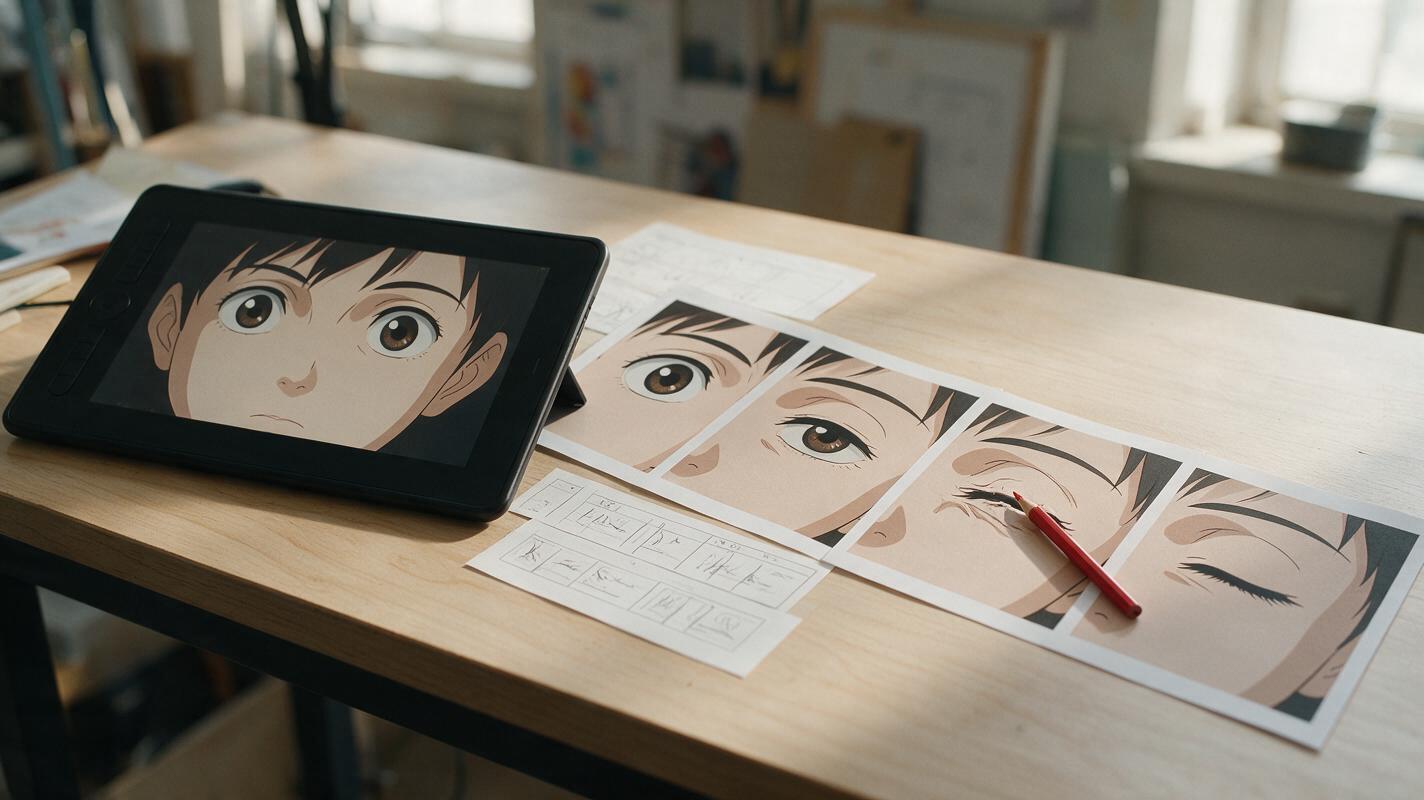
Table of contents
The blink is small, but the damage is obvious
A character can remain perfectly recognizable until a blink makes the eyes shrink, the lashes crawl, or the eyebrows bend into a new expression. The problem is rarely excessive motion alone. Anime eyes are highly designed symbols, while a video model may interpret blinking as a continuous deformation of realistic eyeballs, lids, lashes, and surrounding skin.
A reliable solution is to treat the blink as a short sequence of controlled graphic states. Preserve the character’s eye design, restrict motion to the eyelids, and give the model enough time to return to the original open-eye drawing.
Why generated anime blinks deform the face
In hand-drawn anime, a closed eye is often not a physically compressed version of the open eye. It may be a deliberately simplified line with adjusted lashes and no visible iris. Generative video models instead have to infer every intermediate frame, creating several common failures:
- Iris collapse: the iris shrinks or melts before disappearing.
- Lash migration: the upper lash line slides downward as a separate object.
- Eye-size drift: the reopened eye becomes narrower, rounder, or asymmetrical.
- Eyebrow contamination: the brow moves with the lid and changes the emotion.
- Face-wide morphing: cheeks, nose, bangs, and head shape shift during a tiny blink.
A blink should temporarily change eyelid state, not redesign the character’s eyes.
Build the blink from readable drawing states
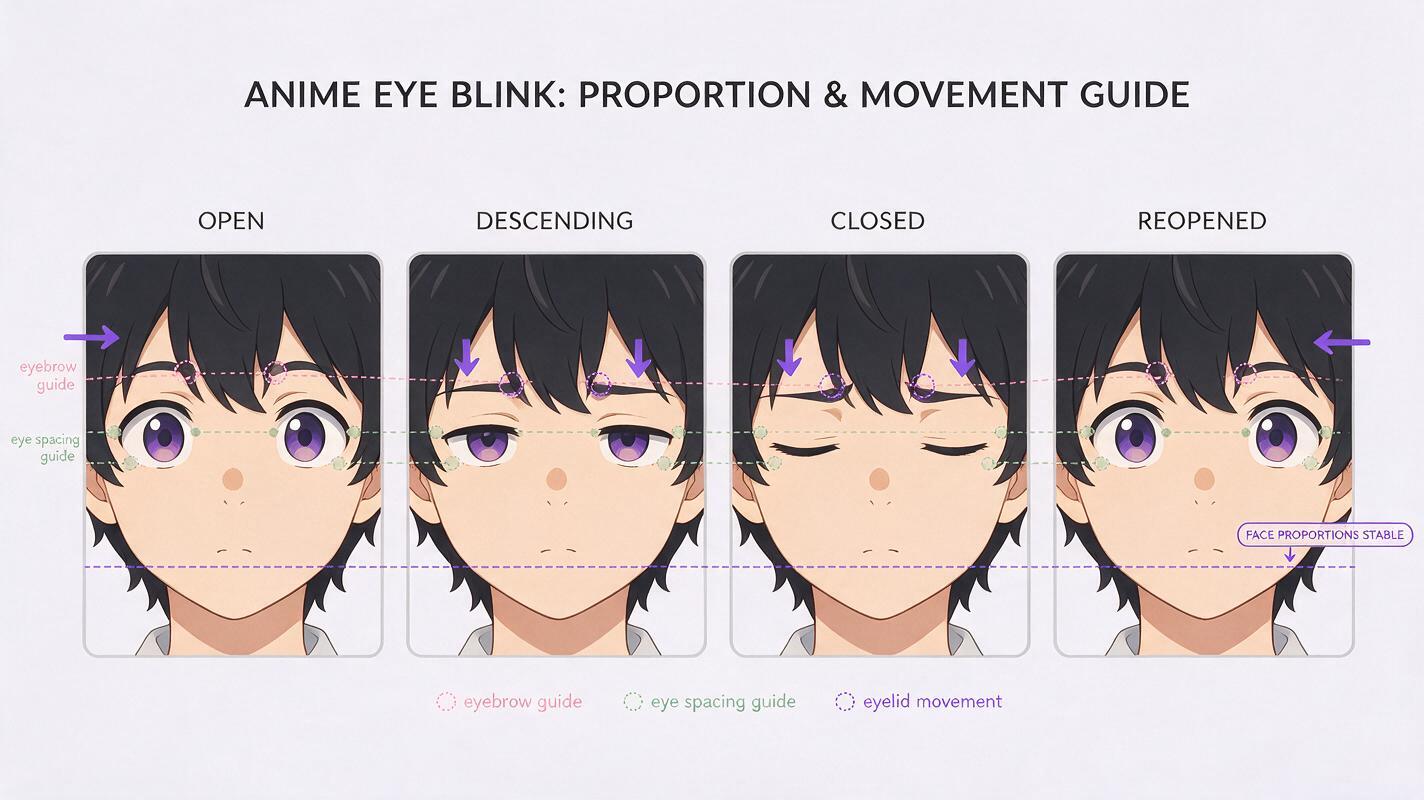
Think in four visual states: open, descending, closed, and reopened. The descending state does not need to be a mathematically perfect midpoint. It only needs to read clearly between the open and closed drawings.
| State | What should change | What should stay fixed |
|---|---|---|
| Open | Nothing; this is the identity reference | Eye shape, iris size, lashes, brows, face |
| Descending | Upper eyelid moves down | Lower lid, eyebrow height, head silhouette |
| Closed | Eye becomes a clean closed-lid line | Lash style, spacing between eyes, expression |
| Reopened | Upper eyelid returns upward | Original iris placement and eye proportions |
For a neutral blink, avoid adding cheek lift, brow compression, or a head nod. Those motions imply a wince, smile, or emotional reaction. They also give the model more opportunities to alter the face.
Prepare a blink-safe source image
Start with a sharp image in which both eyes are readable at the intended output size. Tiny pupils, hair crossing the lash line, heavy bloom, and reflective effects can make lid boundaries ambiguous. If possible, clean these elements before animation rather than asking the video model to resolve them in motion.
- Keep the face large enough to inspect frame by frame.
- Use clear separation between bangs, eyebrows, and upper lashes.
- Remove sparkles or floating particles directly over the eyes.
- Avoid strong motion blur in the source frame.
- Confirm that both irises and catchlights are intentional and symmetrical.
A three-quarter face is workable, but the farther eye should already be drawn smaller in the source. Do not ask the model to correct perspective while it is also animating the blink.
Prompt Vidu for one isolated facial action
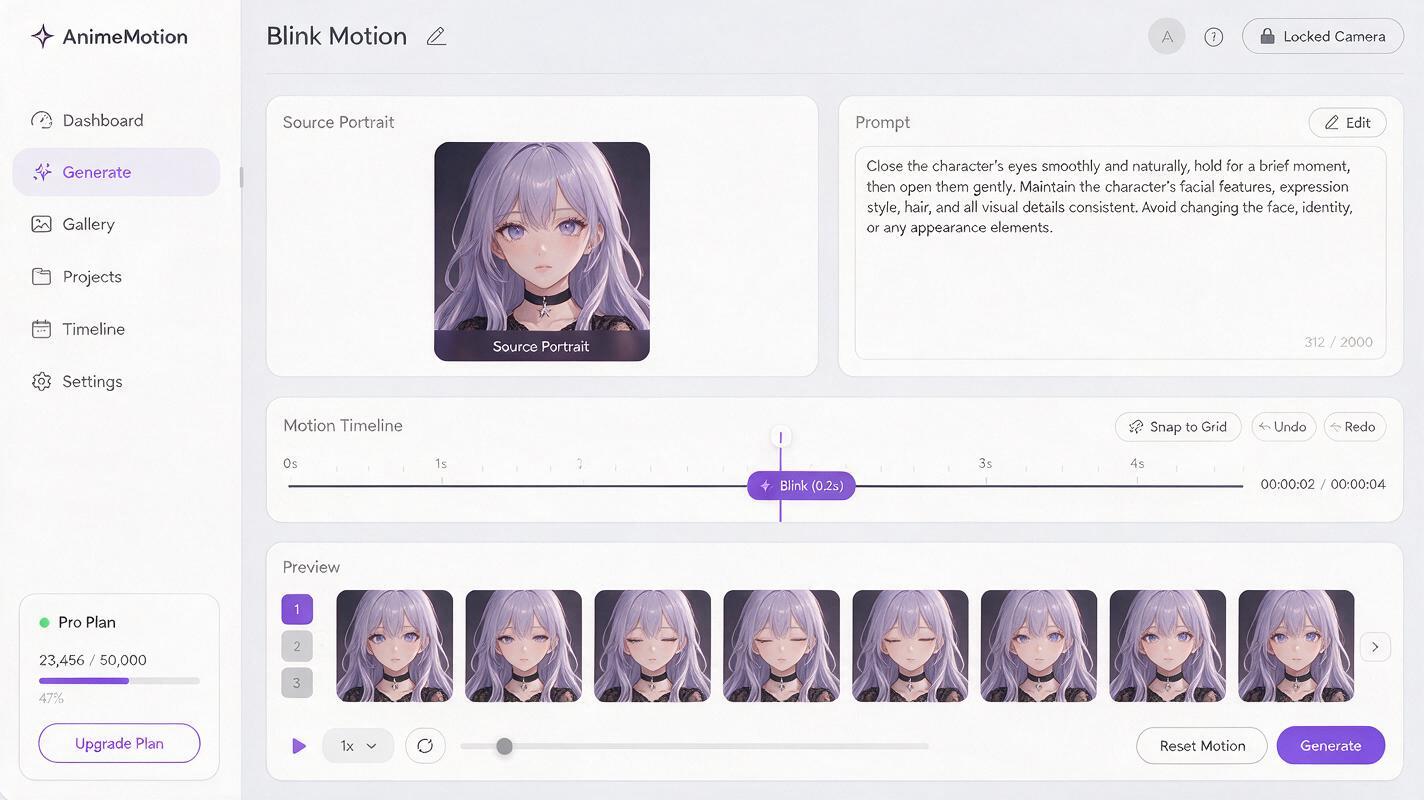
Use Vidu through an image to video workflow so the approved illustration remains the identity anchor. Describe the blink, protected facial features, camera behavior, and ending state. Avoid vague requests such as “natural facial movement,” which may introduce smiling, breathing, hair movement, or a camera push.
Static close-up anime portrait. The character performs one quick, natural blink: the upper eyelids lower cleanly, both eyes close at the same time, then reopen to exactly the original eye shape and gaze. Preserve the iris design, pupil size, catchlights, upper lashes, eyebrows, nose, mouth, face proportions, hairstyle, and line art. No head movement, no camera movement, no expression change, no eye squinting, no facial morphing. End on the original open-eye pose.For a slower dramatic blink, change only the timing and emotional intention:
Anime close-up with a restrained tired blink. The upper eyelids descend slowly, pause briefly in a clean closed-eye drawing, then reopen to the same eye shape and forward gaze. Eyebrows remain still. Preserve facial identity, lash design, iris color, catchlights, hair silhouette, and line quality. Locked camera, stable background, no mouth movement, no head tilt, no added smile.Generate the simplest version first. Once the eye motion is stable, a separate pass can add breathing, hair response, or a slight gaze change.
Control timing before adding secondary motion
A blink that occupies too much of a short clip can look like sleeping or squinting. One that happens immediately at the first frame may also prevent the model from establishing the source identity. Leave a short open-eye hold before and after the action.
| Desired result | Motion direction | Avoid |
|---|---|---|
| Neutral blink | Quick close, immediate reopen | Long closed hold or brow movement |
| Tired blink | Slow descent, brief hold, gentle reopen | Accidental smile or full head drop |
| Surprised reset | Short blink followed by restored wide eyes | Increasing eye size beyond the source |
| Confident pause | Measured blink with unchanged mouth | Automatic nod or camera zoom |
Do not combine blinking, dialogue, turning, and a major expression change in one prompt unless the shot truly requires them simultaneously. A clean blink can be composited into a larger performance more reliably than a damaged face can be repaired across every frame.
Diagnose the first frame where the eye changes incorrectly
Inspect the clip one frame at a time. The visibly worst frame is often not where the error began. Find the earliest point at which the lash contour, iris diameter, eyebrow position, or eye spacing departs from the reference.
- If the iris shrinks before lid contact, specify that the upper lid occludes the unchanged iris.
- If the lower lid rises strongly, request upper-eyelid-driven closure and a stable lower lid.
- If the eyebrows descend, remove emotional words and explicitly lock eyebrow height.
- If the eyes reopen differently, emphasize an exact return to the original open-eye drawing.
- If the entire face pulses, remove secondary motion and use a locked camera.
Compare the reopened frame directly with the source rather than trusting playback. Small eye-shape changes can pass unnoticed in motion but become obvious when the clip is cut beside another shot.
Repair only the unstable blink phase
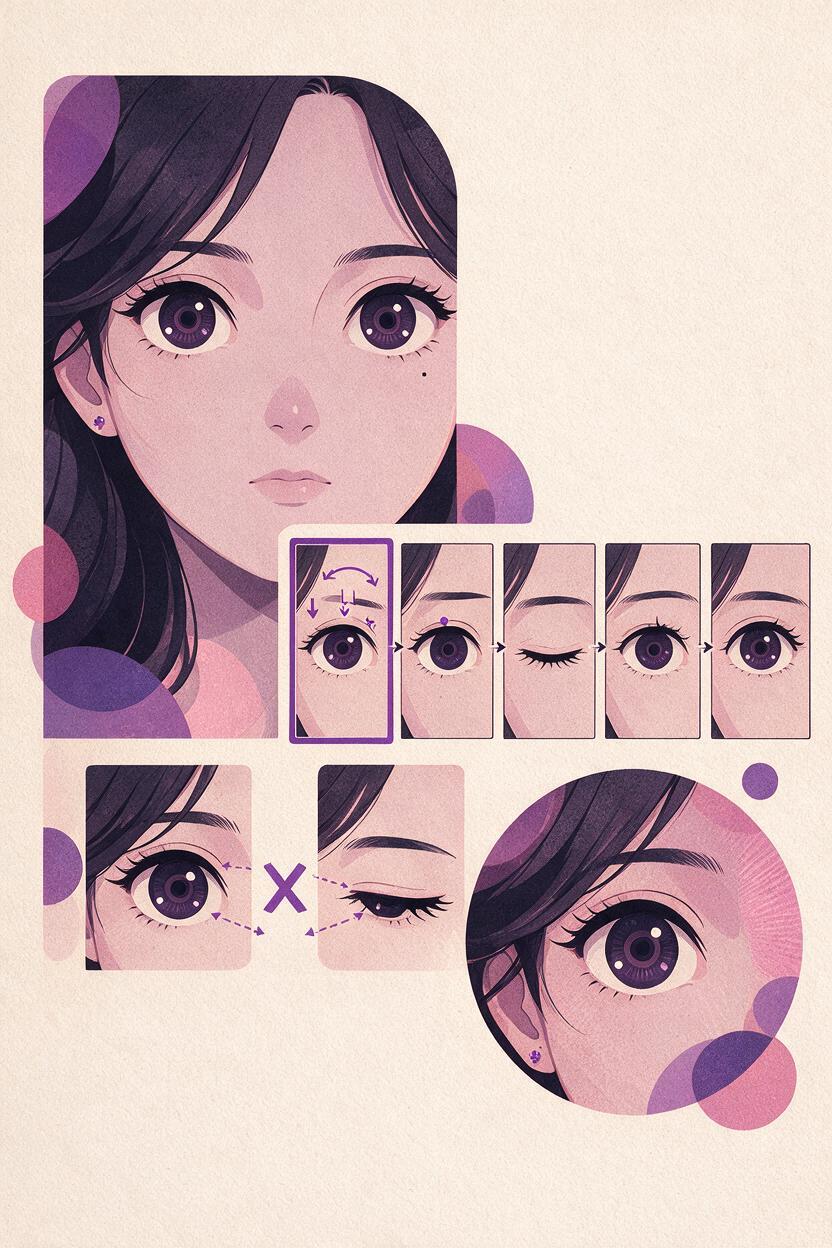
If most of the clip works, avoid regenerating it from scratch. Export the last correct frame before the deformation and use that as a new starting reference. Generate only the closure or reopening segment, then trim and join it to the stable material.
For a malformed closed-eye frame, create a corrected still that preserves the original face while replacing each eye with a clean lid line. That frame can serve as a visual target for a short transition. Match lash thickness, eye spacing, and perspective; a generic curved line may change the character’s expression.
Repair target: same anime character and identical face proportions. Both eyes are naturally closed using clean upper-lid lines that preserve the original lash style and eye spacing. Eyebrows, nose, mouth, cheeks, bangs, lighting, and camera framing remain unchanged. Neutral relaxed expression, no squint, no smile.When the repaired target looks correct, animate into or out of it with minimal motion. You can test this prompt yourself and compare the final reopened frame with the original illustration before rendering a longer shot.
Final checklist
- Use a sharp source image with clearly separated lashes, brows, and bangs.
- Describe one blink rather than general facial movement.
- Make the upper eyelids drive the closure.
- Protect iris size, lash design, eyebrow height, and facial proportions.
- Request a locked camera and no expression change.
- Leave open-eye holds before and after the blink.
- Check the first frame where deformation begins.
- Repair only the broken closure or reopening phase when possible.
- Confirm that the final open eyes match the source image.
Keywords
ai anime blink, anime eye animation, animate anime image, Vidu anime animation, character animation, anime character consistency, 2D animation AI