Flux Prompts for Fictional Mystery Evidence Boards in Faceless Videos
Create evidence-board visuals that help viewers follow a fictional mystery without relying on unreadable AI-generated notes. These Flux prompts separate atmospheric artwork from the clues, names, and timelines you should add in your editor.
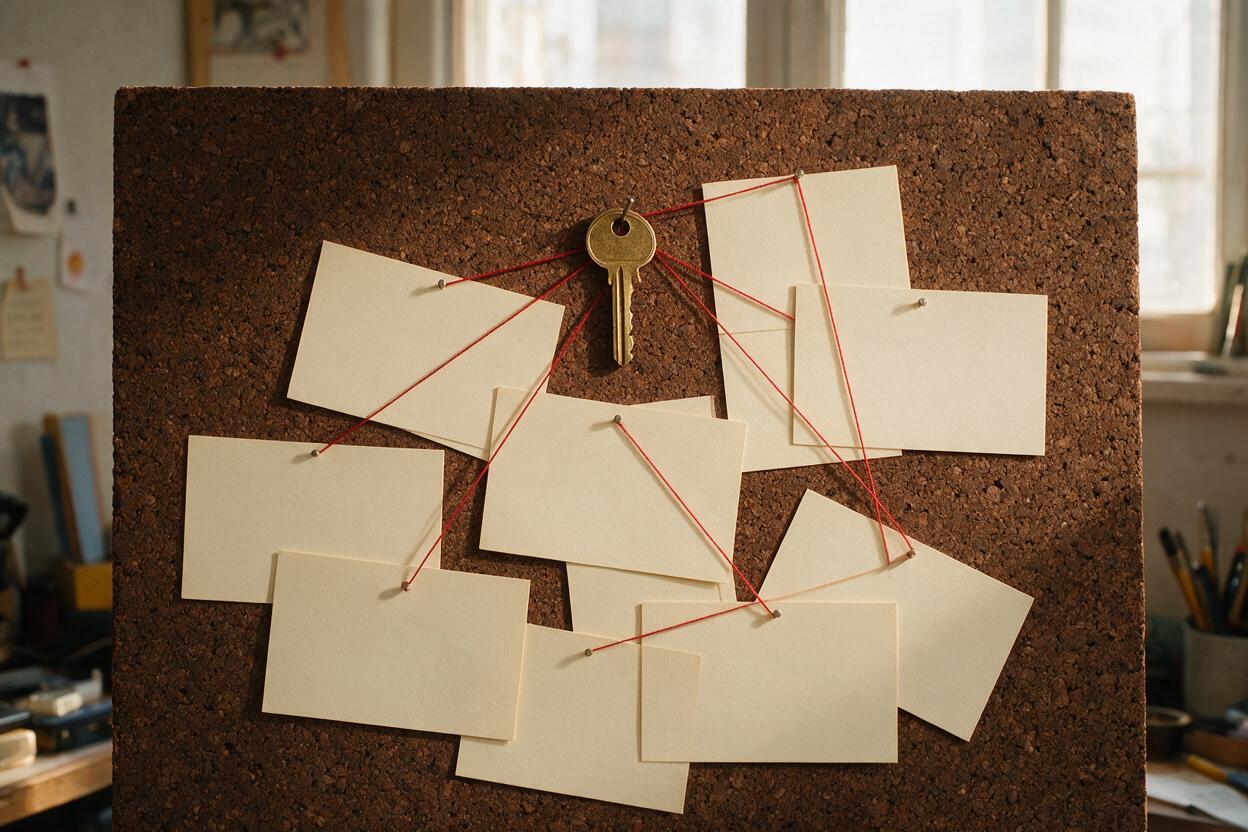
Table of contents
Make the mystery visible, not harder to follow
An evidence board can give a faceless mystery video an immediate visual hook. But if every pinned note contains distorted AI text, viewers will spend the scene trying to decipher nonsense instead of following your story. Use Flux to make the board, props, lighting, and composition; add the actual clues and connections yourself in the edit.
The prompts below are for fictional stories. They produce four distinct visuals: an opening board, a suspect-relationship layout, a timeline surface, and a final-reveal image. Together, they give each story beat a different job without making the board look like evidence from a real case.
Keep clues readable without AI-generated text
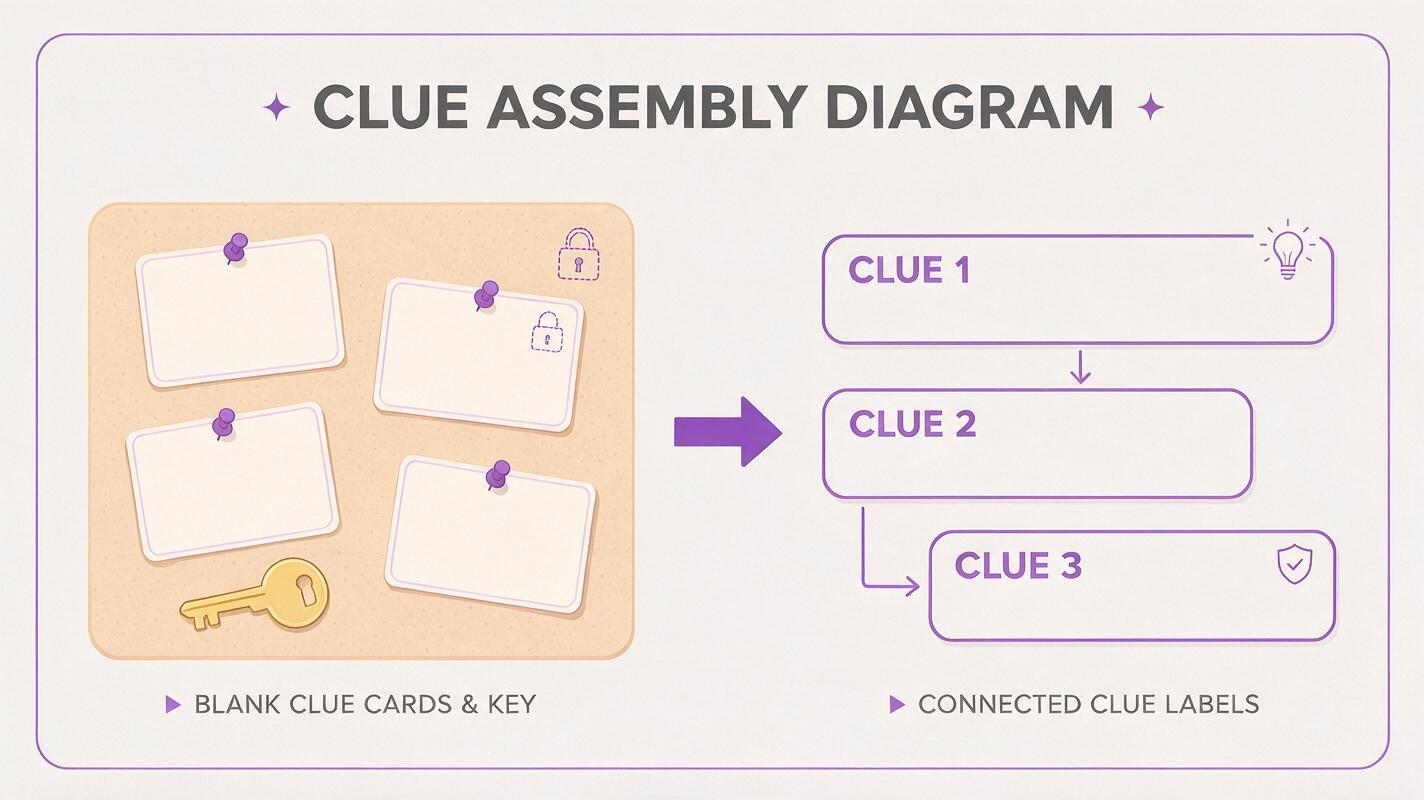
For this kind of asset, an ai image generator is best used as a set designer, not a source of facts. Ask Flux for blank cards, unmarked photographs, string, tape, and useful empty areas. Put every name, date, accusation, and directional arrow in your editing software, where you can spell-check it and change it when the script changes.
Before generating, write a tiny clue inventory: the facts the viewer must notice now, the detail you are deliberately withholding, and the fact that changes meaning at the reveal. If a detail does not serve one of those jobs, it probably does not belong on screen.
Fictional-story safeguard: Use invented characters, places, and props. Do not dress generated imagery as authentic police files, archival evidence, or photographs of real victims.
Prompts for four story beats
These prompts share a visual language—warm desk light, worn paper, restrained red thread—but change the composition to match the narration. Replace the bracketed subject with a fictional prop from your script. Generate the backgrounds without legible writing; add story-specific information afterward.
The opening question
Give viewers one object to remember rather than a wall of possible answers. This image works under a question such as, “Why was the key found twice?”
Fictional mystery evidence board on a cork wall, one small brass key pinned at the center as the unmistakable focal point, three blank cream index cards spaced far apart, two unmarked atmospheric photos of an invented coastal town, a single loose red thread that does not yet connect the cards, warm desk-lamp light, tactile paper and cork, clear visual hierarchy, landscape 16:9 composition with open space on the left for an editor-added question, no readable writing, no logos, no real people, no police insignia.The suspect relationships
Once the narration introduces characters, the board should show structure rather than pretend to prove guilt. Leave room for your own portraits or illustrated character cards, and connect only relationships established in the script.
Close view of a fictional investigation board with four evenly spaced empty portrait-card slots around one central blank card, subtle red-thread paths between the slots, small unmarked paper scraps and binder clips, no faces or names generated, no implication that any one slot is guilty, warm desk-lamp lighting, coherent cream-paper and dark-cork palette, straight-on camera angle for easy editor overlays, landscape 16:9, no legible text, no seals, no official documents.The timeline contradiction
For a time-based reveal, use a clean surface with space for three events. Add times and arrows in the editor so the contradiction is readable on a phone.
Overhead editorial photograph-style image of a fictional mystery timeline being assembled on a wooden desk, three large blank cream cards in a clear left-to-right row, a folded invented-town transit ticket with no readable print, a simple unlabeled clock face as a background prop, narrow red thread near the cards but not covering them, warm evening light, generous clear margins for editor-added timestamps and arrows, landscape 16:9, no legible writing, no real brand marks.The final reveal
Return to the opening object, but change its context. Repeating the key gives the reveal a visual payoff without requiring a brand-new location or cast of generated characters.
Same fictional mystery-board visual language: warm desk light, dark cork, cream cards, restrained red thread; the small brass key now sits beside an opened empty envelope, with the surrounding blank cards pushed softly out of focus, deliberate open space to the right for one editor-added reveal sentence, cinematic but plausible tabletop composition, landscape 16:9, no readable text, no official-looking evidence labels, no faces.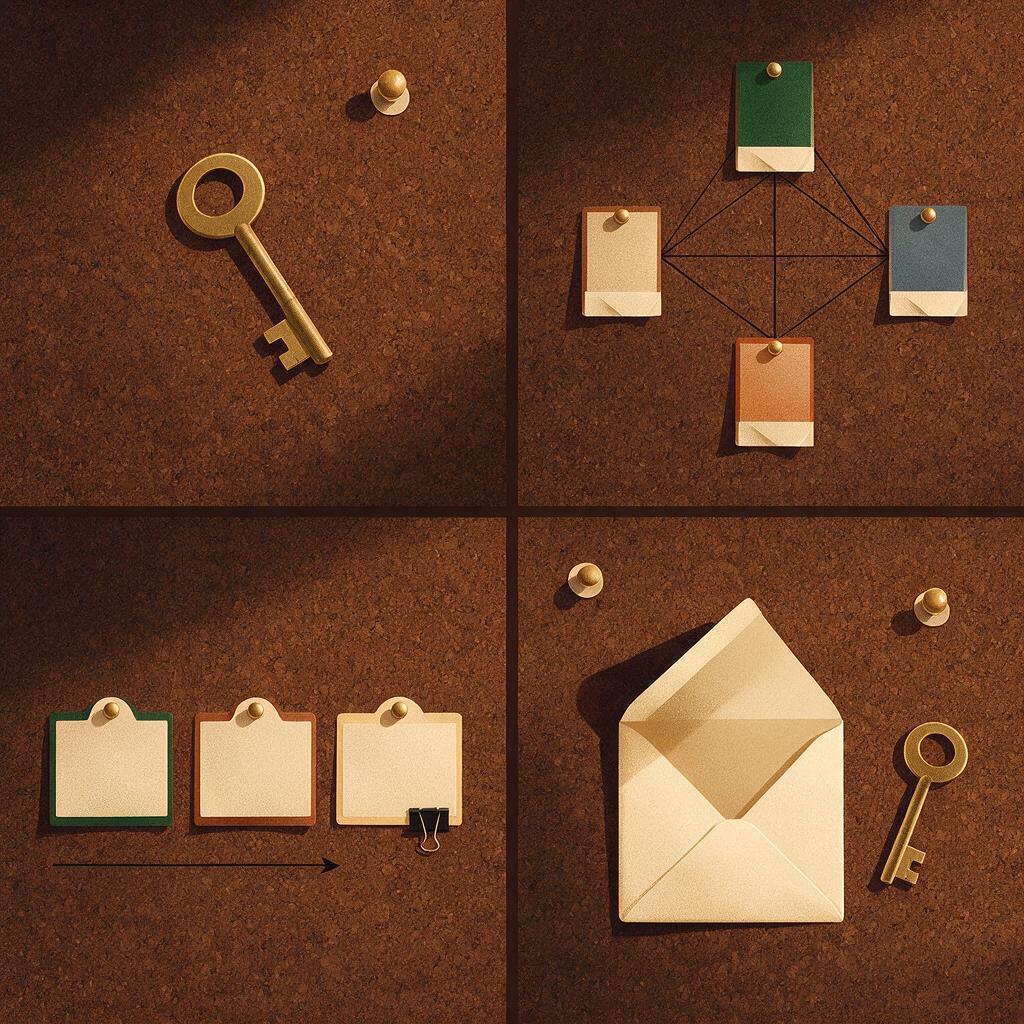
Keep the boards consistent without making them identical
Choose one opening image as your visual reference if your generation interface supports reference images. Otherwise, repeat a short continuity phrase in every prompt: dark cork, cream cards, warm desk light, small brass key, restrained red thread. Keep those constants while changing the camera angle and the arrangement for each beat.
Inspect every result for accidental lettering, extra keys, impossible thread connections, and props that suggest an unmentioned plot point. Crop or regenerate a distracting image rather than explaining away a visual mistake. If Flux does not follow a compositional request reliably, simplify the frame: fewer cards and one focal object usually give you more room to finish the story accurately in the editor.
Build the reveal in the editor
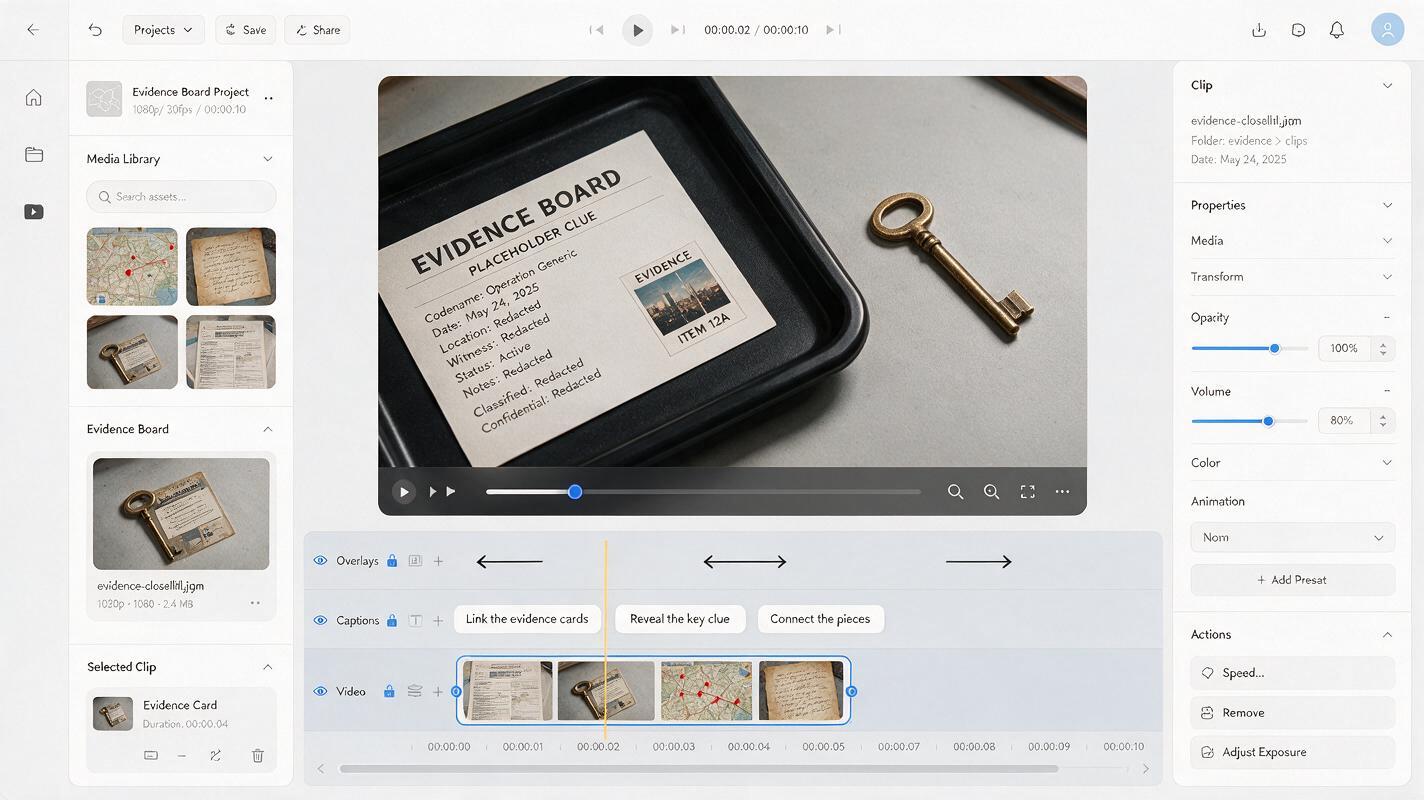
Bring the selected images into your timeline and place names, times, and arrows on separate editable layers. Hold the opening board long enough for viewers to register the key, but do not expose every clue at once. On the relationship board, reveal connections as the narration establishes them. On the timeline, highlight the two times that conflict. Save the envelope and the final line for the moment the script resolves that conflict.
Check the result at phone size, even if you are publishing a horizontal video. A clue that is only readable on your editing monitor is not doing its job. Keep overlays large, use strong contrast, and remove decorative strings that cross important information. If you animate the stills with a slow crop or push-in, keep the motion subtle enough that labels remain legible.
The payoff should come from your written story—not from a generated image inventing evidence. When you have your opening prop and clue inventory ready, test this prompt yourself, then add the facts only after you have chosen the clearest board.
Final checklist
- The board presents one clear focal clue at the opening.
- All names, dates, arrows, and reveal text are editor-added and verified against the script.
- Shared props and lighting connect the images across story beats.
- No generated detail appears to depict a real case or an authentic official record.
- Every important clue remains readable at phone size.
Keywords
flux prompts, fictional mystery visuals, evidence board prompts, faceless story videos, ai image generator, visual storytelling