GPT Image Prompts for Comic Expression Sheets That Keep the Same Face
Create a comic character expression sheet without changing the face, hairstyle, costume, or drawing style between cells. These reusable GPT Image prompts separate fixed identity traits from adjustable acting cues, helping illustrators generate clearer emotions and useful intensity variations.
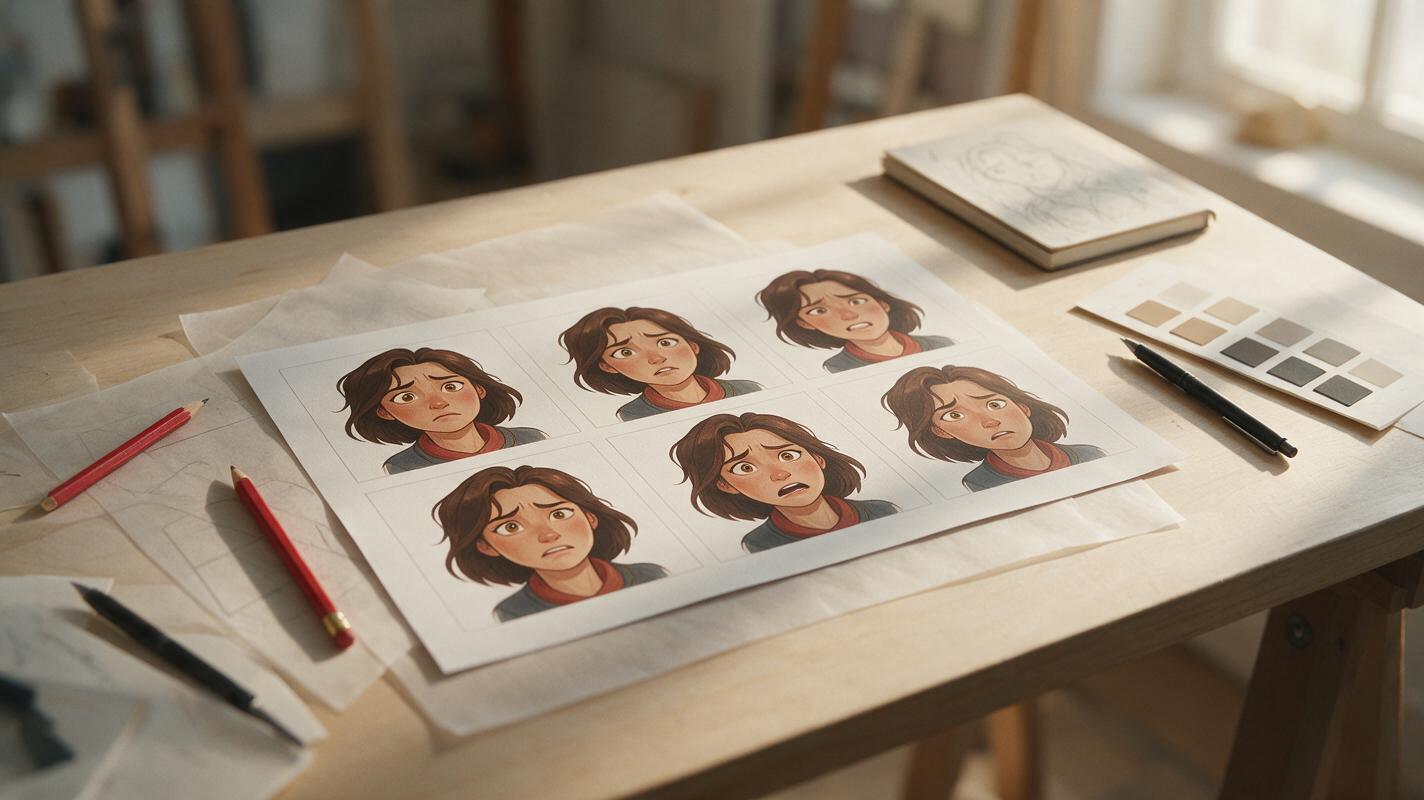
Table of contents
Build expressions without redesigning the character
A useful comic expression sheet should make one character look angry, frightened, embarrassed, relieved, and delighted without turning each emotion into a different person. The common failure is not a lack of emotion. It is uncontrolled change: the jaw becomes narrower, the eye shape changes, bangs move, accessories disappear, or the rendering style shifts between cells.
The solution is to divide the prompt into two layers. One layer defines what must remain fixed; the other describes the facial muscles, posture, and intensity that may change. This prompt framework uses GPT Image, but the same structure can support reference-based illustration work in other image models.
The central rule: identity belongs in the reference and fixed-traits block; emotion belongs in the acting block. Do not ask the model to reinterpret both at once.
Choose a reference that exposes the identity anchors
Start with a clean bust or waist-up drawing in which the character faces roughly forward. Avoid extreme foreshortening, heavy shadow across the eyes, hair covering most of the face, or a hand touching the mouth. Those features make it harder to tell whether later differences are intentional acting or accidental redesign.
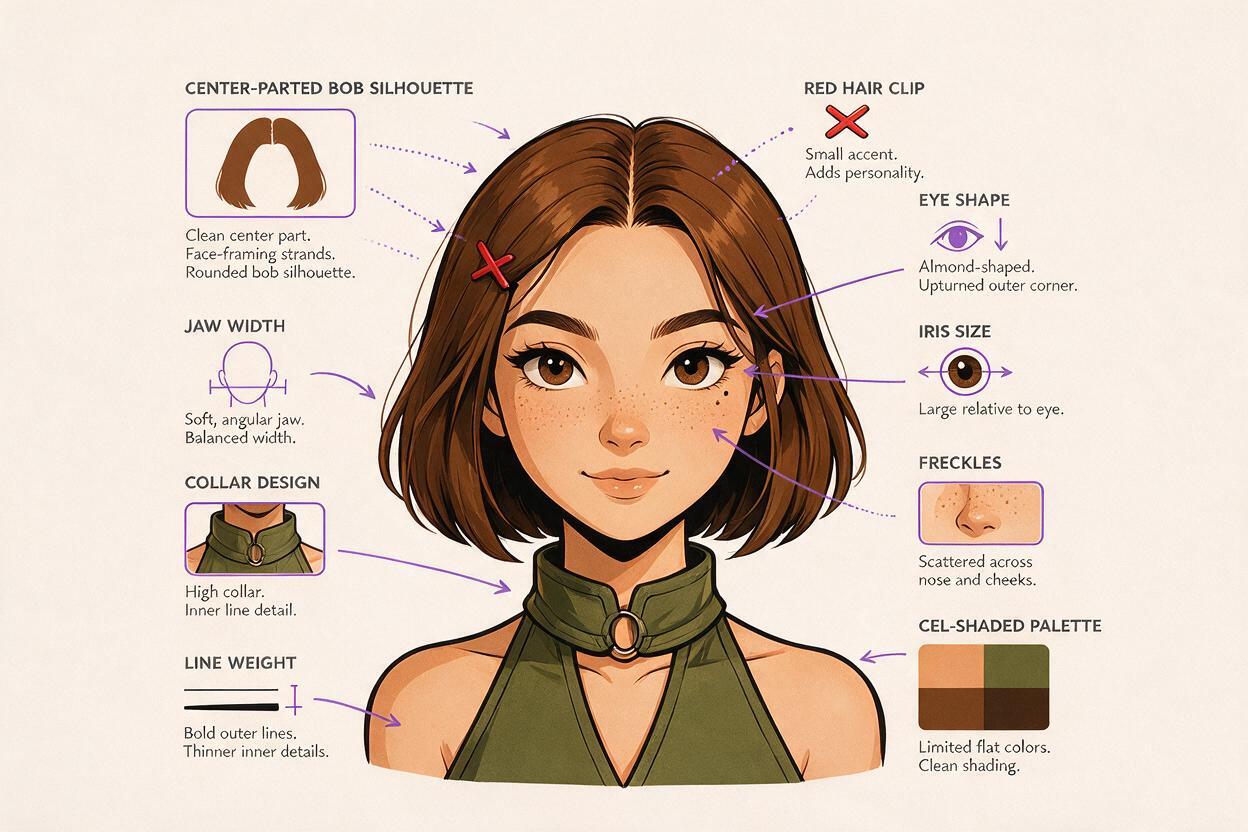
Your reference should clearly show the traits readers use to recognize the character:
- Face structure: jaw width, chin shape, cheek fullness, nose length, and ear placement.
- Eye design: eye shape, iris size, eyelash treatment, pupil style, and eyebrow thickness.
- Hair construction: hairline, parting, bang silhouette, side locks, and overall volume.
- Persistent details: freckles, scars, piercings, glasses, hair clips, or distinctive makeup.
- Art language: line weight, cel-shading method, palette, texture, and level of detail.
MagicBoat's ai image generator can be used with GPT Image to develop the sheet from a prepared character reference. Treat the reference as the design authority rather than asking a text prompt to reconstruct every feature from memory.
Write a fixed-traits block before describing emotion
A fixed-traits block is a short description reused unchanged in every generation. It should identify visible facts, not personality labels. Terms such as “beautiful,” “cool,” or “mysterious” invite interpretation; geometric and costume details provide firmer boundaries.
Create a clean comic character expression sheet using the attached reference.

Keep fixed in every cell:
the same oval face with a broad jaw and short rounded chin;
the same large downturned eyes, dark irises, straight eyebrows, and small nose;
the same black chin-length bob, center part, triangular side locks, and red hair clip;
the same freckles across both cheeks;
the same cream jacket collar and red undershirt;
the same crisp ink lines, flat cel shading, and limited warm palette.

Do not redesign, beautify, age, or restyle the character.
Do not change facial proportions, hairstyle, accessories, costume, or line weight.
Keep this block concise enough to remain readable. If it becomes a page-long inventory, important constraints may compete with one another. Prioritize the five or six traits that would make a reader notice immediately if they changed.
Build an emotion matrix with observable acting cues
Emotion names alone are ambiguous. “Angry” might produce a glare, a scream, clenched teeth, or exaggerated comedy. For controlled results, specify what the eyebrows, eyelids, mouth, head, shoulders, and gaze are doing.
| Emotion | Useful acting cues | Common unwanted result |
|---|---|---|
| Suspicion | One eyebrow slightly raised, narrowed eyelids, lips pressed off-center, head tilted | A generic angry glare |
| Fear | Raised inner brows, widened eyes, small tense mouth, chin drawn back | A theatrical scream |
| Embarrassment | Averted gaze, compressed smile, lifted shoulders, mild cheek warmth | Heavy romantic blushing |
| Relief | Lowered shoulders, softened eyelids, parted lips, gentle exhale | A broad cheerful grin |
| Contained anger | Lowered brows, tight jaw, direct gaze, closed mouth | Open-mouthed rage |
| Delight | Raised cheeks, curved eyes, open smile, slight forward lean | A childlike redesign |
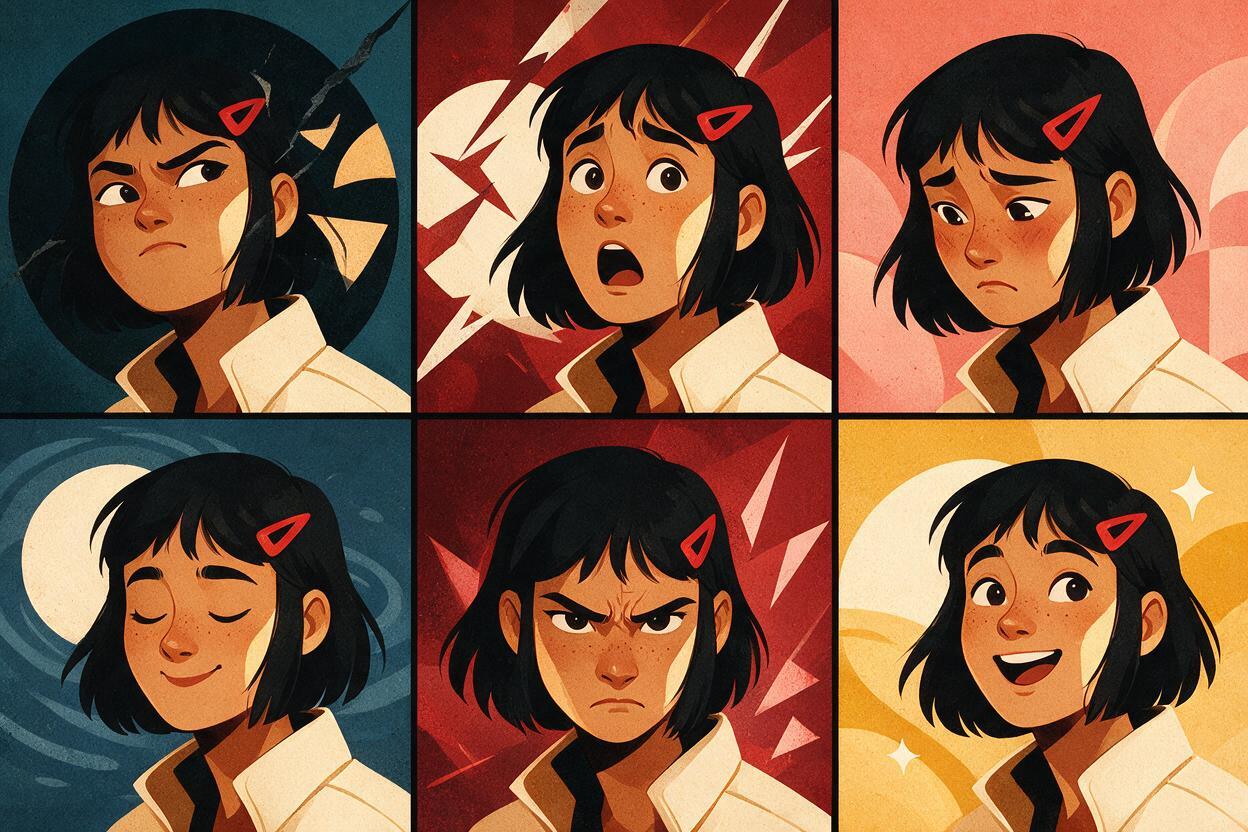
Use the matrix to generate a contact sheet, but label the intended emotions outside the generated artwork whenever possible. Image-generated labels can be inconsistent, while manually added labels remain editable and easy to proofread.
Arrange six equal bust portraits in a neutral contact-sheet grid.
Use the fixed character design from the reference in every cell.

Show these distinct performances:
suspicion — one eyebrow raised, narrowed eyes, lips pressed to one side;
fear — raised inner brows, wide eyes, small tense mouth, chin pulled back;
embarrassment — gaze turned aside, restrained smile, shoulders slightly raised;
relief — softened eyelids, relaxed jaw, lips parted during a quiet exhale;
contained anger — brows lowered, jaw tense, mouth closed, direct stare;
delight — cheeks lifted, eyes curved, open natural smile.

Keep the camera distance, head size, lighting, costume, and rendering identical.
Plain background. No captions, speech bubbles, props, or decorative frames.
Create intensity ladders for important story beats
Comics often need more than one version of the same emotion. A character may move from mild concern to alarm before reaching panic. Generating an intensity ladder helps the artist choose a performance that matches the panel rather than accepting whichever exaggerated face appears first.
Ask for three or four levels while preserving the same emotional family. Change only a few cues at each level so the progression remains readable.
Create four matching bust portraits of the referenced character showing rising fear.

Level A: mild concern, inner brows slightly raised, lips closed, eyes attentive.
Level B: clear alarm, eyes wider, mouth slightly open, neck tense.
Level C: strong fear, pupils focused, brows lifted, chin pulled back, shallow breath.
Level D: near panic, eyes fully widened, mouth open, shoulders raised, but no comedy distortion.

Preserve identical facial structure, hair silhouette, costume, palette, line art, camera angle, and lighting across all four portraits.
For quieter characters, the difference between levels may come mainly from eyelids, breathing, and posture. For expressive comedy, the ladder can expand farther—but the final level should still preserve the defining face and hair silhouette unless deliberate deformation is part of the comic's established style.
Separate facial acting from body acting
If the model changes the costume or anatomy while attempting a strong emotion, generate the face study first. Once the expression works, create a separate waist-up variation that adds shoulders, hands, or a directional pose.
Prompt for restrained body acting
Using the approved relieved expression as the facial reference, create a waist-up comic panel.
The character leans against a closed door after escaping danger.
Shoulders drop, one hand rests loosely against the chest, and the other hangs at the side.
Keep the exact face, hairstyle, freckles, red hair clip, jacket design, line weight, and cel-shaded palette.
Quiet recovery, not happiness; no broad smile and no heroic pose.
Prompt for asymmetrical acting
Create a waist-up reaction pose of the same character trying to hide irritation.
One eyebrow sits slightly lower than the other, the mouth pulls subtly to one side,
and one hand grips the opposite sleeve while the shoulders remain controlled.
Preserve the reference face, hair construction, clothing details, proportions, and comic rendering.
Avoid symmetrical facial features, screaming, clenched fists, and exaggerated anger symbols.
Asymmetry is especially useful for subtext. A perfectly mirrored expression often reads like an icon, while a slightly uneven mouth or eyebrow can suggest hesitation, sarcasm, concealed anger, or a forced smile.
Repair drift without regenerating the entire sheet
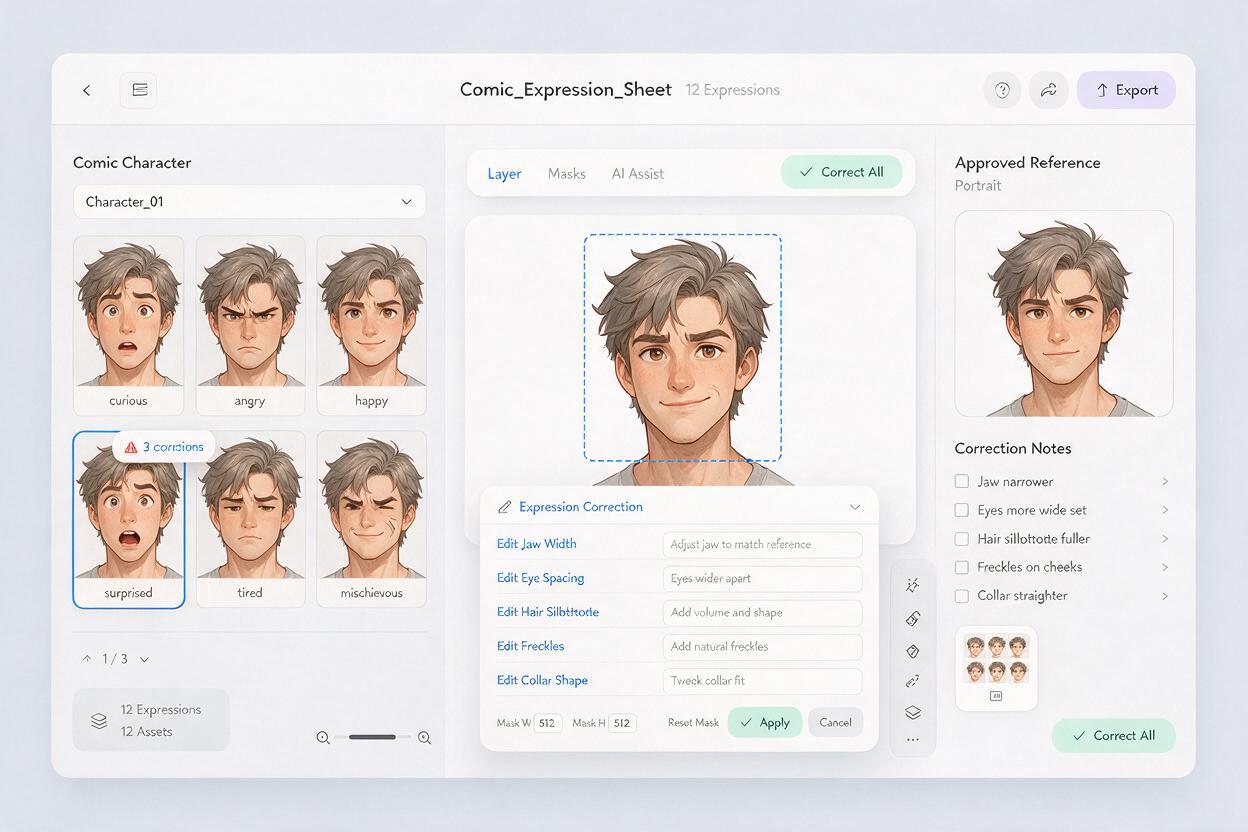
Inspect every cell at thumbnail size and close range. At thumbnail size, look for changes in silhouette, head width, hair volume, and value balance. Up close, compare eye spacing, jaw shape, accessory placement, costume seams, and line treatment.
If five cells work and one drifts, do not reroll the complete sheet. Isolate the faulty cell and request a correction using the best matching cell as an additional reference.
Correct only the selected portrait.
Match the face width, jaw, eye spacing, black bob silhouette, center part,
red hair clip, freckles, collar shape, line weight, and palette of the approved reference.
Keep the current embarrassed expression and averted gaze.
Do not alter the other portraits or increase the emotional intensity.
This repair language distinguishes identity errors from acting choices. “Make it more consistent” is too vague; “match the jaw width and eye spacing while keeping the averted gaze” tells the model exactly what to restore and what to preserve.
Know when the sheet is ready for production
The final sheet does not need to be a polished portfolio piece. Its purpose is to become a stable acting reference for future panels. Keep the strongest version of each emotion, then add your own labels, notes, and any hand-drawn corrections that clarify the design.
- Include a neutral face as the baseline.
- Keep at least one closed-mouth and one open-mouth expression.
- Include subtle, medium, and strong emotional intensities.
- Preserve a consistent crop so facial differences are easy to compare.
- Mark any model output that is inspirational rather than design-accurate.
- Save corrected cells separately so they can serve as future references.
Once the identity block and acting vocabulary match your character, reuse them for reaction panels, dialogue scenes, and thumbnail exploration. When you are ready to test the framework, create your own version with a front-facing character reference and six clearly differentiated emotions.
Final checklist
- The same jaw, eye spacing, nose, hairline, and accessories appear in every cell.
- Each emotion is described with visible facial and posture cues.
- Camera distance, lighting, costume, and rendering remain controlled.
- Intensity changes do not automatically become comedy distortion.
- Failed cells are repaired individually instead of regenerating the full sheet.
- Labels and dialogue are added outside the generated artwork.
Keywords
gpt image prompts, comic expression sheet, character sheet ai, consistent character ai, comic prompts, facial expressions, ai illustration generator