Hailuo Prompts for Clear Lab Safety Training Clips
Create short Hailuo lab-safety clips that show one observable action without distracting camera moves, changing equipment, or ambiguous PPE. These prompt patterns, shot controls, and review checks help educators produce clearer demonstrations while keeping generated footage separate from authoritative safety instruction.
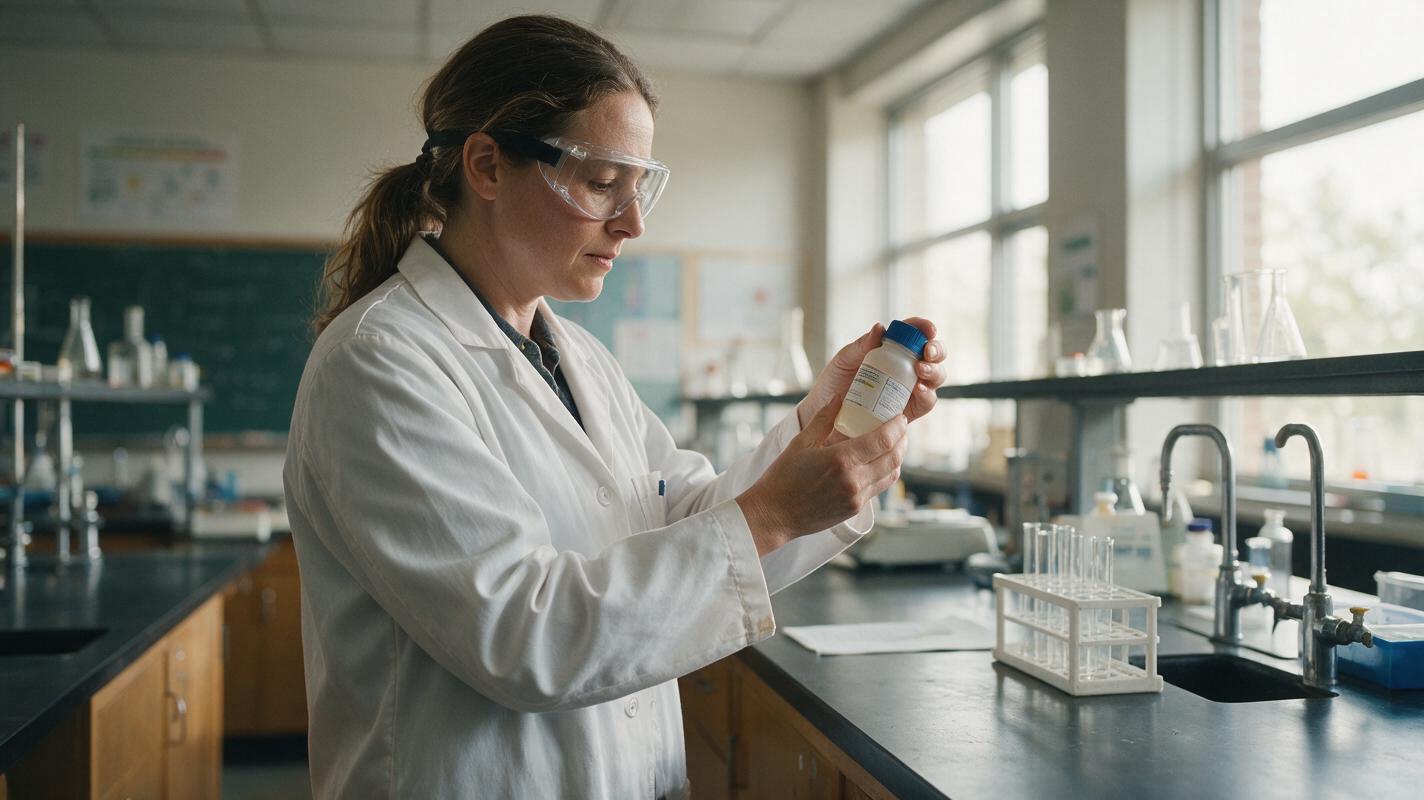
Table of contents
Make lab-safety motion easy to inspect
Generate one visible safety behavior at a time, then reject any clip that changes the equipment, PPE, sequence, or meaning of the procedure.
Lab-safety videos become difficult to teach from when hands move too quickly, goggles disappear between frames, or the camera circles the subject like an advertisement. Hailuo can help create short illustrative clips, but a useful prompt must define the safety state before describing motion.
The goal is not to simulate an entire experiment. It is to produce a focused visual that supports an explanation: tying back hair, checking a container label, positioning a test-tube opening away from people, or placing broken glass in the correct disposal container. Keep official procedures, instructor demonstrations, and local safety rules as the authority.
Plan one observable action per clip
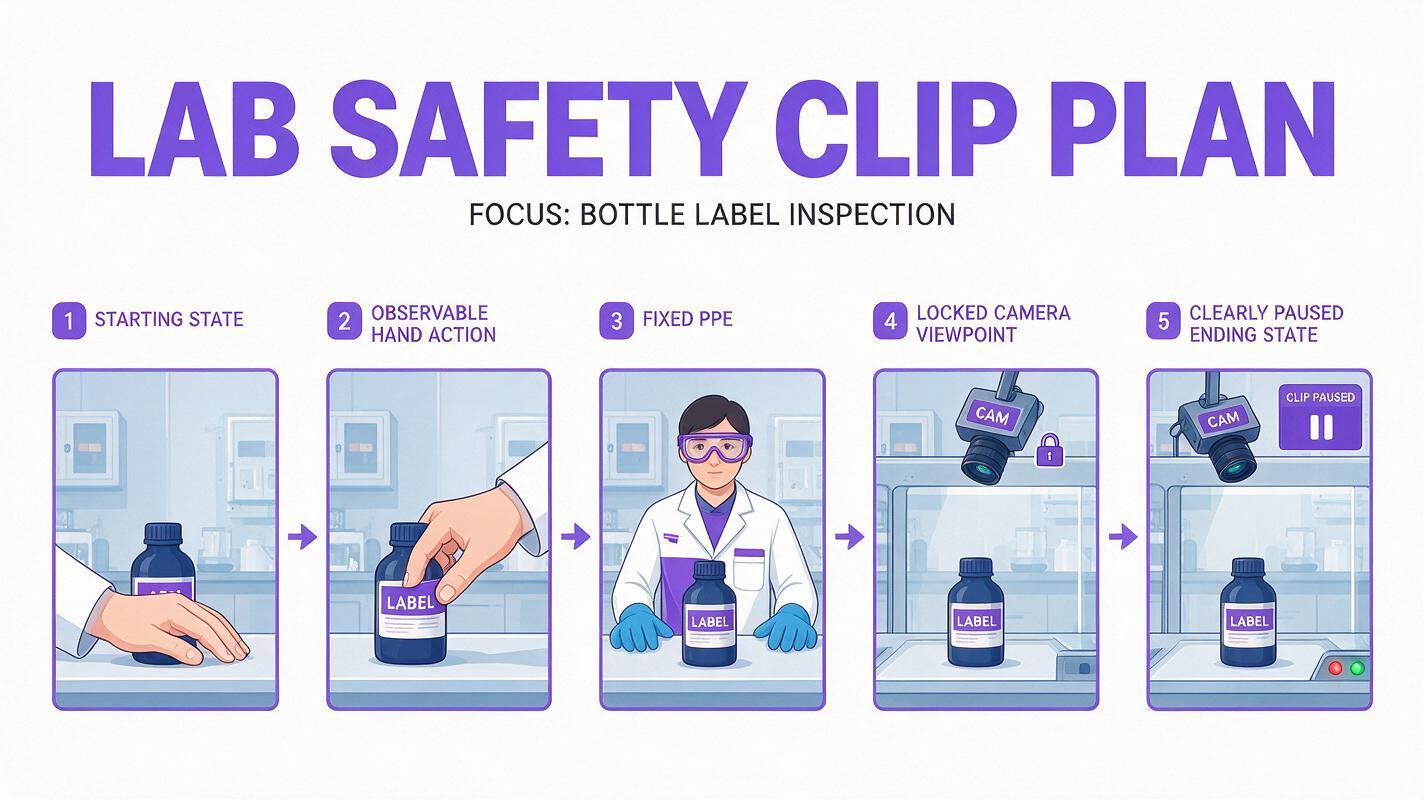
A reliable teaching clip answers one question: What should the learner notice? If the answer contains several verbs, divide the scene. A prompt asking a student to put on goggles, light a burner, heat a tube, and dispose of materials gives the model too many opportunities to invent unsafe transitions.
Before writing the prompt, complete this compact planning frame:
- Behavior: the single action learners must identify.
- Starting state: where the hands, tools, and materials are before movement begins.
- Ending state: the visible result that confirms correct completion.
- Safety invariant: what must remain unchanged throughout the shot.
- Viewpoint: the angle that makes the action easiest to verify.
For example, “inspect the bottle before pouring” is still vague. A more observable behavior is: “The learner keeps the capped bottle on the bench, rotates it until the label faces the camera, and pauses to read it.”
Build prompts around visible safety states
Put the instructional facts before atmosphere or visual style. A practical Hailuo prompt can use five blocks: setting, fixed state, action, camera, and exclusions.
SETTING: Bright secondary-school chemistry lab, clean uncluttered bench.
FIXED STATE: Learner wears splash goggles, buttoned lab coat, tied-back hair; capped reagent bottle remains upright.
ACTION: Learner rotates the bottle until its label faces forward, pauses to inspect it, then returns both hands beside the bottle.
CAMERA: Locked medium close-up from bench height, hands and bottle visible for the entire clip, natural instructional pace.
EXCLUDE: No pouring, no opening the cap, no extra containers, no camera orbit, no disappearing PPE, no readable hazard claims invented by the model.
Exclusions are quality targets rather than guarantees. Review the output frame by frame, especially where fingers contact an object or the action changes direction.
When uniforms, bench layout, or equipment must remain consistent across a course, use a reference image to video workflow. Create or photograph an approved starting composition, remove sensitive information, and animate only the required action. The reference should show the correct PPE and object placement clearly; a visually wrong starting frame will simply preserve the wrong lesson.
Prompt patterns for common lab-safety moments
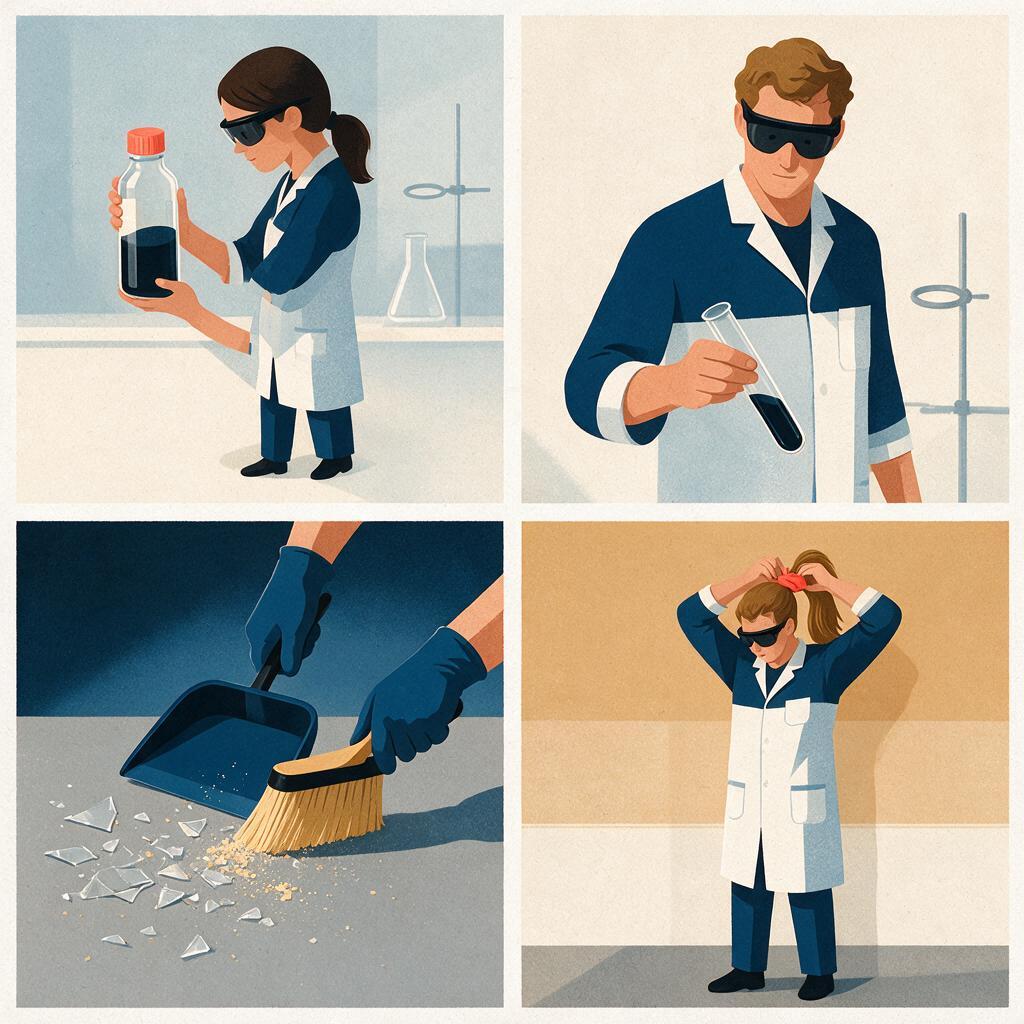
Checking a label before handling a container
Static instructional shot in a school science lab. One learner wearing splash goggles and a closed lab coat stands at a clear bench. A single capped laboratory bottle is upright on the bench. The learner rotates the bottle without lifting it, brings the label into view, pauses to inspect it, and stops. Locked camera, realistic hand movement, moderate pace, no pouring, no cap removal, no additional chemicals, no cinematic motion.Directing a test-tube opening away from people
Side-angle safety demonstration at an uncluttered laboratory bench. A gloved demonstrator holds one empty test tube with a wooden holder. The open end points toward an empty protected area and away from every person. The demonstrator slowly adjusts the angle once, then holds the safe position. Keep goggles, gloves, holder, and tube unchanged. No flame, no liquid, no heating, no bystanders entering the line of the opening.Disposing of broken glass correctly
Close instructional view of a laboratory bench after a minor glass breakage, with no injury and no liquid spill. A clearly designated rigid broken-glass container sits beside the work area. A gloved hand uses a brush and dustpan to collect two visible glass fragments and transfers them into the container. The hand never touches glass directly. Fixed overhead-oblique camera, slow deliberate movement, no bare hands, no ordinary trash bin, no extra fragments appearing.Securing loose hair before practical work
Medium rear three-quarter view of an adult laboratory demonstrator standing at an inactive bench. Before touching any equipment, the demonstrator gathers long hair and secures it fully behind the head. Goggles and lab coat remain correctly worn. No burner flame, no chemicals, no jewelry changes, no camera movement. End with a clear pause showing the secured result.Adapt these prompts to your institution’s approved terminology and procedure. If a generated container label is distorted or fabricated, replace it during editing or keep it outside the shot rather than asking learners to interpret it.
Control the shot without adding drama
Safety instruction benefits from visibility, continuity, and restraint. Dramatic camera language can hide the exact contact point between a hand and a tool. Use a locked shot unless movement is genuinely necessary to reveal the action.
| Teaching need | Useful direction | Direction to avoid |
|---|---|---|
| Show hand placement | Locked close-up with both hands visible | Rapid push-in or shallow focus that blurs the tool |
| Show safe orientation | Side or overhead-oblique view | Orbiting camera that reverses spatial relationships |
| Show a before-and-after state | One continuous action followed by a pause | Montage, jump cuts, or time-lapse |
| Support narration | Neutral pace with visual hold time | Unspecified “dynamic” motion |
Keep the background simple enough that learners can identify the relevant object immediately. Decorative smoke, glowing liquids, crowded benches, and excessive depth-of-field effects may look polished while reducing instructional clarity.
Fix the failures that make training unsafe
PPE vanishes or changes
Move PPE into the fixed-state block and mention only items that must be visible. Shorten the action, choose a camera angle that keeps the face and torso in frame, and reject clips with even brief continuity loss.
Hands merge with tools
Reduce the number of objects and describe where each hand begins. Replace “handles the equipment” with a specific contact such as “right hand grips the wooden holder at its midpoint while the left hand remains flat on the bench.” If the contact remains anatomically unclear, use a still illustration instead of video.
Extra hazards appear
Inventory the scene in the prompt: one learner, one tool, one container, clear bench. Explicitly exclude flames, spills, food, phones, and unrelated glassware when they are not part of the lesson.
The correct action is too fast to judge
Ask for slow, deliberate movement and an ending pause. Do not rely on slow-motion editing to repair a clip with malformed intermediate frames; inspect the original motion first.
The clip looks plausible but teaches the wrong procedure
Do not solve this with more cinematic detail. Compare the action against your approved protocol, then rewrite the starting state, contact point, direction, and stopping condition. If the procedure requires precision the model cannot reproduce reliably, film a qualified demonstrator instead.
Review for teaching value, not visual polish
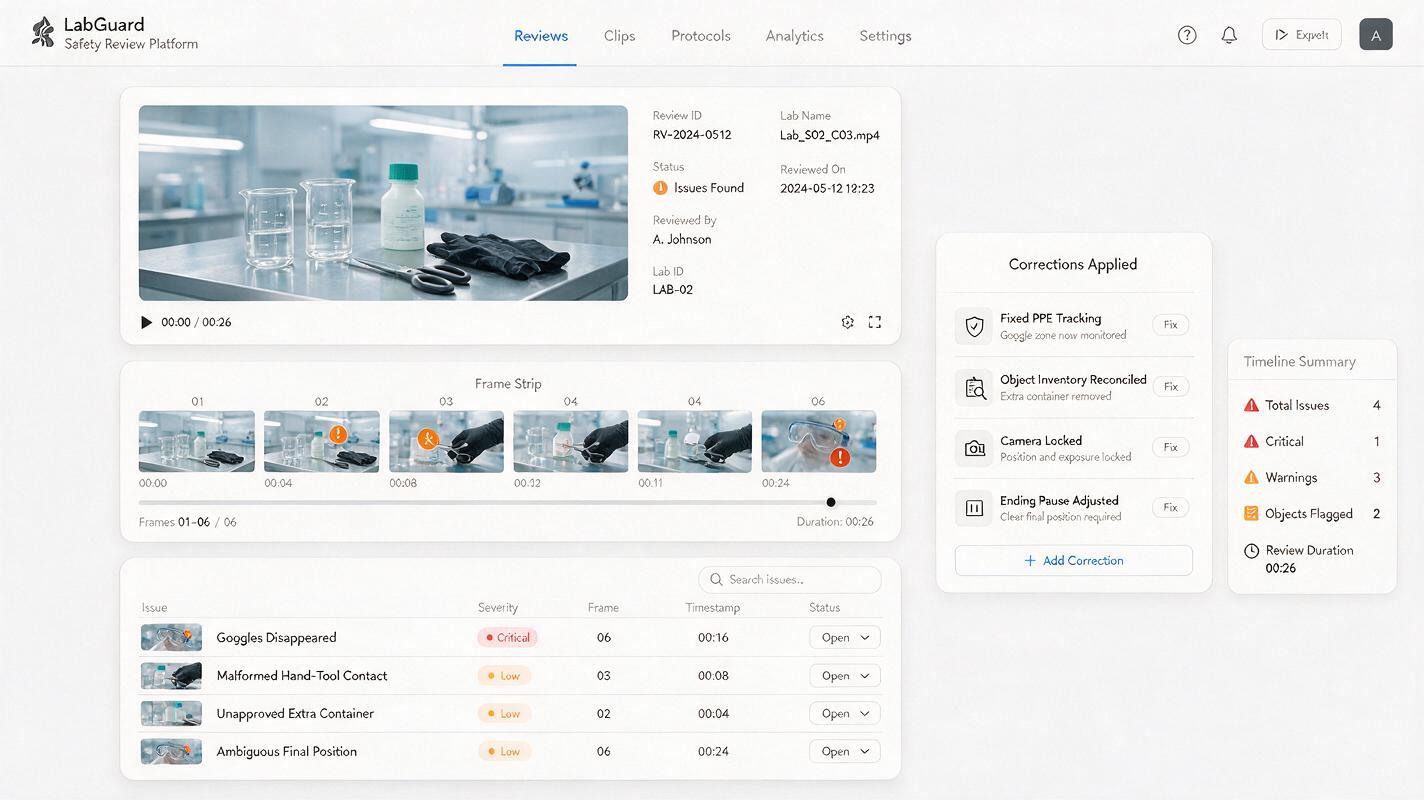
Watch the first review silently. If the intended behavior is not identifiable without narration, the composition or action is probably too ambiguous. Then review at normal speed and frame by frame.
- Does the clip show exactly one assessable behavior?
- Are all required protective items present throughout?
- Do hands, tools, labels, and containers remain structurally consistent?
- Is the safe direction or placement visually unambiguous?
- Does the ending frame confirm completion?
- Could any invented detail be mistaken for an official symbol, rule, or procedure?
- Do captions identify the clip as an illustration when necessary?
Ask a subject-matter reviewer who did not write the prompt to describe what happens. Their description should match the learning objective. Also test the clip with captions, because many learners will watch without sound or may need the action explained in text.
Generated footage is suitable for illustrating a reviewed concept, not for replacing approved laboratory instruction, supervision, or emergency guidance.
Once the safety invariant and observable action are clear, test this prompt yourself with a low-risk behavior such as securing hair or checking a capped container. Review the first result before generating a larger set.
Final checklist
- Choose one visible safety behavior for each clip.
- Define the correct starting and ending states.
- Lock PPE, tools, and object positions in the prompt.
- Use a stable camera angle that exposes the critical action.
- Exclude unrelated hazards and cinematic distractions.
- Inspect hands, equipment, and transitions frame by frame.
- Verify every procedure with an approved source and qualified reviewer.
- Replace unreliable generated motion with a still or filmed demonstration.
Keywords
hailuo prompts, lab safety videos, training video prompts, educational video, science lesson visuals, AI video generator, video troubleshooting