Imagen Prompts for Dynamic Comic Camera Angles
Create dramatic comic panels without sacrificing clarity, anatomy, or scene geography. These reusable Imagen prompts cover low angles, overhead shots, over-the-shoulder framing, close-ups, POV panels, and Dutch angles for manga, webtoon, and illustrated storytelling.
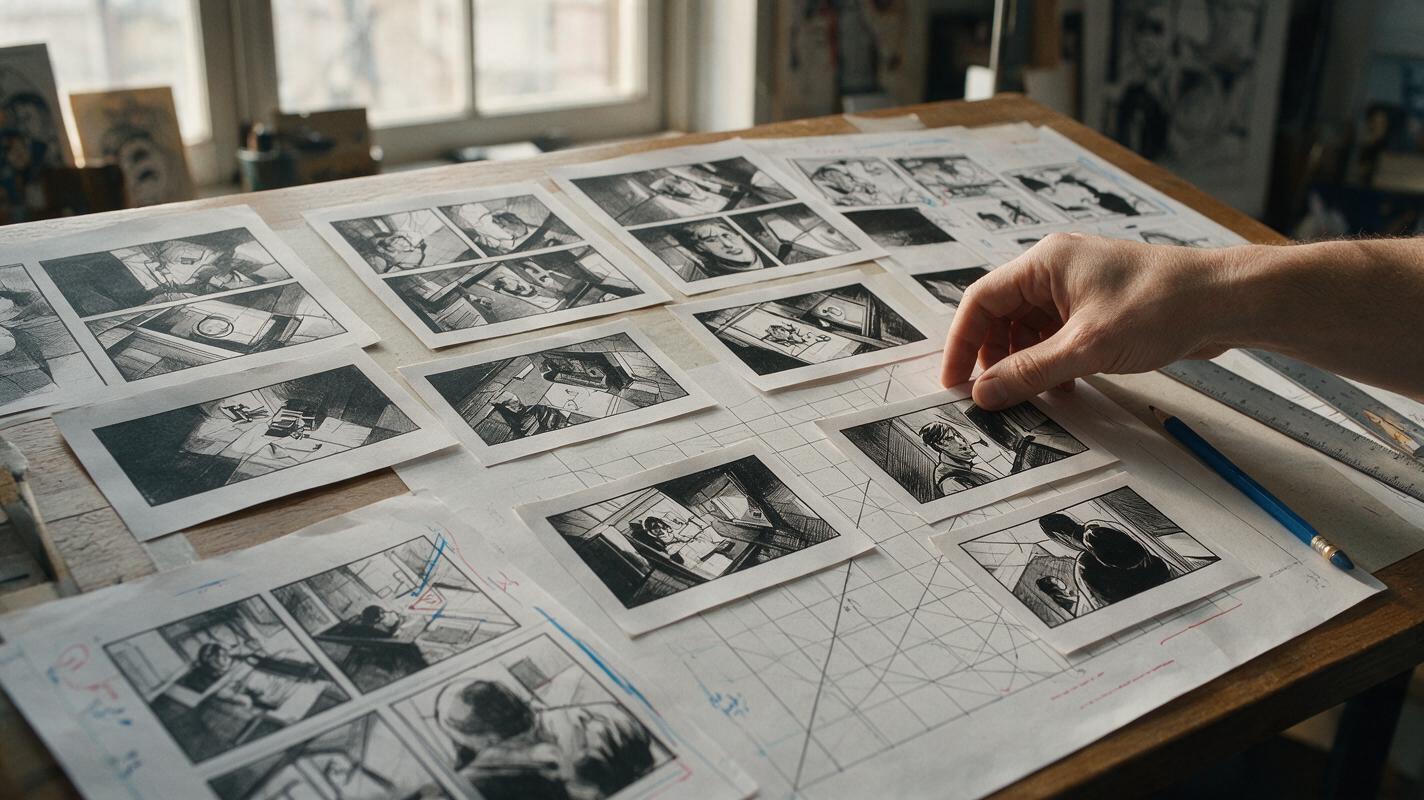
Table of contents
Dynamic Angles Need Clear Spatial Instructions
A dramatic camera angle should intensify a comic moment, not leave readers wondering whose arm they are looking at. Low-angle heroes, overhead confrontations, extreme close-ups, and first-person attacks often fail because a short prompt describes the subject but not the camera, depth, staging, or crop.
Imagen can produce stronger panel candidates when the prompt treats composition as a set of concrete visual decisions. The following prompt patterns are designed for illustrators and comic creators who need usable thumbnails and panel references rather than random cinematic spectacle.
The core rule: describe where the camera is, what occupies each depth plane, and what story information must remain readable.
Build the Prompt Around the Camera
Generic instructions such as “dynamic angle” or “cinematic manga panel” leave too much unresolved. A more reliable comic prompt contains five composition blocks:
- Panel function: reveal, reaction, attack, hesitation, pursuit, or environmental transition.
- Camera position: below eye level, directly overhead, behind a shoulder, at ground level, or inside the character’s viewpoint.
- Subject orientation: facing camera, three-quarter profile, back turned, moving left to right, or looking into the distance.
- Depth structure: a specific foreground object, the acting character in the middle ground, and a readable background landmark.
- Crop and format: close-up, waist-up, full figure, wide establishing panel, tall webtoon panel, or narrow horizontal strip.
Use these blocks when working with an ai image generator, but avoid packing every possible visual adjective into one request. Camera logic should have priority over decorative detail.
COMIC PANEL PROMPT FORMULA

[panel function], [shot size] from [precise camera position],
[character orientation and action],
[foreground object and its scale],
[middle-ground subject],
[background landmark],
[clear depth separation],
[lighting and mood],
[comic rendering treatment],
[panel aspect ratio and crop],
[critical elements that must remain visible]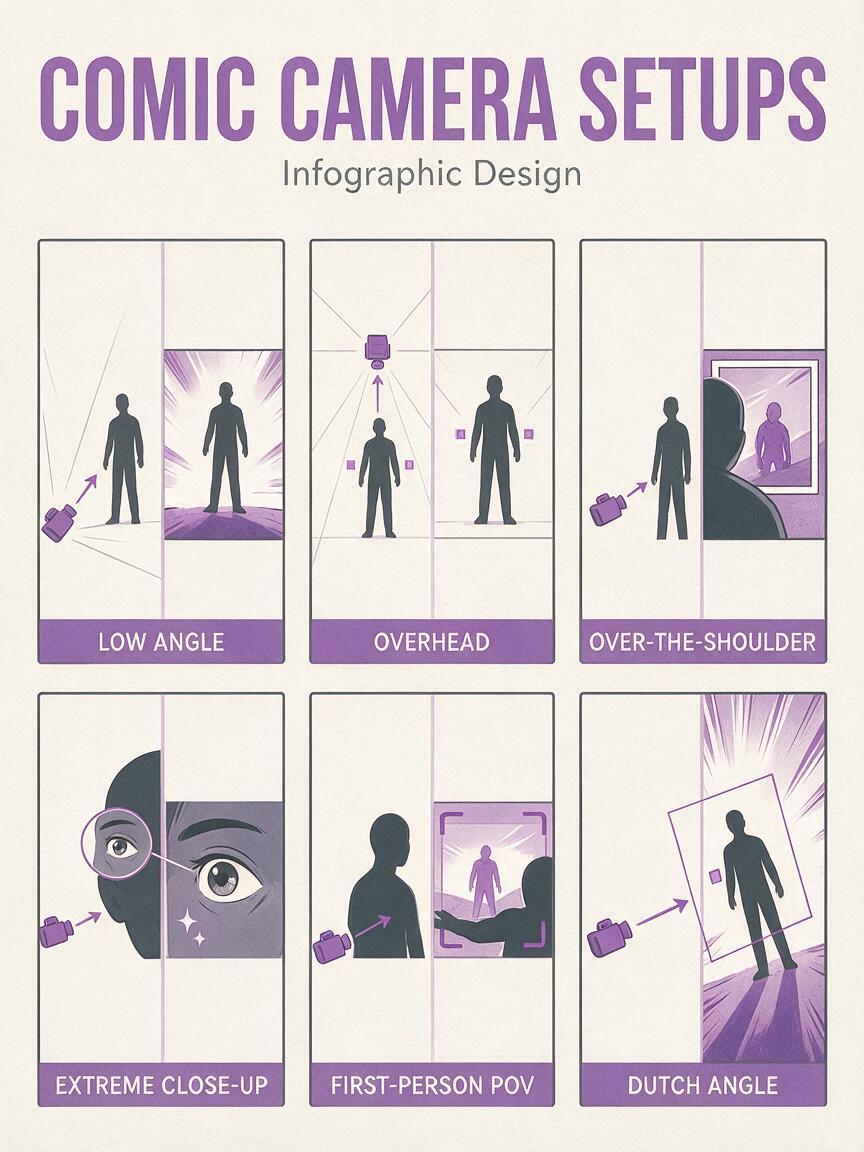
The Camera-Angle Prompt Matrix
Choose an angle because of what it communicates in the story. An unusual viewpoint is not automatically more dramatic; it must support the emotional beat.
| Camera angle | Best narrative use | Essential prompt detail | Common failure |
|---|---|---|---|
| Low angle | Power, threat, resolve | Camera below waist or near floor | Oversized legs hiding the torso |
| Overhead | Isolation, geography, vulnerability | Visible floor plan and character spacing | Flattened bodies with unclear poses |
| Over-the-shoulder | Dialogue, confrontation, discovery | Whose shoulder is foregrounded | Two characters merging together |
| Extreme close-up | Recognition, fear, decision | Exact facial feature and crop | Unwanted full-face portrait |
| First-person POV | Impact, immersion, suspense | Visible hands and gaze target | Extra arms or detached hands |
| Dutch angle | Instability, panic, imbalance | Degree of tilt plus upright subject | Entire scene appearing accidentally rotated |
For sequential art, alternate these views with neutral shots. If every panel uses an extreme angle, the page loses hierarchy and the reader has no stable view of the scene.
Six Reusable Imagen Prompts
Low-angle entrance with readable anatomy
A vertical webtoon panel showing a determined courier entering a ruined train station, full-body low-angle shot from a camera positioned near the floor, the character advances toward the viewer with one boot in the foreground but both legs and the complete torso remain readable, three-quarter view of the face, damaged ticket gates in the middle ground, illuminated station clock in the background, strong depth separation, restrained perspective exaggeration, clean inked comic illustration, controlled cel shading, dramatic rim light, no text, no speech balloonsThe phrase “restrained perspective exaggeration” helps preserve the effect without asking for grotesquely enlarged feet. Naming the torso and both legs as required elements also defines what the crop must retain.
Overhead panel for fight geography
Wide overhead manga panel of two rivals circling each other inside a small rooftop greenhouse, camera directly above the center of the room, both complete figures clearly separated, one character beside the broken doorway and the other beside a rectangular planting table, scattered glass forming a visible path between them, clear floor-plan composition, readable silhouettes, accurate limb count, high-contrast black-and-white ink drawing, sparse screentone, no captionsOverhead prompts work best when the location includes named anchors. “Doorway,” “planting table,” and “glass path” give the model a spatial arrangement instead of an empty floor surrounding two figures.
Over-the-shoulder confrontation
Horizontal comic dialogue panel, over-the-shoulder view from behind the detective on the left, only the detective’s dark shoulder and side of the head occupy the near foreground, the suspect stands fully separated in the middle ground on the right and looks past the camera toward the detective, apartment window centered in the background, calm but tense staging, natural eye line, generous empty wall area above the suspect for later lettering, graphic novel line art, muted color palette, no generated textState which character owns the foreground shoulder. Otherwise, the composition may reverse the speakers or produce a confusing hybrid pose.
Extreme close-up for a silent realization
Narrow horizontal manga panel, extreme close-up of one eye widening after recognizing a familiar symbol, crop from the eyebrow to the upper cheek, the symbol reflected subtly in the iris, sharp eyelid line and one small bead of sweat, face remains still rather than screaming, background omitted, precise black ink linework, minimal screentone, quiet suspense, no textExtreme close-ups become more useful when the prompt identifies both the visible feature and the emotional intensity. “Face remains still” prevents a subtle realization from becoming an exaggerated reaction image.
First-person discovery panel
First-person point-of-view comic panel looking down at an opened wooden evidence box, two correctly formed hands enter from the lower left and lower right edges and hold the lid, an old red scarf lies inside the box as the clear focal point, sleeves match a simple dark raincoat, desk surface visible around the box, soft window light from the right, realistic depth and hand scale, illustrated mystery comic style, no other hands, no textPOV prompts should identify where each hand enters the frame and what each hand is doing. If only one hand is narratively necessary, omit the other to reduce anatomical risk.
Dutch angle without losing orientation
Tall comic panel of a student running through a school corridor during an alarm, camera at chest height with a subtle fifteen-degree clockwise Dutch tilt, the student remains anatomically upright within the tilted frame, corridor lines create controlled diagonal tension, classroom doors recede toward one clear vanishing point, papers moving through the foreground, anxious expression, crisp webtoon illustration, limited blue and red palette, no text, no duplicated limbsDefining a modest degree of tilt produces more intentional framing than simply requesting a “crazy Dutch angle.” Keep the character upright relative to the world so the result reads as camera instability rather than a falling body.
Keep Action Direction Consistent Across Panels
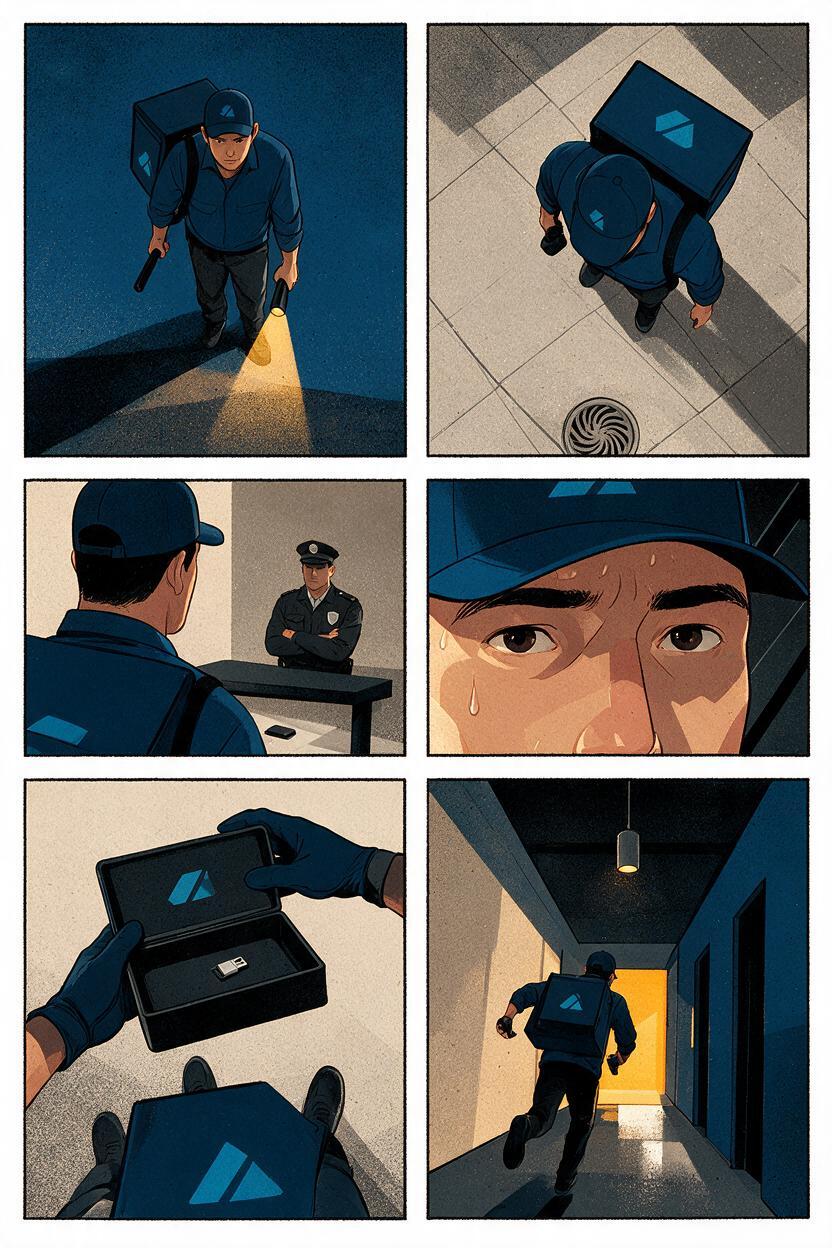
A strong single image can still damage a sequence if movement reverses without explanation. When generating adjacent panels, write the screen direction into every prompt:
- “The courier moves from left to right.”
- “The pursuer enters from the left edge and faces right.”
- “The exit remains on the right side of the background.”
- “The character looks off-panel right toward the unseen threat.”
Before changing the camera, make a simple top-down sketch of the location. Mark each character, the main landmark, and the direction of movement. This tiny map is more valuable than adding another paragraph of style language.
When the camera crosses to the opposite side of the action, include a neutral transition panel or a clear landmark that helps the reader reorient.
Generate Controlled Variations, Not Random Rewrites
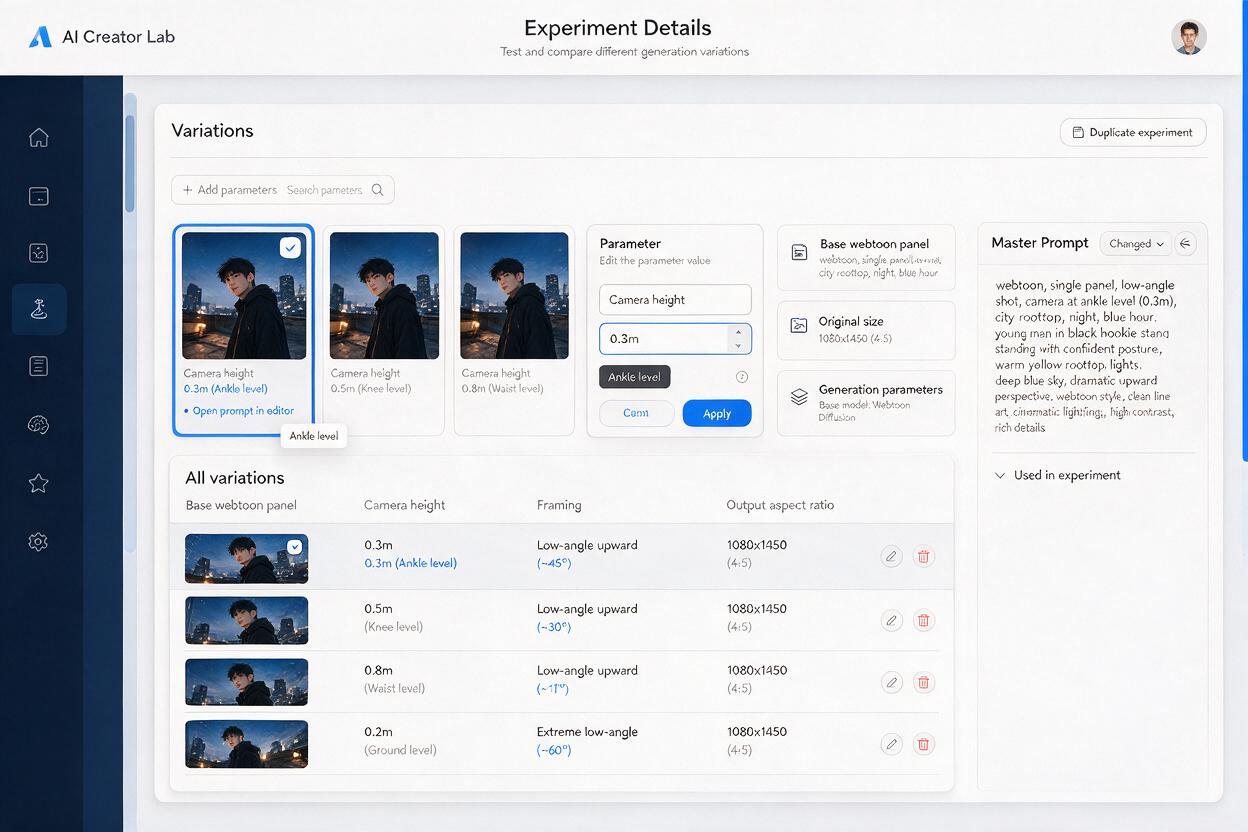
For each panel, keep one master prompt and change only a single composition variable. Useful variation batches include:
- The same low angle at ankle height, knee height, and waist height.
- The same close-up with a calm, tense, and shocked expression.
- The same overhead layout with tighter and wider crops.
- The same POV shot with one hand, two hands, or no visible hands.
Compare the results as thumbnails before inspecting detail. The best panel is the one whose action and focal point remain obvious when viewed small. Once the composition works, revise costume details, facial features, and rendering rather than regenerating the entire scene from unrelated wording.
If you want to evaluate the camera formula on your own scene, test this prompt yourself with one character, one action, and one unmistakable background landmark.
Fix the Most Common Camera-Angle Failures
| Problem | Likely cause | Prompt revision |
|---|---|---|
| Huge foreground limb | Perspective requested without limits | Add “restrained foreshortening” and list the body parts that must remain visible |
| Unreadable overhead pose | No floor anchors or silhouette instruction | Name each character’s position relative to fixed objects |
| Characters merge in dialogue | Foreground speaker is ambiguous | Specify which shoulder enters from which edge |
| Extra hands in POV | Hand placement and function are undefined | Assign one action and one entry edge to each hand |
| Close-up is not close enough | Only emotion was described | Define exact crop boundaries such as eyebrow to upper cheek |
| Dutch shot looks rotated | Tilt is excessive or unmeasured | Request a subtle angle and keep the subject upright in the scene |
Do not attempt to correct every defect in one regeneration. Decide whether the failure is primarily camera position, pose, depth, crop, or style, then revise only that block of the prompt.
Final Checklist
- Give the panel a clear narrative function before choosing the angle.
- Name the camera’s physical position instead of asking only for “dynamic framing.”
- Define foreground, middle ground, and background elements.
- Preserve movement direction and stable landmarks across adjacent panels.
- Specify crop boundaries and body parts that must remain visible.
- Use restrained foreshortening when readability matters more than spectacle.
- Compare variations at thumbnail size before refining the rendering.
- Remove generated lettering and add dialogue during page assembly.
Keywords
Imagen prompts, comic camera angles, manga panel generator, comic prompts, dynamic comic panels, webtoon AI, AI illustration generator