Imagen Prompts for Mascara Ads Without Spider Lashes
Create polished mascara campaign concepts without fused lashes, oversized fibers or distorted applicator wands. These Imagen prompts separate lash anatomy, makeup finish, product packaging and lighting so beauty teams can produce more realistic editorial visuals.
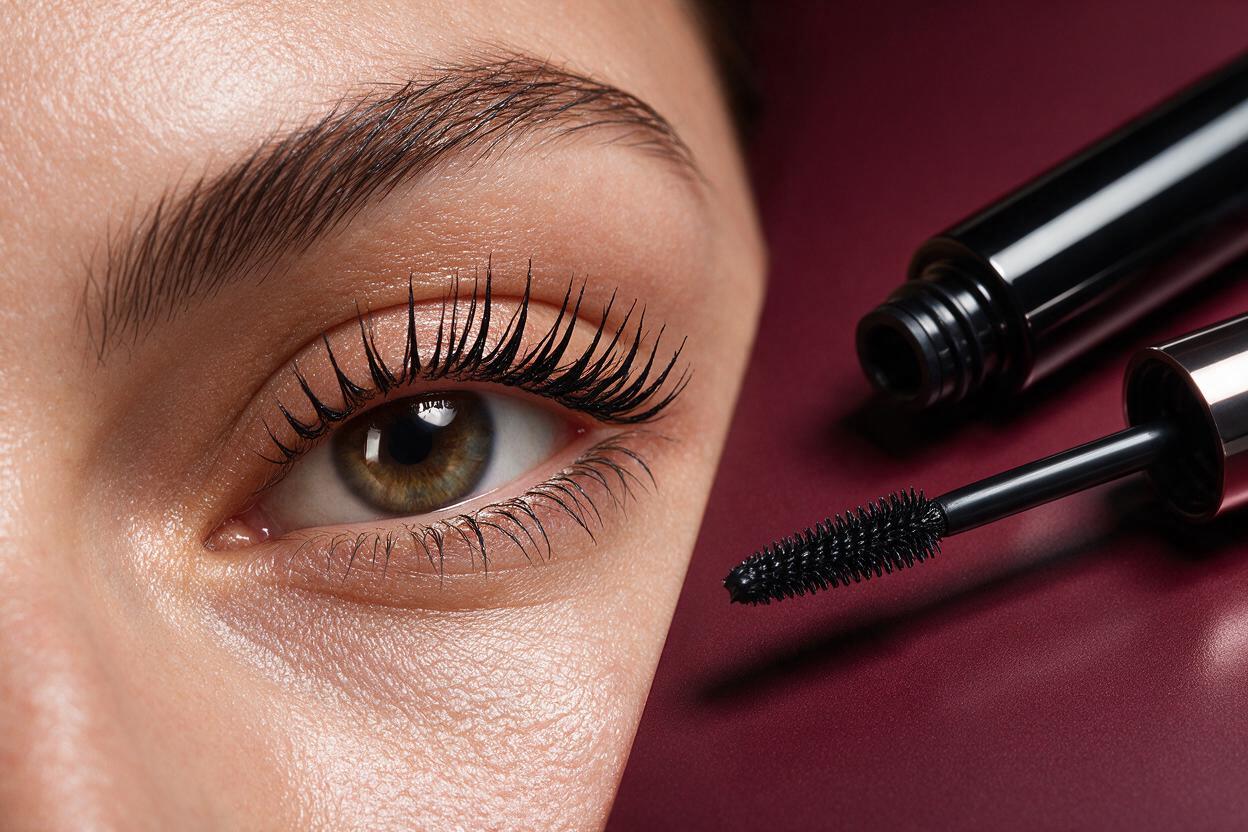
Table of contents
Create polished mascara visuals without sacrificing lash anatomy
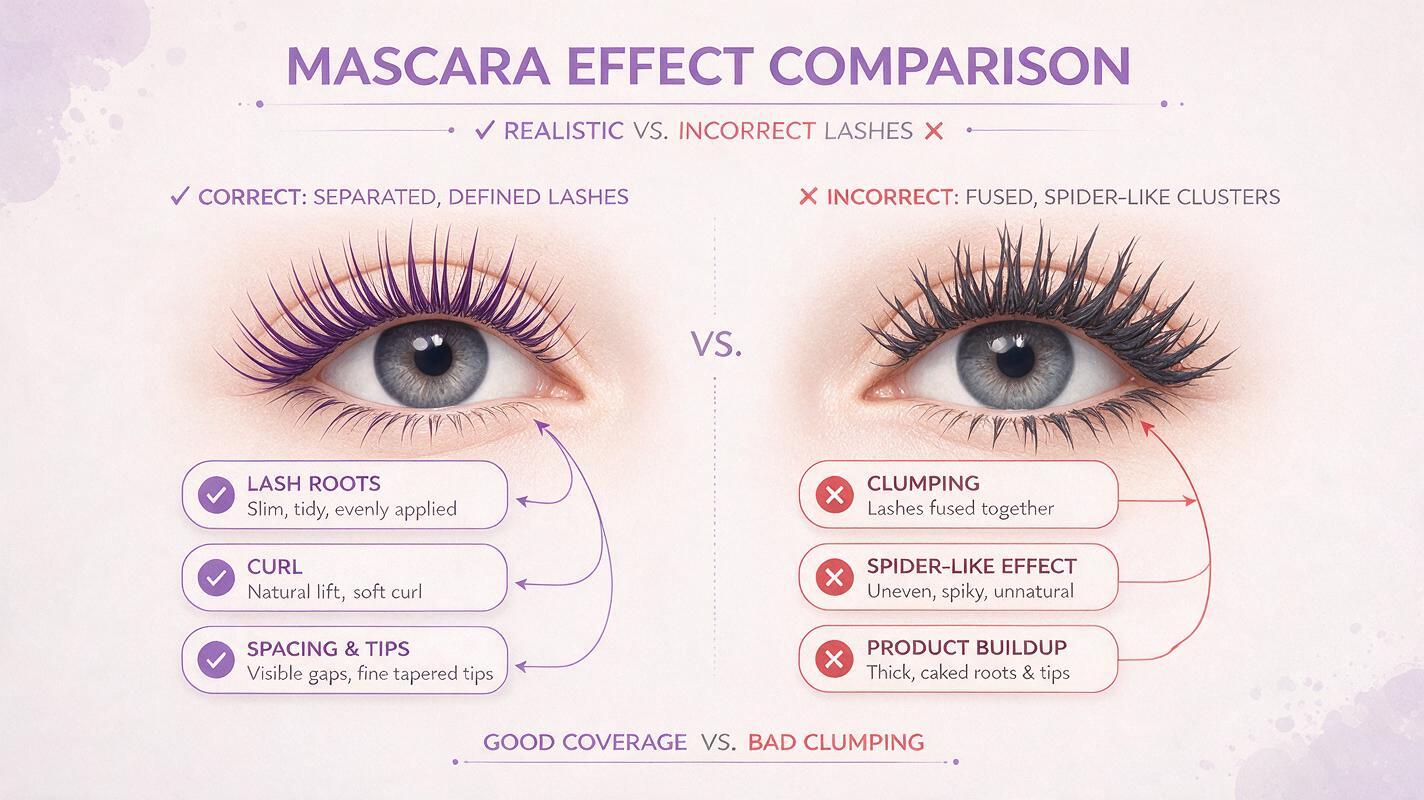
Spider lashes usually appear when an image prompt asks for dramatic volume without defining separation, fiber distribution or the intended mascara finish. The model interprets “extreme” as thicker, longer and more numerous, eventually merging individual lashes into rigid black spikes.
For a usable mascara campaign concept, describe the eye, lashes, wand and package as separate subjects. Imagen can support this prompt-led exploration through an ai image generator, but every output should still pass human review before it represents a real product or performance claim.
Why AI-generated mascara turns into spider lashes
Mascara advertising combines several details that are difficult to render simultaneously: fine curved hairs, wet cosmetic material, a reflective eye, precise eyelid anatomy and often a brush positioned millimeters from the lashes. Generic beauty language gives the model too much room to exaggerate.
- “Maximum volume” becomes fused bundles. The image may show four or five heavy spikes instead of many separate lashes.
- “Fiber mascara” becomes visible debris. Fibers can resemble lint, insect legs or loose hair fragments.
- “Jet-black pigment” hides structure. Dense black areas erase the spaces between lashes and the natural lash line.
- “Dramatic length” changes anatomy. Lashes may grow from the eyelid skin, point downward or cross through one another.
- Product and face compete for attention. A close wand, eye and branded tube in one generation increase the chance of malformed bristles or packaging text.
Describe the desired lash distribution before adding high-impact campaign language. “Separated, tapered lashes with visible gaps” is more controllable than “the most dramatic mascara ever.”
Build the prompt around observable lash details
A reliable prompt should specify what a retoucher or makeup artist could inspect in the final frame. Replace subjective adjectives with visible properties.
| Prompt component | Useful direction | Avoid relying on |
|---|---|---|
| Lash anatomy | Individual tapered hairs emerging from the natural lash line | Perfect lashes |
| Separation | Visible narrow gaps, no fused fan-shaped clusters | Huge volume |
| Finish | Satin black coating with slight natural variation | Ultra-black everywhere |
| Curl | Soft upward C-curve, shorter inner lashes and longer outer lashes | Extreme curl |
| Skin | Visible pores and fine under-eye texture | Flawless airbrushed skin |
| Brush | Defined bristle rows, clean stem and light product loading | Oversized mascara wand |
Also state the camera distance and focus target. A macro eye image needs a shallow depth of field that still keeps the lash roots and tips readable. A product hero image can tolerate softer eye detail because the package is the primary subject.
Clean lengthening mascara prompt
This concept works for a refined everyday mascara campaign where separation matters more than theatrical volume.
Photorealistic macro beauty campaign photograph of one human eye wearing clean lengthening mascara, individual upper eyelashes clearly separated from root to tapered tip, visible narrow gaps between lashes, soft upward C-curve, shorter inner lashes and gradually longer outer lashes, lightweight satin-black coating, no fused clusters, no false lash strip, natural lower lashes with minimal product, realistic eyelid folds, visible pores and fine skin texture, soft diffused studio light, neutral warm-gray background, sharp focus on lash roots and tips, premium cosmetics editorial photography, restrained retouching, anatomically correct eyeFor a softer result, replace “satin-black” with “soft brown-black” and request lower contrast around the lash line. Do not add more superlatives when the first result lacks impact; increase the curl, outer-corner length or directional light one variable at a time.
Volumizing campaign prompt with controlled density
Volumizing mascara can look substantial without becoming clumpy. The key is to request more coated lashes, not thicker merged shapes.
High-resolution cosmetics campaign close-up of one eye wearing volumizing mascara, dense natural lash count while every lash remains individually readable, two to three delicate micro-bundles only at the outer corner, flexible tapered ends, slim roots, rich black cream pigment distributed evenly, no chunky deposits, no spider-leg spikes, no lashes growing from eyelid skin, softly lifted curl, realistic moisture along the waterline, natural eyebrow hairs, directional beauty light creating fine highlights on separate lashes, deep plum studio backdrop, sophisticated evening makeup, authentic skin textureIf Imagen produces a solid black band, reduce “dense” to “moderately full” and add “a thin natural lash line remains visible beneath the mascara.” That instruction preserves visual space between the coating and eyelid.
Mascara wand application prompt
Application shots are especially fragile because the wand may intersect the eye or duplicate its bristles. Ask for a paused demonstration moment rather than a sweeping motion.
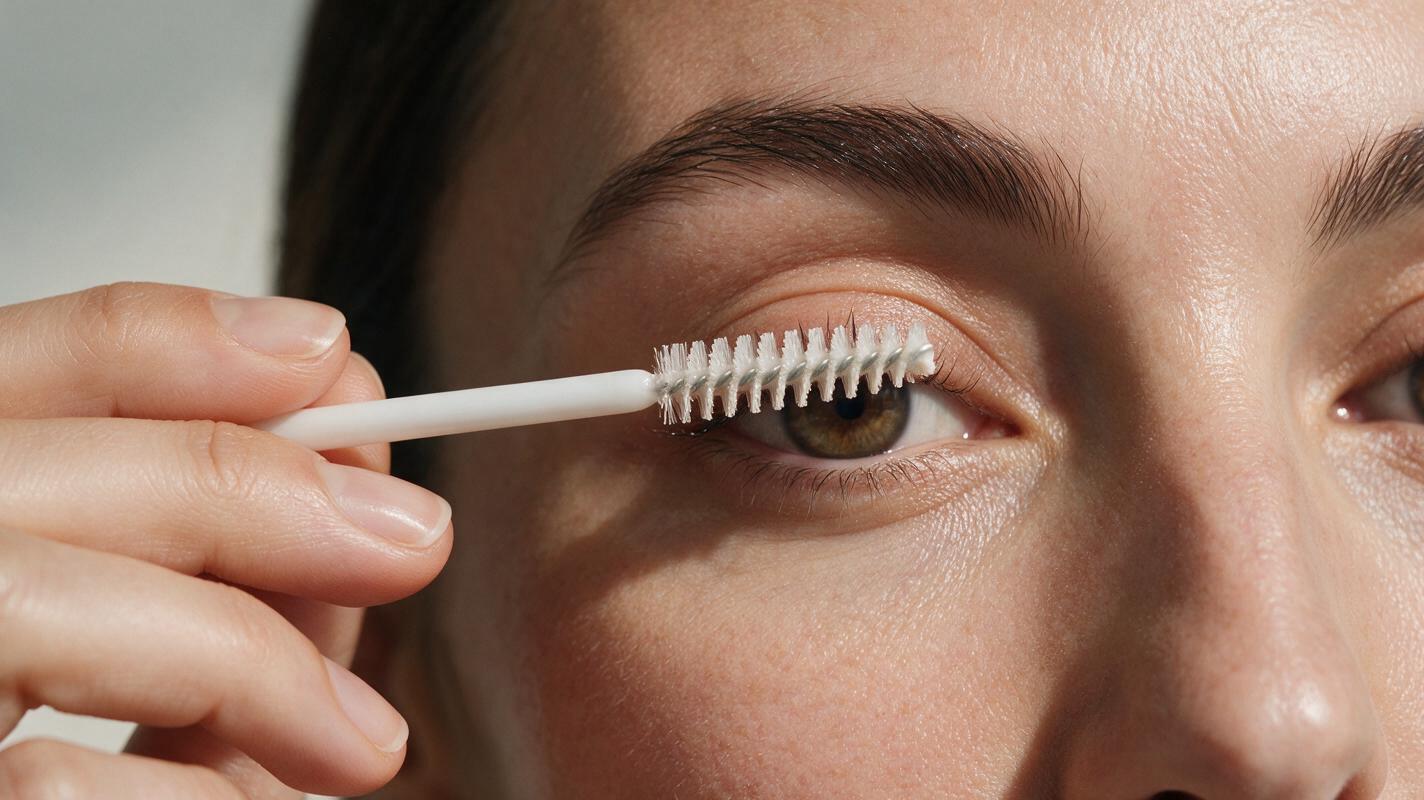
Photorealistic mascara application demonstration, three-quarter close-up of an adult model holding a slim black mascara wand horizontally beneath the upper lashes, brush positioned near but not touching the eyeball, straight clean wand stem, evenly spaced silicone bristles, light realistic product coating without blobs, upper lashes combed upward into separated tapered hairs, natural hand anatomy, relaxed eyelid, no duplicated brush, no bent stem, no bristles passing through lashes, clean daylight beauty lighting, pale beige background, credible beauty creator aesthetic, sharp focus on eye and applicatorGenerate the eye, hand and wand first without visible branding. Composite the approved product tube or label afterward if exact packaging is essential. This is safer than asking one generation to solve anatomy, fine brush geometry and small legal copy at once.
Product-and-eye hero prompt
Use a divided composition when both the mascara result and package must appear. Leaving physical space between them reduces accidental merging.
Luxury mascara advertising still life with a photorealistic close-up eye on the left and one upright mascara tube on the right, clear negative space separating face and product, eye wearing defined lifted lashes with visible gaps and tapered tips, realistic skin texture, cylindrical tube with stable proportions and a blank centered label area reserved for later brand artwork, matching black and burgundy palette, controlled glossy reflections, soft key light with narrow rim light, premium editorial cosmetics photography, balanced horizontal composition, no extra products, no duplicated eye, no floating wandReserve label replacement for the final production stage. Generated typography may be useful for rough layout, but it should not be treated as approved packaging artwork.
Test variations without redesigning the entire image
Keep a locked base prompt and change only one creative variable per batch. This makes it easier to identify which phrase caused clumping, warped bristles or excessive retouching.
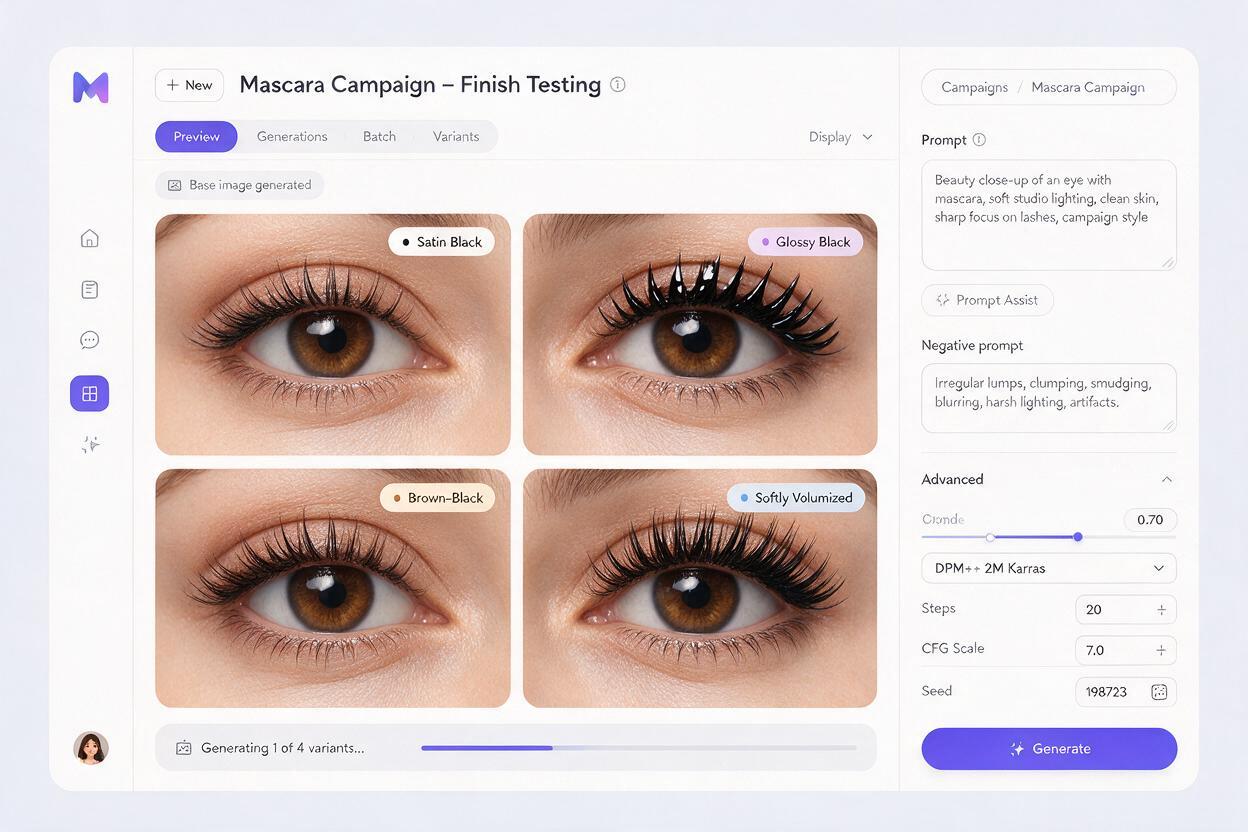
- Finish test: satin black, glossy black or soft brown-black.
- Effect test: lengthening, volumizing or lifted outer-corner definition.
- Lighting test: diffused daylight, crisp editorial side light or luminous studio beauty light.
- Framing test: single-eye macro, three-quarter face or product-and-eye split composition.
- Campaign test: minimal everyday beauty, evening color story or clean clinical demonstration.
Use the same seed or reference controls when available, then compare the lash roots, tips, iris shape, eyelid crease and package silhouette at full resolution. When you are ready to produce a batch, test this prompt yourself and save the strongest base image before exploring more dramatic variants.
Diagnose common mascara image failures
| Failure | Likely cause | Prompt correction |
|---|---|---|
| Four thick spider-like spikes | Volume is emphasized without separation | Add individual tapered hairs, visible gaps and slim roots |
| False-lash strip appears | The request implies uniform dramatic density | Specify natural variation in spacing and length, no lash band |
| Brush melts into lashes | Action and contact are ambiguous | Request a paused pose with the brush beneath the lashes |
| Black flakes cover the skin | Fiber language is interpreted as loose particles | Describe fibers as integrated into the coating, with clean under-eye skin |
| Eye looks plastic | Beauty retouching language is too strong | Restore pores, fine lines, eyelid folds and realistic moisture |
| Tube label is unreadable | Small typography is being generated inside a complex scene | Use a blank label zone and add approved artwork later |
Keep campaign claims and retouching credible
AI-generated mascara images are best used for concept development, mood boards, layout exploration and clearly disclosed synthetic creative. They should not be presented as evidence that a commercial formula produced a specific length, curl or volume result unless the claim is substantiated through the brand’s normal testing and approval process.
For comparison layouts, preserve identical crop, lighting, gaze, pupil size and skin treatment. Avoid fabricating a “before” image by shortening natural lashes or adding redness. Beauty teams should also check that editing does not alter eye shape, remove normal texture or imply an unrealistic universal result.
Final checklist
- Define individual lashes, visible gaps, tapered tips and slim roots.
- Choose one primary effect: length, volume or lift.
- Keep the wand near the lashes without intersecting the eye.
- Generate packaging with a blank label area when brand accuracy matters.
- Inspect lash roots, eyelid anatomy, iris shape and brush geometry at full size.
- Change one prompt variable per batch instead of rewriting everything.
- Retouch approved brand artwork manually and review all performance claims.
Keywords
Imagen prompts, mascara ads, AI makeup generator, beauty campaign AI, mascara photography, cosmetic product images, realistic eyelashes