Luma Prompts for Visualizing Invisible Forces in Physics Lessons
Use Luma to create short physics lesson clips that represent magnetic fields, electric forces, gravity, and convection without presenting conceptual models as literal footage. This guide includes reusable prompts, misconception checks, and practical ways to keep generated motion scientifically useful.
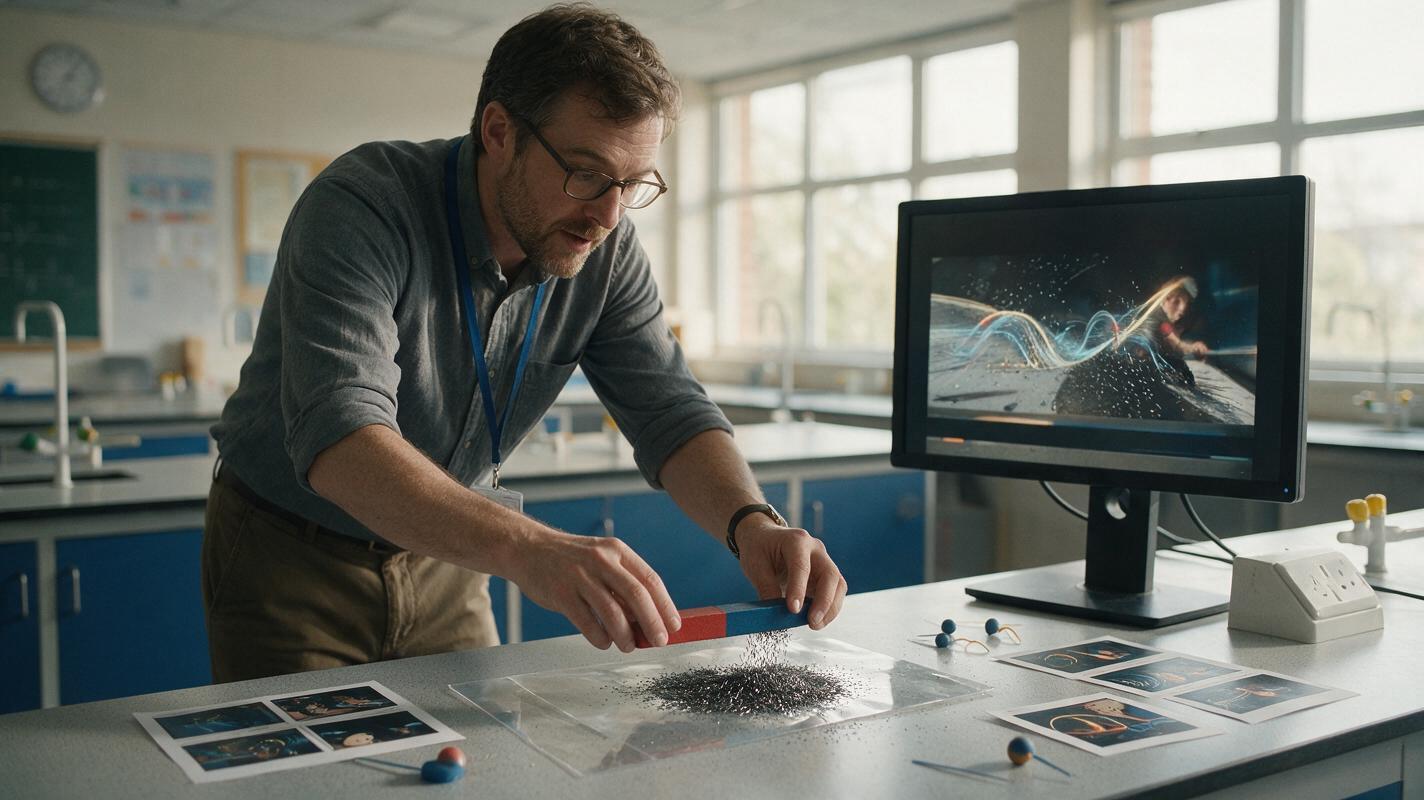
Table of contents
Make invisible physics visible without teaching the wrong model
Invisible forces are difficult to explain because students cannot directly observe fields, vectors, or particle-level interactions. A short Luma clip can make those relationships easier to discuss, but attractive motion is not automatically accurate motion. Field lines may behave like physical strings, particles may move at impossible speeds, and decorative effects can obscure the actual concept.
The safest approach is to treat generative video as a conceptual visualization, not a simulation. Build one scientifically controlled reference frame, animate only the relationship students need to notice, and review the result for misconceptions before adding it to a lesson.
Teaching rule: If a visual convention could be mistaken for a real object or directly observed process, identify it as a model in the narration or caption.
Choose one observable relationship for each clip
A prompt such as “make a video about magnetism” leaves too many decisions to the model. It could produce moving field lines, glowing energy, spinning magnets, sparks, or unrelated laboratory imagery. A useful lesson clip begins with a narrower learning target.
Write the target as a relationship students should be able to describe after watching:
- Magnetism: Iron filings align differently around the poles of a bar magnet.
- Electric fields: A positive test charge accelerates in the direction of the local force vector.
- Gravity: Objects near Earth accelerate downward regardless of their horizontal velocity when air resistance is neglected.
- Convection: Warmer fluid rises while cooler fluid descends, forming a circulating current.
- Wave behavior: Individual particles oscillate locally while the disturbance travels through the medium.
Limit each generated shot to one of these relationships. Comparisons, equations, labels, and exceptions can be introduced in surrounding slides or narration rather than crowded into the video.
Build the scientific reference frame before adding motion
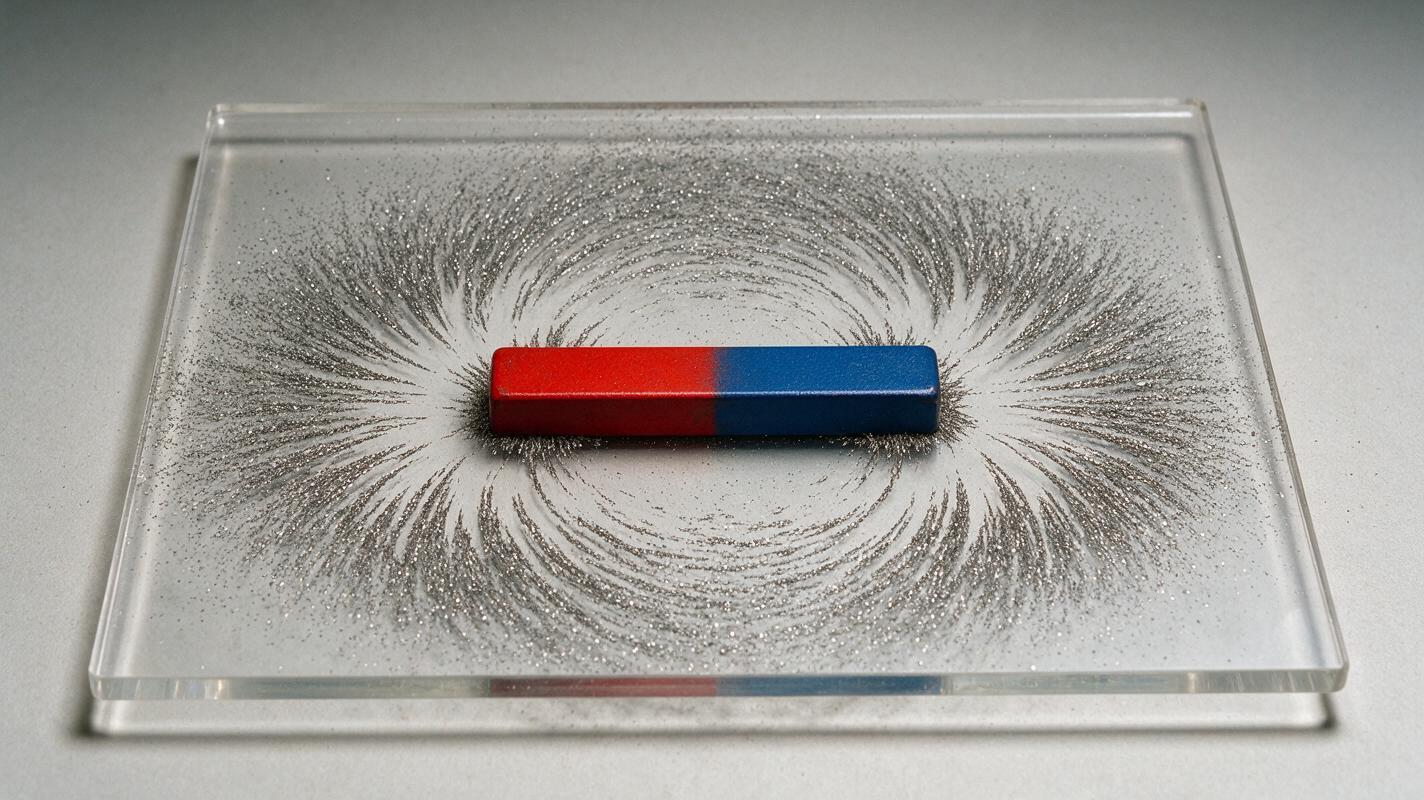
Start with a still image that already contains the correct apparatus, scale, orientation, and visual hierarchy. For example, a magnetic-field lesson might use a top-down view of a bar magnet beneath a transparent sheet with iron filings distributed across it. The poles should be clearly positioned, but the image does not need luminous field lines or dramatic energy effects.
A clean source frame gives Luma fewer opportunities to redesign the science while generating motion. It also lets the educator approve the instructional composition before spending time on animation.
Educational physics demonstration, top-down view of a horizontal bar magnet beneath a clear acrylic sheet, fine iron filings evenly scattered across the sheet, north pole on the left and south pole on the right, neutral classroom laboratory lighting, uncluttered pale background, realistic materials, fixed camera, no hands, no sparks, no glowing energy, no decorative textOnce the frame is correct, use image to video so the source image remains the visual anchor. Avoid placing essential equations or long labels inside the generated frames; add them afterward in the lesson editor, where their wording and position remain controllable.
Prompt motion as a teaching model, not a spectacle
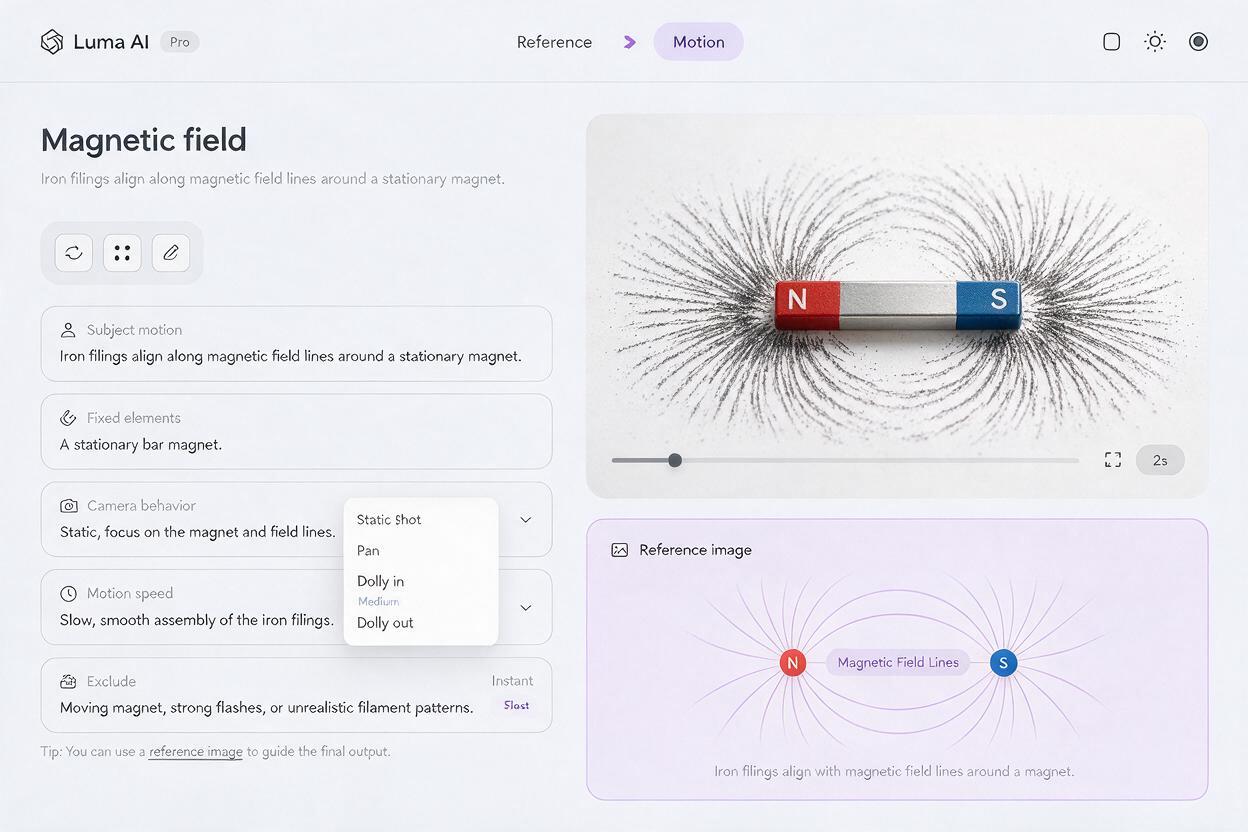
A dependable animation prompt describes what changes, what remains fixed, how the camera behaves, and what must not appear. It should also specify whether an effect represents a conceptual model rather than something visible in a real experiment.
Fixed overhead camera. The iron filings gradually rotate and align into smooth curved patterns around the stationary bar magnet. The strongest concentration forms near both poles. The magnet, sheet, lighting, and camera remain completely still. Motion is slow and instructional. No flying particles, no sparks, no glowing field lines, no camera movement, no new objects.This prompt does not ask Luma to explain all of magnetism. It requests one observable classroom result: alignment around a stationary magnet. The teacher can then introduce field direction with a separate overlay or diagram.
Magnetic-field model prompt
Use this variation when the learning goal specifically requires a conventional field representation:
Static side-by-side educational visualization of a bar magnet. Thin, evenly spaced blue guide curves gradually appear from the north pole toward the south pole, representing a magnetic-field model. The curves are diagrammatic overlays, not physical strands. The magnet remains fixed. Neutral background, fixed camera, restrained motion, no electricity, no sparks, no pulsing glow.The accompanying caption should say that the curves are a representation used to show field direction and relative pattern. They are not visible threads surrounding the magnet.
Convection-current prompt
Cross-sectional educational view of a transparent rectangular container filled with water, gently heated at the lower left. A small amount of red tracer moves slowly upward above the warm region, travels across the top, cools, and descends on the right. Blue tracer near the right moves downward and returns along the bottom. Smooth continuous circulation, fixed container and camera, realistic fluid motion, no boiling, no steam, no turbulent splashes.Transverse-wave prompt
Side view of an evenly spaced row of identical small markers connected by a subtle horizontal guide. Each marker moves only up and down around its original position while a single transverse pulse travels from left to right. Fixed camera, uniform spacing, slow instructional speed, no marker travels horizontally, no extra waves, no perspective shift.That final constraint—“no marker travels horizontally”—protects the central distinction between particle motion and wave propagation.
Match visual treatment to the kind of scientific claim
| Lesson claim | Useful visual treatment | Risk to avoid |
|---|---|---|
| Directly observable classroom event | Realistic apparatus and restrained physical motion | Adding effects that would not be visible in the experiment |
| Conceptual field model | Simple curves, vectors, or color regions identified as overlays | Making the representation look like physical matter |
| Particle-level explanation | Schematic particles with consistent size and controlled motion | Implying literal scale, color, or speed |
| Idealized law or principle | Minimal scene with irrelevant variables removed | Presenting the idealization as a complete real-world account |
| Comparison of conditions | Matched framing, duration, and object scale | Changing several variables between clips |
When starting from words rather than a reference frame, use ai video generator for simple conceptual scenes with few objects. Reference-led generation is usually easier to review when apparatus geometry or object placement matters.
Control speed, camera movement, and visual emphasis
Physics animations often fail because the model tries to make the shot cinematic. Rapid camera moves and exaggerated acceleration may increase excitement while reducing instructional value. Add explicit restraints to the prompt:
- Camera: “fixed overhead camera,” “locked side view,” or “no zoom or pan.”
- Speed: “slow enough to compare positions” or “one continuous cycle at instructional speed.”
- Continuity: “all apparatus remains stationary” and “no objects appear or disappear.”
- Emphasis: “only the tracer particles move” or “only the force arrow changes length.”
- Style: “clean educational visualization” rather than “cinematic” or “dramatic.”
Generate a short clip before attempting a longer sequence. If the first few seconds contain incorrect movement, a longer render will usually amplify rather than solve the problem.
Catch misleading motion before students see it
Review the clip once without narration. If its scientific meaning depends entirely on the voiceover correcting what the image appears to show, revise the visual.
| Problem | Likely misconception | Prompt correction |
|---|---|---|
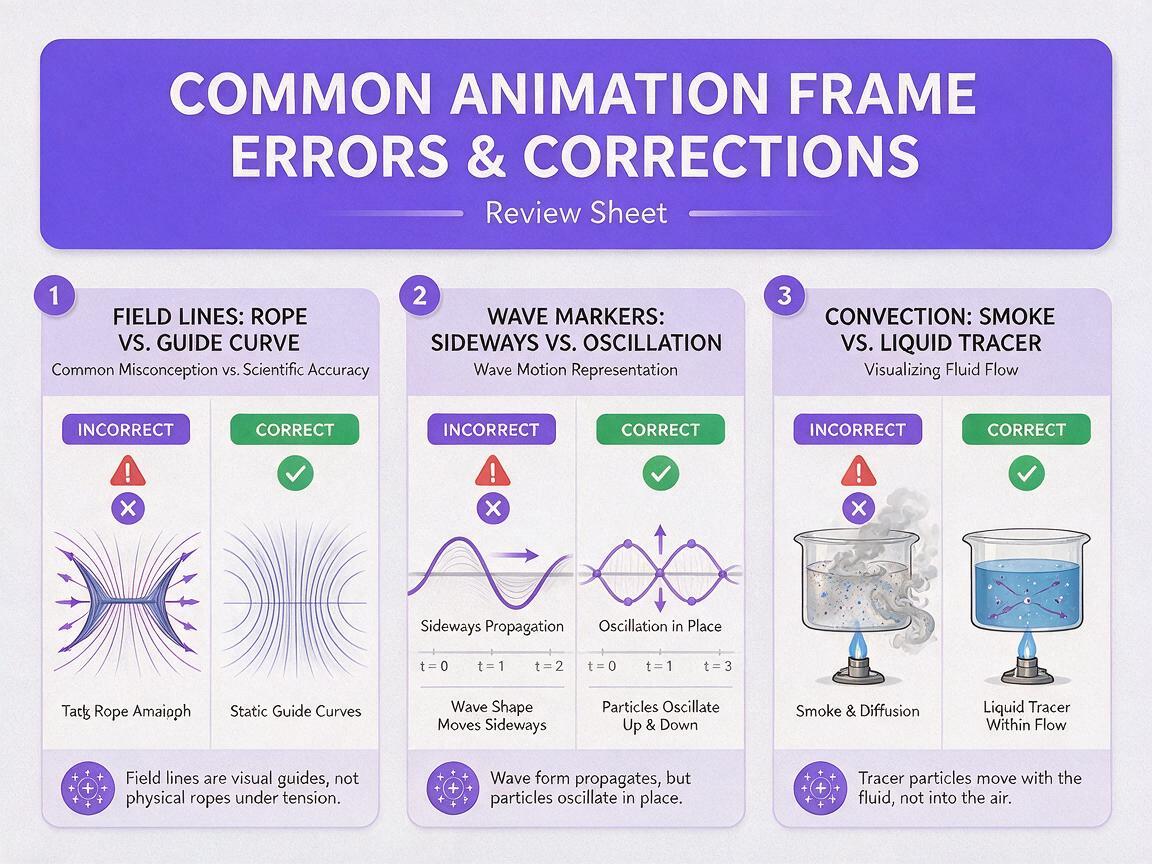
| Field lines sway like ropes | Fields are made from physical strands | “Static diagrammatic guide curves; curves do not oscillate or flow” |
| Wave markers travel with the pulse | Matter moves from the source to the receiver | “Every marker keeps the same horizontal coordinate” |
| Convection tracer expands into smoke | Heating creates a new substance | “Tracer remains dissolved in the liquid; no gas or steam” |
| Force arrows detach and fly away | A vector is a moving physical object | “Arrow remains anchored to the object’s center” |
| Objects change size during motion | Distance or mass is changing | “Constant object dimensions and fixed camera perspective” |
Then inspect the clip frame by frame and ask:
- Does every object remain identifiable and geometrically stable?
- Is the direction of motion consistent with the intended model?
- Did the generation introduce extra causes, such as wind, sparks, or an unseen impact?
- Are color and brightness being used as conventions rather than unsupported measurements?
- Could a student state an incorrect rule after watching the clip without explanation?
Do not repair a fundamental physics error with a disclaimer. Regenerate the shot or replace it with a static diagram when the motion itself communicates the wrong relationship.
Add narration that separates observation from representation
Precise narration prevents students from confusing a model with direct evidence. Use verbs that reveal the status of the visual:
- “The iron filings show a pattern associated with the magnetic field.”
- “The blue curves represent field direction.”
- “The markers model particles in the medium.”
- “This animation slows the process down so we can compare positions.”
- “The diagram omits air resistance to isolate gravitational acceleration.”
Follow the clip with a retrieval question that tests the intended distinction: “Do the blue curves represent objects that would be visible around the magnet?” or “Which moved across the screen: the pulse, the markers, or both?”
Final checklist
- The clip teaches one clearly stated relationship.
- The source frame contains correct apparatus and object placement.
- Motion is restrained, continuous, and scientifically relevant.
- The camera stays fixed unless movement has instructional value.
- Conceptual overlays are identified as representations.
- No decorative effect implies an unsupported cause or measurement.
- The clip has been checked frame by frame for drift and new objects.
- Narration distinguishes observation, model, and idealization.
- A question checks whether students interpreted the visual correctly.
Choose one concept, prepare a controlled reference frame, and test this prompt yourself. A simple five-second visualization that preserves the physics is more valuable than a spectacular clip that students must later unlearn.
Keywords
luma prompts, physics lesson visuals, invisible forces, educational animation, image to video, scientific visualization, ai video generator