Luma vs Seedance vs Runway: Which Makes Better 3-Second Performance Ad Hooks?
This head-to-head comparison evaluates Luma, Seedance, and Runway on their ability to generate high-converting 3-second performance ad hooks for short-form platforms. We score each tool on hook clarity, motion impact, brand consistency, and generation speed to help performance marketers pick the right fit for their creative testing workflows. Reusable hook prompts and use case recommendations are included to cut down iteration time.
Table of contents
Why 3-second ad hooks deserve their own AI tool evaluation
Your 3-second ad hook determines whether 70% of viewers keep watching or scroll past—yet most ai video generator evaluations focus on full 15-30 second ads, not the high-stakes opening frame. For performance marketers running creative tests at scale, a tool that excels at full videos but fumbles the hook wastes both budget and iteration time.
This comparison focuses exclusively on what matters for short-form ad hooks: the ability to stop scroll, communicate a core value prop, and stay on-brand in 3 seconds flat. We tested Luma, Seedance, and Runway with real performance ad prompts across e-commerce, SaaS, and DTC categories to see which delivers the most testable, high-potential hook clips.
Evaluation criteria for performance ad hook generators
We scored each tool on six metrics that directly impact hook performance and testing efficiency:
- Hook clarity: Does the core message or value prop land within the 3-second window, even for sound-off viewers?
- Motion impact: Is there enough dynamic movement to stop a scroll, without being so chaotic it distracts from the offer?
- Brand and product consistency: Do logos, packaging, and product details stay intact through the clip, no mid-shot distortion?
- Generation speed: How long does it take to produce 4 hook variations, the minimum needed for a valid creative test?
- Aspect ratio flexibility: Can it generate 9:16 (TikTok/Reels), 1:1 (Feed), and 16:9 (YouTube Shorts) hooks without reworking the prompt?
- Text legibility: Do on-screen hook headlines stay sharp and readable, even with fast motion?
Luma for 3-second ad hooks: strengths and limitations
Luma’s text-to-video model is known for cinematic, fluid motion and dynamic camera work—two features that make it a strong candidate for scroll-stopping hooks. For product reveal hooks (e.g., a new skincare serum rotating into frame with a glow effect), Luma delivers visually striking footage that stands out in crowded feeds.
Its biggest strength for hooks is motion variety: you can prompt for quick zooms, whip pans, or slow reveals that feel intentional, not jittery. This makes it ideal for testing "visual surprise" hook angles that rely on eye-catching movement to grab attention.
Limitations: Luma struggles with precise text rendering and brand consistency. Logos often warp or shift mid-clip, and on-screen headlines can come out blurry or misspelled. It also generates slower than purpose-built ad tools, averaging 2-3 minutes per 3-second clip, which slows down batch testing.
Reusable Luma hook prompt:
3-second vertical ad hook, glass skincare serum bottle rises from a bed of green aloe leaves, slow zoom in with soft golden hour light, text overlay "24hr Hydration in 1 Drop" in bold white sans-serif at the top, no extra objects, clean minimal background, cinematic qualitySeedance for 3-second ad hooks: strengths and limitations
Seedance, built specifically for short-form marketing content, prioritizes the exact metrics performance marketers care about for hooks: clarity, consistency, and speed. It’s optimized for ad use cases, so it handles product placement, text overlays, and brand assets far more reliably than general-purpose video AI.
Its biggest advantage for hook testing is batch consistency: you can generate 4 variations of the same hook with small tweaks (different angles, text variations) and get predictable, on-brand results every time. Text rendering is sharp, and product details like packaging labels stay intact through the full 3 seconds. Generation speed is also fast, with most clips ready in 30-60 seconds.
Limitations: Seedance’s motion is more controlled than Luma’s, so it doesn’t deliver the same "wow" cinematic factor for highly visual product reveals. It’s better for direct-response hooks that prioritize message clarity over flashy visuals.
Reusable Seedance hook prompt:
9:16 3-second performance ad hook, white ceramic coffee mug with brand logo on front, steam rises slowly, bold black text overlay "10-Second Brew, Café Quality" at bottom third, bright kitchen background, clean product focus, no distortionRunway for 3-second ad hooks: strengths and limitations
Runway’s Gen-3 model is a versatile general-purpose video AI with a wide range of style controls, making it a popular pick for marketing teams that create content across multiple formats. For UGC-style hooks (e.g., a person holding a product and speaking directly to camera), Runway delivers natural-looking human motion that feels less uncanny than many competing tools.
Its biggest strength for hooks is style flexibility: you can match specific aesthetic vibes (TikTok UGC, retro, minimalist) with simple prompt adjustments, and the built-in editing tools make it easy to tweak hook timing or add text overlays after generation.
Limitations: Runway struggles with product consistency, especially for small details like logos or label text. Motion can feel jittery in fast-paced hooks, and generation speed is middling, averaging 1-2 minutes per clip. It’s also less reliable for batch testing, as variations of the same prompt can have wildly different results.
Reusable Runway hook prompt:
3-second vertical UGC ad hook, 20-something woman holding a portable blender, smiling directly at camera, quick pan to blender blending a pink smoothie, casual home kitchen background, natural phone camera quality, no textHead-to-head scorecard
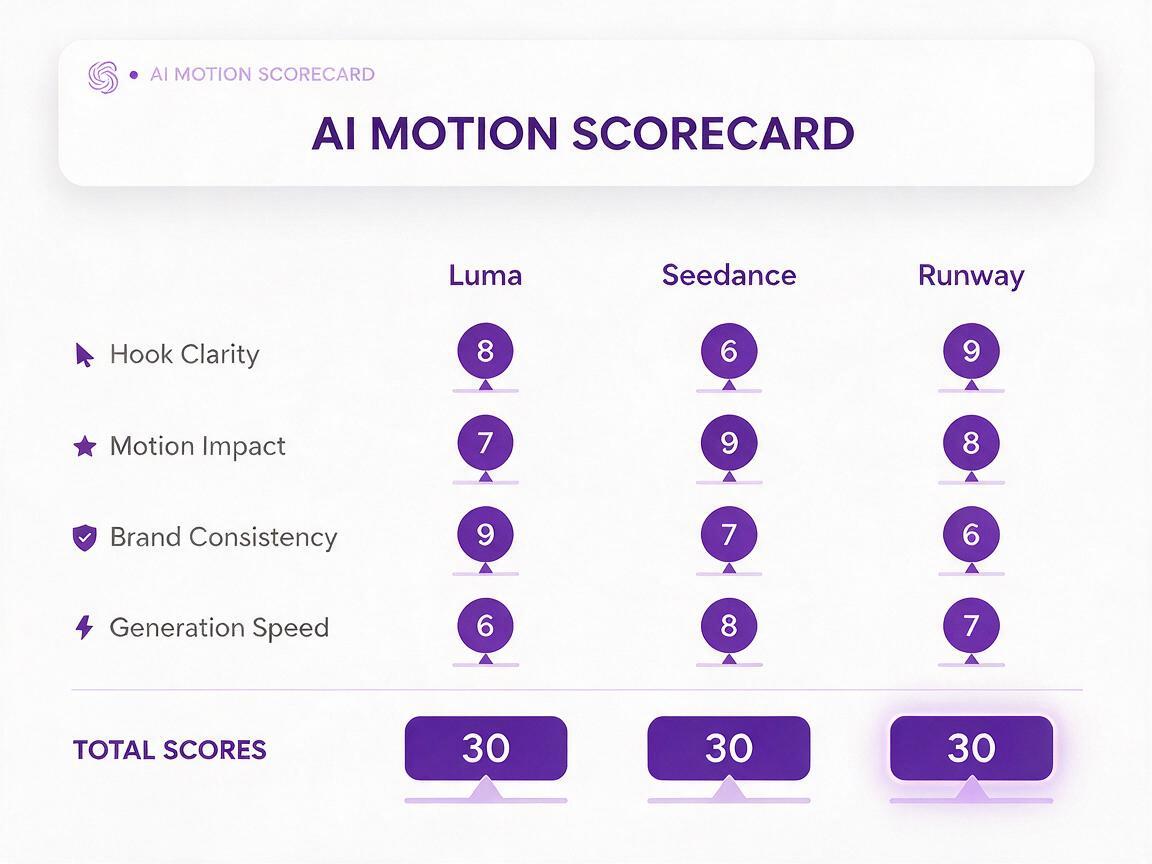
We scored each tool 1-5 on every criteria, with 5 being best-in-class for performance ad use cases:
| Criteria | Luma | Seedance | Runway |
|---|---|---|---|
| Hook clarity | 3/5 | 5/5 | 4/5 |
| Motion impact | 5/5 | 3/5 | 4/5 |
| Brand/product consistency | 2/5 | 5/5 | 3/5 |
| Generation speed | 2/5 | 5/5 | 3/5 |
| Aspect ratio flexibility | 4/5 | 5/5 | 4/5 |
| Text legibility | 2/5 | 5/5 | 3/5 |
| Total (out of 30) | 18/30 | 28/30 | 21/30 |
Seedance leads overall because it’s built specifically for the constraints of performance ad creative, where consistency and speed matter more than cinematic flair. Luma scores highest on motion impact, making it the best pick for visual-first product categories, while Runway sits in the middle as a flexible all-rounder for teams that need it for more than just ad hooks.
Which tool should you use for your ad hooks?
The right tool depends on your hook strategy and testing workflow:
- Pick Luma if: You’re testing visual surprise or product reveal hooks for a visually driven brand (skincare, fashion, tech gadgets), and you have time to touch up logos and text in post-production.
- Pick Seedance if: You run high-volume creative testing for direct-response ads, need consistent on-brand results, and want to generate multiple hook variations fast. It’s the best fit for performance marketers who prioritize test validity and speed.
- Pick Runway if: You need a multi-purpose tool that can handle UGC-style hooks alongside other marketing content, and you’re comfortable with small post-production tweaks to fix product details.
If you want to test Seedance’s ad hook generation alongside other purpose-built marketing AI tools, try these models for free.
Key takeaways
- 3-second ad hooks have unique requirements that don’t always align with general-purpose AI video tool evaluations.
- Seedance is the top pick for performance-focused hook testing, thanks to its consistency, speed, and ad-optimized features.
- Luma delivers the best motion for cinematic product reveal hooks, while Runway excels at UGC-style content.
- Always test at least 4 hook variations per campaign to get statistically significant creative testing results.
Keywords
ai video generator, performance ad hooks, luma ai video, seedance, runway ai, ad creative testing, 3-second ad hooks