Midjourney Ad Moodboard Prompts for Shoot-Ready Campaign Concepts
Turn vague campaign ideas into coherent, shoot-ready ad moodboards with Midjourney prompts built around products, audiences and performance hypotheses. This guide includes reusable prompt structures, four campaign concepts and a practical scoring system for choosing ideas before production.
Table of contents
Turn a vague campaign idea into a shootable visual system
A useful ad moodboard should help your team make production decisions—not merely collect attractive images. The prompts in this guide turn a product, audience insight and campaign hypothesis into coherent visual directions that a designer, photographer or video team can execute.
Midjourney is especially useful during concept development, when you need to explore environments, lighting, framing and emotional tone before committing production budget. The generated images should be treated as references rather than finished ads: preserve the real product, add final copy manually and verify that every concept can be reproduced.
Define the campaign decision before writing prompts
Begin with the decision the moodboard must resolve. A vague objective such as “find a premium look” usually produces attractive but interchangeable references. A stronger brief identifies the audience perception you want to change and the evidence the eventual ad must show.
Write a one-sentence creative hypothesis using this structure:
For [audience], showing [product or benefit] in [specific buying context] will increase [desired response] because it makes [value or emotional payoff] immediately believable.For example:
For hybrid workers, showing the travel mug surviving a crowded morning commute will increase product-page visits because portability and spill resistance become visible rather than claimed.
This sentence gives the moodboard a job. It must communicate a commute, controlled movement, product visibility and practical confidence. Images that do not support those requirements can be rejected even if they look impressive.
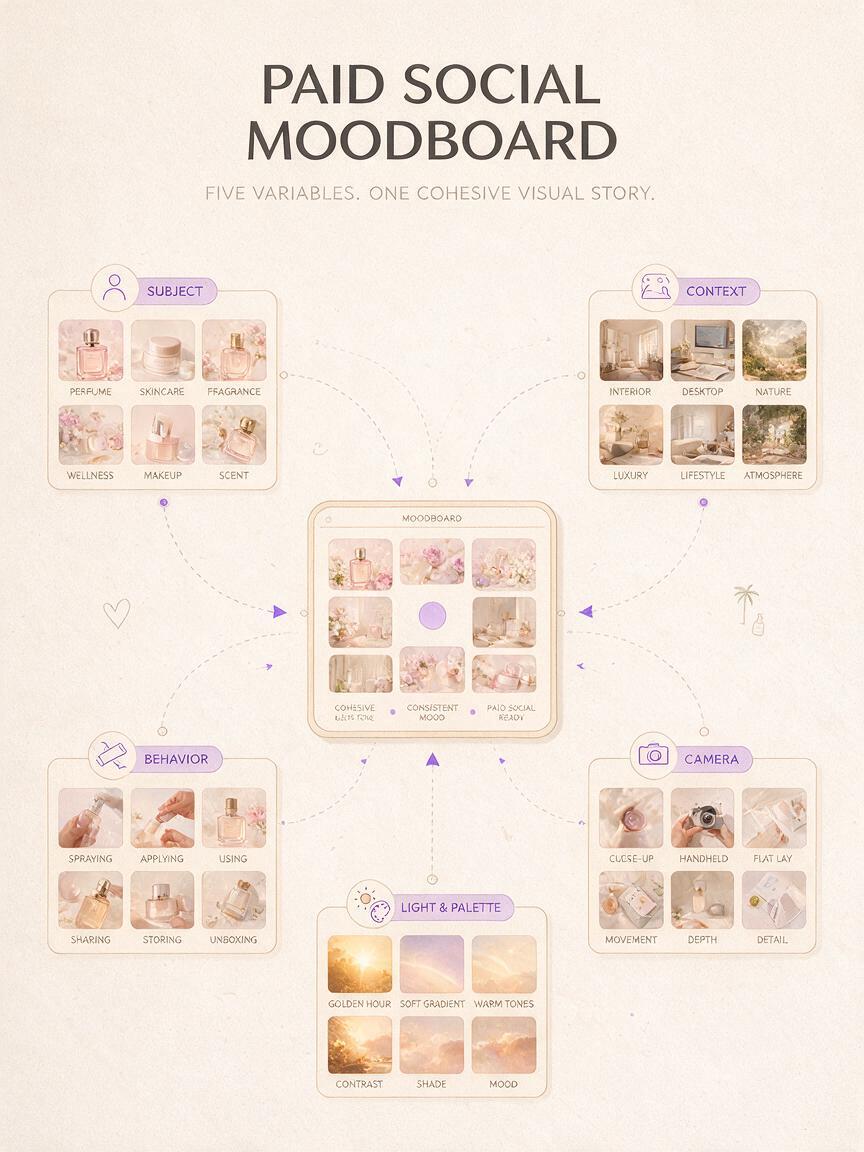
Build a prompt from five production variables
A reliable moodboard prompt describes the production variables that need to remain coherent across the campaign. It does not need a long list of decorative adjectives.
| Variable | Question to answer | Useful prompt language |
|---|---|---|
| Subject | What must remain visually important? | Product in foreground, hand interacting with product, recognizable silhouette |
| Context | Where does the buying problem occur? | Early commuter train, compact apartment, gym locker room |
| Behavior | What action makes the benefit believable? | Packing, pouring, comparing, carrying, opening |
| Camera | How should the ad direct attention? | Eye-level medium shot, overhead product layout, close detail |
| Light and palette | What emotional category should the campaign occupy? | Soft window light, hard midday sun, restrained neutral palette |
Use those variables to create images with ai in batches. Keep the strategic brief constant while changing one visual direction at a time. This prevents a moodboard from becoming a mixture of unrelated sets, lenses and color treatments.
Reusable master prompt
Editorial advertising concept for [PRODUCT CATEGORY], designed for [AUDIENCE] in the moment when [BUYING CONTEXT]. Show [VISIBLE ACTION] so the benefit [BENEFIT] is understandable without text. [SHOT TYPE] with [COMPOSITION], [LIGHTING], and a restrained [COLOR PALETTE] palette. Realistic materials, plausible body position, practical location, intentional negative space for campaign copy. Consistent art direction suitable for a paid social campaign moodboard. No logos, no written words, no impossible product features, no distorted hands.The instruction “suitable for a paid social campaign moodboard” establishes the purpose, while the concrete production variables do most of the work. Do not depend on broad labels such as cinematic, viral or luxury unless you explain what those labels mean visually.
Four moodboard directions worth testing
These prompt patterns represent different advertising mechanisms. Replace the bracketed details with your product information, but retain the visual logic of each direction.
Problem-in-context realism
Use this direction when the buying trigger is a familiar frustration. The product does not need to appear heroic; it needs to feel relevant.
Documentary-style advertising photograph for a compact noise-canceling headset, created for remote workers taking calls in shared spaces. A commuter sits near the door of a busy train while joining a focused work call, headset clearly visible in profile, surrounding passengers rendered with natural motion rather than dramatic blur. Eye-level medium shot, cool morning daylight, muted navy and gray palette, realistic public transit interior, open copy space above the seated subject. No text, no logos, no futuristic interface.Benefit demonstration
Choose a physical action that makes the core benefit visible in one frame. Avoid magical effects that cannot be recreated in a shoot.
Performance advertising concept for a lightweight waterproof running jacket. A runner folds the jacket into its own small travel pouch on a wooden trail bench after light rain, both the full garment and compact packed size clearly understandable. Three-quarter close shot, damp natural textures, soft overcast light, forest green and warm stone palette, realistic hands and fabric folds, clean negative space on the left for a headline. No text, no logos, no floating objects.Identity and aspiration
This direction connects the product to the person the buyer wants to become. Keep the aspiration attainable and rooted in a credible routine.
Contemporary editorial campaign for a meal-planning mobile service, aimed at busy first-time parents who want calmer weeknights. A bright but lived-in kitchen at 6 p.m., one parent calmly preparing vegetables while a phone rests securely on a counter stand, family details present without visual clutter. Wide environmental composition, warm side light, terracotta and sage accents, believable home styling, room for vertical copy near the upper wall. Phone screen blank for later compositing, no text, no logos.Product-world visual metaphor
A metaphor can interrupt the feed, but it should still connect to a product truth. Use it as a concept route, not as evidence for an unsupported claim.
Surreal yet physically plausible advertising set for a productivity notebook designed around daily prioritization. An open notebook sits on a studio table while dozens of loose paper strips converge into three clean organized paths leading toward the pages, representing reduced mental clutter. Overhead composition, crisp directional shadows, cream paper with cobalt and coral accents, tactile handmade materials, generous negative space, premium practical art direction. No written words, no logos, no floating paper.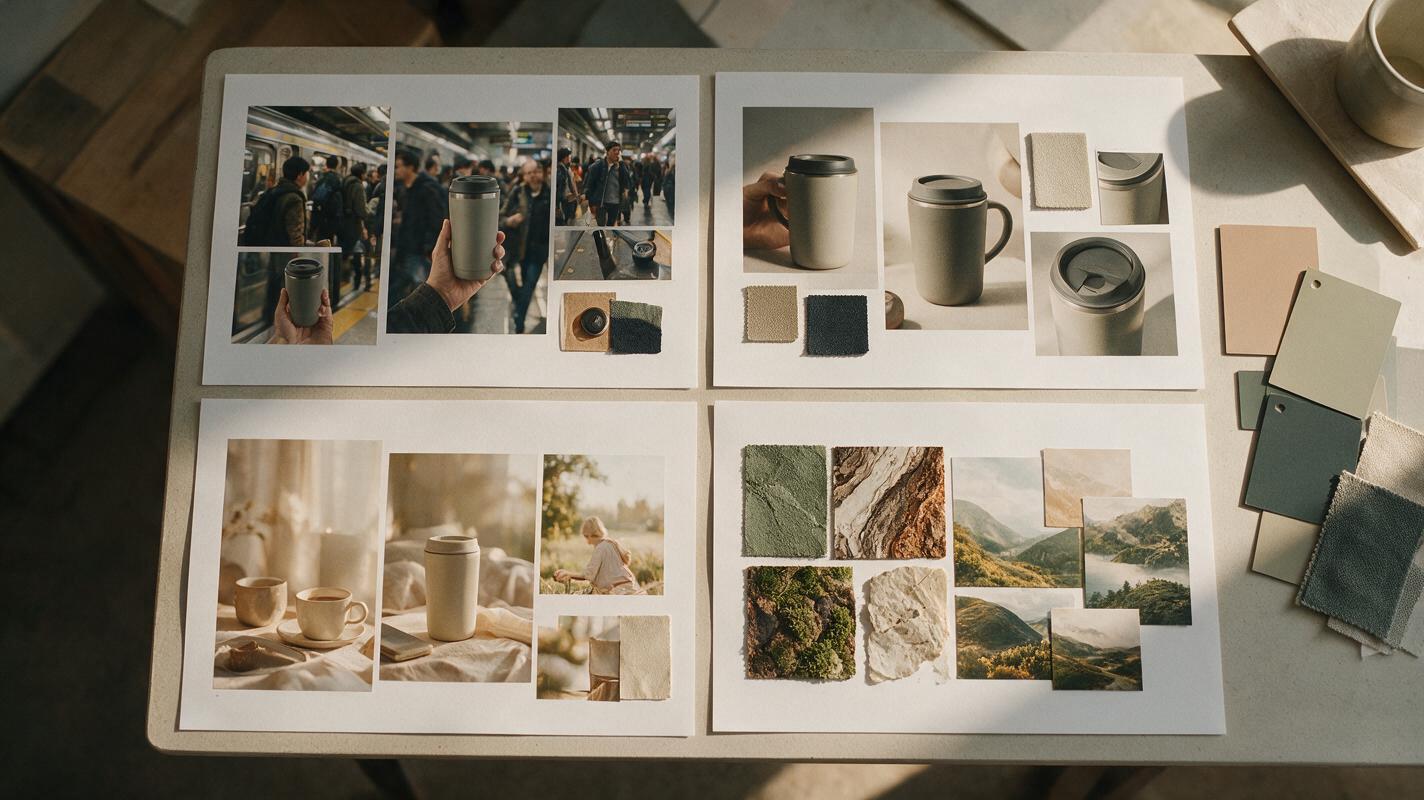
Create a coherent board instead of isolated hero images
A single striking image does not reveal whether an idea can sustain a campaign. Generate a small visual family for every promising direction:
- Hero frame: the clearest expression of the campaign idea.
- Product detail: a closer view that establishes material, function or interaction.
- Environmental frame: the wider buying context or customer routine.
- Alternate crop: a composition with negative space suitable for a different placement.
Repeat the same location, palette, lighting logic and audience description across the family. Change only the requested shot. Controlled ai image generation makes it easier to distinguish a repeatable art direction from a lucky output.
Maintain the same campaign world, audience, location, lighting direction and color palette as the previous concept. Create a close product-interaction detail showing [ACTION]. Preserve realistic materials and leave [COPY AREA] uncluttered. No text, no logos, no redesign of the product.If the product must be exact, use the generated frames as composition references and place verified product photography into the final assets. Never ask stakeholders to approve a concept based on a product feature that does not exist.
Score concepts for production and performance potential
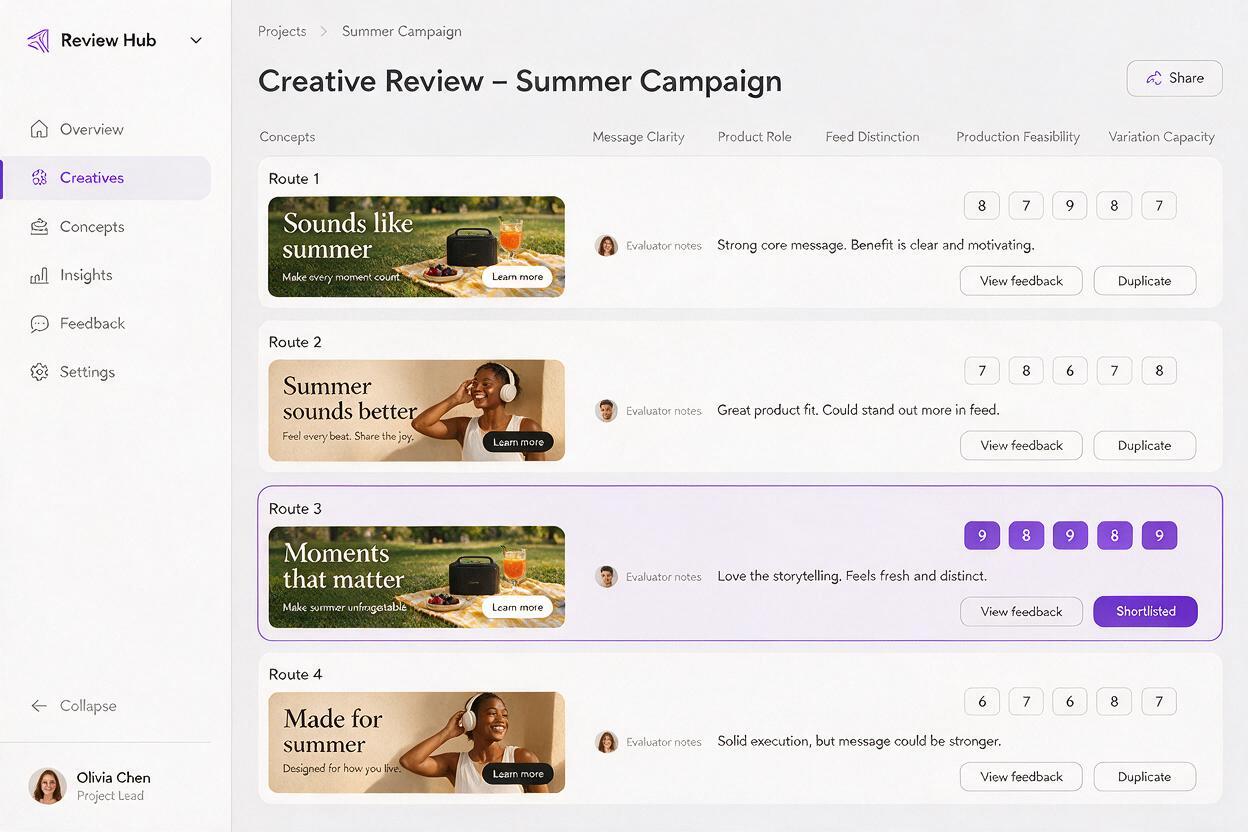
Do not select the winner through a general “which one do you like?” discussion. Score each direction against the same campaign requirements.
| Criterion | Review question | Weight |
|---|---|---|
| Message clarity | Can someone identify the situation and benefit without a caption? | 30% |
| Product role | Is the product necessary to the idea rather than decorative? | 20% |
| Feed distinction | Does the visual differ from the brand’s current ads and category defaults? | 15% |
| Production feasibility | Can the location, action, lighting and props be reproduced? | 20% |
| Variation capacity | Can the direction support several hooks, crops and scenes? | 15% |
Advance the two strongest routes rather than polishing only one. The alternatives should test different hypotheses—for example, practical problem recognition versus aspirational identity—not trivial differences in background color.
Translate the selected direction into a creative brief
The moodboard becomes operational when every visual choice is converted into a production instruction. Record what is fixed, what may vary and what must never be inferred from generated images.
- Fixed: audience, product category, campaign promise, setting and visual tone.
- Variable: hook, camera distance, talent action, headline and call to action.
- Verified assets: product packshot, interface capture, logo, legal copy and offer details.
- Prohibited: unsupported product behavior, invented testimonials, false before-and-after results and unreadable synthetic text.
For the first paid test, vary the underlying concept rather than changing every production detail. Once a direction wins, test executions within that direction. This separates strategic learning from aesthetic preference and gives the next production cycle a clearer signal.
Final checklist
- The moodboard answers one defined campaign decision.
- Every direction is based on a distinct marketing hypothesis.
- The product benefit is demonstrated through a believable action or context.
- Each concept includes a hero frame, detail, environment and alternate crop.
- Real product photography and approved copy will replace generated approximations.
- Concepts are scored for clarity, feasibility and variation capacity.
- The paid test compares strategic directions before minor aesthetic variants.
Choose one active campaign, insert its audience and buying context into the master structure, and try this prompt for free.
Keywords
midjourney prompts, ad moodboard, campaign creative, ai advertising images, creative direction, performance ad creative, creative testing