Midjourney Prompts for Chrome Makeup Packaging Without Melted Reflections
Chrome lipstick tubes, mirrored compacts and metallic mascara packaging often develop wavy edges, liquid-looking surfaces and impossible reflections in AI images. These Midjourney prompts use controlled studio environments, explicit material language and reflection geometry to produce more credible cosmetic campaign concepts.
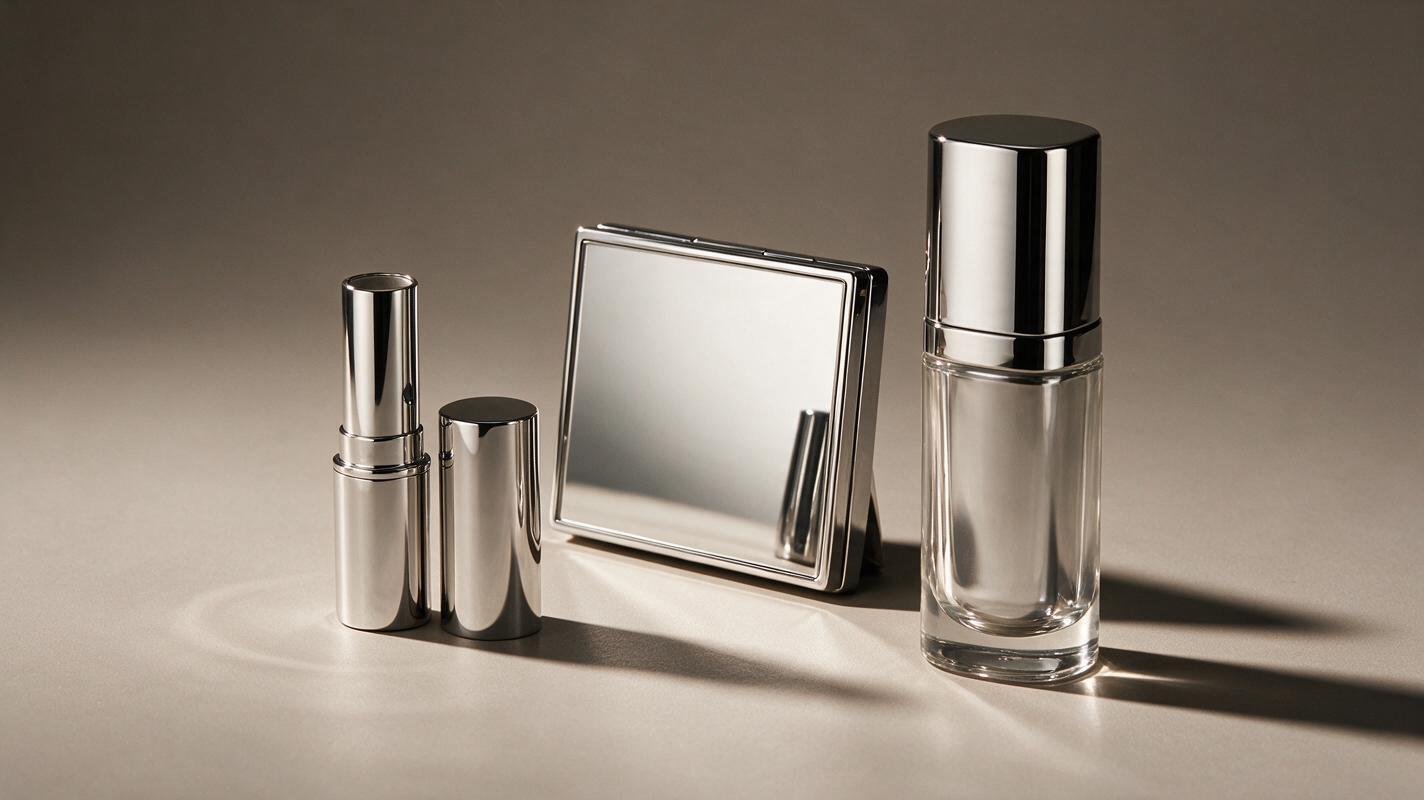
Table of contents
Make reflective packaging look solid, polished and premium
Chrome cosmetic packaging should reflect its environment without looking melted, dented or covered in random highlights.
The problem is rarely solved by adding more words such as “luxury” or “photorealistic.” A useful prompt must define the product’s construction, the studio environment and the reflections that connect those elements. Otherwise, mirrored lipstick tubes become liquid metal, compact lids lose their circular geometry and brand panels disappear under white glare.
Midjourney is well suited to developing visually polished campaign concepts when exact packaging reproduction is not the only priority. Use it as an ai image generator for composition, lighting and art-direction exploration, then verify packaging geometry and add approved label artwork during retouching.
Important: Treat generated labels, ingredient text and regulatory copy as placeholders. Final advertising artwork should use approved brand assets and be reviewed for claim compliance.
Why chrome packaging turns into liquid metal
A reflective package does not have a visible color in the same way as a matte carton. Its appearance comes from reflected lights, surfaces and objects. If the prompt requests “a chrome lipstick on a white background” but says nothing about the studio around it, the model has to invent an environment and map that invention onto the package.
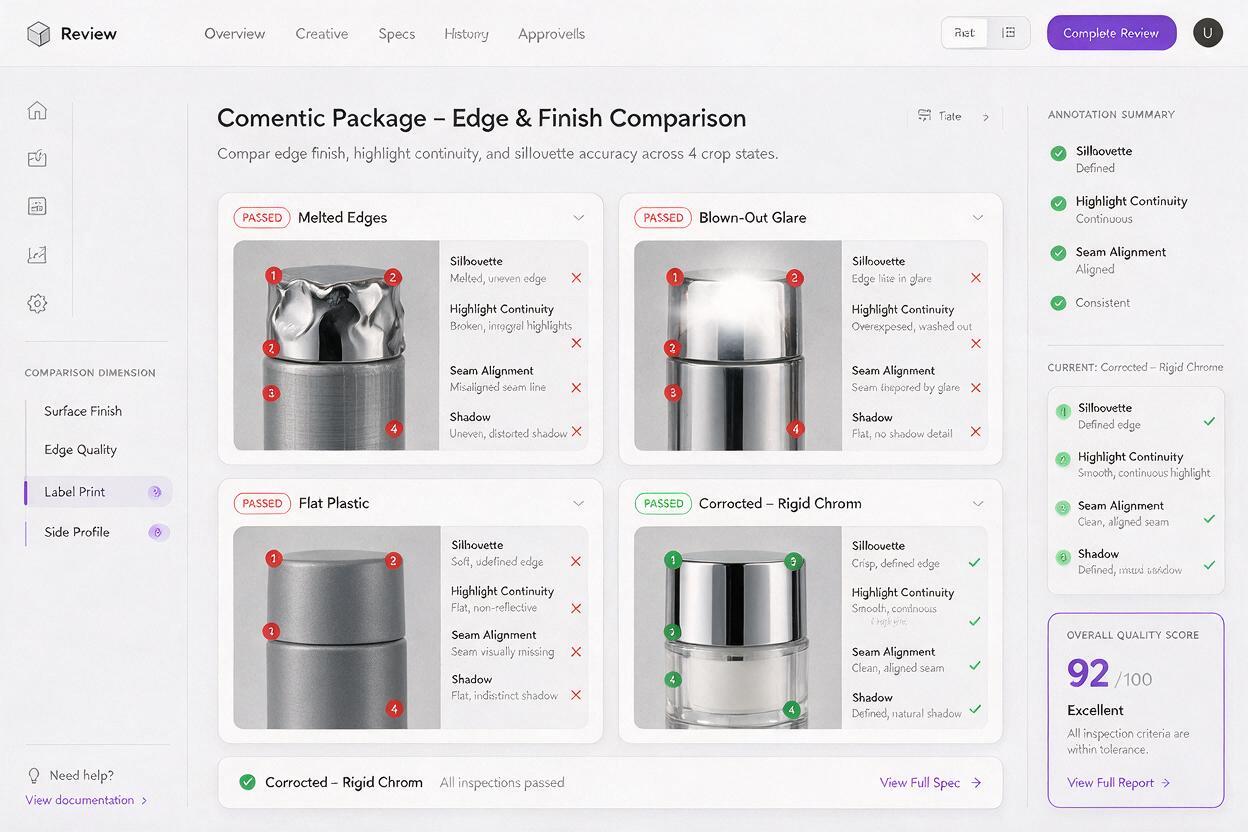
This often produces four recognizable failures:
- Wavy silhouettes: straight tubes develop pinched waists or softened edges.
- Random reflection bands: highlights cross caps, hinges and seams without respecting their geometry.
- Liquid-looking metal: the surface resembles mercury instead of plated aluminum or polished stainless steel.
- Blown-out brand panels: bright reflections erase the intended logo area.
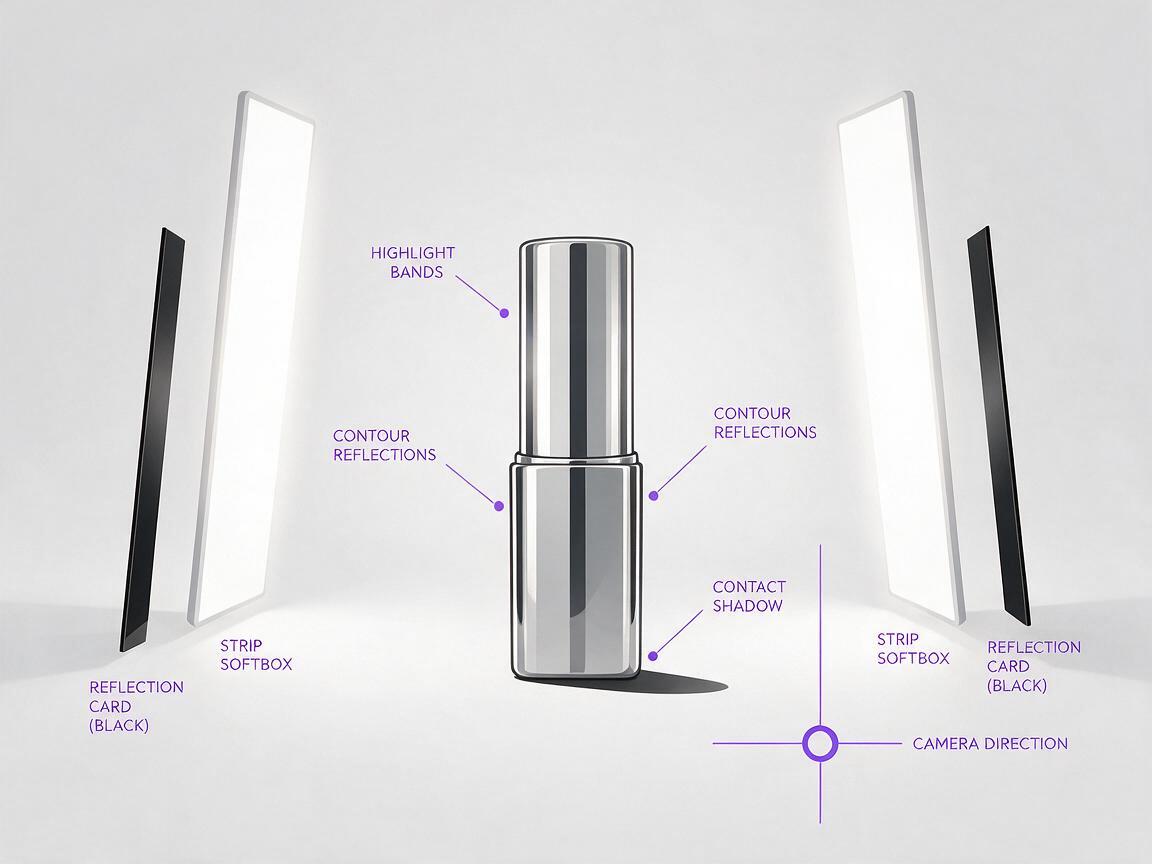
The most reliable correction is to describe a simple physical set. Large softboxes create broad vertical highlights. Black flags create dark contour lines. A neutral sweep produces a predictable central reflection. These details give the generated surface something coherent to reflect.
Build the prompt around physical reflection geometry
A strong chrome-product prompt can be organized around five decisions: object construction, surface finish, set design, light shape and camera behavior.
| Prompt component | What to specify | What it prevents |
|---|---|---|
| Construction | Rigid cylinder, flat cap, precise seam, centered hinge or beveled rectangular case | Melted silhouettes and uneven parts |
| Material | Polished aluminum, chrome-plated metal or mirror-finish stainless steel | Plastic, foil or mercury-like surfaces |
| Environment | Neutral studio sweep with controlled black and white reflection cards | Unexplained colors and chaotic scenery |
| Lighting | Two tall strip softboxes with narrow edge highlights | Patchy glare and clipped reflections |
| Camera | Front three-quarter product view, level verticals and moderate depth of field | Distorted proportions and unreadable profiles |
Use “mirror finish” only when you genuinely want recognizable studio reflections. For a softer premium result, ask for “polished metal with controlled linear reflections.” That wording still communicates shine while reducing the chance of a chaotic mirrored surface.
Chrome lipstick hero prompt
A lipstick tube needs a stable cylinder, a clear cap seam and separation between the metal package and the exposed bullet. Avoid requesting splashes, crystals or multiple props until the basic construction is working.
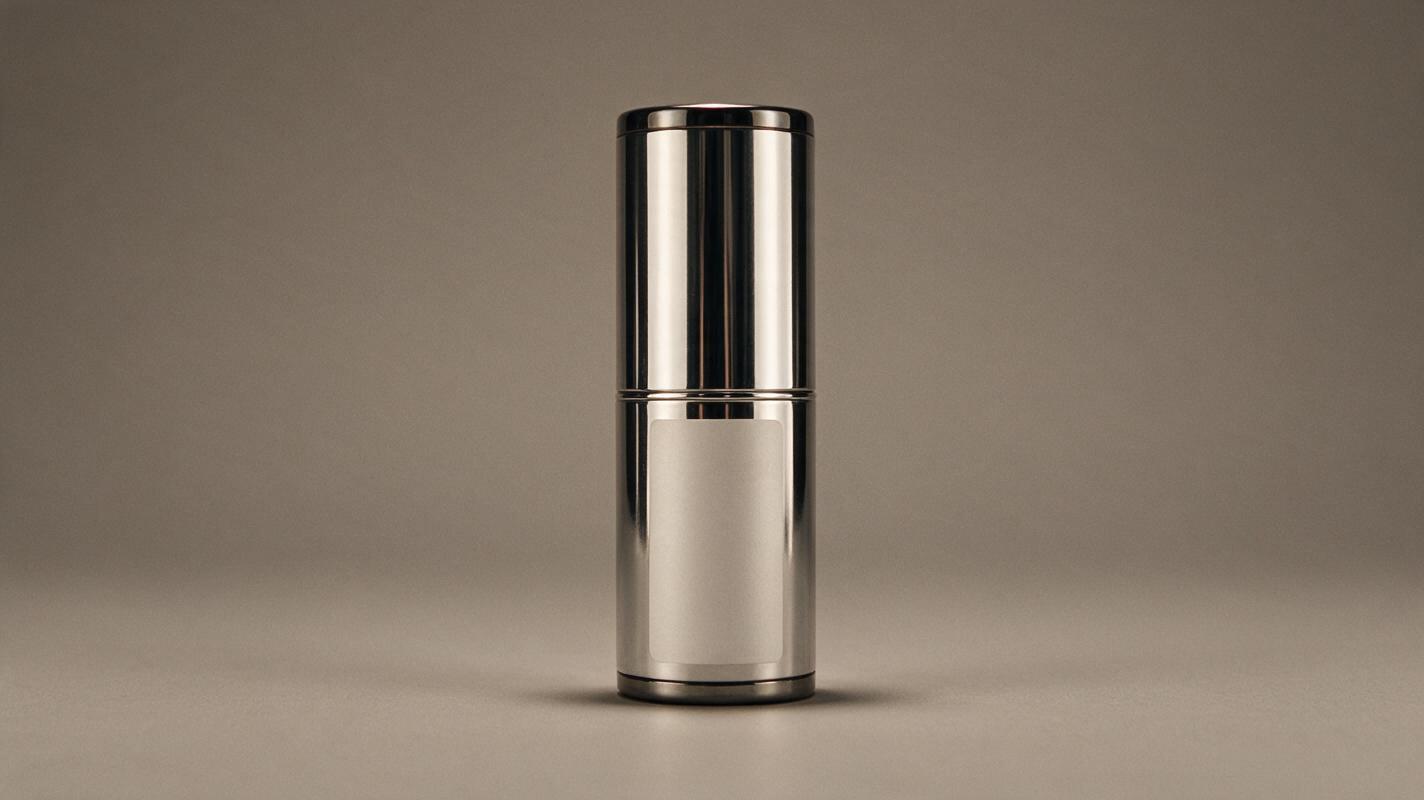
Luxury cosmetic product photograph of one closed lipstick tube, rigid straight cylindrical body, precisely fitted flat cap, narrow clean seam between cap and base, polished chrome-plated aluminum with controlled vertical reflections, no dents or warped edges. Minimal warm-gray studio sweep, two tall strip softboxes creating symmetrical white highlight bands, slim black reflection cards defining both outer contours, centered front three-quarter view, level camera, realistic contact shadow, premium beauty campaign lighting, crisp product silhouette, generous negative space, blank protected label panel with soft even contrast, no extra products, no floating parts, no liquid-metal appearance.If the first result is too mirror-like, replace “polished chrome-plated aluminum” with “brushed satin silver aluminum with restrained linear highlights.” This changes the material rather than asking the model to make contradictory chrome that is both highly reflective and reflection-free.
Mirrored compact prompt with a clean circular edge
Round compacts commonly become oval, asymmetrical or too thin to contain a real pan. The prompt should establish that the camera is only slightly above the product and that the lid and base remain concentric.
Premium makeup compact campaign image, one closed circular compact with a rigid machined-metal shell, perfectly concentric lid and base, consistent thickness, precise horizontal opening seam, polished silver mirror finish. Compact resting flat on a pale stone surface, camera slightly above at a shallow angle so the circular geometry remains believable, broad overhead diffusion, two controlled curved highlight bands following the lid, dark contour reflection around the rim, subtle realistic grounding shadow, clean central area reserved for brand artwork, high-end cosmetic product photography, no oval distortion, no melted rim, no duplicate compact, no powder or applicator.When the compact still appears oval, reduce the viewing angle instead of repeatedly adding “perfect circle.” A near-overhead composition makes circular geometry easier to communicate, while a low dramatic angle naturally creates an ellipse.
Metallic mascara tube prompt with readable separation
A mascara pack has several narrow components that can merge under strong reflections. The collar, cap and body need distinct seams, and the tube should remain closed if applicator anatomy is not part of the shot.
Editorial beauty product photograph of one closed metallic mascara tube, long rigid cylindrical body, straight parallel sides, separate fitted cap with a precise collar seam, balanced real-world proportions, polished gunmetal chrome finish with smooth controlled vertical reflection gradients. Deep burgundy seamless background, soft frontal diffusion with one tall narrow highlight on each side, black flags defining the silhouette, product positioned diagonally but not floating, crisp cap-to-body separation, realistic soft shadow beneath the tube, uncluttered luxury cosmetics advertising composition, protected low-glare logo zone, no wand, no brush, no bent tube, no liquid metal, no additional packaging.A dark chrome product can disappear against a dark background unless the edge highlights are explicitly preserved. Ask for two narrow highlights along the sides rather than a bright reflection across the entire front panel.
Chrome foundation bottle prompt with glass and metal separation
Foundation packaging becomes especially difficult when clear glass, colored liquid and a reflective metal pump appear together. Name each material separately and describe where it begins and ends.
Photorealistic studio campaign image of one rectangular glass foundation bottle with straight vertical edges, transparent heavy glass walls, warm neutral liquid fill with a level fill line, polished chrome pump collar and rigid chrome cap, every component cleanly separated. Three-quarter front view on a matte cream pedestal, large diffused key light revealing the glass thickness, vertical strip light reflected only in the metal cap, subtle black edge card defining the bottle sides, accurate refraction through the glass base, soft contact shadow, understated prestige cosmetics art direction, blank front label area, no warped pump, no duplicated cap, no spilled liquid, no metallic glass.The phrase “reflected only in the metal cap” helps establish material boundaries, but generated results should still be checked carefully. If the bottle body turns silver, simplify the composition and state “transparent uncoated glass body” near the beginning of the prompt.
Diagnose the reflection before changing the whole prompt
Change one variable at a time. Rewriting the product, background, lighting and camera together makes it difficult to identify which instruction corrected the image.
| Visible problem | Likely cause | Targeted prompt adjustment |
|---|---|---|
| Surface looks melted | Material language is too abstract | Add rigid construction, machined edges and a specific plated metal |
| Front panel is pure white | Softbox reflection crosses the label area | Request a protected low-glare central panel |
| Package reflects a fake room | No studio environment was defined | Add a seamless sweep and controlled reflection cards |
| Edges blend into the background | Insufficient contour separation | Add slim black or white edge reflections |
| Chrome resembles gray plastic | Highlights are too broad and flat | Request bright linear highlights beside deep dark reflection bands |
| Logo becomes gibberish | Generated text is being treated as final artwork | Generate a blank label zone and add approved artwork later |
For campaign exploration, generate the clean product first. Add florals, water, stones or reflective platforms only after the silhouette and material read correctly. Every additional prop introduces another object that can appear in the package reflection.
Choose the strongest result for production
Do not select an image solely because it looks glossy at thumbnail size. Inspect the cap seam, base alignment, highlight continuity and contact shadow at full resolution. A production candidate should satisfy all of these conditions:
- The left and right edges follow the intended package geometry.
- Reflection bands wrap around the form rather than cutting through it randomly.
- Separate materials remain visually separate.
- The product appears to touch the surface with a plausible shadow.
- The label zone has enough contrast for approved artwork.
- No important hinge, collar, pump or closure has been invented.
Once one composition works, preserve its core set description and vary only one creative element, such as background color, pedestal material or crop. This produces a more coherent campaign family than generating every image from an unrelated prompt.
Final checklist
- Define the package as a rigid physical object before describing its mood.
- Name the exact metal finish instead of relying on “shiny” or “luxury.”
- Describe the studio cards and softboxes that create the reflections.
- Keep the first generation free of unnecessary props.
- Protect a low-glare area for approved branding.
- Inspect seams, edges and shadows at full size.
- Add final logos and regulated copy during production retouching.
Ready to explore a polished chrome lipstick, compact or foundation concept? test this prompt yourself, then refine the set description around your package’s real shape and finish.
Keywords
Midjourney prompts, chrome makeup packaging, cosmetic product photography, beauty product image, metallic packaging, AI beauty ad, product photography prompts