Midjourney Prompts for Cohesive Creative Pitch Moodboards
Build a coherent Midjourney moodboard for an advertising pitch without filling the deck with disconnected images. This practical method uses a visual thesis, an anchor frame, shot-role prompts, and a simple coherence test to keep campaign worlds focused and persuasive.
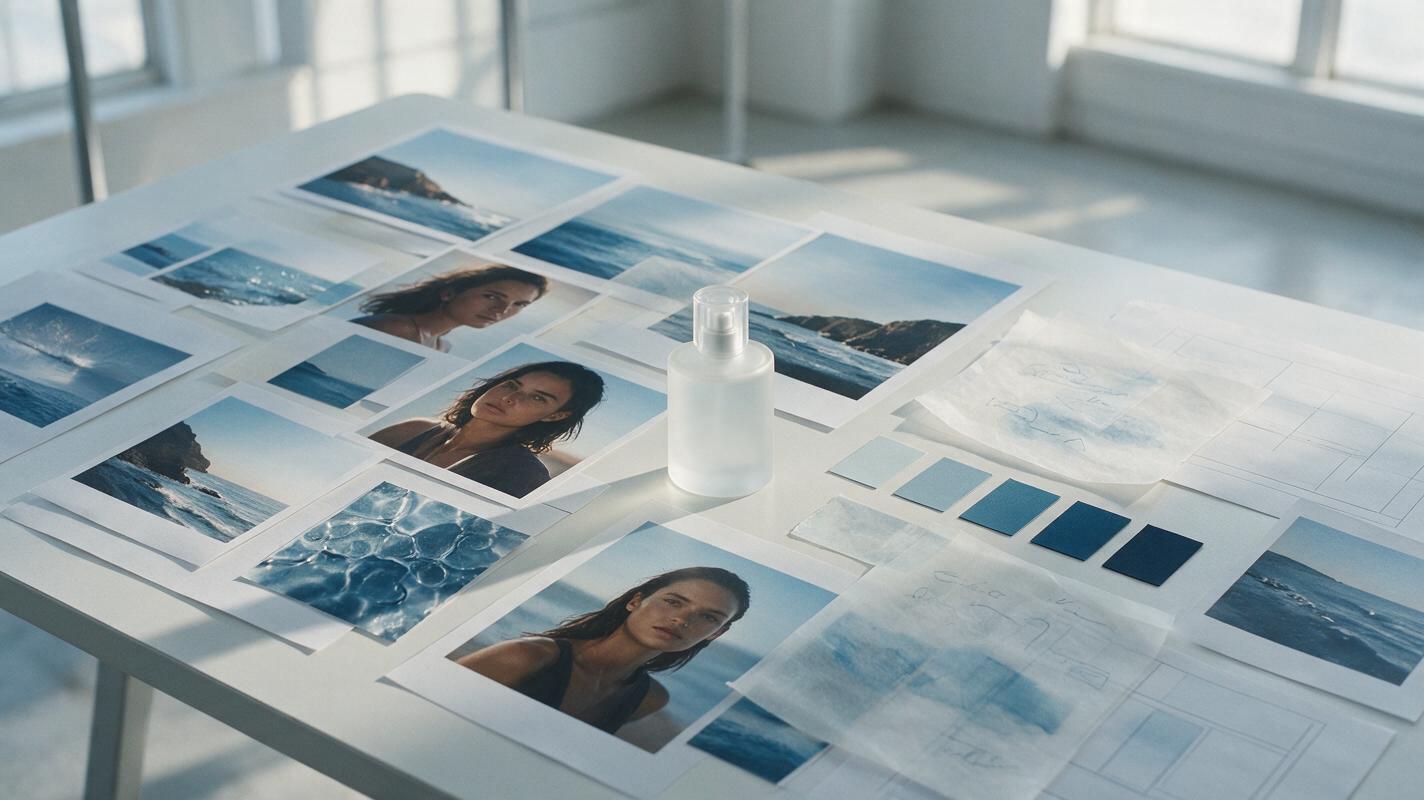
Table of contents
Build a moodboard that sells one idea
A creative pitch moodboard can contain individually impressive images and still fail as a campaign. The usual problem is visual drift: the product belongs to one world, the talent appears to come from another, and every frame uses a different lighting language. Midjourney can accelerate concept exploration, but cohesion comes from controlling the brief—not generating more options.
This method helps advertising creatives build a focused board for commercials, spec ads, brand films, and campaign treatments. Instead of asking for eight unrelated hero images, you will define one visual thesis, establish an anchor frame, and expand it into images with specific roles.
Why AI pitch moodboards lose coherence
Broad prompts encourage broad interpretation. A request such as premium skincare campaign, cinematic, beautiful model, luxury lighting may produce attractive images, but it does not define a recognizable campaign world.
Drift usually enters through four variables:
- Lighting drift: soft daylight, hard flash, neon color, and studio gradients appear on the same board.
- Material drift: polished chrome, raw concrete, silk, water, and translucent acrylic compete for attention.
- Camera drift: editorial portraits sit beside wide cinematic scenes and abstract macro images without a clear hierarchy.
- Tone drift: playful frames, severe luxury imagery, and documentary moments communicate different brand personalities.
A cohesive moodboard does not require every image to look identical. It requires every image to feel directed by the same creative decision.
Define the visual thesis before prompting
Compress the concept into one sentence that describes the subject, environment, light, material language, and emotional effect. This becomes the fixed core of every prompt.
For a fictional fragrance launch, the thesis might be:
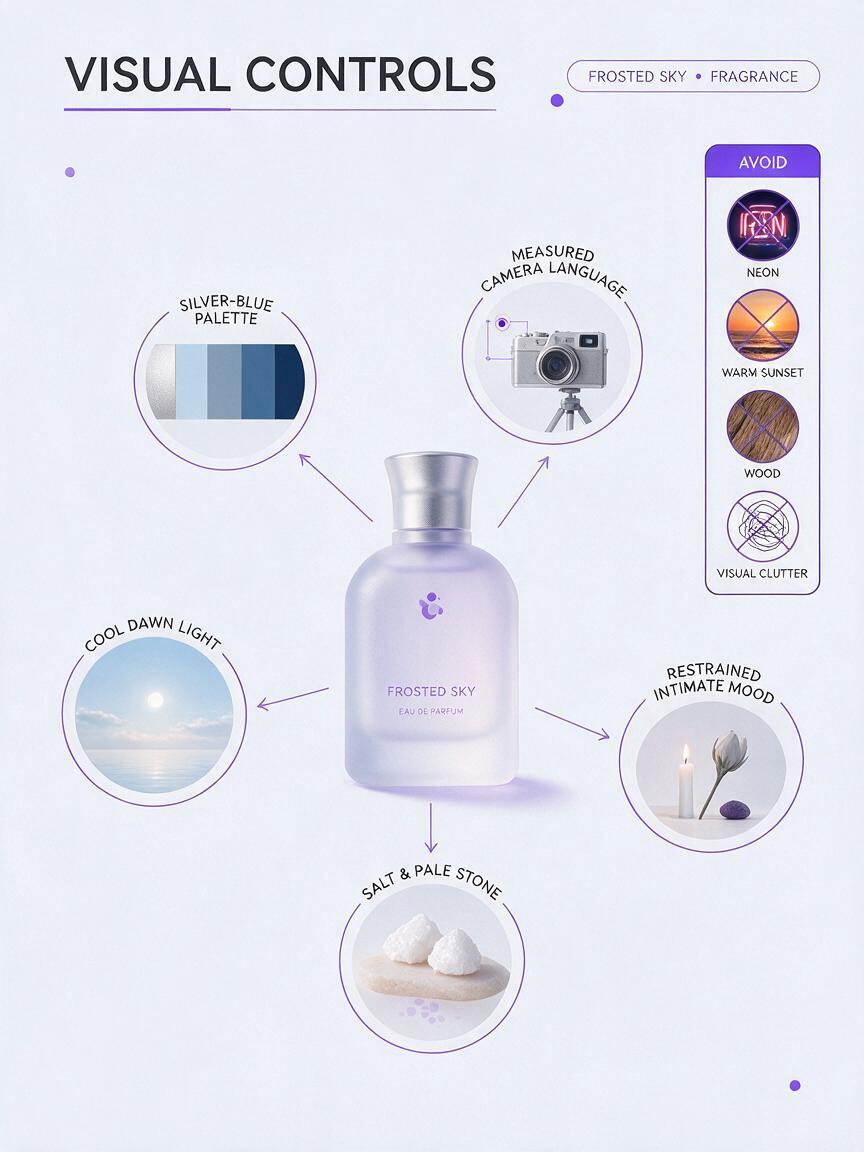
A solitary fragrance bottle in a mineral coastal world, shaped by wind and salt, photographed in cool dawn light with restrained silver-blue color and quiet sensuality.Convert that sentence into a compact continuity card:
| Control | Locked direction | Avoid |
|---|---|---|
| Palette | Silver, slate blue, chalk white | Warm orange and saturated green |
| Light | Low cool dawn light, soft directional shadows | Neon, hard flash, golden sunset |
| Materials | Salt crystal, frosted glass, pale stone | Wood, velvet, glossy plastic |
| Camera | Measured compositions, close tactile detail | Extreme wide-angle distortion |
| Mood | Elemental, restrained, intimate | Busy, festive, aggressively futuristic |
The continuity card should fit on one screen. If it becomes a page of adjectives, it is no longer controlling the work. Select details that can be seen in an image rather than abstract claims such as innovative or authentic.
Build one anchor frame
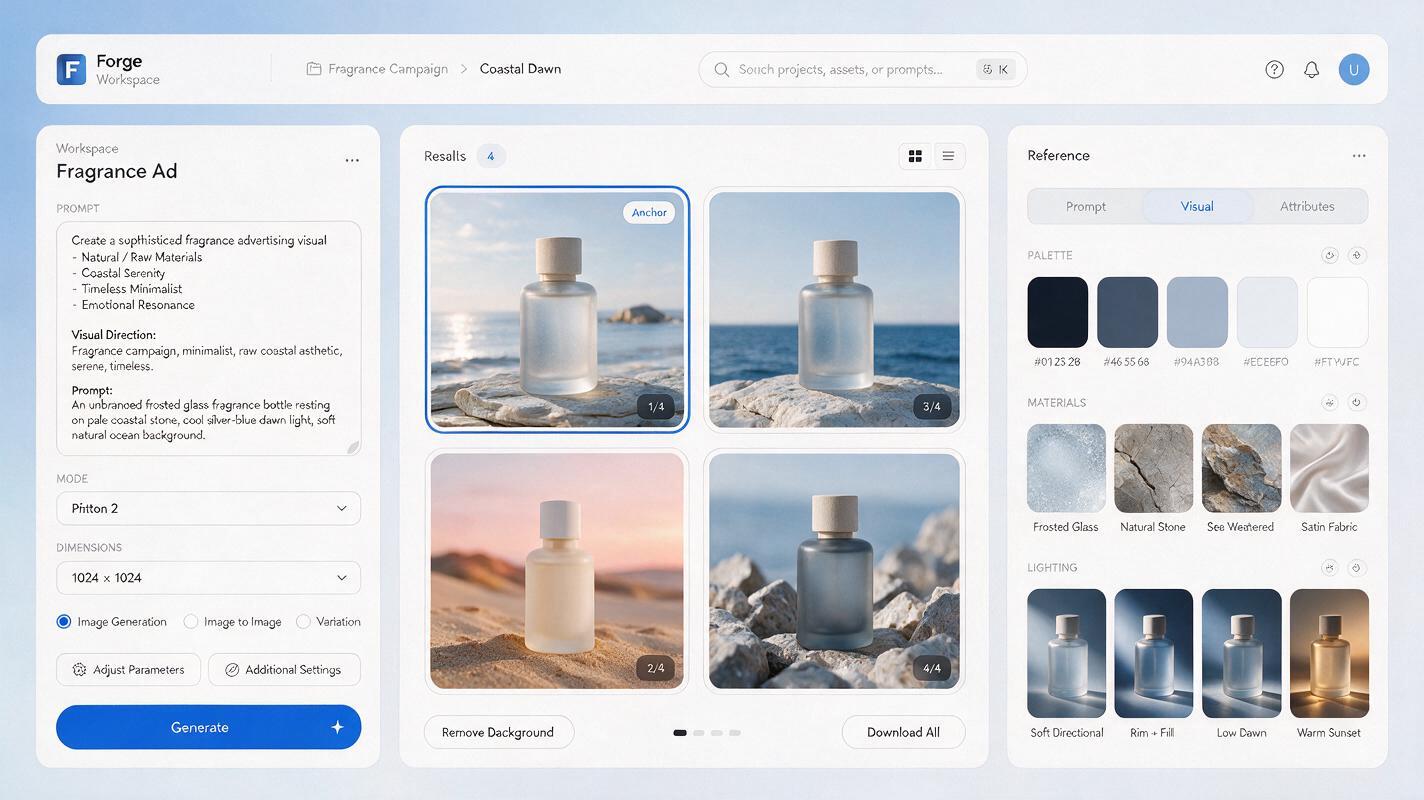
Start with the image that most clearly expresses the campaign promise. For a product-led commercial, this is often a hero still rather than a portrait or establishing shot. The anchor establishes the visual rules that later images must inherit.
Use Midjourney as an ai image generator to explore compositions, but keep the continuity card intact while changing only one major variable at a time. A useful anchor prompt is:
Advertising hero image for a fictional unbranded fragrance bottle, monolithic pale stone platform on a wind-shaped coastal landscape, fine salt crystals suspended near the glass, cool silver-blue dawn light, soft directional shadow, tactile frosted glass, restrained luxury art direction, centered product hierarchy, realistic commercial photography, generous clean space for campaign typography, no readable text, no logoGenerate a small batch and choose the frame with the clearest hierarchy—not necessarily the most spectacular frame. The winning anchor should answer three questions immediately:
- What is the audience meant to notice first?
- What physical world does the campaign occupy?
- What makes this world specific to the concept?
Save the selected image as a visual reference when the interface supports reference-based generation. Treat it as guidance for atmosphere, palette, and composition rather than a guarantee of exact product or character continuity.
Expand the board by shot role
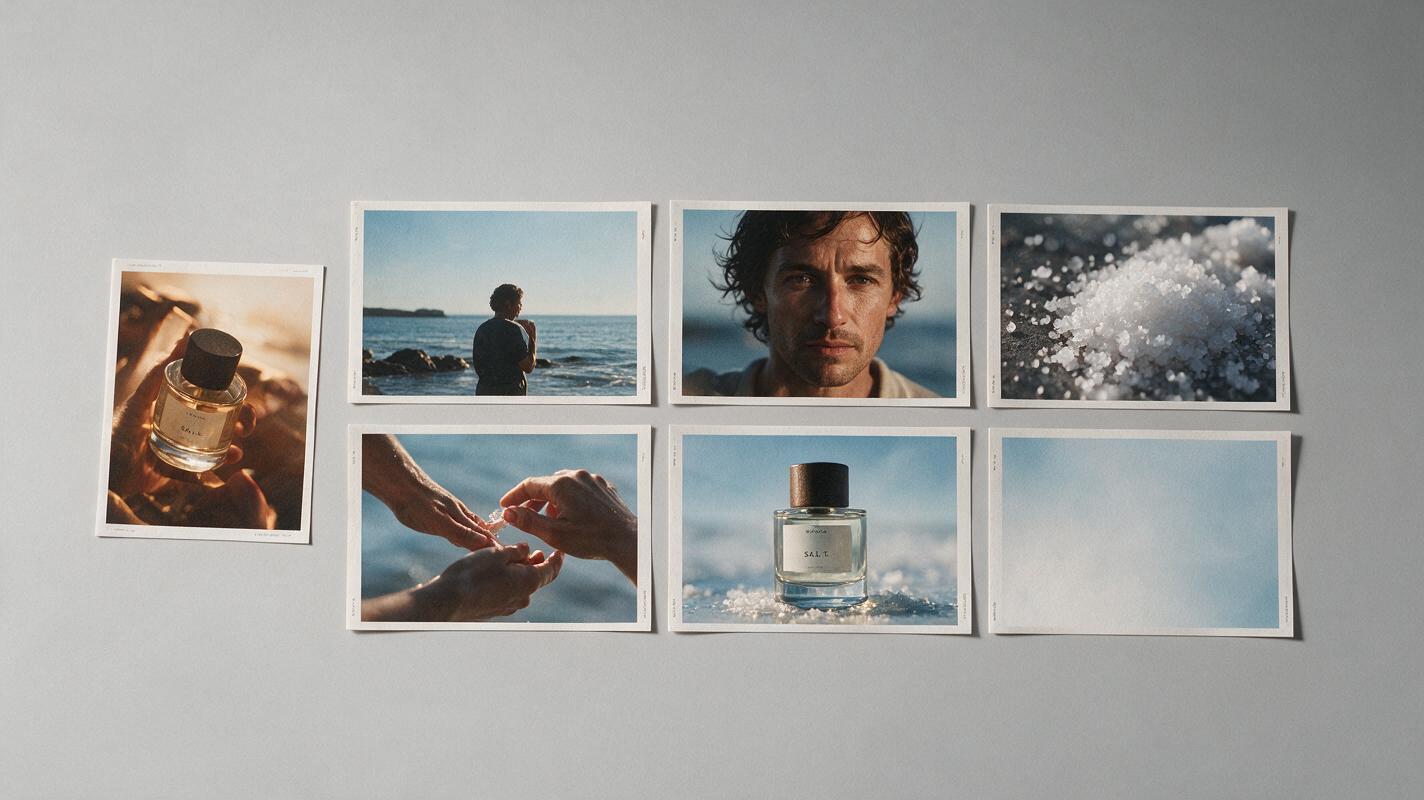
A useful commercial treatment needs visual coverage, not repeated hero shots. Keep the thesis fixed and assign every new image a job in the proposed film.
Establishing image for the campaign world
Wide establishing shot of a mineral coastline before sunrise, chalk-white rock formations shaped by wind, traces of salt in the air, cool silver-blue palette, low soft dawn light, sparse and elemental atmosphere, restrained luxury fragrance commercial, realistic cinematic location photography, no people, no buildings, no textHuman image for emotion and scale
Close editorial portrait of one adult subject standing in a cool coastal wind, natural skin texture, minimal styling in chalk-white fabric, silver-blue dawn light, quiet sensual expression, pale stone and sea mist behind the subject, restrained fragrance campaign art direction, realistic commercial photography, no jewelry, no textMacro image for sensory detail
Extreme macro advertising photograph of salt crystals and condensation across frosted glass, cool silver-blue highlights, shallow depth of field, tactile mineral texture, soft dawn illumination, quiet premium fragrance campaign mood, photorealistic, no label, no readable textProduct interaction image for the edit
Adult hand placing an unbranded frosted fragrance bottle onto pale weathered stone, fine salt moving in the coastal wind, controlled natural gesture, cool dawn light, soft directional shadow, silver-blue and chalk-white palette, realistic premium commercial still, product remains upright and geometrically clean, no textEnd-frame image for campaign lockup
Minimal advertising end frame with one unbranded frosted fragrance bottle on pale mineral stone, distant silver-blue horizon, cool dawn light, elegant soft shadow, large uncluttered negative space above and to the left for headline and logo placement, restrained luxury product photography, no generated typography, no readable labelThese prompts vary subject and scale while preserving the same palette, materials, light, and emotional register. That controlled variation makes the board feel like a film rather than a folder of references.
Separate concept exploration from brand approval
Generated pitch imagery is best treated as concept visualization unless the depicted packaging, talent, locations, and legal rights have been approved. Do not imply that an invented bottle, logo, celebrity, or location is a finished brand asset.
For client-facing decks, label relevant frames as concept art or visual direction. If exact packaging matters, replace the exploratory product with an approved packshot during compositing rather than asking the generation to reproduce tiny labels perfectly.
This separation also improves the pitch. Midjourney can establish the atmosphere, shot language, styling, and campaign world, while the production plan explains how final brand accuracy will be achieved.
Judge the board as a system
Review the images together at thumbnail size. A frame that looks excellent alone may damage the board if it introduces a new color, location, casting direction, or photographic style.
| Review question | Keep the image when | Regenerate when |
|---|---|---|
| Is the concept legible? | The frame reinforces the mineral coastal idea | It could belong to any luxury campaign |
| Does it share the same light? | Direction, softness, and color temperature align | It introduces flash, neon, or warm sunset light |
| Does it add coverage? | It supplies a new shot role or story beat | It repeats an existing composition |
| Is the product hierarchy clear? | The eye reaches the intended subject quickly | Scenery or styling overwhelms the product |
| Can it support production? | The team can infer location, lens mood, styling, or light | The visual depends on unexplained surreal accidents |
A strong first pitch board may need only six to nine carefully selected images. Remove near-duplicates, even when they are beautiful. The board should create confidence that the concept can expand, not prove that the team generated hundreds of options.
Fix common moodboard failures
The images look premium but generic
Replace broad luxury adjectives with physical evidence. Name the particular stone, atmospheric condition, shadow behavior, garment texture, and composition. Specific nouns usually create a more ownable world than additional style adjectives.
The talent changes in every frame
Use one selected portrait as the reference for later character images where supported. Keep hair, wardrobe, age range, light direction, and camera distance explicit. For a treatment, avoid filling the board with multiple close views that suggest exact casting continuity unless that continuity can be maintained.
Every frame has the same composition
Change shot function rather than changing art direction. Move deliberately between establishing, portrait, product, macro, interaction, and end-frame views while retaining the continuity card.
The board has no room for copy
Request a precise open area and name its location, such as uncluttered negative space in the upper-left third. Generate typography-free imagery and add final headlines, logos, and legal copy in the design layout.
The concept becomes stranger with each generation
Return to the anchor prompt and remove accumulated embellishments. Introduce only the new shot role. Do not solve weak art direction by adding more surreal objects.
Assemble the pitch in narrative order
Arrange the selected images so the client experiences the idea as an emerging commercial: world, character, sensory detail, product interaction, hero product, and end frame. Add short annotations explaining what each image proves about the proposed execution.
Keep rejected experiments out of the main narrative. Alternatives can appear on a separate page when the decision is meaningful, such as two casting directions or two levels of environmental scale. When the thesis and shot roles are ready, test this prompt yourself and curate for coherence rather than volume.
Final checklist
- The campaign can be summarized in one visual thesis.
- One anchor frame defines the world, light, palette, and material language.
- Every image has a distinct role in the commercial or campaign.
- Color and lighting remain consistent across the full board.
- Product, talent, and location imagery is clearly presented as concept work where required.
- Copy space is intentional, and generated typography is excluded.
- Generic or duplicate frames have been removed.
- The final sequence communicates an executable campaign idea.
Keywords
Midjourney prompts, creative pitch moodboard, advertising moodboard, commercial treatment, campaign concept art, visual consistency, spec ad