Midjourney Prompts for Evidence-Based History Illustrations
Historical illustrations can make unfamiliar places and periods easier to understand, but polished images may also turn uncertain details into apparent facts. This guide provides a source-led Midjourney prompting method that separates verified evidence, plausible reconstruction, and deliberate unknowns.
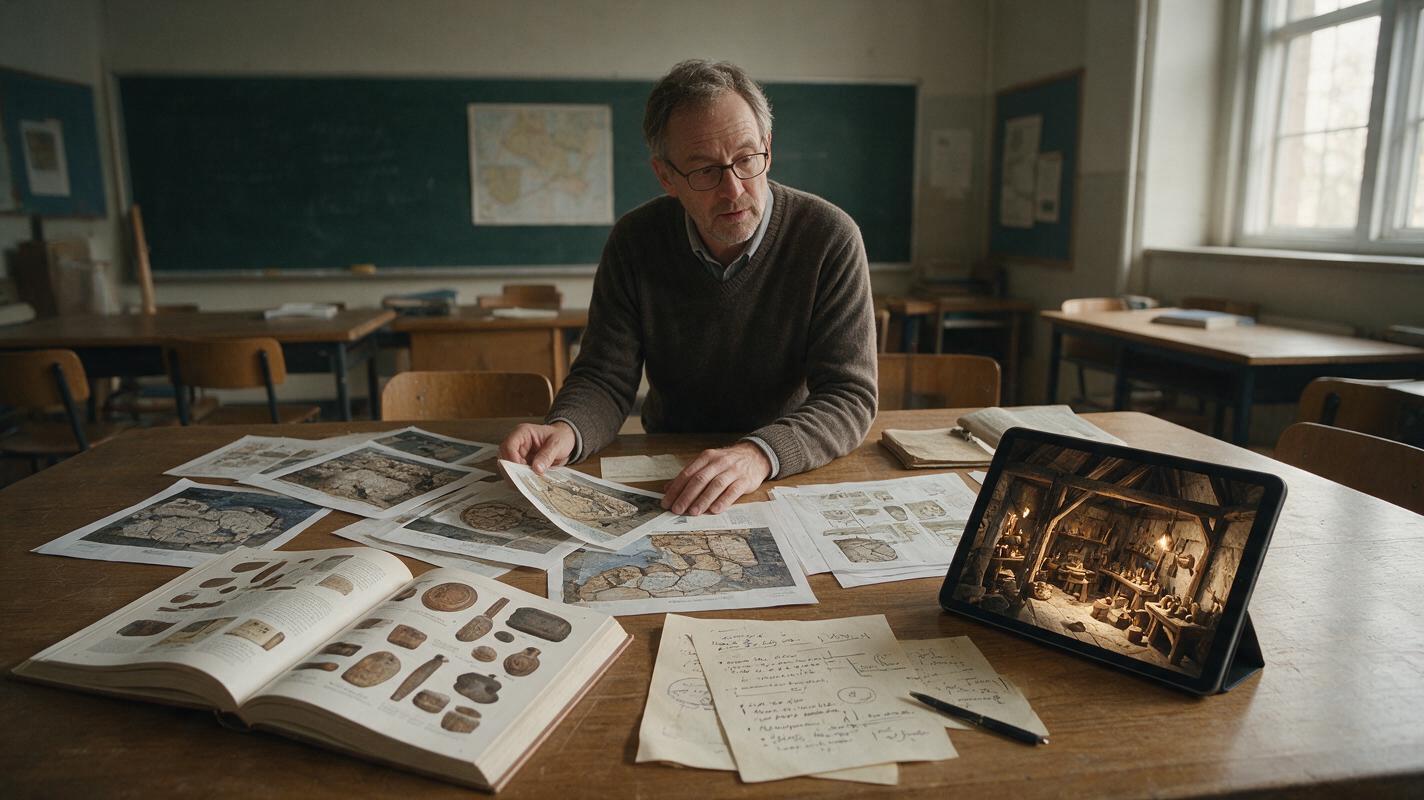
Table of contents
Create atmosphere without disguising invention as evidence
A convincing historical illustration can help learners understand architecture, clothing, labor, trade, or daily life. The same realism can also cause trouble: students may assume every generated object, color, and facial expression is historically documented. The solution is not to avoid reconstruction. It is to build each image from an evidence ledger, constrain unsupported details, and label uncertainty outside the generated scene.
This method uses Midjourney for visual reconstruction while keeping factual decisions under educator control. It works for slide decks, worksheets, museum-style learning content, course chapters, and narrated explainers.
Core rule: A generated historical scene is an interpretation of evidence, not a primary source. Present it as a reconstruction even when it looks photographic.
Build an evidence ledger before writing the prompt
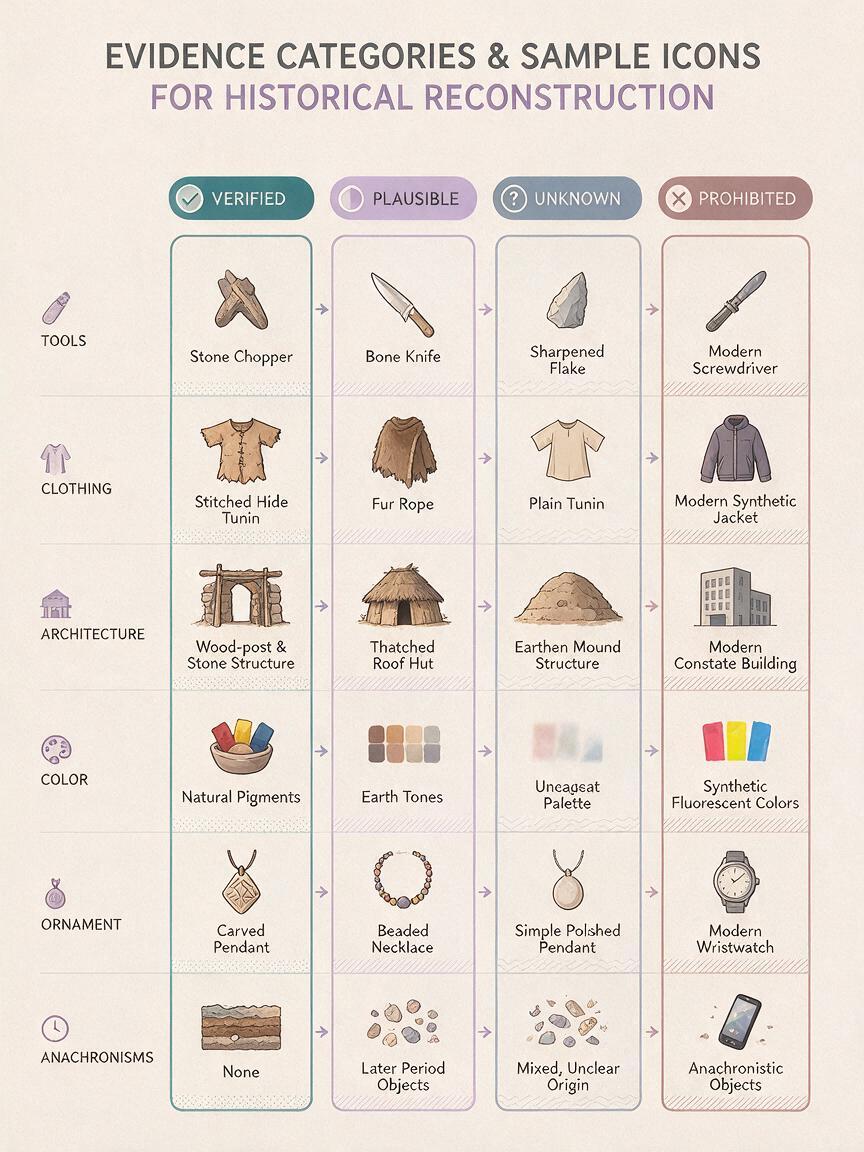
Do not begin with a broad request such as “show daily life in an ancient city.” Broad prompts leave the model to invent the most visually familiar version of a period. Instead, create a compact ledger that separates what is documented from what is merely possible.
| Evidence class | What belongs here | How it affects the image |
|---|---|---|
| Verified | Objects, materials, layouts, garments, tools, or practices supported by reliable sources | Show clearly and describe precisely |
| Plausible | Details consistent with the setting but not confirmed for this exact place or moment | Keep secondary and visually restrained |
| Unknown | Colors, decorations, identities, expressions, or arrangements that sources do not establish | Omit, obscure, simplify, or disclose in the caption |
| Prohibited | Anachronisms, unsupported symbols, modern materials, or dramatic events with no basis | Exclude explicitly |
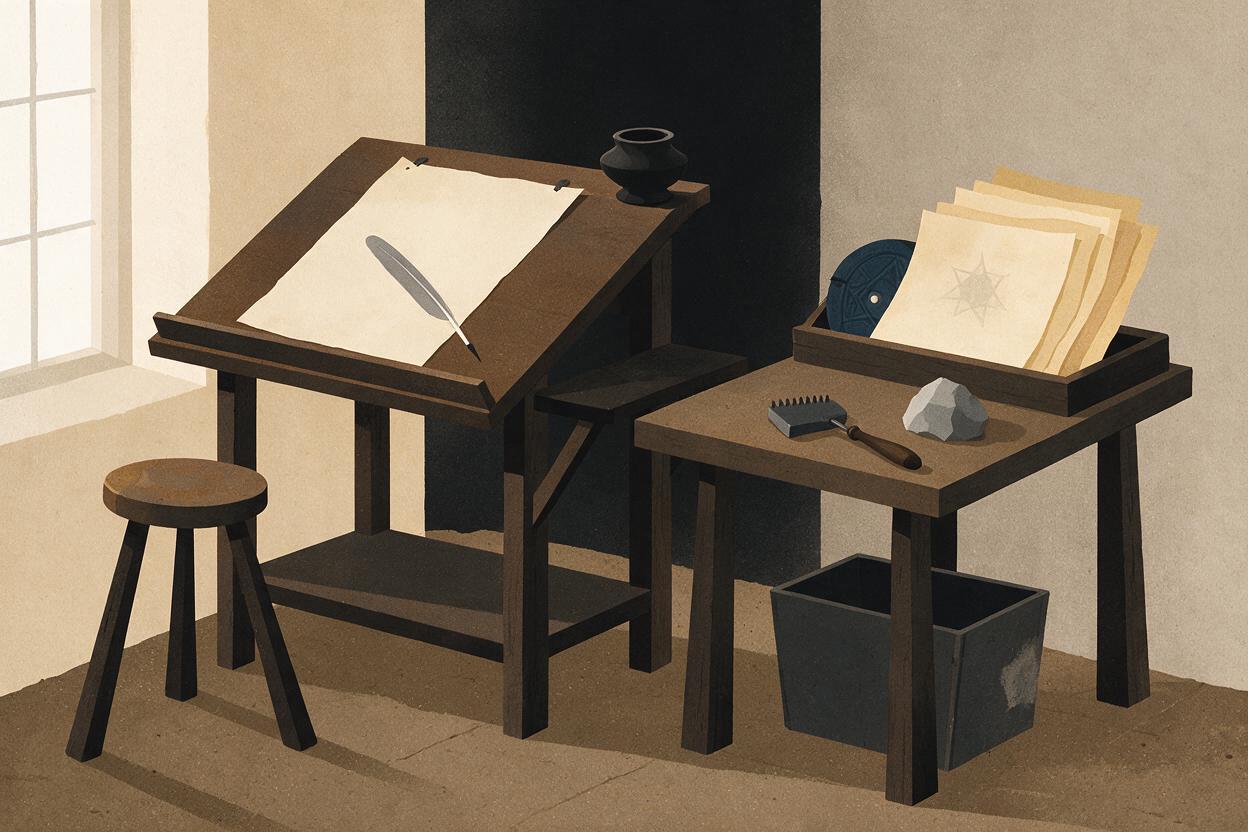
For example, a lesson about a medieval manuscript workshop might verify parchment preparation, writing tools, desk forms, and window placement. Exact wall colors or the identity of an individual worker may remain unknown. This distinction gives the prompt a defensible factual structure.
Convert the ledger into a source-bounded scene brief
A useful reconstruction prompt describes the learning target before the visual style. State the location and period, identify the observable activity, list verified features, restrict uncertain details, and finish with a short exclusion list.
Educational historical reconstruction of [place and period].
Learning focus: [one concept learners must observe].
Main action: [specific documented activity].
Verified features: [architecture, objects, materials, clothing, spatial relationships].
Composition: [viewpoint that makes the evidence easy to inspect].
Uncertain details: restrained, undecorated, and visually secondary.
Do not include: [anachronisms, unsupported symbols, modern objects, cinematic spectacle].
Naturalistic educational illustration, legible object boundaries, neutral lighting, no text.
Keeping the learning focus to one concept reduces decorative clutter. If students need to inspect a water-lifting mechanism, that mechanism should be unobstructed and large enough to study. A crowded panorama may look impressive while concealing the evidence that matters.
Open ai image generator only after the ledger and scene brief agree. Midjourney can propose composition, lighting, and visual detail, but it cannot determine whether your historical claims are adequately sourced.
Use prompts that reveal relationships, not just period style
“Historically accurate” is too vague to function as a reliable instruction. Replace it with observable relationships: where a tool is held, how materials are arranged, which object is connected to another, and what part of a process is taking place.
Material culture inspection
Educational reconstruction of a manuscript workshop in late medieval Europe.
Learning focus: tools and materials used during manuscript production.
A seated craft worker trims prepared parchment on a sloped wooden desk; quill,
small ink vessel, ruling tool, pumice, and loose parchment sheets are separated
and clearly visible. Simple workshop interior based on documented materials.
Eye-level three-quarter view, neutral daylight, restrained colors.
No printed books, fountain pens, electric lighting, modern furniture, fantasy symbols,
or decorative text. No labels inside the image.
Infrastructure and cause
Evidence-led reconstruction of a Roman urban water distribution point.
Learning focus: how water moves from a raised supply into local outlets.
Show the verified stone and ceramic components as distinct connected structures,
with the water route physically understandable from the composition.
Use a cutaway-like viewing angle without making hidden details appear excavated facts.
Secondary buildings remain plain and low-detail.
No modern pipes, steel valves, dramatic flooding, imperial ceremony, or invented inscriptions.
Everyday work without invented drama
Educational illustration of textile work in [verified place and period].
Learning focus: the sequence from prepared fiber to thread.
One worker performs [documented action] using [verified tool]; raw material,
partly processed material, and finished thread appear in separate visible areas.
Calm working posture, practical interior, documentary composition.
Do not invent a named historical person, ceremonial clothing, conflict, luxury décor,
or emotional storytelling unsupported by the lesson sources.
Adapt the bracketed details to your evidence. Avoid combining objects from several centuries simply because they share a broad label such as “medieval,” “ancient,” or “industrial.”
Keep labels and factual annotations outside the generated image
Generated lettering can be malformed, and a polished label can make an uncertain interpretation look authoritative. Produce the reconstruction without text, then add labels in presentation, diagram, or page-layout software.
External annotations also make revision easier. If a specialist corrects the name of an object, you can change the label without regenerating the scene. Use three visually distinct annotation types:
- Direct label: names an object that is clearly visible and verified.
- Interpretive note: explains what the reconstruction proposes.
- Uncertainty note: states what is unknown, generalized, or based on comparison.
A suitable caption might read: Reconstruction based on surviving workshop tools and period images. The room arrangement and clothing colors are plausible interpretations rather than documented features of one specific workshop.
Correct only the failure that affects learning
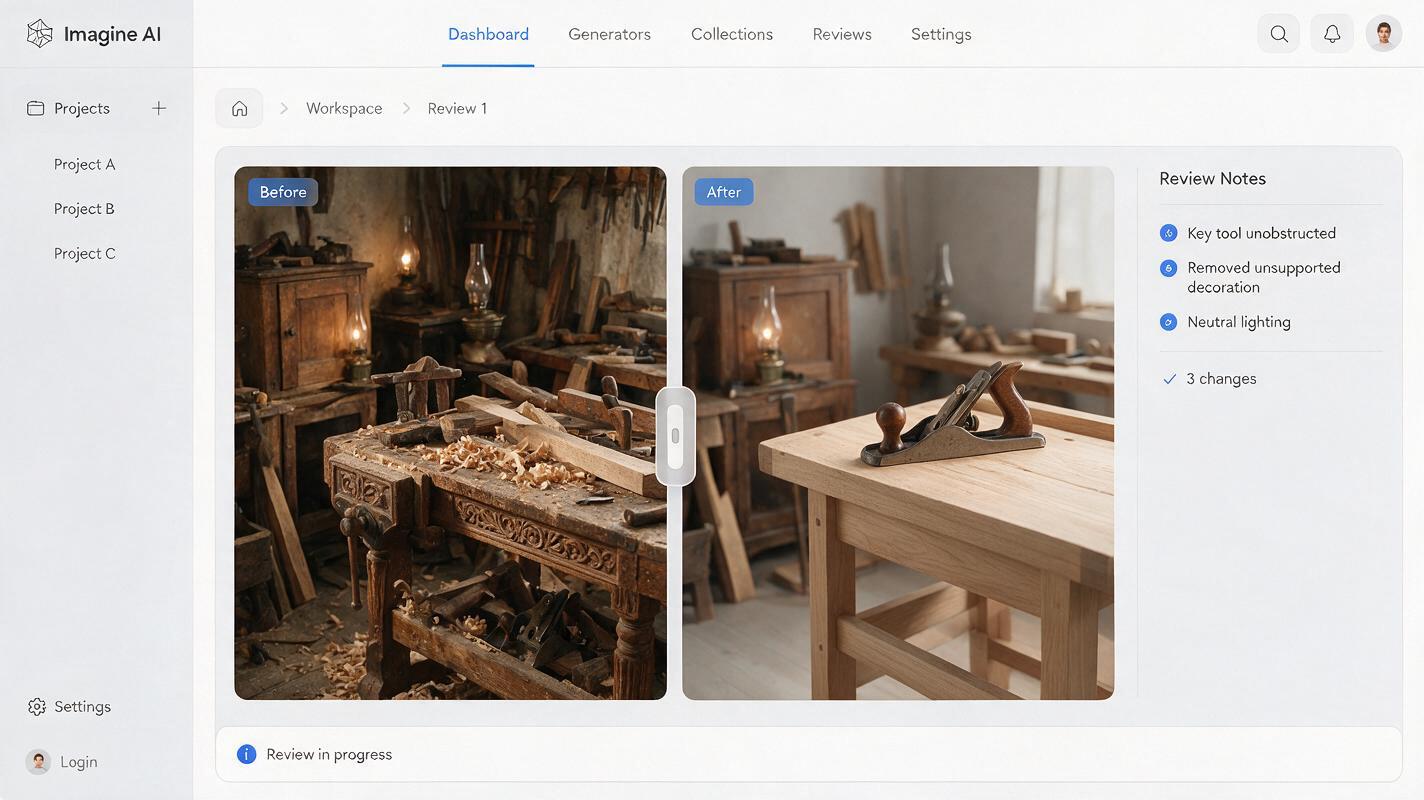
Regenerating an entire image to fix one object can introduce new inaccuracies elsewhere. First identify the educational failure, then make the smallest practical correction.
| Failure | Why it matters | Better correction |
|---|---|---|
| Key tool is hidden | Learners cannot inspect the process | Request a clearer angle and fewer foreground objects |
| Era mixing | The image teaches a false chronology | Name the prohibited object and tighten the date and location |
| Unsupported ornament | Decoration appears evidential | Request plain surfaces and restrained secondary detail |
| Process is physically unclear | Students cannot infer cause and effect | Describe hand position, material state, and tool relationship |
| Scene looks too cinematic | Spectacle overwhelms inspection | Use neutral light, eye-level framing, and documentary composition |
Do not judge success only by realism. A flatter educational illustration may be more useful than a dramatic scene if it separates the relevant objects and makes the process visible.
Compare the output against sources, not against expectations
Historical familiarity is not the same as historical evidence. Before publishing, compare every prominent feature with the sources used to build the ledger. Inspect architecture, tools, clothing construction, materials, gestures, environmental conditions, and social roles separately.
- Can every major object be traced to a source or identified as a plausible reconstruction?
- Does the scene combine regions, social classes, or decades without disclosure?
- Has the model added writing, symbols, flags, or decorations that imply specific evidence?
- Are people shown performing actions the sources support?
- Could a learner mistake a compositional choice for a documented fact?
- Does the caption identify the image as generated or reconstructed?
If a detail cannot be verified and does not help the learning objective, remove it. If it is necessary for visual continuity, keep it subdued and disclose the uncertainty.
Turn one reconstruction into an inquiry activity
The image becomes more educational when students investigate its evidential status rather than passively consume it. Pair the reconstruction with one primary source, one archaeological or material reference, and a short comparison task.
Ask learners to classify visible features as supported, plausible, or unresolved. They can then propose a revised caption or identify which detail should be changed. This transforms a potential source-literacy problem into a lesson about how historical knowledge is constructed.
For a course video, reveal annotations gradually while narration distinguishes evidence from interpretation. Avoid artificial camera movement that makes a static reconstruction seem like recovered footage. A slow crop toward a verified object is usually more responsible than animating invented actions.
Final checklist
- The image has one explicit historical learning target.
- Verified, plausible, unknown, and prohibited details are separated before generation.
- The prompt names observable objects and relationships instead of claiming generic accuracy.
- Important evidence is visible, unobstructed, and large enough to inspect.
- Labels and explanatory text are added outside the generated image.
- Prominent details have been checked against appropriate sources.
- The caption identifies uncertainty and presents the scene as a reconstruction.
- Learners are not encouraged to treat the image as a primary source.
When your ledger is ready, test this prompt yourself, review the first result for unsupported details, and revise the evidence constraints before changing the visual style.
Keywords
Midjourney prompts, history illustrations, historical reconstruction, lesson visuals, evidence-based images, educational illustrations, source literacy