Midjourney Prompts for a Shootable Low-Budget Music Video Storyboard
Build a visually coherent music video storyboard without filling it with locations, effects, or camera moves your budget cannot support. This guide provides practical Midjourney prompts, production constraints, shot-planning methods, and troubleshooting advice for turning ambitious ideas into shootable scenes.
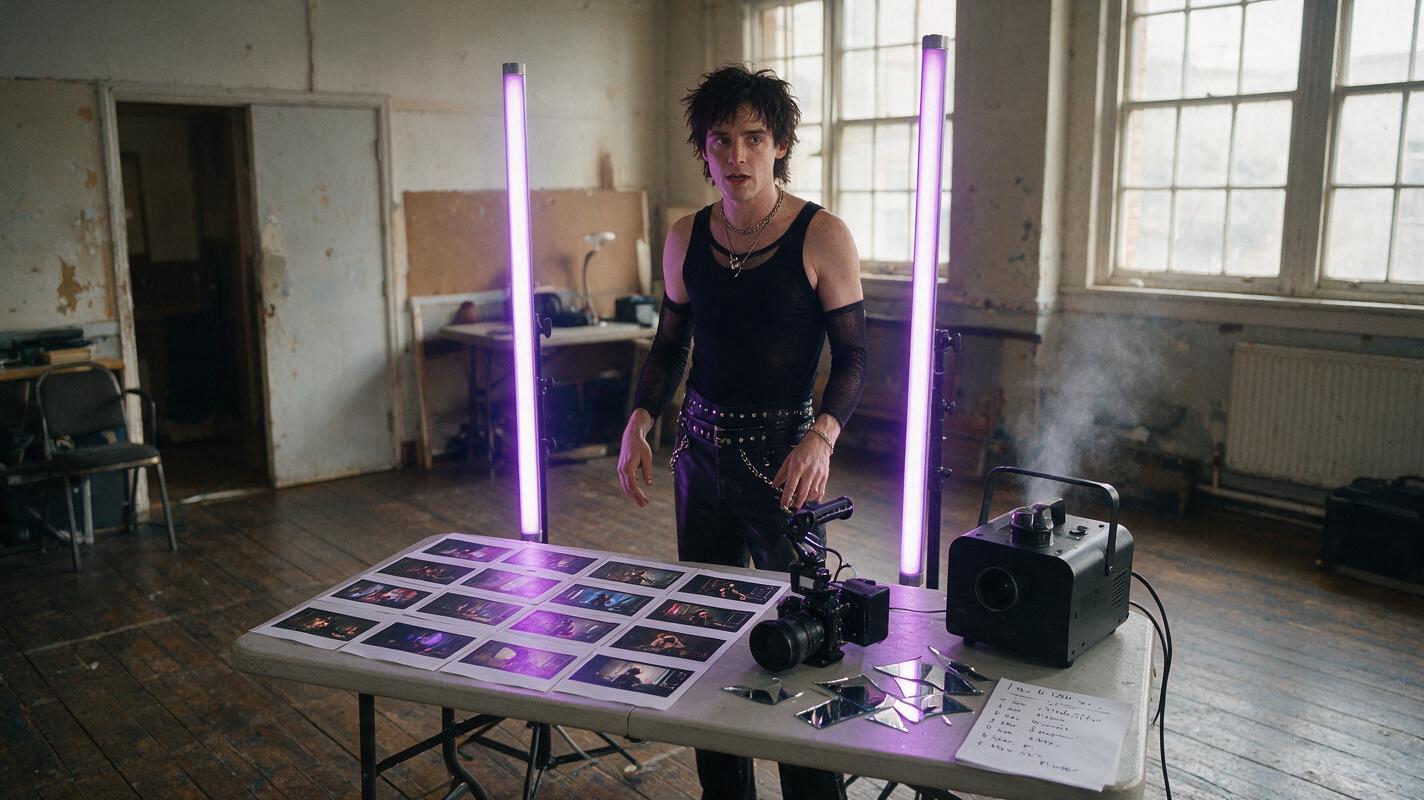
Table of contents
Plan the music video you can actually shoot
A beautiful storyboard is useless when every frame requires a different location, custom set, expensive vehicle, or impossible camera move. The better approach is to define your production limits first, then use Midjourney to visualize scenes that fit inside them. The result should be more than a mood board: it should show repeatable locations, practical lighting, achievable framing, and enough visual progression to carry the song.
This method is designed for independent artists, directors, and small crews planning performance videos, narrative clips, or hybrid concepts. It uses an ai storyboard to connect song structure with production reality before money is spent on a shoot.
Why attractive storyboard frames become unshootable
Image models naturally reward visual novelty. If every prompt is written independently, one frame may show a warehouse while the next moves to a desert, nightclub, rooftop, and flooded cathedral. The sequence looks impressive but has no practical continuity.
Common warning signs include:
- Location inflation: each section introduces an entirely new environment.
- Lighting without a source: the frame depends on elaborate illumination that cannot be reproduced on set.
- Uncontrolled wardrobe changes: the artist appears in a different outfit or styling treatment in every image.
- Impossible coverage: a small crew would need cranes, tracks, rain rigs, crowds, or extensive compositing.
- No editorial progression: the frames are individually attractive but provide no change in energy across the song.
Use AI frames to answer production questions, not merely to decorate a pitch deck.
Lock the production box before writing prompts
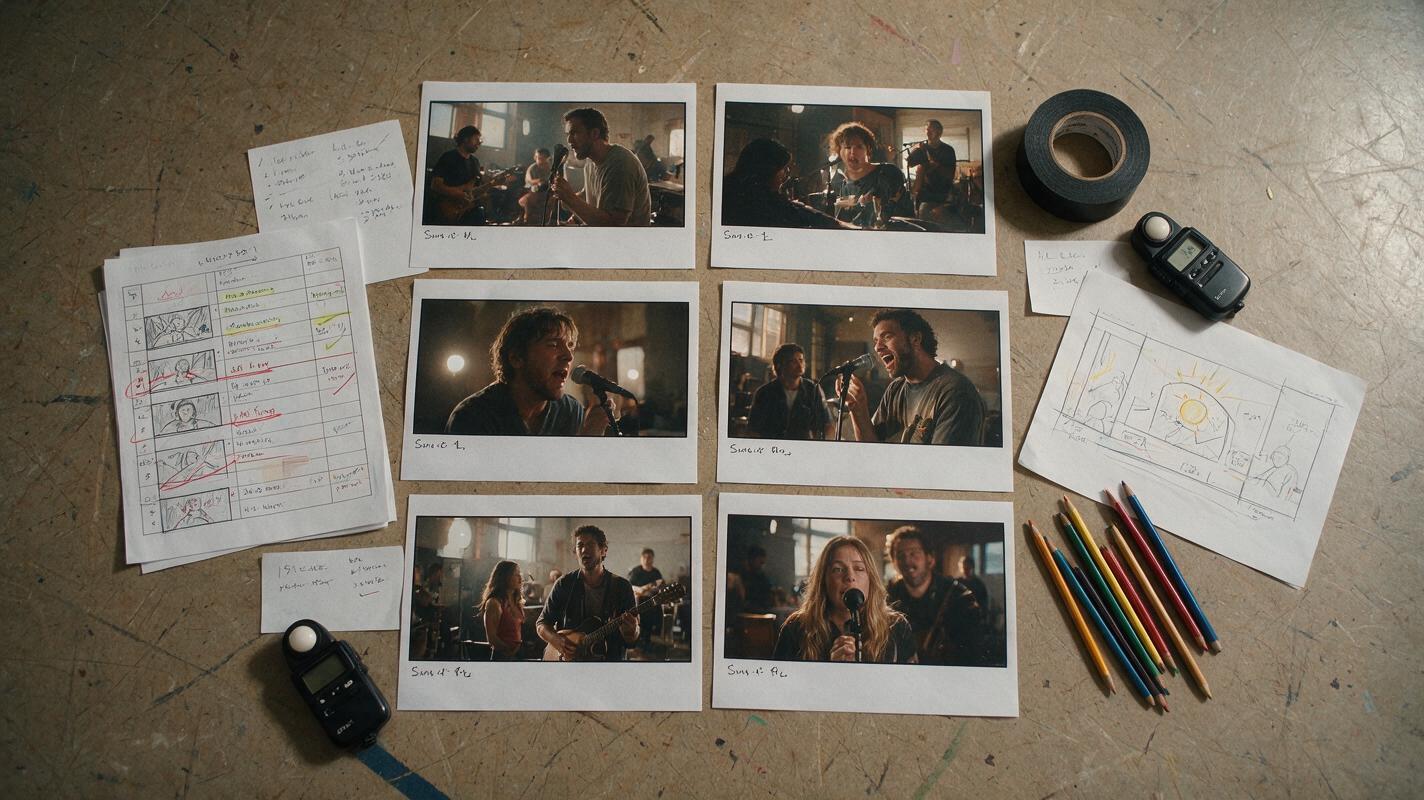
Start by writing a short constraint sheet. It prevents the model from expanding the concept beyond the available time, equipment, and locations. Be specific enough that every generated frame can be tested against the same limits.
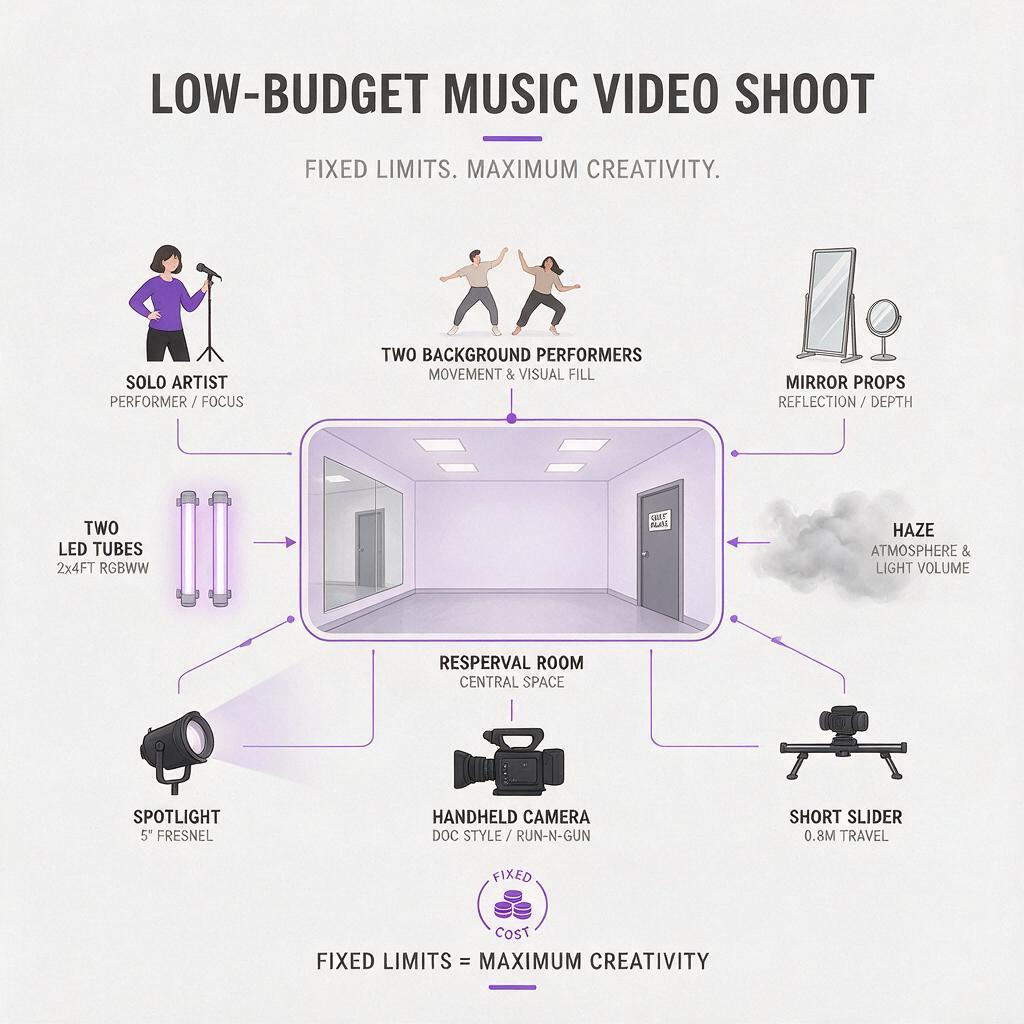
| Production variable | Example low-budget limit | Prompt language |
|---|---|---|
| Locations | One rehearsal room and one exterior alley | single practical location, reusable set |
| Cast | Solo artist plus two background performers | three people maximum |
| Lighting | Two LED tubes and one hard spotlight | minimal practical lighting, visible LED tubes |
| Camera | Tripod, handheld rig, short slider | static wide shot, handheld close-up, short lateral slide |
| Wardrobe | One hero outfit | same black stage outfit in every frame |
| Effects | Haze, projection, mirror fragments | in-camera haze and projected textures |
These restrictions are creative ingredients rather than apologies. A recurring room, costume, and lighting motif can make the finished video feel intentional while reducing continuity problems.
Translate the song into visual energy zones
Do not generate one image for every lyric. Divide the track into energy zones such as restrained opening, first lift, full chorus, breakdown, and final release. Each zone should introduce one visible change while preserving the same visual world.
- Opening: negative space, static framing, limited light.
- Verse: closer coverage and restrained artist movement.
- Pre-chorus: a new light source, projection, or camera angle appears.
- Chorus: wider performance, stronger contrast, and faster coverage options.
- Breakdown: remove visual elements rather than adding more.
- Final chorus: combine established motifs at their highest intensity.
This structure creates escalation without requiring another location. It also gives the editor alternatives for changing pace while maintaining continuity.
Build a visual grammar that every frame must follow
Create a master description containing the elements that should remain constant. Reuse it at the start of every prompt, changing only the action, framing, or energy treatment.
Low-budget music video storyboard frame for a solo alternative R&B artist,
same rectangular rehearsal room with worn gray walls,
same black performance outfit with silver cuff,
two vertical LED tubes and one hard overhead spotlight,
light atmospheric haze, practical in-camera effects,
muted charcoal and deep violet palette,
realistic production design, achievable by a small crew,
cinematic storyboard still, 16:9 composition
A useful visual grammar describes the room, wardrobe, palette, available light, practical effects, and production scale. Avoid broad phrases such as “epic cinematic music video” because they invite spectacle without explaining how that spectacle could be produced.
Prompt performance frames with camera logic
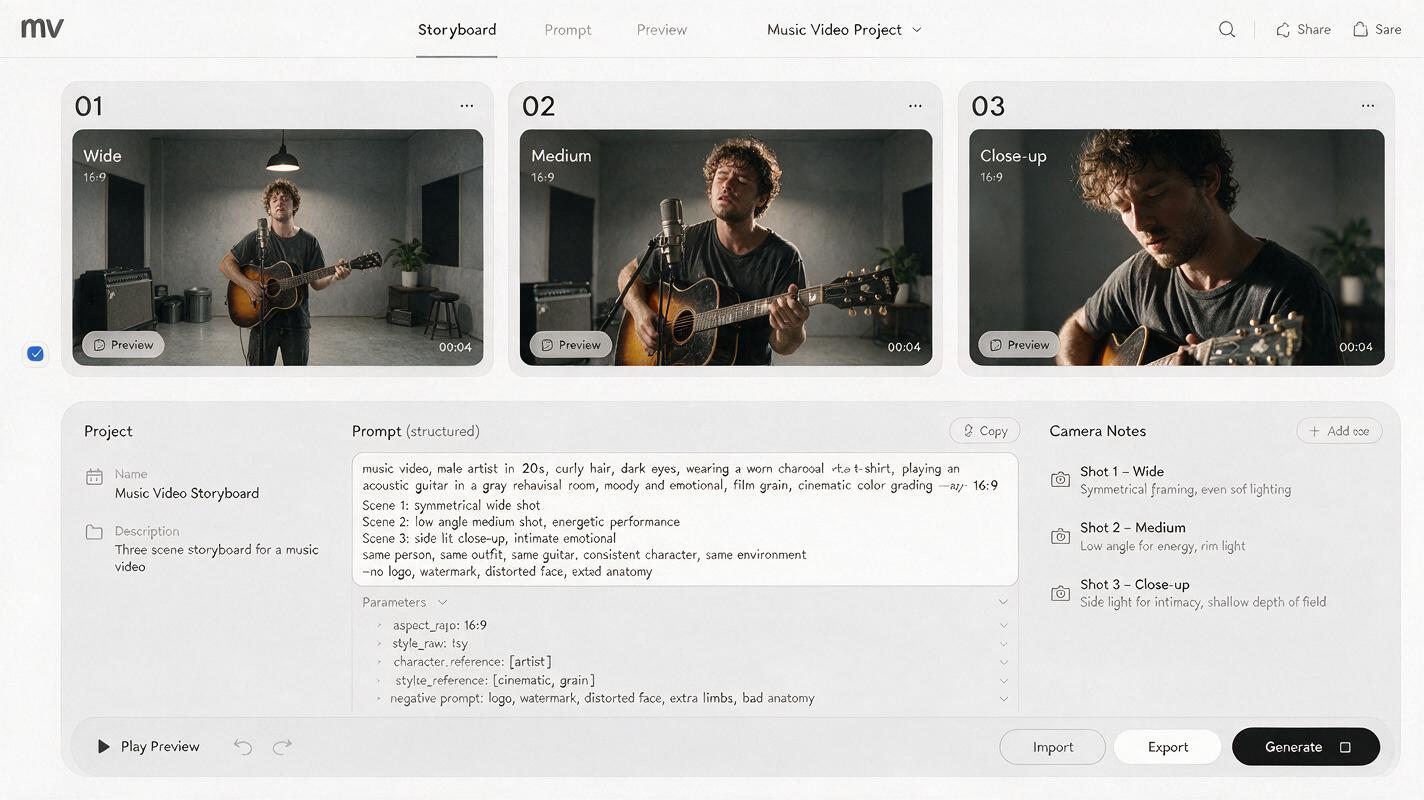
Performance coverage needs visual variety, but that variety can come from framing rather than expensive scene changes. Use an ai image generator to explore a controlled set of wide, medium, and close shots inside the same environment.
Restrained opening frame
[MASTER DESCRIPTION]
artist standing alone at the far end of the room,
large area of empty floor in the foreground,
only one LED tube illuminated,
locked-off symmetrical wide shot from eye level,
quiet tension, minimal movement, shootable composition
Chorus performance frame
[MASTER DESCRIPTION]
artist performing directly toward camera,
two background performers visible only as silhouettes,
both LED tubes illuminated through denser haze,
low-angle medium-wide handheld framing,
high physical energy without pyrotechnics or crowd effects
Intimate vocal close-up
[MASTER DESCRIPTION]
tight head-and-shoulders performance portrait,
artist looking just past the lens while singing,
hard side light and soft projected texture across the rear wall,
85mm portrait perspective, shallow depth of field,
no extra props, same wardrobe and hairstyle
Generate several candidates for each framing category, but approve only images that remain compatible with the location diagram and equipment list. A compelling image that violates the production box should be treated as a rejected concept, not a goal.
Add narrative inserts without adding another production day
A performance-only concept can gain emotional depth through inserts filmed on the same set. Hands, objects, shadows, mirrors, fabric, projected lyrics, or close details can suggest a larger story without introducing new cast members or locations.
[MASTER DESCRIPTION]
insert shot of the artist's hand pressing against a scratched standing mirror,
reflection fragmented into three narrow sections,
the rehearsal room remains recognizable in the background,
one hard spotlight, practical mirror effect,
macro detail, emotionally tense, feasible tabletop-sized setup
[MASTER DESCRIPTION]
close shot of a portable projector casting moving handwritten phrases
across the artist's black sleeve and the worn wall,
visible projector beam in haze,
no digital holograms, no futuristic interface,
practical music video insert, simple controlled lightingLimit narrative inserts to one recurring object or action. Repetition gives the editor a motif that can return during transitions, instrumental passages, or lyric pauses.
Keep the artist recognizable across the board
Storyboard frames do not need perfect facial duplication, but the performer must remain identifiable enough for collaborators to understand composition and styling. Repeat the same physical description, hairstyle, wardrobe, accessories, and approximate camera distance in every relevant prompt.
For stronger continuity:
- Choose one approved portrait as the visual reference for later exploration.
- Describe fixed wardrobe details with concrete colors, fabrics, and accessories.
- Avoid changing age, makeup, hair, lens perspective, and expression in one prompt.
- Use rear views, silhouettes, hands, and wide shots where exact facial detail is unnecessary.
- Label storyboard frames as visual intentions rather than promises of exact final appearance.
If the face keeps changing, simplify the prompt before adding more identity language. Too many competing style instructions can make the desired subject less clear.
Convert attractive frames into a working shot list
Place approved frames in song order and write a practical shot instruction beneath each one. Separate what the image communicates from what the crew must execute.
| Song section | Frame purpose | Shoot instruction | Coverage option |
|---|---|---|---|
| Intro | Establish isolation | Static wide, artist centered at rear wall | Ten-second clean plate |
| Verse | Introduce direct performance | Medium handheld take from waist height | Profile close-up |
| Pre-chorus | Increase tension | Short lateral slider move as second light activates | Mirror insert |
| Chorus | Release energy | Low-angle wide with all performers | Fast handheld close coverage |
| Breakdown | Create contrast | Single side-lit portrait with background lights off | Projected-texture insert |
Also mark frames that depend on haze, projection, mirrors, or background performers. Grouping those shots together reduces setup changes and helps the assistant director build an efficient schedule.
Fix the storyboard when it exceeds the budget
Every frame shows a different room
Move the location description to the beginning of every prompt and repeat its fixed architectural features. Change light state, lens choice, blocking, and props instead of replacing the environment.
The lighting looks too expensive
Name visible, practical sources and limit their quantity. Replace vague “concert lighting” with two LED tubes, one spotlight, haze, and a projected texture. Ask whether each visible effect has a plausible physical source.
The frames feel repetitive
Keep the set but rotate shot scale, camera height, performer orientation, foreground objects, and light intensity. Repetition of location is useful; repetition of composition is not.
The sequence has no emotional build
Arrange frames by song energy rather than generation order. Reserve the widest composition, strongest contrast, or full-cast image for a musical peak instead of revealing everything in the opening.
The model adds large crowds or impossible effects
State the cast limit and practical-effects rule directly. Phrases such as “three people maximum,” “no crowd,” “no vehicles,” and “achievable in one room” make the intended production scale explicit.
Review the board like a producer
Before presenting the concept, inspect every frame with three questions: Can the crew access what is shown? Can the lighting and movement be recreated safely? Does the image add a shot the editor will genuinely use? Remove frames that fail those tests, even when they are visually impressive.
When the constraint sheet, visual grammar, and shot prompts are ready, try these models for free and compare a few interpretations before committing to the final board.
Final checklist
- The storyboard uses no more locations, cast members, or effects than the production can support.
- Every frame repeats the same visual grammar and core wardrobe details.
- The song is divided into clear energy zones with visible progression.
- Performance coverage includes wide, medium, close, and practical insert options.
- Each approved image has a corresponding camera and lighting instruction.
- Recurring props and effects can be produced safely on the chosen set.
- The strongest visual treatment is reserved for a musical peak.
- Unshootable frames have been removed rather than rationalized.
Keywords
midjourney prompts, music video storyboard, low-budget music video, ai storyboard, music video planning, performance concepts, mv shot list