Novel to Video: Visualize Internal Monologue Without Heavy Voiceover
Learn how to adapt a novel’s internal monologue into cinematic action, visual motifs, subjective shots, and controlled sound instead of explaining every thought with narration. This practical workflow moves from prose analysis to character references, AI storyboards, generated clips, and a clarity-focused edit.
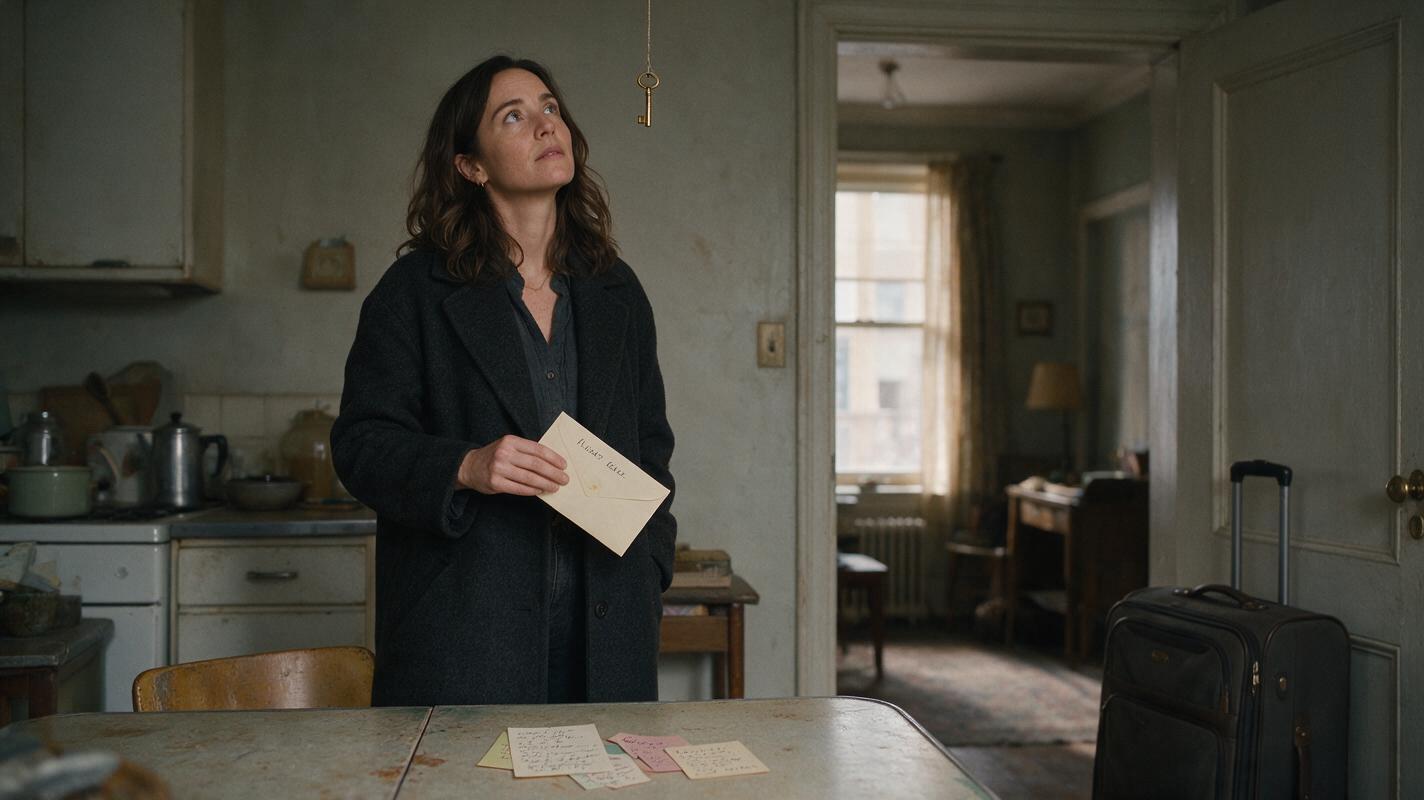
Table of contents
Turn private thoughts into visible story beats
The most reliable way to adapt internal monologue is not to illustrate every sentence literally. Convert each thought into one of four cinematic signals: behavior, a recurring object, a subjective image, or a change in sound.
This tutorial follows a fictional example: Mara returns to her late mother’s apartment intending to sell it, but a familiar brass key makes her hesitate. The method works for literary fiction, romance, mystery, and any novel in which the decisive conflict happens inside a character.
Working rule: preserve the emotional decision behind the prose, not necessarily the prose’s original wording.
Step 1 — Extract the invisible story
Begin by separating what the reader knows from what a camera can record. Copy the passage into a two-column adaptation sheet. In the first column, identify the internal statement. In the second, propose physical evidence that could communicate it.
| Novel information | Filmable equivalent |
|---|---|
| Mara feels guilty about selling the apartment. | She hides the estate agent’s envelope beneath a stack of old recipes. |
| She remembers waiting for her mother after school. | Her fingers trace old height marks beside the kitchen door. |
| She wants to leave before changing her mind. | She keeps her coat on and places her suitcase beside the exit. |
| She decides to stay for one night. | She removes her coat, closes the door, and puts the brass key back on its hook. |
Use this prompt to perform the extraction without letting the model rewrite the entire scene:
You are adapting a novel passage for a dialogue-light short film.

For each sentence, identify:
1. the private thought or memory,
2. the emotional change,
3. one observable behavior,
4. one object or environmental detail that could express it,
5. whether voiceover is essential, optional, or unnecessary.

Do not add new plot events. Prefer small, playable actions over symbolic spectacle.
Passage: [PASTE PASSAGE]
Keep only actions that affect the scene’s decision. Decorative symbolism may look cinematic, but it weakens the adaptation if it does not change what the audience understands.
Step 2 — Lock the character before visualizing thoughts
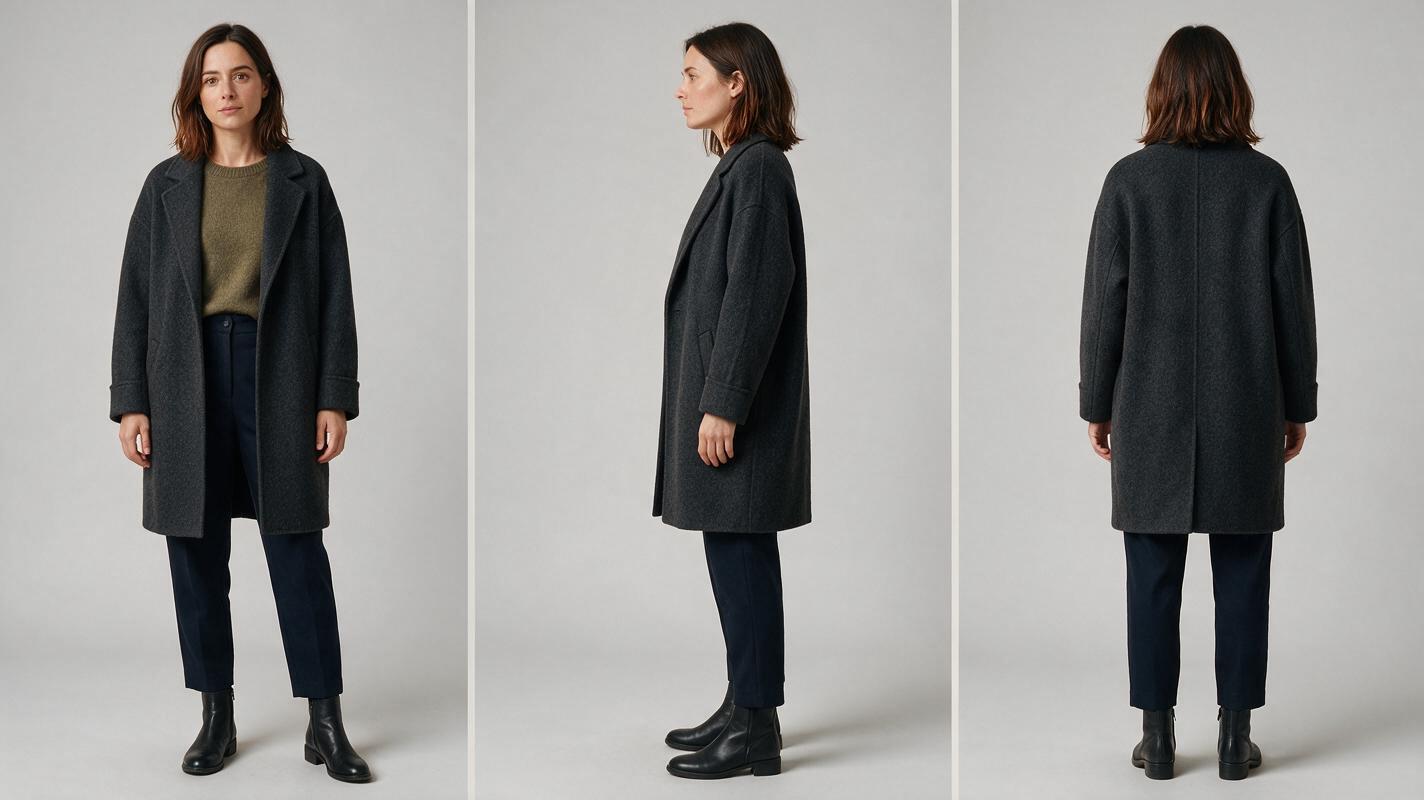
Internal conflict depends on subtle performance, so character drift is especially damaging. Establish Mara’s face, age range, hairstyle, wardrobe, and silhouette before generating emotional close-ups. Use one neutral reference sheet rather than introducing her through a dramatic scene.
Generate front, side, and back views with identical clothing. Avoid expressive poses because they can accidentally become part of the identity reference.
Reusable character-sheet prompt
Photorealistic three-panel character reference sheet of the same fictional woman, Mara, age 34, shoulder-length dark brown hair with a natural center part, thoughtful brown eyes, charcoal wool coat over a muted olive sweater, dark straight-leg trousers, practical black boots. Left panel front view, center panel exact side profile, right panel back view. Identical clothing, hairstyle, body proportions, and lighting in every panel. Relaxed neutral posture, arms naturally at her sides, no props, no facial expression change. MANDATORY CAMERA: full-body eye-level 85mm reference photography, orthographic-feeling composition with minimal perspective distortion. MANDATORY LAYOUT: three equal vertical panels inside one landscape 16:9 frame, neutral light-gray seamless studio background, soft diffused light, no text, no logo, no interface elements.This reference can anchor subsequent frames produced through an ai storyboard workflow. Keep the character description stable; change only action, framing, lighting, and location.
Step 3 — Assign one visual language to each kind of thought
Do not represent every thought with a flashback. Give different mental events distinct screen grammar:
- Immediate emotion: posture, breathing, gaze, and interrupted action.
- Memory: a brief sensory insert connected to a present object.
- Fear or imagined outcome: one clearly subjective shot that breaks from objective coverage.
- Decision: a completed physical action that cannot be mistaken for indecision.
For Mara, guilt appears through the hidden envelope. Memory appears through the height marks. Fear appears as a momentary image of the apartment emptied of all furniture. Her final decision appears when she returns the key to its hook.
Limit each scene to one dominant motif. Repeating the brass key in the opening, midpoint, and ending gives it meaning through context; introducing six symbolic objects would divide the audience’s attention.
Step 4 — Build a subjective storyboard
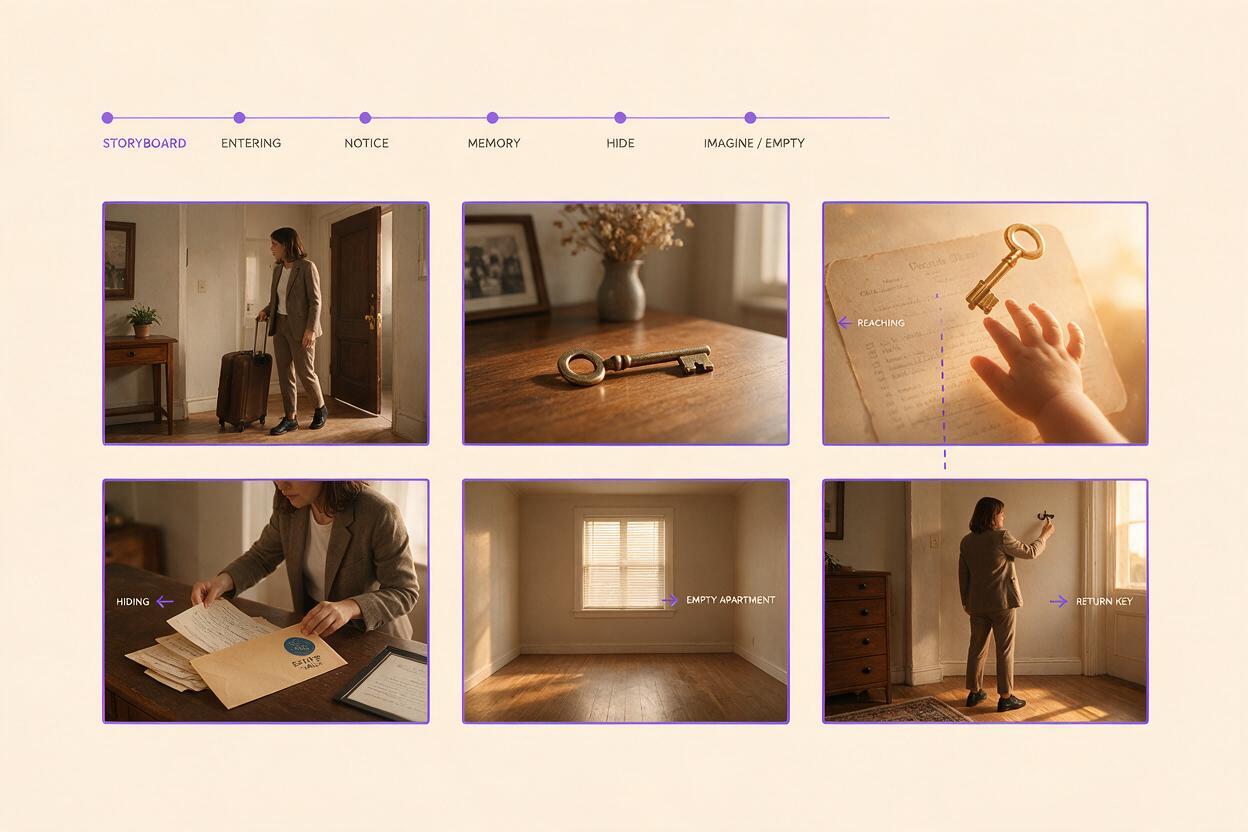
A conventional storyboard records what happens. A subjective storyboard also records whose perception controls each shot. Mark every frame as objective, observed detail, memory fragment, imagined outcome, or decision image.
| Frame | Mode | Image | Story function |
|---|---|---|---|
| A | Objective | Mara enters with her suitcase. | Establishes her intention to leave quickly. |
| B | Observed detail | Brass key swinging on its hook. | Triggers recognition. |
| C | Memory fragment | A child’s hand reaching toward the same hook. | Connects the key to belonging. |
| D | Objective close-up | Mara hides the sales envelope. | Reveals resistance through behavior. |
| E | Imagined outcome | The apartment empty and stripped of warmth. | Makes the consequence emotionally visible. |
| F | Decision image | The key returns to the hook. | Completes the internal turn. |
Reusable storyboard prompt
Create a six-frame cinematic storyboard contact sheet for a quiet literary short film. Use the same woman and the same lived-in apartment in every relevant frame. Sequence: woman entering with suitcase; close detail of brass key on wall hook; child’s hand reaching for that hook as a restrained memory fragment; woman hiding an estate-sale envelope beneath old recipes; subjective image of the apartment completely empty; woman returning the key to the hook at dusk. MANDATORY CAMERA: alternate stable eye-level medium shots with 85mm object inserts; no extreme wide-angle distortion. MANDATORY LAYOUT: two rows of three equally sized 16:9 frames, left-to-right narrative order, consistent screen direction and warm overcast daylight shifting toward dusk. Cinematic editorial realism, restrained color palette, no captions, no text, no logos, no interface elements.Before generating motion, test whether a viewer can infer a clear emotional turn from the six still frames alone. If not, revise the actions rather than relying on explanatory narration.
Step 5 — Generate clips around readable actions
Produce short shots with one action each. A clip in which Mara enters, notices the key, remembers childhood, hides the envelope, and changes her mind asks the model to maintain too many states at once.
Instead, use the approved storyboard frame as the visual reference and describe a single movement with an explicit endpoint. An image to video pass is useful here because the composition and character appearance have already been decided.
Use the supplied storyboard frame as the visual and identity reference.

Mara stands beside the kitchen table, holding a cream envelope. She pauses, looks toward the brass key beyond the frame, then slowly slides the envelope beneath a stack of handwritten recipe cards. Her hand remains resting on the cards at the end.

Camera: locked eye-level medium close-up, 50mm lens feeling.
Motion: restrained natural hand movement, subtle breath, no camera movement.
Continuity: charcoal coat remains on; suitcase stays beside the closed door; warm overcast afternoon light.
End frame: envelope fully hidden, Mara’s hand still, gaze held off-screen right.
Avoid: new objects, duplicated hands, exaggerated crying, speaking, wardrobe changes, rapid movement.
The end-frame instruction matters because it gives the next shot a concrete continuity state. Generate the decisive actions before atmospheric inserts; they carry the narrative and reveal which supporting shots are genuinely needed.
Step 6 — Replace explanatory voiceover with an evidence test
Assemble a silent rough cut and ask a viewer three questions: What does Mara want when she enters? What makes that goal difficult? What choice does she make at the end? If the answers are unclear, locate the missing evidence.
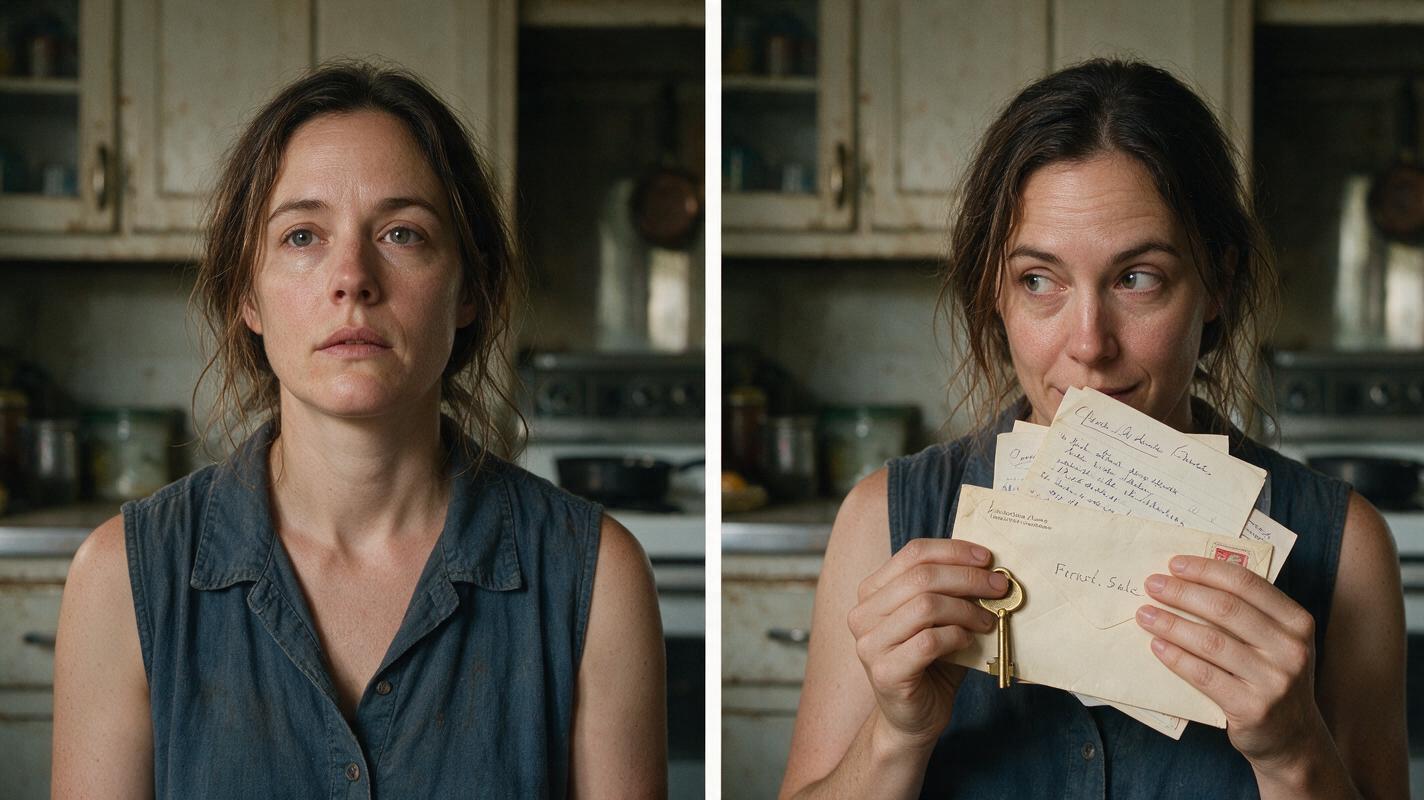
Do not immediately add voiceover. First compare a weak literal version with a filmable version:
- Weak: Mara stares into space while narration says she feels guilty.
- Stronger: Mara conceals the sales document, then cannot remove her hand from her mother’s recipes.
- Weak: a long flashback explains the family history.
- Stronger: a two-shot sensory fragment links the present key to a child’s hand.
Reusable failure-mode comparison prompt
Photorealistic side-by-side cinematic comparison featuring the same fictional woman in the same old apartment. LEFT: weak adaptation, woman staring blankly into middle distance with no meaningful action, generic composition, emotionally unreadable. RIGHT: improved adaptation, woman deliberately hiding a cream estate-sale envelope beneath handwritten recipe cards while glancing toward a brass key on the wall, visible tension in her restrained hand posture. MANDATORY CAMERA: matched eye-level medium close-up, 50mm lens, identical camera position and character scale on both sides. MANDATORY LAYOUT: two equal 16:9 comparison panels within one wide frame, a clean central division, no text labels, no logos, no interface elements. Cinematic editorial realism, believable lived-in kitchen, soft overcast window light, natural skin and hands.Retain voiceover only when it contributes something images cannot: distinctive literary phrasing, unreliable interpretation, or a contradiction between what the character says and does. Keep it selective so the prose and images remain partners rather than duplicates.
Step 7 — Finish with sound that follows attention
Internal experience can become audible without becoming verbal. Build the soundtrack around what Mara notices: suitcase wheels stopping, the key tapping against the wall, paper sliding under recipe cards, a refrigerator hum, and the final click of the hook.
Reduce environmental sound briefly before the imagined empty-apartment shot, then restore it when Mara returns to the present. Avoid using a dramatic musical swell to announce every emotional beat. The physical action should make the decision understandable before music reinforces it.
At the high-intent production stage, you can try for free by taking one extracted passage through reference creation, storyboarding, and clip generation before committing to a full chapter.
FAQ
Should every internal monologue become a visual metaphor?
No. Begin with behavior and cause-and-effect. Use a metaphor only when it grows naturally from an object, location, or action already present in the story.
How much of the original prose should remain as voiceover?
Keep lines whose language, unreliability, or narrative perspective is essential. Remove narration that merely describes an action viewers can already see.
How can an adaptation show memories without confusing the timeline?
Connect each memory to a present-tense sensory trigger, keep it brief, and give it a consistent visual or sonic distinction. Return to the triggering object to reestablish the present.
What should be generated first?
Generate the character reference and decision-bearing storyboard frames first. Motion tests should begin with the actions that reveal intention, conflict, and choice.
Sources
Final checklist
- Identify the decision hidden inside the internal monologue.
- Translate thoughts into behavior, objects, subjective images, or sound.
- Lock the recurring character with a neutral three-view reference sheet.
- Assign every storyboard frame a clear perceptual mode.
- Generate one readable action and one continuity endpoint per clip.
- Test the silent edit before adding narration.
- Use voiceover for literary value or contradiction, not basic explanation.
Keywords
novel to video, script to video ai, ai storyboard generator, ai movie maker, ai story video generator, direct an ai short film, ai clip maker