Runway vs Seedance for Product Demo Videos: Which Has Better Accuracy?
Choosing the right AI video tool for product demos means balancing product accuracy, motion quality, and ad readiness for ecommerce audiences. This head-to-head comparison of Runway and Seedance tests both tools on common ecommerce product types and demo motions, with clear tradeoffs for shape retention, label preservation, texture fidelity, and workflow efficiency. Ecommerce marketers will get actionable recommendations based on their catalog type, team size, and core use case.
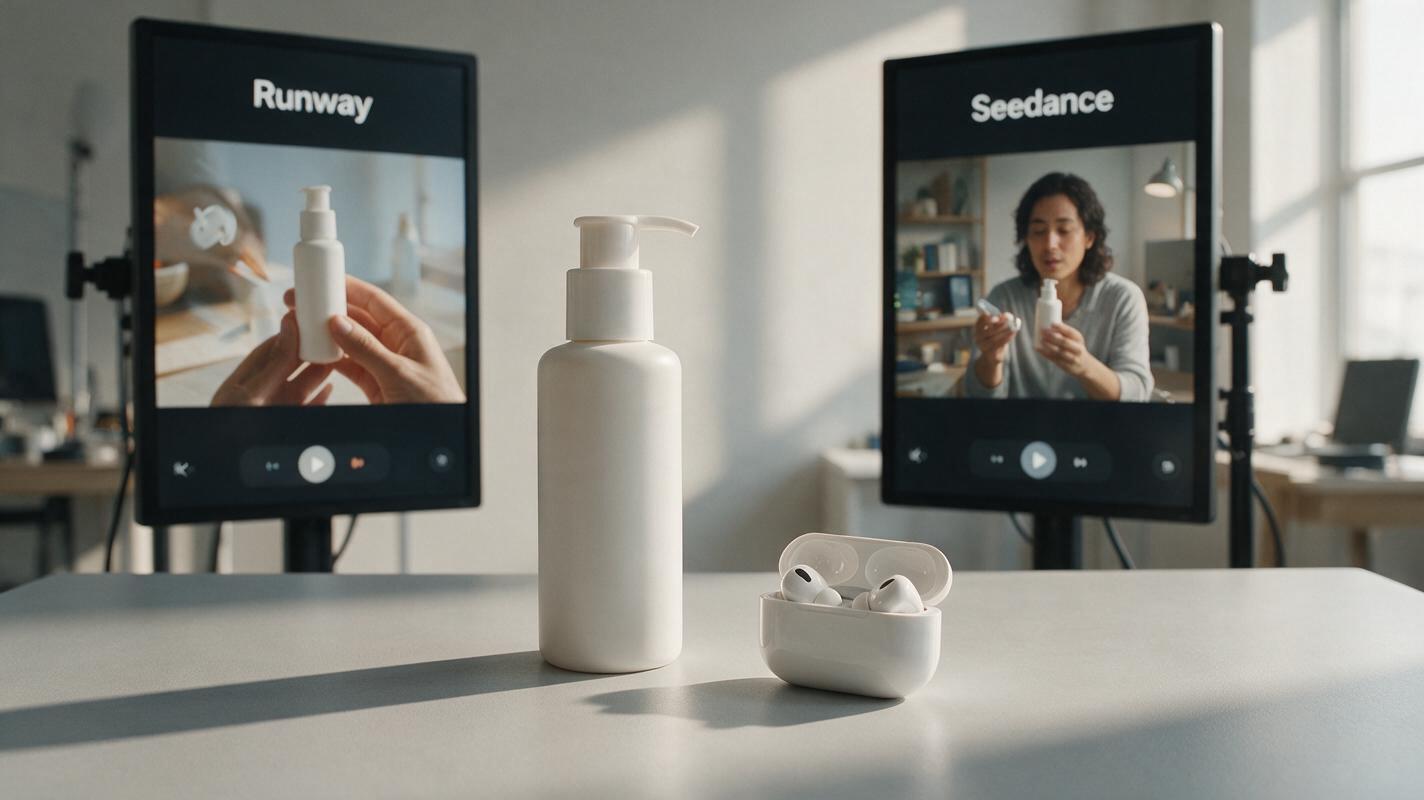
Table of contents
Why product demo video accuracy matters
If you’ve ever wasted hours re-rendering AI product demos because packaging warped or a logo melted mid-video, you know tool choice makes or breaks ecommerce creative output.
Product demo videos can lift conversion rates by 20–40% on product pages and ad campaigns, but only if the product looks exactly like it does in real life. Distorted shapes, blurred labels, or changed textures erode customer trust and increase return rates, turning a creative win into a revenue loss.
Finding an ai video generator that preserves product details while adding engaging motion can cut creative production time by 80% for ecommerce teams. Runway and Seedance are two of the most popular options for turning static product photos into short demos, but most general comparisons ignore the ecommerce-specific accuracy metrics that matter most.
Both tools excel at image to video workflows that turn a single static product photo into a short, engaging demo, but their performance on label preservation, shape consistency, and texture fidelity varies significantly. This head-to-head comparison tests both tools on real ecommerce product types and demo use cases to help you pick the right one for your catalog.
Test setup and evaluation criteria
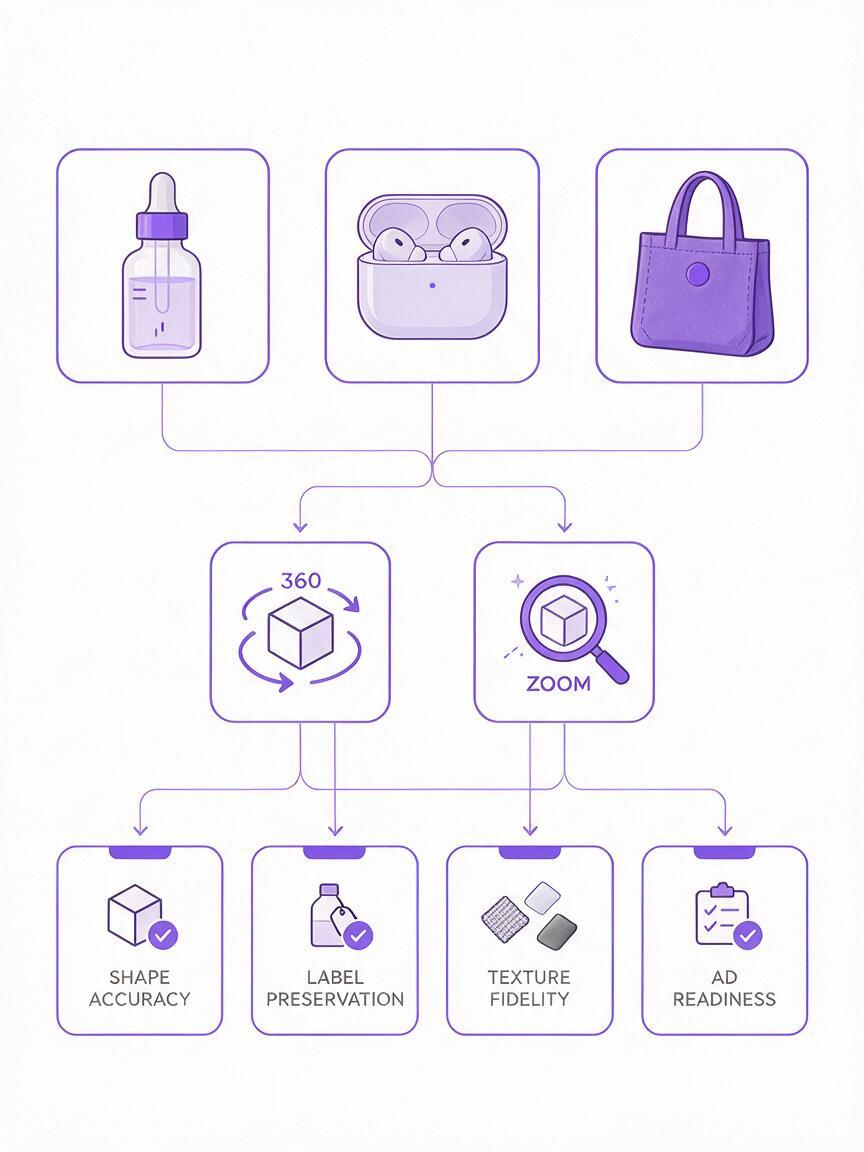
We tested both tools on three common ecommerce product types and two high-performing demo motions, using the same source photo and base prompt for each tool to ensure a fair comparison.
- Product types tested: matte skincare bottle with small ingredient label and front logo, glossy wireless earbud case with etched brand mark, textured canvas tote bag with printed graphic
- Demo motions tested: slow 360-degree spin (for full product overview), gentle close-up zoom on a key feature (for highlight ads)
We scored each tool on four ecommerce-focused criteria, weighted by how much they impact conversion and customer trust:
- Shape and proportion accuracy: Does the product keep its exact dimensions and form through the entire motion?
- Label and logo preservation: Are text, logos, and printed graphics legible and undistorted at all angles?
- Texture fidelity: Do matte, glossy, textured, and fabric finishes look consistent with the source photo?
- Ad readiness: How easy is it to export platform-optimized videos that need no extra editing?
All tests used the highest quality output setting for each tool, with reference strength set to maximum for image-to-video generation.
Shape and proportion accuracy
For rigid products like skincare bottles and electronics, shape consistency is non-negotiable—even a slight warp can make the product look cheap or counterfeit.
Seedance delivered near-perfect shape retention across all rigid product tests. The skincare bottle kept its cylindrical form and flat base through the full 360 spin, with no bulging or flattening on side angles. The earbud case maintained its sharp edges and precise hinge line, even during the close-up zoom motion.
Runway performed well on larger products but showed minor warping on small, detailed rigid items. The skincare bottle’s base flattened slightly on the 180-degree spin frame, and the earbud case’s hinge line softened and distorted during the tilt motion. For the canvas tote bag, however, Runway’s shape and drape looked more natural than Seedance’s slightly stiffer fabric movement.
Winner: Seedance for rigid products; Runway for soft goods with natural drape.
Label, logo, and texture preservation
This is the most critical criteria for ecommerce brands, as labels and logos carry brand identity and regulatory information (like ingredient lists or safety warnings).
Seedance’s reference-locked generation kept all labels and logos crisp and legible through every motion. The skincare bottle’s 8pt ingredient text remained readable even on side angles, and the earbud case’s etched logo stayed sharp and correctly positioned. Texture fidelity was also strong: matte finishes stayed matte, glossy finishes had consistent reflectivity, and the canvas tote’s woven texture remained visible.
Runway struggled with small text and fine logo details. The skincare bottle’s ingredient text blurred beyond legibility on angles beyond 45 degrees, and the earbud case’s etched logo distorted and shifted position slightly during the tilt. Texture was more variable: Runway added an unintended sheen to the matte bottle, but rendered the canvas tote’s texture more realistically than Seedance.
If your products have small text, regulatory labels, or precise brand marks, label preservation should be your top deciding factor.

Motion quality and ad readiness
Accuracy matters, but the motion also needs to feel natural and engaging enough to stop scrollers in their tracks.
Runway’s motion is more fluid and dynamic, with subtle, realistic movement that feels closer to a professionally shot studio video. It also supports longer video lengths (up to 16 seconds per generation), which gives more room for storytelling in launch ads or product page demos.
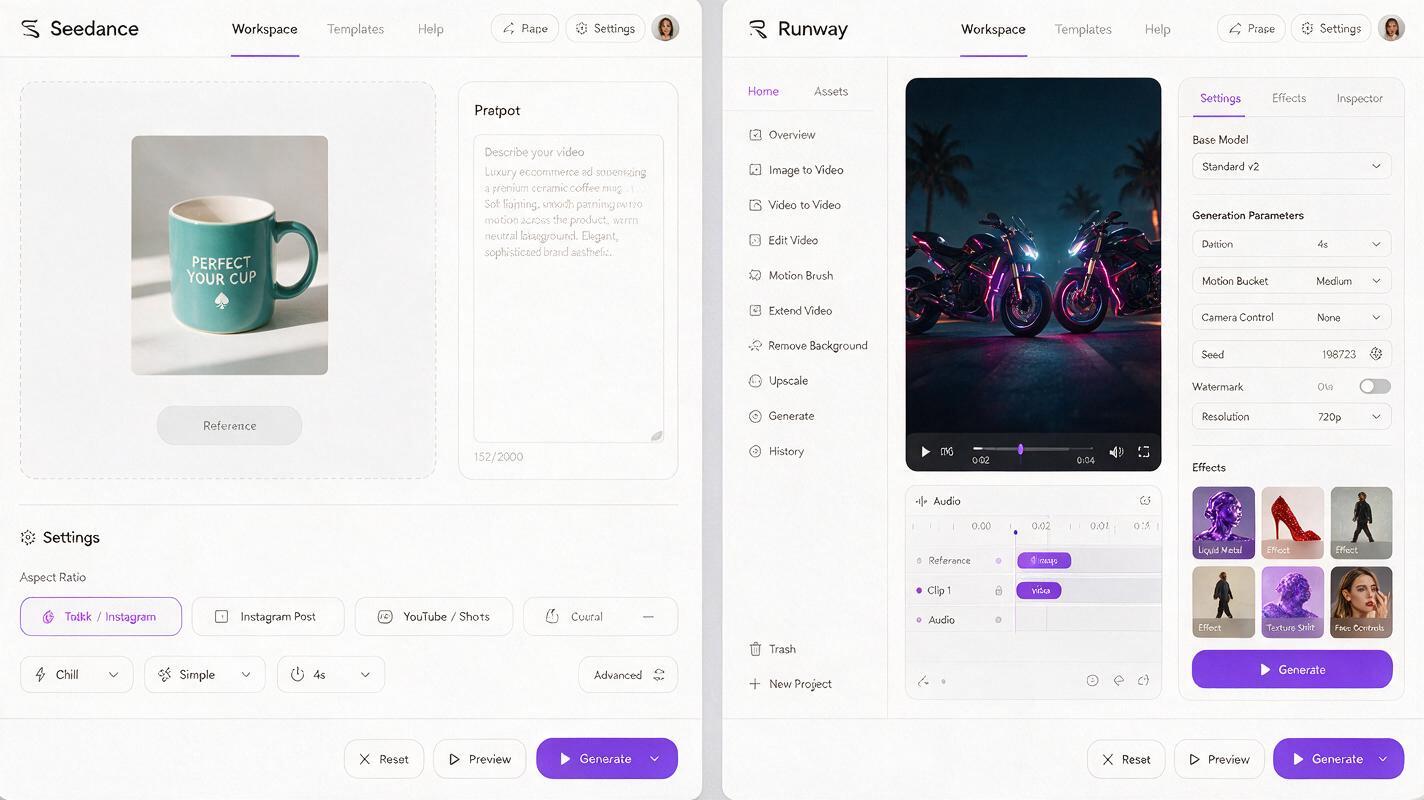
Seedance’s motion is more controlled and deliberate, with less unexpected movement. It’s slightly less dynamic than Runway, but it’s also far less likely to produce random artifacts or off-topic motion. For ad readiness, Seedance has built-in presets for all major ecommerce ad platforms (TikTok, Instagram Reels, Facebook Feed, Amazon Product Video) that automatically set aspect ratio, length, and resolution, cutting down on post-processing time.
Runway has aspect ratio options, but they’re general-purpose rather than ecommerce-specific, so you’ll likely need to crop or trim videos before uploading to ad platforms. It also offers more editing tools within the platform, which is useful if you need to add text overlays or transitions.
Winner: Seedance for fast, ad-ready exports; Runway for dynamic, long-form motion.
Workflow speed and cost value
For ecommerce teams managing hundreds of SKUs, speed and cost efficiency are just as important as output quality.
Seedance has a simpler, more streamlined interface for image-to-video generation. You upload a reference photo, add a short motion prompt, pick an aspect ratio preset, and generate. Batch generation is straightforward: you can generate up to 4 variants of the same product at once, which is perfect for testing different ad angles. Average render time for a 6-second video is 60–90 seconds.
Runway has a steeper learning curve, with more settings and features that can feel overwhelming for teams only making product demos. Batch generation for image-to-video is more limited, with only 2 variants per generation by default. Average render time for a 6-second video is 2–3 minutes, though higher quality settings can take longer.
On cost: Seedance offers pay-as-you-go pricing starting at $0.10 per generation, which is ideal for small teams or occasional catalog updates. Runway’s subscription starts at $12/month for 125 credits, which works out to roughly $0.20–$0.30 per image-to-video generation, but includes access to all of Runway’s other video editing and generation tools.
Winner: Seedance for small teams and product-only workflows; Runway for full-service creative teams that need multiple video tools.
Which tool should you pick?
The right choice depends entirely on your catalog type and core use case. Here’s how to decide:
Pick Seedance if:
- You sell rigid products with labels, logos, or regulatory text (skincare, supplements, electronics, packaged goods)
- You need fast, batch-generated demo videos for a large catalog
- Ad-ready exports that require minimal post-processing are a top priority
- You want a simple, no-fuss workflow for your ecommerce team
Pick Runway if:
- You sell soft goods or textured products (apparel, textiles, home decor, furniture)
- You need longer, more dynamic demo videos for launch campaigns or product pages
- Your team already uses Runway for other creative tasks like editing, text-to-video, or motion graphics
- You have the bandwidth to tweak settings for optimal results
If you’re still unsure which tool fits your catalog, test these models for free now with a single product photo to compare results for your specific use case.
Key takeaways
- Product accuracy (shape, labels, texture) is the most important factor for ecommerce demo videos, as distorted products hurt trust and increase returns.
- Seedance outperforms Runway on label preservation, rigid product shape accuracy, and ecommerce-specific ad workflow tools.
- Runway delivers more fluid, natural motion and longer video lengths, making it a better fit for soft goods and dynamic launch ads.
- Match your tool choice to your catalog type and team workflow, rather than choosing the most popular general-purpose AI video tool.
- For mixed catalogs, using both tools for their respective strengths can deliver the best overall results across your product line.
Keywords
runway vs seedance, product demo videos, ai video generator, product video accuracy, ecommerce video ads, product photo animation, ai product demos