Seedream 4.5 Prompts for Consistent Character Turnarounds
Create front, profile, rear and three-quarter character views without letting the face, costume or proportions drift. This practical Seedream 4.5 workflow shows illustrators how to prepare a strong reference, control camera language, generate difficult angles and repair isolated inconsistencies.
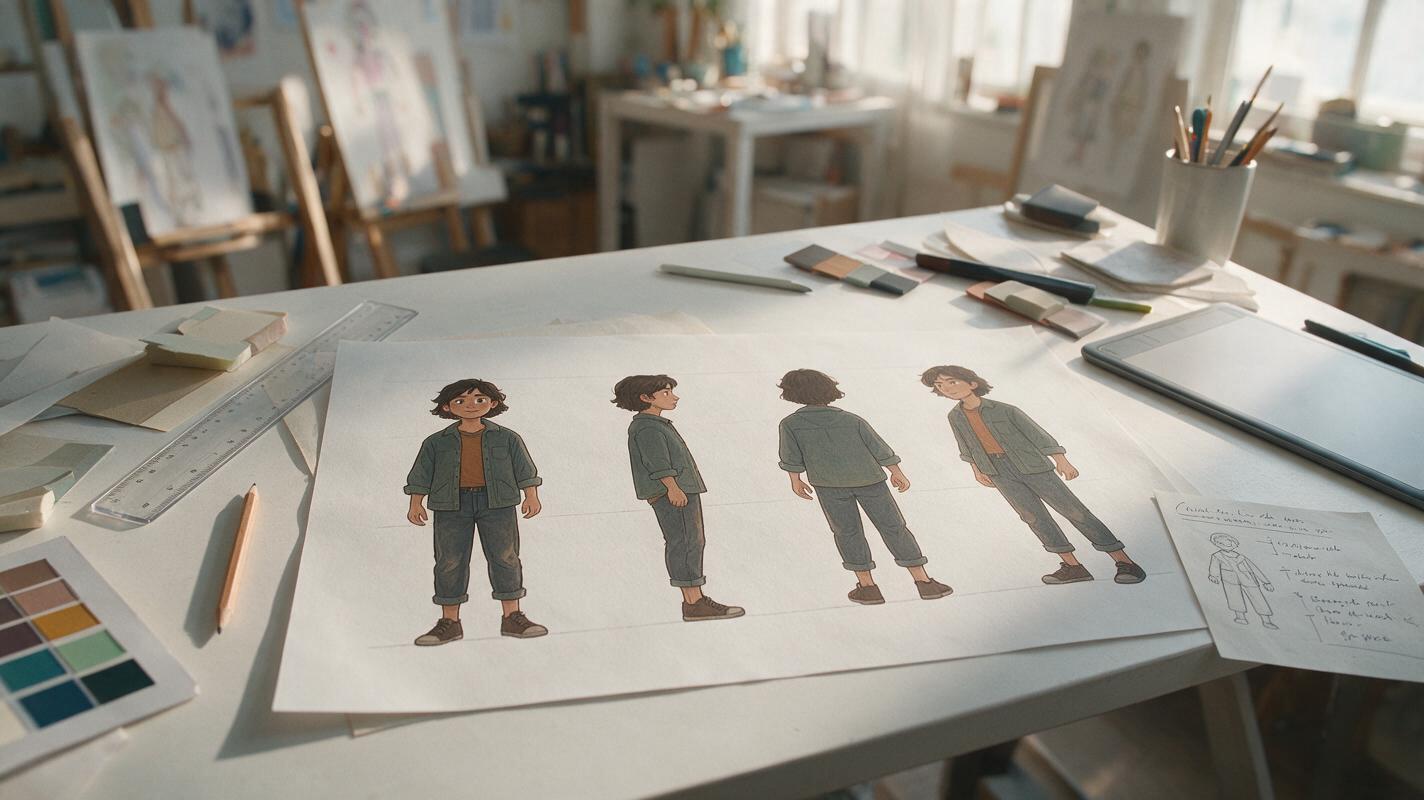
Table of contents
Turn one character design into views you can trust
A character turnaround becomes useless when every angle invents a different nose, hairstyle, jacket length or body type. The goal is not to produce five attractive portraits. It is to show one construction clearly enough that you can draw the character again in future comic panels.
This workflow uses seedream 4.5 to develop controlled front, profile, rear and three-quarter views from an established design. It concentrates on the details that matter to illustrators: stable proportions, visible costume construction, repeatable silhouettes and views that remain useful at actual panel size.
What a production-ready turnaround must lock
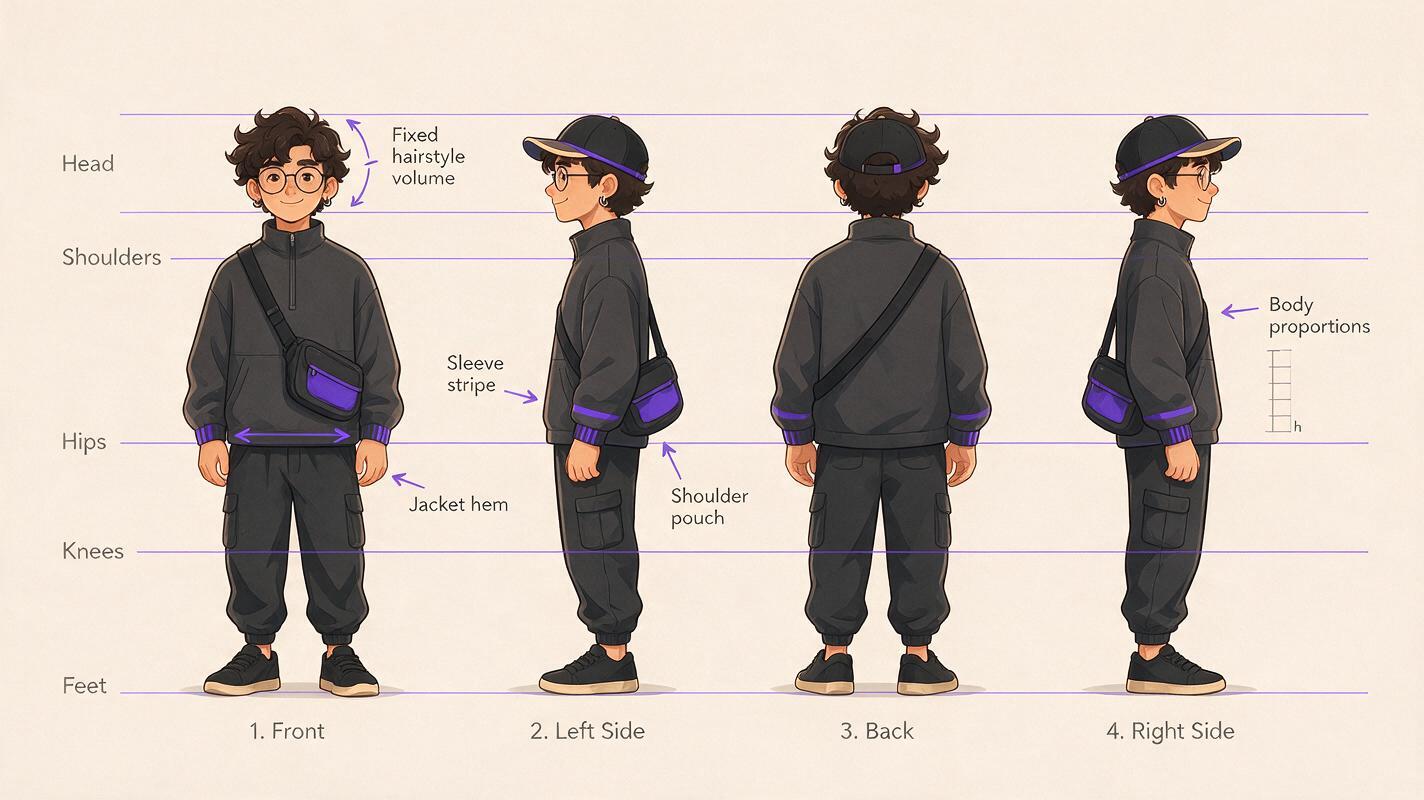
A strong sheet separates permanent design facts from details that may change with acting, lighting or perspective. Before generating anything, decide which features belong to the character rather than the current image.
| Design category | Keep fixed | Allow to vary |
|---|---|---|
| Head | Face shape, hairline, ear placement, eye spacing | Expression, blink state, loose hair movement |
| Body | Height ratio, shoulder width, limb proportions | Weight shift, gesture, breathing |
| Costume | Hem lengths, closures, seams, pockets, accessories | Minor folds and fabric compression |
| Color | Local colors and identifying accents | Shadows caused by the chosen lighting |
| Silhouette | Hair mass, coat shape, footwear and carried gear | Small overlaps created by the viewing angle |
Choose three to five identity anchors that remain readable even when the face is small. For an urban courier, these might be an asymmetrical fringe, a cropped yellow jacket, one square shoulder pouch, dark high-top shoes and a white stripe on the left sleeve.
Useful test: fill every view with solid black. If the character appears to change height, shoulder width or costume volume, the turnaround is already drifting.
Build the reference before asking for new views
Begin with the clearest existing drawing, not necessarily the prettiest one. A neutral front or three-quarter image usually communicates more construction than a foreshortened action pose. The full hairstyle, hands, footwear and major accessories should be visible.
Remove elements that could confuse the next generation:
- Speech bubbles, sound effects and decorative borders
- Strong colored lighting that hides local costume colors
- Props crossing important seams or body landmarks
- Motion blur, extreme wind or exaggerated fabric movement
- Other characters whose features could leak into the design
Next, write a compact design record. Describe visible construction rather than personality. “Reserved teenage courier” may influence mood, but “cropped jacket ending above the hips, square pouch on right shoulder, stripe on left sleeve” tells the model what must survive rotation.
REFERENCE RECORD
Character: young urban bicycle courier
Proportions: 7 heads tall, narrow shoulders, long forearms
Face: oval jaw, straight nose, wide-set dark eyes
Hair: short black bob, asymmetrical fringe covering part of right eyebrow
Costume: cropped mustard jacket, charcoal shirt, tapered black trousers
Fixed details: white stripe on left sleeve, square pouch on right shoulder
Footwear: dark high-top shoes with light soles
Rendering: clean webtoon line art, flat local colors, restrained cel shading
If the source drawing hides the rear of a coat, bag strap or hairstyle, decide that construction yourself before generating a back view. Otherwise, the model must invent it, and that invention can conflict with later panels.
Use camera language that prevents redesign
Many failed turnarounds ask for “different angles,” which leaves both camera position and pose open to interpretation. The character may turn, lean, tilt the head, shift weight and change expression at the same time. That creates an appealing pose sheet rather than a construction sheet.
Use orthographic-style language and specify that only the viewpoint changes:
Create a clean character turnaround reference for the same character shown in the reference image.

Neutral upright stance, arms relaxed slightly away from the torso, feet parallel, calm closed-mouth expression. Maintain identical body proportions, head size, hairstyle volume, facial construction, costume dimensions, accessory placement and local colors.

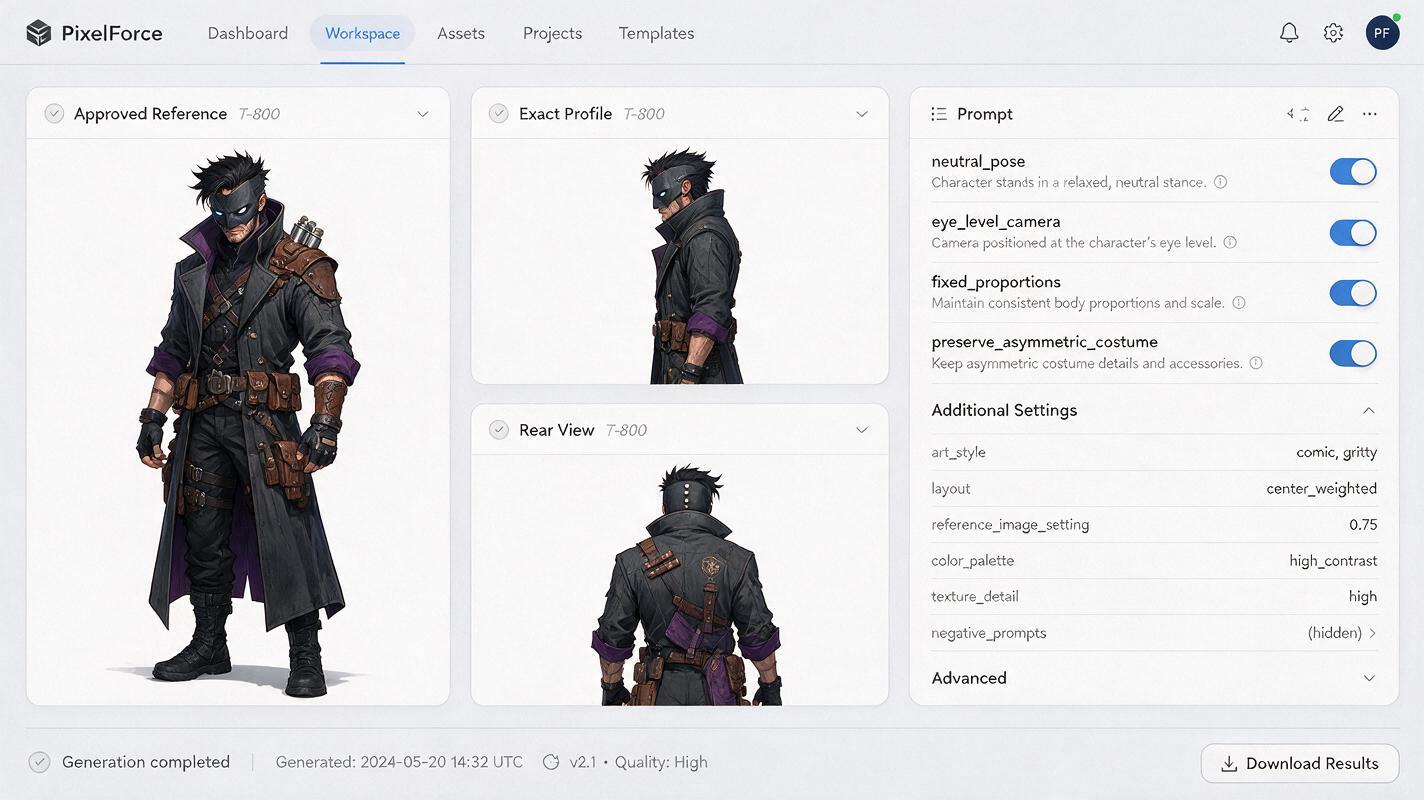
Show a full-body front view, exact left profile, exact rear view and rear three-quarter view. The character remains in the same neutral pose while only the viewing direction changes. Eye-level camera, minimal perspective distortion, even studio lighting, plain light background.

Preserve these asymmetric details: white stripe only on the left sleeve; square pouch attached at the right shoulder. Clean webtoon line art, flat colors, restrained cel shading. No text, labels, props or decorative frame.
This is an appropriate task for an ai image generator only when you continue to act as the designer. Treat generated views as construction proposals that must pass continuity checks, not as automatic ground truth.
Generate difficult views as separate controlled passes
A single multi-view sheet is convenient, but one weak cell can contaminate the others. The profile may acquire a different jaw while the rear view moves an accessory to the wrong side. Generate the front and three-quarter views first, then request profile and rear views separately when they need more control.
Exact profile prompt
Using the supplied character reference, render the same character in an exact left-facing full-body profile.

Keep the head level and the torso unrotated. Show one eye contour, one nose silhouette and clear chin projection. Preserve the original cranial mass, hair length, jacket hem, leg length and shoe shape. The white stripe remains on the character's left sleeve and is visible according to the profile angle. Neutral stance, no walking pose, no head turn, no perspective exaggeration.
Rear construction prompt
Using the supplied front and three-quarter references, render an exact full-body rear view of the same character.

Preserve height, shoulder width, hairstyle volume and costume dimensions. Show the established rear construction clearly: jacket center seam, collar shape, correct bag strap path and cropped hem above the hips. Do not add logos, pockets, straps or hair accessories. Neutral upright pose, eye-level view, even lighting, plain background.
Rear three-quarter prompt
Render the same character from a rear three-quarter angle, turned 45 degrees away from the viewer. Maintain the neutral turnaround stance and identical proportions. Reveal how the side seam, sleeve stripe, shoulder pouch, collar and rear jacket seam connect around the body. No action pose, no dramatic perspective and no costume redesign.Keep the pose deliberately dull. Neutrality makes discrepancies easier to see. Dynamic posing can come later, after the turnaround has established the character’s anatomy and clothing.
Repair drift without repainting the whole sheet
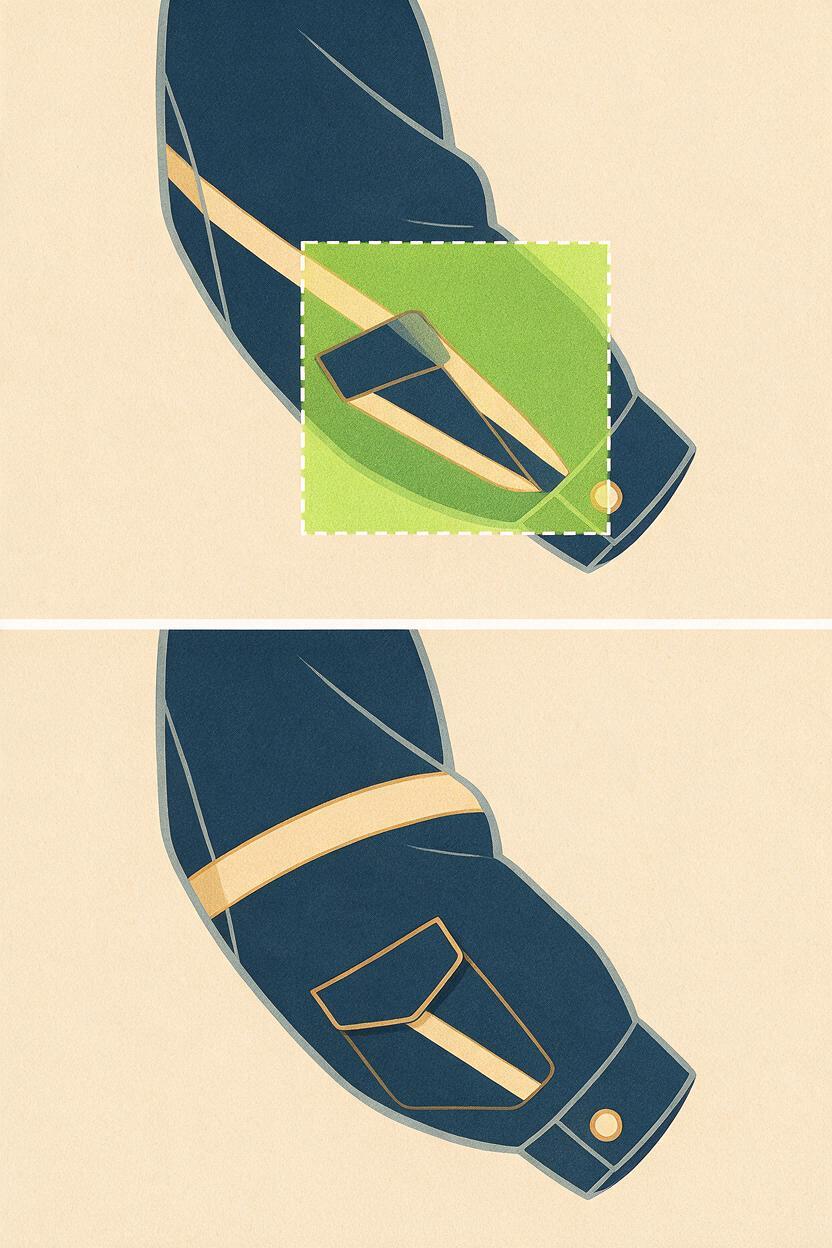
Regenerating an entire view to fix one pocket risks changing the face, shoes and silhouette. Instead, isolate the smallest incorrect region and describe both the required repair and the surrounding features that must remain untouched.
| Visible failure | Likely cause | Targeted correction |
|---|---|---|
| Profile face looks older | Vague side-view anatomy | Restore the reference jaw length, nose projection and forehead curve |
| Accessory changes sides | Left and right were not anchored | Name the character’s side, not the viewer’s side |
| Back view gains new pockets | Hidden construction was undefined | State the exact seam and pocket count |
| Body becomes broader | View generated as a new portrait | Reassert shoulder-to-head and hip-to-shoulder ratios |
| Hair shrinks from behind | Front contour mistaken for total volume | Define the rear hair mass and neckline |
A localized repair prompt can be short:
Correct only the selected jacket area. Restore one white stripe on the character's left sleeve, matching its width and vertical position in the front reference. Preserve the arm anatomy, sleeve silhouette, folds, line weight, colors, shading and every unselected part of the image.Compare repaired views at thumbnail size as well as full resolution. At thumbnail size, look for proportion and silhouette drift. At full size, inspect seam continuity, eye shape, hairline, closures and accessory attachment points.
Assemble a sheet your future panels can actually use
Place the approved views on one canvas at the same scale. Align the soles to a common baseline and add horizontal guides through the top of the head, chin, shoulders, elbows, hips and knees. If those landmarks jump between neutral views, correct the source images rather than hiding the problem during layout.
Include only information that helps future drawing:
- A fixed color swatch row sampled from the approved design
- Close-ups of complex closures, jewelry or prop attachments
- A small silhouette row for instant proportion comparison
- Short notes for asymmetrical details that can be mirrored accidentally
- One approved line-weight and shading example
Keep expressions and action poses on separate sheets. A turnaround explains construction; an expression sheet explains facial acting; a pose sheet explains movement. Combining all three makes it harder to identify which differences are intentional.
Save both a flattened sheet for quick reference and layered source files for corrections. When generating later comic panels, attach the clearest view for the requested camera angle instead of relying on the entire sheet every time. A profile panel benefits most from the approved profile, while a shot from behind should prioritize the rear and rear three-quarter references.
Final checklist
- The same facial construction survives front, profile and three-quarter views.
- Head-to-body, shoulder-to-head and leg-to-torso ratios remain stable.
- Hair volume works as a three-dimensional mass rather than a front-only shape.
- Jacket hems, seams, pockets and closures connect logically around the body.
- Left-right asymmetry is described from the character’s perspective.
- No view introduces unapproved accessories, logos or costume panels.
- Feet share a baseline and anatomical landmarks align across the sheet.
- The silhouette remains recognizable at comic-panel size.
Once your design record and strongest reference are ready, create your own version and test the profile before spending time polishing a complete turnaround.
Keywords
seedream 4.5, character turnaround, consistent character ai, character sheet ai, comic character prompts, webtoon character design, ai illustration generator