Vidu Prompts for Subtle Anime Acting Without Face Drift
Subtle anime acting often fails when a video model replaces controlled facial movement with exaggerated blinking, talking, or head motion. These Vidu prompt patterns help creators animate breathing, gaze shifts, restrained reactions, and small gestures while preserving the original character design.
Table of contents
Make a still anime character perform without redesigning the face
The hardest anime character animation is often the quietest. A small breath, delayed glance, or tightening hand can communicate more than a dramatic camera move, but generative video models frequently turn these restrained actions into face drift, random speech, excessive blinking, or rubbery body motion.
Vidu works best for this task when the source image already defines the character clearly and the prompt treats acting as a sequence of visible physical changes. The goal is not to ask for “sad acting” or “a nervous character.” It is to specify what moves, when it moves, how far it moves, and what must remain unchanged.
Why subtle anime acting becomes unstable
A still illustration contains no explicit timing information. When a prompt says only “she looks worried,” the model must invent the performance. It may add lip movement, reshape the eyes, tilt the camera, or move the entire body because all of those choices could represent worry.
Four ambiguities cause most failures:
- Emotion without action: words such as sad, tense, or surprised describe an internal state rather than visible motion.
- No motion hierarchy: the model cannot tell whether the eyes, head, shoulders, hair, or camera should lead the shot.
- No protected features: distinctive pupils, bangs, accessories, and facial proportions may be treated as flexible details.
- Too many beats: breathing, turning, blinking, smiling, and speaking in one short clip create competing transitions.
For restrained acting, one clear emotional beat is stronger than five simultaneous movements.
Build a source frame that can survive motion
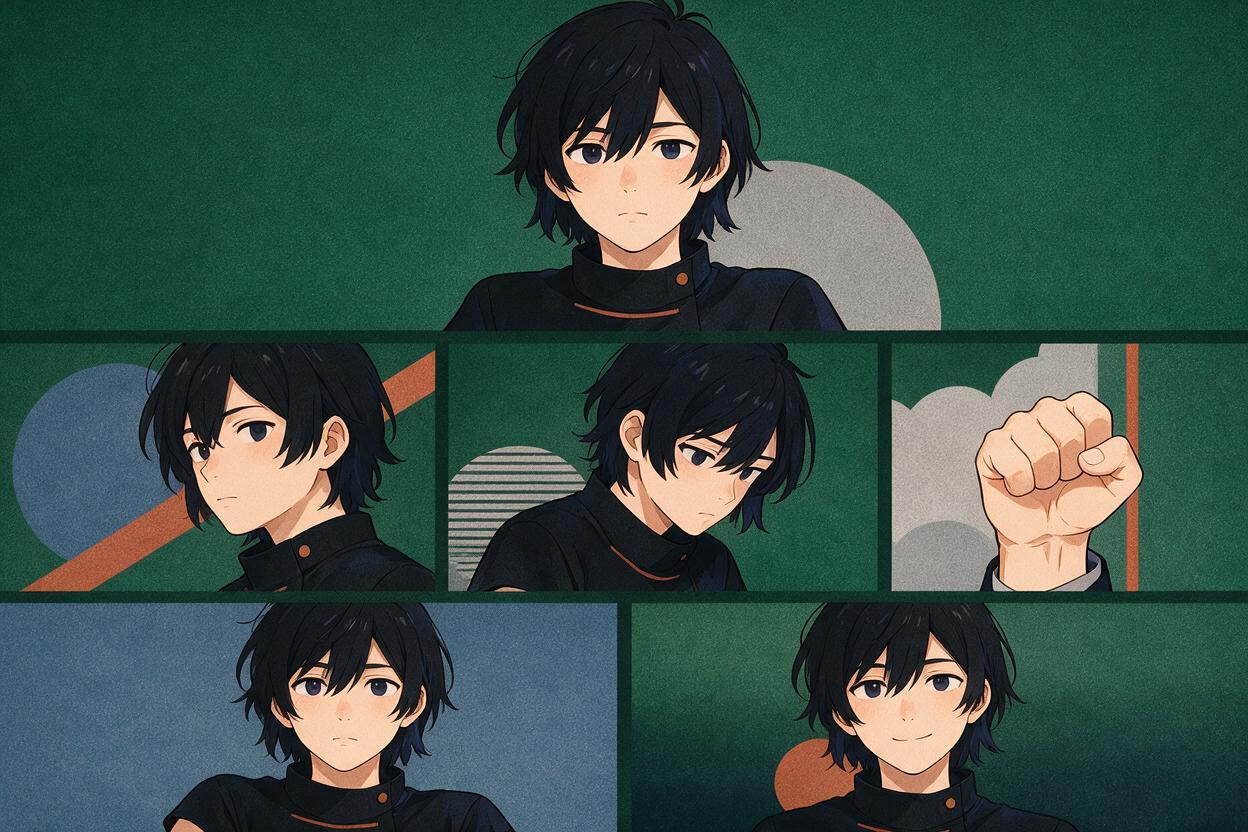
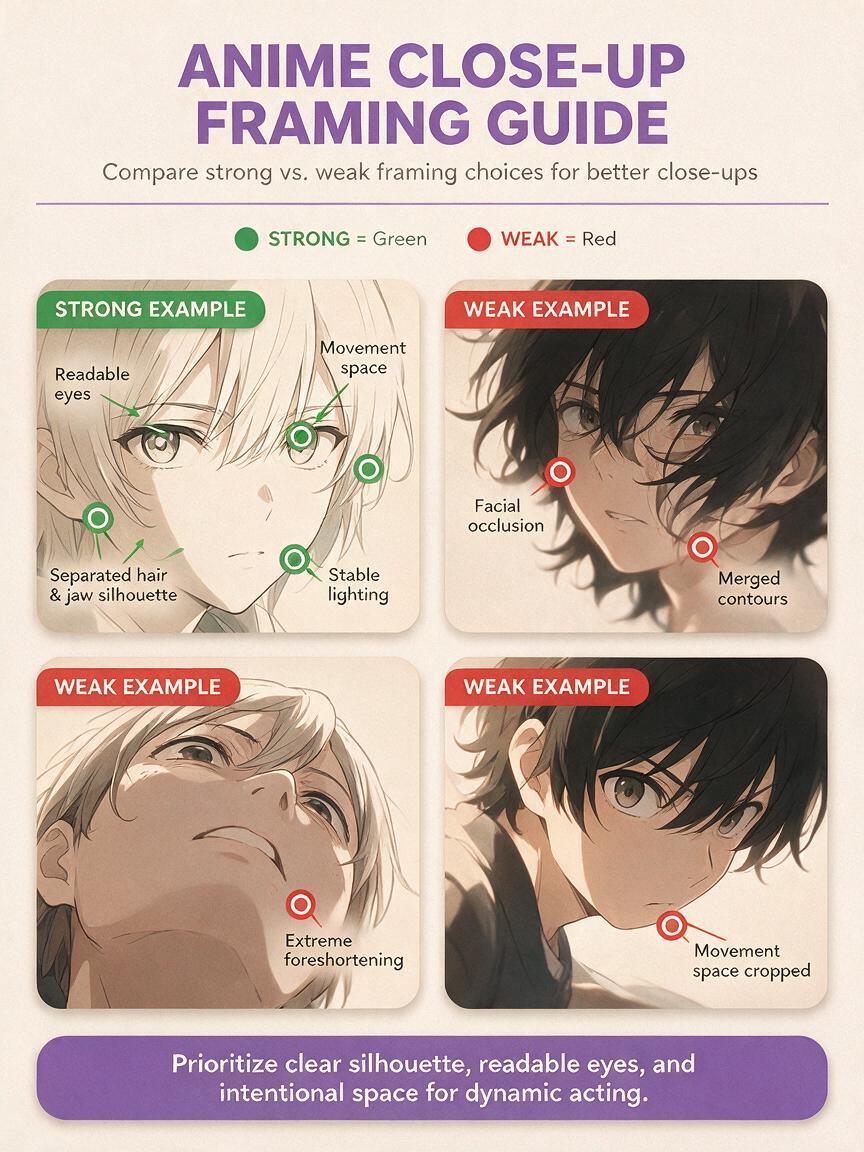
Start with a clean medium shot or close-up in which the facial features are readable. Avoid hands covering the mouth, hair crossing both eyes, extreme foreshortening, and accessories that merge into the face. These are valid artistic choices, but they make identity preservation more difficult when the image begins to move.
A reliable source frame usually has:
- A clearly drawn jawline, nose, eyelids, irises, and mouth
- Separated silhouettes for the chin, collar, shoulders, and hair
- Enough empty space for the intended head or hand movement
- A stable camera angle that does not need to change during the performance
- One dominant light direction with no effects hiding the face
Use reference image to video when the illustration already contains the exact design, pose, framing, and lighting you want. The image should carry identity; the prompt should carry motion and timing.
Prompt the performance, not the emotion label
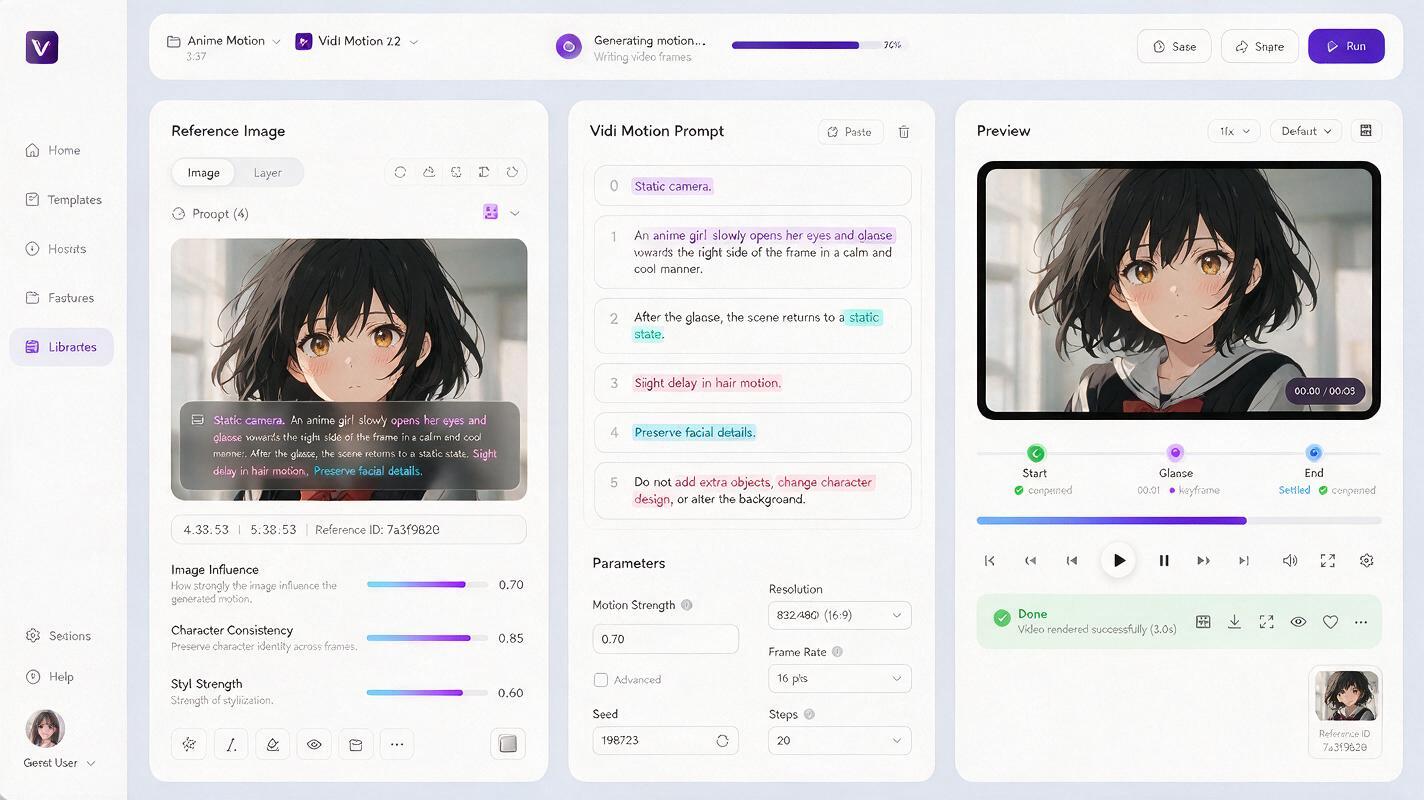
A useful acting prompt can be divided into five parts: the fixed shot, the primary action, the timing, the secondary motion, and the protected details. This structure gives Vidu less room to substitute a different performance.
| Prompt component | Weak instruction | More controllable instruction |
|---|---|---|
| Shot | Anime close-up | Locked medium close-up, static camera |
| Primary action | She becomes nervous | Her eyes shift briefly toward the doorway |
| Timing | Natural movement | She holds still, glances aside, then settles |
| Secondary motion | Hair moves | Only the loose hair tips respond with slight delayed motion |
| Protection | Consistent character | Preserve eye shape, pupil design, bangs, mouth size, and costume |
Sequence language is especially helpful. Phrases such as holds still, then, briefly, returns, and settles describe an acting beat with a beginning and an end. They are more useful than adding several cinematic adjectives.
Reusable Vidu prompts for subtle anime acting
Quiet breathing during a held close-up
Use this pattern for reflective dialogue pauses, visual-novel scenes, and calm character introductions.
Locked anime medium close-up, static camera. The character remains composed and silent. Only a very slight breathing motion raises and lowers the upper chest and shoulders. One soft natural blink occurs near the middle of the shot. Loose hair tips respond with minimal delayed motion. Preserve the exact face shape, eye design, hairstyle, costume, line art, and background. No speaking, no camera movement, no body sway, no expression change.A controlled glance toward an off-screen sound
The eyes should lead this action. Moving the head first can make the reaction feel broad or theatrical.
Static anime close-up. The character holds the original expression, hears something off-screen, and shifts only the eyes toward frame right. After a short pause, the head turns a few degrees in the same direction and stops. The mouth remains closed. Preserve the original pupils, eyelids, facial proportions, bangs, earrings, and lighting. No zoom, no sudden turn, no talking, no new expression.Restrained sadness without facial collapse
Avoid requesting tears immediately. First establish the physical signs of suppressed emotion.
Locked close-up of the same anime character suppressing sadness. The gaze lowers slightly, the upper eyelids relax, and the lips press together without changing size. The shoulders sink by a very small amount at the end. Keep the jawline, nose, eyes, hair silhouette, and costume exactly on model. No crying, no lip movement, no dramatic head drop, no camera motion.A hand tightening before action
This prompt creates anticipation without forcing the whole character into a new pose.
Static anime medium shot. The character holds the original pose. The visible hand slowly tightens into a firm fist while the wrist and arm remain in place. The fingers close in a believable order, followed by a slight tension in the forearm and shoulder. The face stays still and focused. Preserve finger count, sleeve design, body proportions, and background. No camera shake, no arm swing, no costume change.A small smile that does not trigger speech
Define the mouth as a closed shape and keep the change narrow.
Locked anime close-up, unchanged framing. The character's neutral expression gradually becomes a faint closed-mouth smile. The corners of the mouth lift slightly while the lips stay together. The eyes soften without changing shape or color. Preserve the exact face, nose, chin, bangs, pupils, and linework. No talking, no teeth, no open mouth, no head movement, no camera movement.Keep secondary motion subordinate to the acting beat
Hair, fabric, rain, smoke, and light can support a performance, but they should not compete with it. If the emotional beat is a glance, describe the glance first and limit environmental motion to a small response. A phrase such as “hair flowing dramatically in the wind” can redirect the generation away from the eyes and toward full-body motion.
A practical motion hierarchy is:
- Primary: the action that communicates the thought or reaction
- Secondary: a delayed response in hair, clothing, or posture
- Ambient: low-intensity background movement
- Fixed: camera, facial identity, costume construction, and scene geometry
When you animate image to video, keep the primary action to one sentence and place protection language after the motion description. This makes the prompt readable while clearly separating performance from continuity constraints.
Diagnose drift before rewriting the whole prompt
Watch the generated clip once at normal speed, then inspect the beginning, action peak, and final frame. Identify the first moment where the result departs from the intended performance. The earliest error is usually more useful than the most distorted frame.
| Visible failure | Likely cause | Prompt adjustment |
|---|---|---|
| Random talking | Emotion interpreted as dialogue | Add “mouth remains closed” and “no speaking” |
| Eyes change design | Gaze movement is too broad | Specify direction, short distance, and preserved pupils |
| Head keeps drifting | No stopping point is defined | Add “turns a few degrees and stops” |
| Hair overwhelms the face | Secondary motion is too strong | Limit movement to loose tips with slight delay |
| Expression becomes exaggerated | Abstract emotion is doing too much work | Replace the emotion label with eyelid, gaze, and mouth actions |
| Body sways continuously | Breathing lacks anatomical limits | Restrict motion to the upper chest and shoulders |
Change one instruction at a time. If you simultaneously rewrite the action, camera, emotion, and protection clauses, you will not know which change improved the result.
Separate complex performances into editable shots
A character who notices danger, turns, stands, reaches for a weapon, and speaks is performing several beats. Generating the entire sequence as one clip increases the chance of facial and costume drift. Divide it into short shots: recognition, decision, and action.
End each shot on a stable pose that can support the next cut. A still reaction close-up can lead into a hand detail, followed by a wider action shot. This resembles intentional anime editing and removes the need for one generation to solve every anatomical transition.
If a prompt needs several uses of “and then,” it probably contains more than one shot.
Final checklist
- Use a source image with readable facial features and separated silhouettes.
- Describe one visible acting beat instead of naming an abstract emotion.
- State which body part moves first, how far it moves, and where it stops.
- Keep hair, clothing, particles, and lighting secondary to the performance.
- Explicitly protect eye design, face shape, hairstyle, costume, and line art.
- Add “mouth remains closed” when the character should not speak.
- Inspect the first frame where drift appears before revising the prompt.
- Split multi-beat performances into separate, editable shots.
Choose one source image and one restrained action, then test this prompt yourself before adding more movement.
Keywords
Vidu prompts, anime character animation, subtle anime acting, anime image to video, face consistency, 2D animation AI, anime motion prompts