US Tech Stocks Plunge as Meta, Nvidia and Oracle Fall
Meta and Nvidia fell 3% while Oracle dropped 8.8% during a broad US technology-stock selloff, even as ASML reported a strong third quarter and a record backlog extending through 2030.
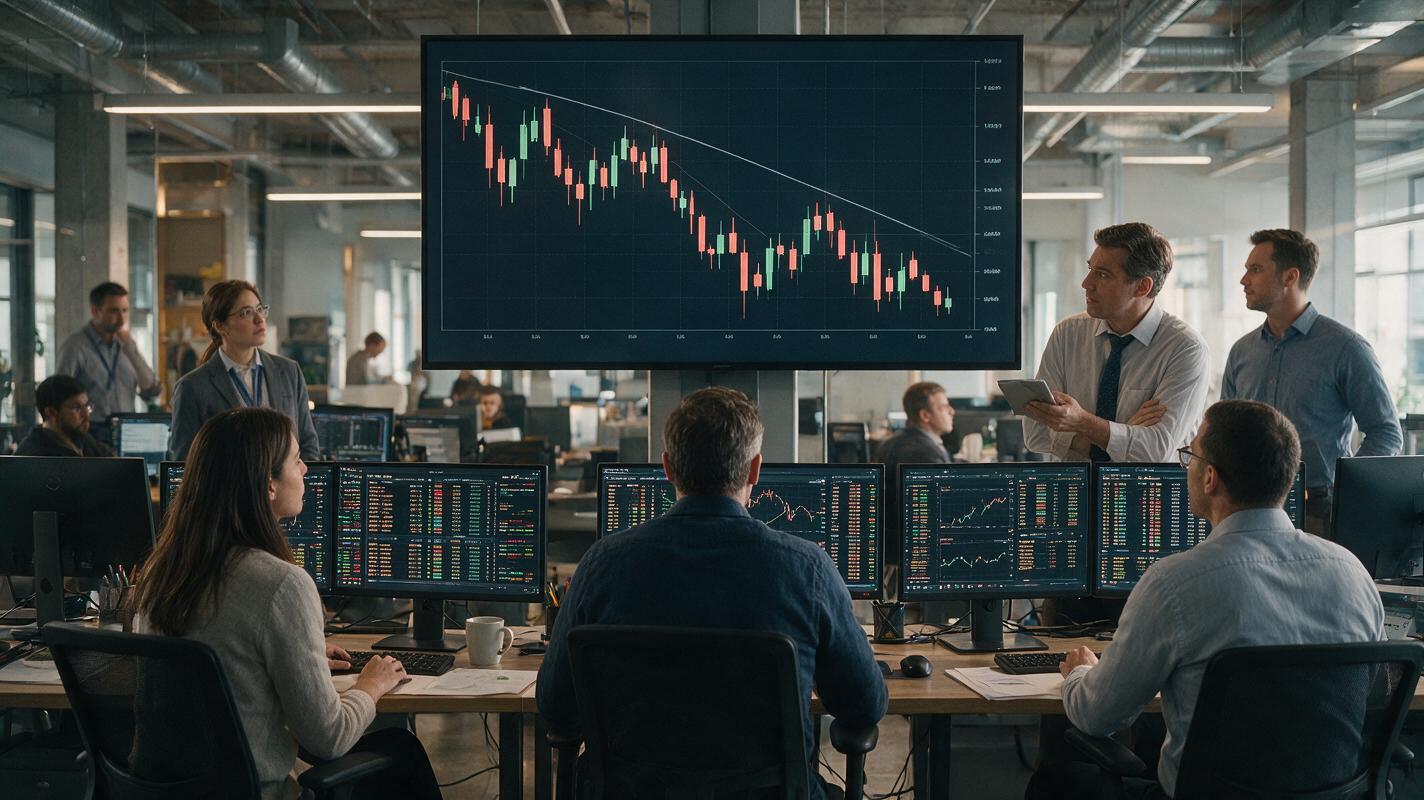
Table of contents
AI Industry News
US Tech Stocks Plunge as Meta, Nvidia and Oracle FallA sharp technology-stock selloff put pressure on major AI-linked companies, while ASML’s third-quarter performance offered a contrasting signal from the semiconductor supply chain.
Meta and Nvidia Fall 3% as Oracle Drops 8.8%
US technology stocks suffered a broad decline on October 15, 2026, with several companies closely associated with the AI industry recording substantial losses. Meta and Nvidia each fell 3%, while Oracle dropped 8.8%. The moves showed how quickly market sentiment can turn against businesses positioned around artificial intelligence, cloud infrastructure and large-scale computing.
The same report delivered a notable counterpoint from ASML. The semiconductor-equipment company beat expectations in its third-quarter results and reported a record backlog extending through 2030. No backlog value was provided, but the long time horizon indicates sustained demand for the equipment required to expand advanced chip manufacturing capacity.
Taken together, the developments present a divided picture. Public-market valuations moved lower for several major technology companies, yet a critical supplier serving the semiconductor sector reported strong quarterly performance and unusually long order visibility. The contrast matters because share-price movements measure investor sentiment, while an equipment backlog reflects committed demand elsewhere in the supply chain.
For content teams, the immediate lesson is not to treat a single trading session as a verdict on AI adoption. It is more useful to watch the underlying economics—including infrastructure availability, operating costs and platform reliability—that can eventually influence production tools and AI video cost.
What the Market Moves Actually Show
| Company | Reported development | Relevant market signal |
|---|---|---|
| Meta | Shares fell 3% | Investor pressure on a major technology and AI company |
| Nvidia | Shares fell 3% | Weaker sentiment around a central AI computing supplier |
| Oracle | Shares fell 8.8% | The largest reported decline among the named companies |
| ASML | Third-quarter results beat expectations | Operational strength despite the wider technology selloff |
| ASML | Record backlog extending through 2030 | Long-range demand for semiconductor manufacturing equipment |
The figures should remain in their proper categories. A 3% or 8.8% share decline does not establish that a company’s AI products are failing, nor does ASML’s backlog prove that every planned AI project will succeed. The report supplies a snapshot of market performance and semiconductor-equipment demand, not a complete forecast of revenue, product adoption or future computing prices.
The most useful signal is the divergence: technology valuations can fall in the short term while demand for foundational semiconductor equipment remains strong over a much longer period.
ASML’s Backlog Adds a Long-Term Infrastructure Signal
ASML occupies a different position from consumer platforms, cloud providers and AI software vendors. Its reported third-quarter beat and record backlog through 2030 concern the industrial foundation behind advanced computing rather than a single assistant, model or content product.
That distinction helps explain why its results can look strong during a weak session for US technology stocks. Equity prices respond to changing expectations across many time horizons. Semiconductor manufacturing capacity, by contrast, depends on long purchasing, installation and production cycles. A backlog extending through 2030 therefore belongs to a longer planning horizon than one day of market trading.
The backlog also offers context for the continuing debate over AI capital expenditure. Expanding AI services requires more than model development. The broader chain includes chipmaking equipment, semiconductor manufacturing, data-center capacity and the infrastructure needed to operate computing-intensive services. The supplied report does not attach a capital-expenditure figure to ASML’s backlog, but it does show that demand for manufacturing equipment remains visible years ahead.
Why Short-Term Stock Volatility Is Not a Production Strategy
Content teams may follow Meta, Nvidia, Oracle and ASML because changes across the AI industry can eventually affect the software and infrastructure available to them. Even so, daily share-price movements should not dictate which production tool a team uses for a campaign.
A practical evaluation should focus on factors that directly affect output:
- Availability: whether the required creation capability is accessible when a deadline arrives.
- Workflow portability: whether a project can continue if one provider changes access or performance.
- Production economics: whether generation, revision and delivery costs fit the project budget.
- Output suitability: whether the result matches the intended channel, format and audience.
- Operational consistency: whether a team can repeat its process across multiple campaigns.
These considerations are especially relevant for teams using an ai image generator or an ai video generator. Infrastructure investment and semiconductor demand form part of the economic backdrop, but creators encounter the market through generation access, iteration time and usable output.
What the Selloff Means for AI Content Teams
The October 15 decline highlights concentration risk at both the investment and workflow levels. When a production process depends entirely on one vendor, changes in availability or economics can create avoidable disruption. A multi-model environment can give teams more flexibility without requiring them to rebuild every project around a separate account and workflow.
Separate market headlines from creative requirements
A company’s stock may rise or fall for reasons that do not alter the immediate quality of a content workflow. Teams should define the asset they need—such as an image, video concept or campaign variation—and assess tools against that requirement rather than reacting to market momentum.
Track total production cost, not only generation price
AI video cost includes more than an initial output. Revisions, rejected generations, staff time and the need to move between disconnected services can all affect the final budget. Stable access to multiple creation options can reduce the operational friction associated with testing alternatives.
Keep workflows adaptable as infrastructure evolves
ASML’s record backlog through 2030 signals a long cycle of semiconductor demand, but it does not specify when or how that capacity will change individual creative products. Teams are better served by adaptable production practices than by attempting to predict which infrastructure investment will deliver the next immediate advantage.
A Multi-Model Response to an Uneven AI Market
The split between falling technology shares and ASML’s strong operational report reinforces a broader point: the AI market does not move as one uniform category. Software vendors, cloud businesses, chip suppliers and semiconductor-equipment companies operate at different points in the value chain and on different commercial timelines.
MagicBoat gives content teams a one-account, multi-model environment for creative production. That structure helps users assess output according to the needs of a project rather than tying an entire workflow to the market fortunes of one technology provider.
This does not remove the importance of infrastructure or AI capital expenditure. Instead, it gives creators a practical way to manage the uncertainty they can control: model selection, workflow continuity, revision efficiency and the path from an idea to a publishable asset.
Key Takeaways
- Meta and Nvidia each fell 3% during the reported US technology-stock decline.
- Oracle dropped 8.8%, the steepest fall among the companies named in the report.
- ASML beat expectations in its third-quarter results.
- ASML reported a record backlog extending through 2030.
- The stock declines reflect short-term market sentiment, while the backlog offers a longer-range semiconductor demand signal.
- Content teams should judge AI tools by availability, production economics, output suitability and workflow flexibility.
Keep AI Production Flexible
Market volatility can change quickly, but content deadlines remain fixed. Use a multi-model creative environment to compare options and maintain a more adaptable production workflow.