AI Capital Expenditure: A Smarter Cost Playbook for Creators
AI capital expenditure is becoming a defining business issue for the AI industry, but infrastructure spending does not automatically translate into cheaper creative output. This analysis shows creators and teams how to evaluate AI video cost, image-generation expenses, and multi-model workflows without betting their budgets on a single provider.

Table of contents
AI Infrastructure Spending Is Reshaping Creative Decisions
AI capital expenditure has become a central business theme as technology companies invest in the computing capacity needed to build and operate increasingly capable models. For creators and marketing teams, the practical promise is not automatically lower prices; it is a wider choice of models, faster experimentation, and more reasons to measure the cost of each usable asset.
Funding announcements and infrastructure plans can sound distant from a designer generating campaign images or a producer testing short-form video. In reality, those investments influence model availability, competition, processing capacity, and the pricing structures that creative teams eventually encounter.
The useful question is not whether AI investment is large. It is whether a creative workflow can turn access to that investment into more approved content per dollar.
What AI Capital Expenditure Means in Creative Production
AI capital expenditure generally supports the physical and technical foundation behind AI services: computing hardware, data-center capacity, networking, storage, and related infrastructure. AI funding can also support model research, product development, hiring, and distribution.
These categories matter to creators because generative media is computationally demanding. Text ideation may require relatively modest resources, while high-resolution image generation, repeated variations, and video rendering can consume substantially more processing capacity.
However, a company spending more on infrastructure does not guarantee an immediate reduction in AI video cost. Providers may use additional capacity to improve quality, increase speed, serve more customers, train new models, or protect margins. Prices can also vary through subscriptions, usage credits, output duration, resolution, or feature tiers.
| Business signal | Possible tool-level effect | What creators should monitor |
|---|---|---|
| More computing capacity | Higher throughput or broader access | Queue times, generation limits, and reliability |
| New AI funding | Faster product and model development | Useful releases rather than announcement volume |
| Greater model competition | More choices across quality and cost | Cost per approved output |
| Demand for richer media | More image and video features | Resolution, duration, consistency, and editing needs |
The Price of Generation Is Not the Cost of Content
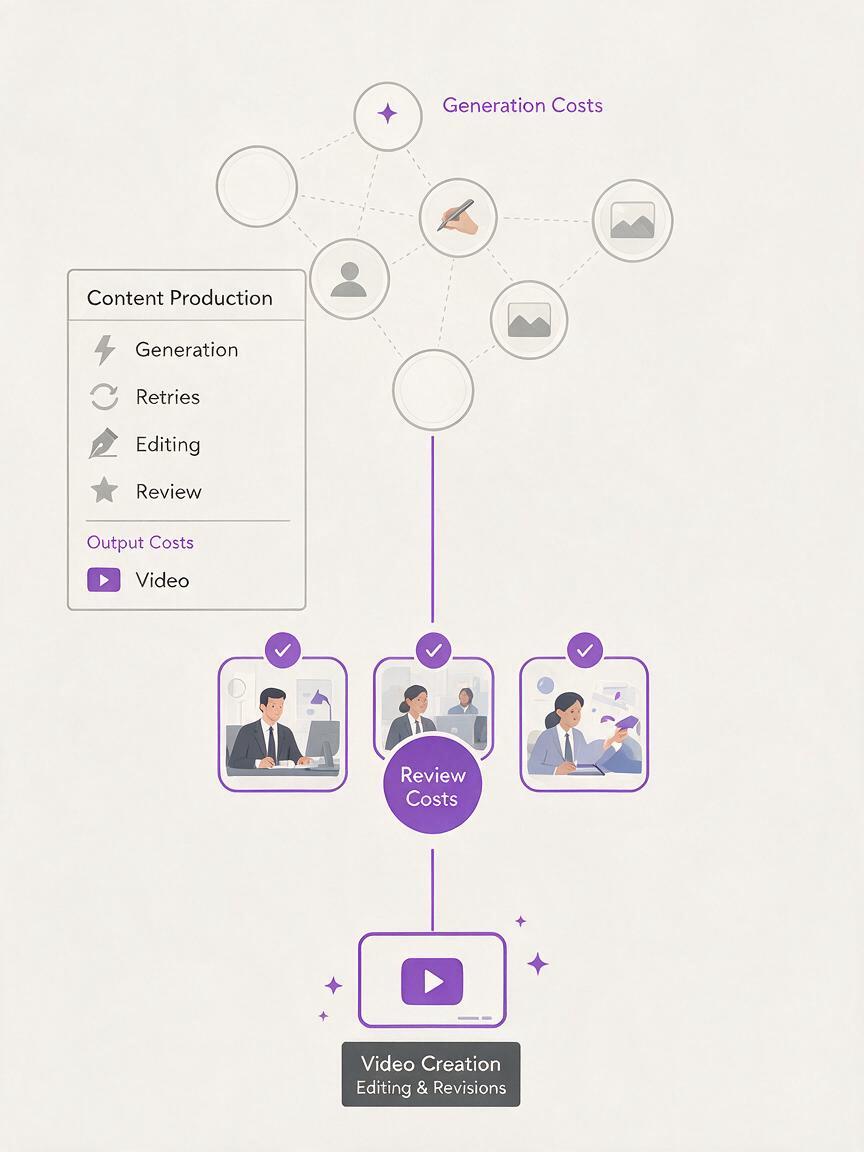
A low generation price can be attractive, but it is only one component of production economics. A team may create dozens of images before finding one that follows the brief, preserves the product accurately, and meets brand standards. Video adds further variables, including motion consistency, clip duration, retries, upscaling, sound, and post-production.
A more useful internal metric is cost per approved asset:
Cost per approved asset = total tool and production cost ÷ number of approved assetsThis calculation can include subscriptions, usage credits, failed generations, editing time, review time, and specialist work. It prevents a cheap first render from looking economical when it requires extensive correction.
Why AI Video Cost Deserves Separate Tracking
Still images and videos should not share one undifferentiated budget. An AI image generator can support rapid composition tests, mood boards, product backgrounds, thumbnails, and social variations. Video introduces a temporal dimension: a visually strong frame is not enough if subjects, objects, or camera movement become inconsistent over time.
Creative teams can control exposure by validating an idea with text and images before committing resources to motion. A rough storyboard can reveal whether the concept is clear, whether every scene is necessary, and which visual references need refinement.
Multi-Model Access Changes the Buying Decision
The expanding AI industry is making model selection a workflow decision rather than a one-time software purchase. One model may be useful for brainstorming and prompt refinement, another for a particular visual treatment, and another for motion tests.
This does not mean teams should switch models constantly. Uncontrolled switching makes quality difficult to reproduce. The advantage appears when models are compared against the same brief and evaluated with consistent criteria.
A multi-model AI library can reduce the friction of exploring different creative approaches. MagicBoat provides free entry, access to a multi-model library, and one-account workflows, allowing creators to begin testing without assembling a separate workflow for every experiment.
| Approach | Potential advantage | Common cost risk |
|---|---|---|
| Single-model workflow | Simple training and repeatable settings | Forcing every brief through one model |
| Separate provider accounts | Direct access to specialized services | Fragmented subscriptions and asset handling |
| One-account, multi-model workflow | Faster comparison and centralized access | Testing without a defined evaluation rubric |

A Practical Budgeting Framework for Creative Teams
Instead of trying to predict which AI company will spend the most or which model will dominate, teams can build a budget around work they control. Start with a real deliverable, such as a product launch image set, a six-scene storyboard, or several short social concepts.
Define approval criteria before generating. Depending on the project, those criteria may include:
- Brief adherence: Does the output communicate the required idea?
- Visual accuracy: Are products, text, hands, faces, and physical details acceptable?
- Brand fit: Do color, tone, composition, and pacing match the campaign?
- Edit burden: How much manual correction is still required?
- Repeatability: Can the team produce related assets without starting over?
Then test a limited set of variations. Record the number of attempts, the time spent reviewing them, and the outputs that reach approval. This turns model selection into evidence rather than preference.
A Reusable Brief for Model Comparisons
The same structured prompt can be adapted across text, image, and video tools:
Goal: Create a campaign concept for [product or subject].
Audience: [specific audience].
Format: [image, storyboard, or short video concept].
Required elements: [objects, message, setting, action].
Visual direction: [lighting, framing, palette, mood].
Constraints: [brand rules and details that must not change].
Success test: [what an approver must understand immediately].
Keeping the brief stable makes comparisons more meaningful. If every model receives different instructions, the test measures prompt variation rather than model suitability.

Where DeepSeek and Model Competition Fit
DeepSeek is part of the broader discussion about model competition, AI funding, and the economics of access. Creators do not need to turn that discussion into loyalty to a particular model. The practical response is to separate tasks and choose tools according to output requirements.
For example, reasoning or text models can help clarify a campaign proposition, compress a long brief, generate shot alternatives, or identify missing constraints before visual production begins. An AI image generator workflow can then be used to test compositions before the team allocates more resources to video.
This progression matters because better planning can reduce avoidable generations. Infrastructure competition may expand access, but disciplined pre-production determines whether that access produces useful work.
What Creators Should Watch as Investment Expands
Large AI capital expenditure can affect the market over time, but creators should focus on observable product changes rather than assuming that every investment headline will lower costs. Useful signals include:
- Whether generation limits become more practical for real projects
- Whether image and video outputs require fewer retries
- Whether faster processing is available at the same effective cost
- Whether model choice expands without adding account complexity
- Whether commercial workflows become easier to organize and repeat
- Whether new capabilities reduce editing work instead of merely adding novelty
The strongest value often comes from reducing waste between ideation and approval. A slightly more expensive generation can be economical if it saves several retries or hours of manual repair.
Build Around Flexibility, Not Headlines
AI investment cycles will continue to influence the tools available to creative professionals. Yet no capital-spending announcement can replace project-level measurement. Teams that track approval rates, retries, editing time, and final output quality will be better equipped to benefit from changing model economics.
MagicBoat offers a free entry point, a multi-model library, and one-account workflows for exploring these choices. Start creating with MagicBoat and compare approaches using a real brief rather than an abstract benchmark.
Sources Note
The supplied background material did not expose public third-party article URLs or retrievable company figures. Accordingly, this analysis makes no company-specific claim about revenue, funding totals, server purchases, capital-expenditure amounts, or model pricing.
Final Checklist
- Measure cost per approved asset, not only cost per generation.
- Track image and video expenses separately.
- Validate concepts before committing resources to high-cost renders.
- Compare models with the same brief and approval criteria.
- Include retries, editing, and review time in production costs.
- Use multi-model access selectively rather than switching without a plan.
Keywords
ai capital expenditure, ai video cost, ai image generator, deepseek, ai funding, ai industry, multi-model ai