AI News Roundup: A Verification-First Playbook for Creators
This verification-first AI news roundup explains how creator teams can respond when the available topic feed lacks public evidence for specific launches or industry claims. It provides a practical framework for evaluating model releases, AI video tools, platforms, and content trends without turning unconfirmed buzz into published fact.

Table of contents
AI News Without the Guesswork
Today’s most useful AI news takeaway is a publishing discipline: when a topic feed contains no verifiable public details, creators should turn the gap into an evidence-ready testing plan rather than repeat unsupported launch claims.
The background material available for this edition did not include extractable story text, public citations, release notes, prices, benchmarks, or entertainment-industry announcements. That means there is no responsible basis for presenting a specific model release or platform update as today’s confirmed headline.
For creator teams, however, a quiet or incomplete feed is still actionable. It is an opportunity to define what evidence a new AI tool must provide, prepare repeatable comparison assets, and build a production queue that can move as soon as primary sources become available.
The creator advantage is not being first to repeat a claim. It is being ready to test a confirmed change against a real brief.
Model Releases Need an Evidence Gate
No model release is being elevated in this AI roundup because the supplied material contains no public release announcement that can be cited. That absence matters: model names, version numbers, benchmark scores, access tiers, and capability claims can change the practical meaning of a headline.
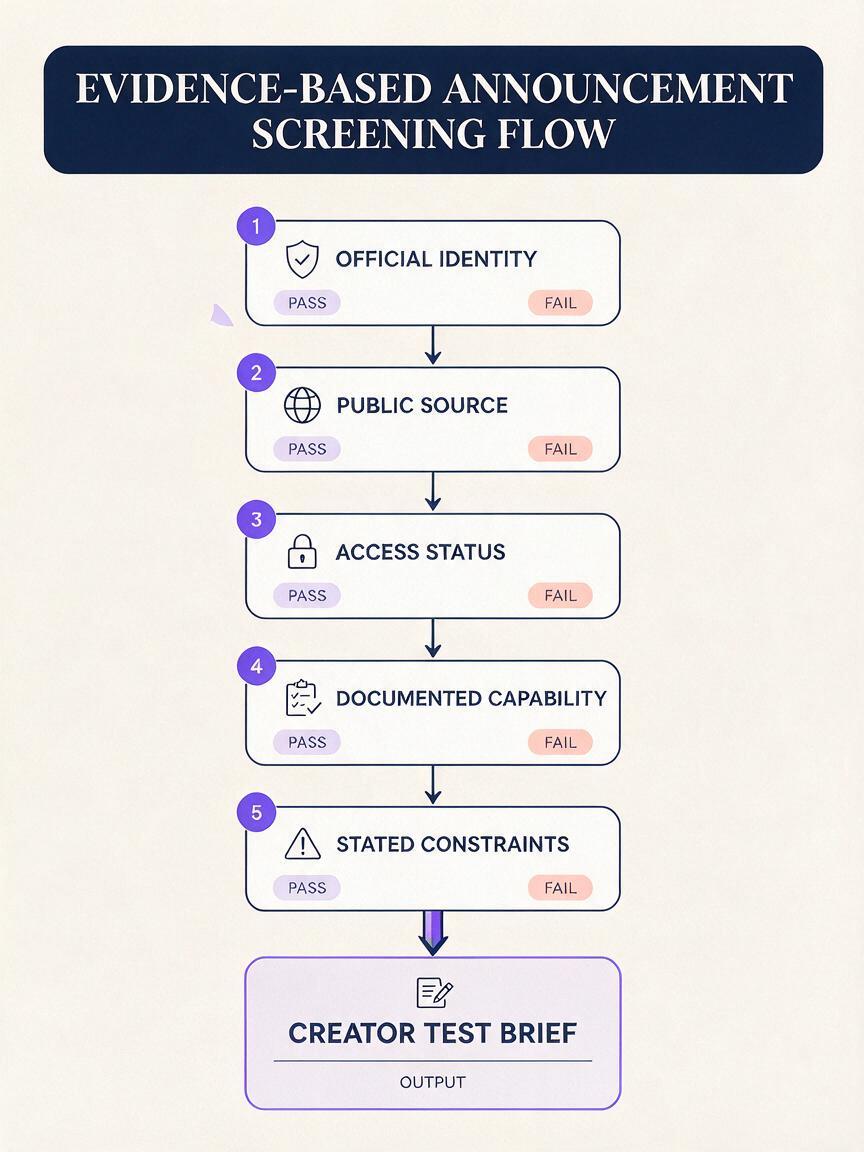
Before a model story enters a creator brief, the supporting evidence should answer a compact set of questions:
- Identity: What is the model’s official name and version?
- Source: Did the developer publish a release note, product page, or technical report?
- Access: Is the feature generally available, limited, or only announced?
- Capability: What input and output formats are explicitly documented?
- Constraint: Are duration, resolution, region, account, or usage limits stated?
This prevents a familiar category error: treating a preview, research demonstration, API update, and finished creator product as though they were interchangeable. They are not the same kind of event, and they do not create the same production opportunity.
Once a release is confirmed, creators can translate it into a narrow experiment rather than an open-ended test. A writer might compare revisions against one locked brief. A visual team might reuse the same reference image and shot description. Centralizing those trials through a model workspace such as MagicBoat makes it easier to focus on the creative result instead of scattering the brief across unrelated experiments.
Business Moves Must Change a Workflow to Matter
The available source material also provides no citable funding, partnership, acquisition, licensing, or distribution announcement for this edition. Rather than filling that space with speculation, creator teams can use a simple relevance filter: identify what would actually change if a future business headline is confirmed.
| Business signal | Evidence to find | Creator implication |
|---|---|---|
| Platform partnership | Official scope and product integration | Fewer handoffs or a new publishing route |
| Licensing agreement | Named catalog, market, and permitted use | Possible changes to usable source material |
| Acquisition | Closing status and product roadmap | Potential account, access, or tool consolidation |
| Pricing change | Official plan and effective terms | Revised cost per approved asset |
The key question is not whether a company move sounds large. It is whether the move changes access, rights, cost, speed, or distribution for a real creator workflow. If none of those variables moves, the announcement may be strategically interesting without being immediately useful in production.
Agents and Platforms Should Be Judged by Their Handoffs
No verified agent or platform announcement can be drawn from the supplied feed today, so there is no basis for claiming a new autonomous workflow, integration, or deployment capability. This is especially important with agents, where broad language can hide the difference between generating a suggestion and completing an approved action.
A creator-focused agent evaluation should map the handoffs that remain visible to a human:
- Where does the initial brief enter the system?
- Which inputs can be retrieved, and from what approved location?
- What decisions require human review?
- Where are drafts, sources, and revisions recorded?
- Which application performs the final export or publication?
A useful agent does not merely produce more intermediate text. It reduces a measurable coordination burden while preserving review at the moments that affect accuracy, brand voice, rights, and final quality.
For a campaign team, this can mean separating orchestration from creation. An agent may organize a brief and output variants, while specialized AI tools handle copy, still images, motion, or audio. That separation makes it easier to replace one component without rebuilding the entire campaign process.
AI Video Trends Are Best Read Through Outputs
The feed provides no public evidence for a specific AI video generator launch or entertainment trend in this edition. That makes output-based comparison more valuable than product-name speculation. Creators can prepare a fixed set of visual briefs now and run them only when a tool or update is confirmed.
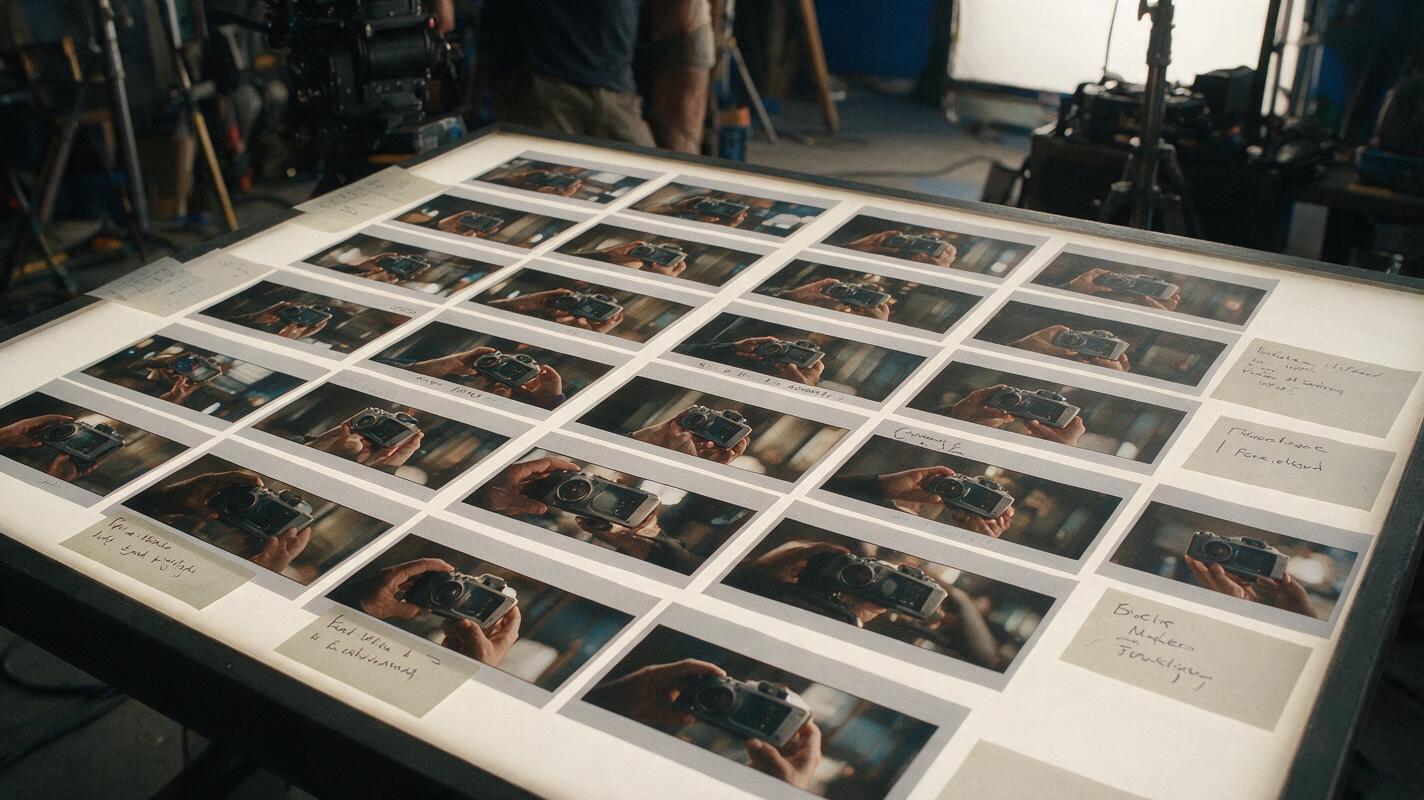
A balanced test set should represent different production challenges:
- Product continuity: a physical object remains recognizable across the shot.
- Human motion: hands, walking, or interaction remain spatially coherent.
- Camera intent: the generated movement follows a clearly described pan, push, or locked frame.
- Reference adherence: an input image keeps its composition, subject, and visual identity.
- Editability: the result can be trimmed, captioned, sequenced, or regenerated without restarting the concept.
These cases also clarify when to choose text to video and when to choose image to video. Text-led generation is useful when the concept is still fluid and exploration is the goal. Image-led generation is often the more appropriate test when a team already has an approved product frame, character design, storyboard panel, or campaign key visual.
CREATIVE TEST BRIEF
Goal: Produce one usable five-shot concept sequence
Subject: [approved subject or product]
Setting: [specific real environment]
Motion: [one subject action and one camera instruction]
Continuity lock: [details that must not change]
Reject if: [visible failure conditions]
Review for: adherence, motion, consistency, editability
The point is not to declare a universal winner. It is to discover which generation path produces the highest proportion of usable material for a defined format.
Content Trends Need Comparable Creative Artifacts
There is no citable film, television, streaming, or social-content trend in the supplied material to summarize as fact today. Creator teams can nevertheless prepare the artifacts needed to evaluate the next confirmed trend quickly.
Instead of collecting isolated examples, build a comparison package containing the original brief, reference assets, first output, revision prompt, final selection, and reason for rejection or approval. This turns trend watching into production knowledge.
For example, if short-form AI video becomes the subject of a verified platform announcement, the team already has a way to ask meaningful questions: Does the update improve the opening frame? Does it preserve a product between cuts? Can the result support captions and reframing? Does it reduce revisions, or simply generate more options?
This before-and-after record is more valuable than a folder of polished demonstrations because it exposes the distance between a promising output and a publishable asset.
Build a Publishable Creator Brief
A verification-first newsroom and a creator studio can share one lightweight brief. Each confirmed story should produce an evidence record and a creative response:
| Brief field | What to record |
|---|---|
| Confirmed fact | The narrow claim supported by a public source |
| Unknowns | Access, limits, rights, quality, or timing not yet documented |
| Creator hypothesis | The workflow improvement worth testing |
| Test asset | A repeatable prompt, image, script, or storyboard |
| Decision rule | The conditions for adopting, monitoring, or rejecting the tool |
This format keeps reporting and experimentation connected without confusing one for the other. A public announcement establishes what happened. A controlled creator test determines whether it matters to the work.

Key Takeaways
- Do not convert an incomplete topic feed into invented AI news.
- Require a public primary or reputable third-party source before publishing release details.
- Translate confirmed model news into narrow, repeatable creative tests.
- Judge business announcements by changes to access, rights, cost, speed, or distribution.
- Evaluate agents by their real handoffs and approval boundaries.
- Compare AI video outputs with fixed briefs, references, and rejection criteria.
- Preserve prompts, revisions, and decisions as reusable production knowledge.
Turn the Next Confirmed Headline Into a Creative Test
When verified model, platform, or content news arrives, bring a locked brief and test the relevant generation path in one place. Open MagicBoat and start a creator-ready experiment built around an actual deliverable rather than an unverified claim.
Sources Note
No public third-party source links or extractable news details were present in the supplied hot-topic material, so no external launch, pricing, benchmark, business, or entertainment claim is listed as confirmed in this edition.
Keywords
ai news, ai tools, ai video generator, text to video, image to video, ai roundup, creator workflow