Amazon Reportedly Near Acquiring AI Cloud Startup Decart
Amazon is reportedly nearing an acquisition of AI cloud startup Decart, according to an October 12, 2026 report from The Automated Daily. The deal would bolster Amazon Web Services' AI cloud capabilities amid intensifying competition among major cloud providers for AI workloads. The move has notable implications for AI content creators navigating a consolidating AI tooling ecosystem.

Table of contents
The Amazon Decart Acquisition Report
On October 12, 2026, a report from The Automated Daily revealed that Amazon is reportedly near acquiring AI cloud startup Decart, marking the latest in a fast-moving string of AI-focused investments and expansions from the e-commerce and cloud computing giant. The news comes amid a broader wave of consolidation across the AI infrastructure space, as major technology and cloud firms race to capture surging demand for AI workloads from enterprises, developers, and individual content creators alike.
While details of the prospective deal remain limited, its potential impact ripples across the AI industry, from enterprise cloud services to the tools that independent creators use every day. This report fits into a well-documented pattern of large cloud providers scaling their AI capabilities through targeted acquisitions, as they compete to dominate the fast-growing AI infrastructure market.
What the Report Confirms
At this stage, core details about the prospective deal are sparse. The October 12 report outlines that Amazon is in advanced discussions to acquire Decart, an AI cloud startup, though no official confirmation has been issued by either company as of press time. No financial terms, expected closing timeline, or specific post-acquisition product roadmap details have been disclosed in initial reporting.
What is clear is that the potential acquisition fits into a well-documented pattern of Amazon scaling its AI capabilities across every layer of the technology stack, from underlying infrastructure to end-user tools and agent experiences. The move also aligns with a broader industry trend of large cloud providers snapping up specialized AI startups to fill gaps in their product offerings and stay competitive in a rapidly evolving market.
Industry observers note that AI cloud startups have become highly sought-after targets in 2026, as demand for specialized AI infrastructure and tooling outpaces the ability of large providers to build all capabilities in-house.

Amazon's Recent AI Ecosystem Expansion
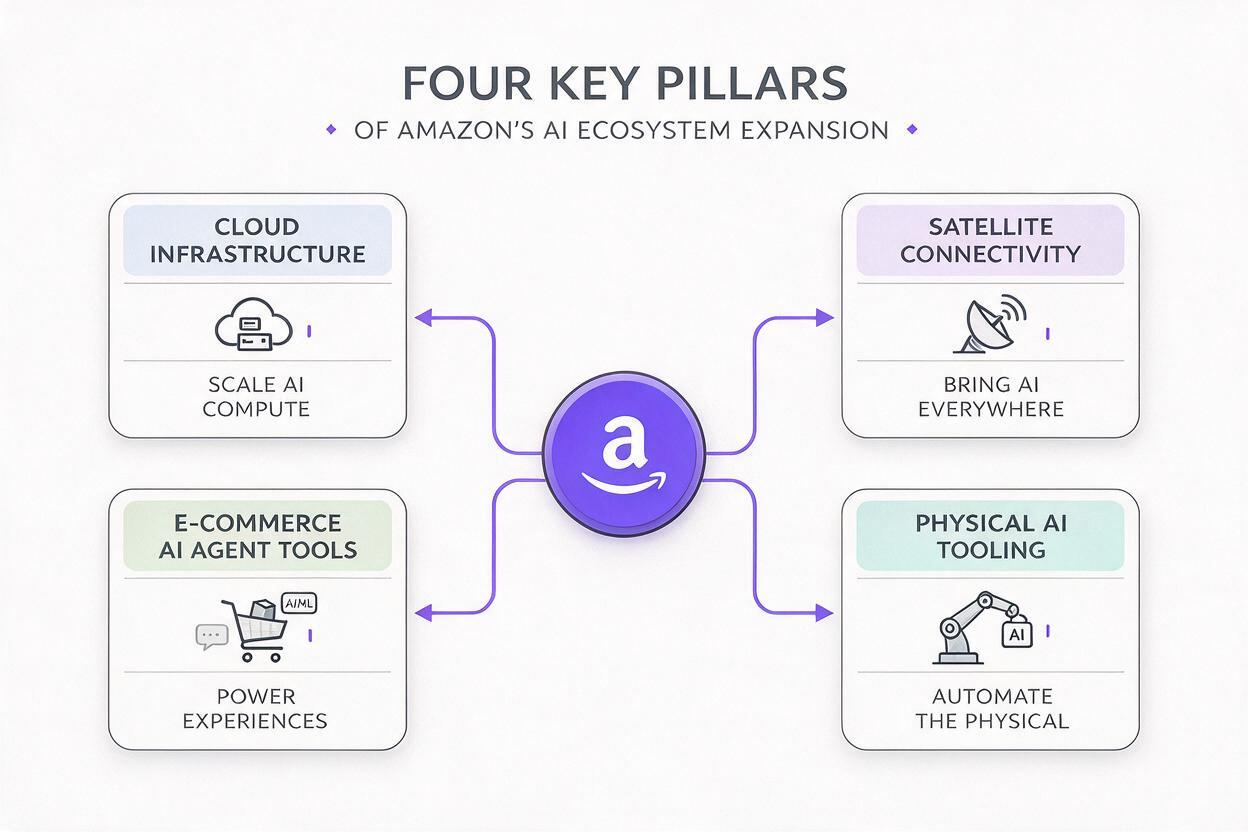
The Decart acquisition report is far from an isolated move for Amazon. Over the past several weeks, the company has announced or been linked to a range of AI-focused initiatives across its consumer, enterprise, and cloud divisions, painting a picture of a company aggressively positioning itself at the center of the global AI ecosystem.
On October 8, 2026, Amazon Web Services (AWS) launched an open-source Physical AI Toolchain designed for robotics and manufacturing use cases, with built-in integration for NVIDIA's AI stack. The toolchain is part of AWS's push to expand its AI offerings beyond pure software and into physical industries, bridging the gap between cloud-based AI models and real-world automated systems.
Also in early October 2026, Amazon's Kuiper low Earth orbit (LEO) satellite production line passed the 1,000-satellite milestone. The full Kuiper constellation is planned to include ~3,236 satellites, which will provide high-speed internet access to remote and underserved areas — a critical piece of infrastructure for delivering cloud and AI services to users outside of major urban centers.
On the e-commerce side, Amazon made a notable shift in late September 2026 when it opened its seller tools to third-party AI agents, starting with Claude. The move marked a major step forward for AI agent interoperability, allowing AI shopping assistants to access Amazon's seller data and functionality directly. At the same time, Amazon has taken steps to control how external AI agents interact with its platform, including blocking Meta's Muse shopping agent with "unauthorized agent access" popups in late September 2026, as reported by GeekWire and Moast.
Taken together, these moves show Amazon pursuing a two-pronged AI strategy: expanding its underlying infrastructure and tooling to support more AI workloads, while also shaping the rules of engagement for AI agents operating within its e-commerce ecosystem. The Decart acquisition would likely strengthen the first pillar of that strategy by adding specialized AI cloud capabilities to AWS's already robust portfolio.
Why AI Cloud Startups Are in High Demand
Amazon's interest in Decart is part of a much larger industry trend of massive investment flowing into AI cloud and infrastructure startups. Demand for AI compute, specialized tooling, and optimized cloud infrastructure has exploded over the past year, driven by the rapid adoption of generative AI tools across every sector from software development to content creation.
A late September 2026 report from Goldman Sachs estimated that AI capital expenditure from the world's five largest cloud giants will grow 50%+ to reach $1.2 trillion next year, reflecting the unprecedented scale of investment being poured into AI infrastructure. That spending is flowing not just into data centers and chips, but also into the software platforms and tools that make it easier for developers and creators to build and run AI applications.
Other recent funding and acquisition news from the AI infrastructure space underscores this trend. In early October 2026, Oxide Computer raised $445 million in Series D funding, led by Eclipse with strategic investment from AMD, to develop rack-scale private cloud servers optimized for modern workloads including AI. That same week, Typesafe AI announced an $870 million Series A round at a $7.5 billion valuation, led by Andreessen Horowitz, to build TypeScript-focused AI infrastructure powered by its Jev runtime.
For large cloud providers like AWS, acquiring specialized AI cloud startups offers a faster path to filling product gaps and acquiring top AI talent, rather than building every capability in-house. For startups, joining a larger cloud ecosystem can provide the scale and resources needed to bring their tools to a global audience.
What This Means for AI Content Creators
While AI infrastructure consolidation may seem far removed from the day-to-day work of content creators, it has tangible implications for anyone who uses cloud-based AI tools to produce videos, images, audio, or written content.
On one hand, increased investment in AI cloud infrastructure is likely to lead to faster performance, more reliable access, and new capabilities for AI tools over time. As cloud providers build out more specialized AI hardware and software, the tools creators use every day — from ai video generator platforms to ai image generator services — will be able to deliver higher quality output in less time.
On the other hand, consolidation also raises the risk of provider lock-in. As fewer large companies control more of the AI infrastructure stack, creators who build their workflows around a single provider's tools may find themselves facing sudden price increases, feature changes, or service disruptions if the provider shifts its strategy following an acquisition or market move.
This is where flexible, multi-model AI platforms offer a critical advantage. By using a unified platform that integrates tools from multiple providers, creators can avoid being tied to any single cloud ecosystem. If one provider raises prices, changes its terms, or discontinues a favorite tool, creators can simply switch to an alternative option without rebuilding their entire workflow from scratch.
MagicBoat is designed with this flexibility in mind, offering a single account access to a wide range of AI content creation tools across video, image, audio, and text use cases. The platform's multi-model approach means creators can pick the best tool for each specific task, while maintaining a consistent workflow and centralized asset management. try these models for free to experience the benefits of a flexible, provider-agnostic AI content workflow.
Beyond avoiding lock-in, a multi-model approach also helps creators stay on the cutting edge of AI innovation. As new startups emerge and existing providers roll out new features, platforms like MagicBoat can integrate new tools quickly, giving creators access to the latest capabilities without having to research, sign up for, and learn dozens of separate services.

Key Takeaways
- Amazon is reportedly near acquiring AI cloud startup Decart, according to an October 12, 2026 report from The Automated Daily, marking the latest in a string of AI-focused moves from the cloud and e-commerce giant.
- The potential acquisition fits into a broader industry trend of massive AI infrastructure investment, with Goldman Sachs estimating top cloud giants will increase AI capex by 50%+ to $1.2 trillion next year.
- For AI content creators, infrastructure consolidation offers the promise of better performance and new features, but also carries risks of provider lock-in and shifting service terms.
- Flexible, multi-model AI platforms help creators navigate an evolving market by providing access to multiple tools under one roof, reducing reliance on any single provider.
Keywords
amazon decart acquisition, ai cloud startup, aws ai, ai ecosystem, ai infrastructure, ai content creation, cloud ai tools