Amazon and Claude Agents: Building Creative Work That Can Recover
Amazon opening seller tools to Claude agents raises an important operational question for creators: can an AI-assisted campaign recover cleanly when its model, inputs, or execution path changes? A versioned creative packet gives teams a durable record that can move across models while preserving approved facts, decisions, and assets.

Table of contents
Amazon’s Claude Agent Move Changes the Creative Control Question
Amazon is opening seller tools to Claude agents.
For creators, the practical opportunity is to build an AI workflow that does not lose its approved facts, creative decisions, or production state when a model, input, or execution path changes.
The news points toward a broader agent ecosystem in which an AI agent can work closer to operational tools. That proximity can reduce repetitive handoffs, but it also makes continuity more important. A useful creative system should not depend on one conversation remembering everything correctly. It should preserve a recoverable campaign record that a person, Claude, or another AI assistant can understand.
The durable asset is not the agent session. It is the reviewed creative state that survives beyond the session.
Why Recoverability Matters in an Agent-Connected Workflow
Traditional content production already has failure points: an outdated product description reaches a copywriter, a storyboard uses a superseded claim, or a revision removes a required qualification. AI automation can accelerate production, but acceleration also allows a weak input to travel farther before someone notices it.
An agent-connected seller workflow adds another consideration. When an AI agent can participate closer to seller tools, teams need to distinguish between information the system can access and information the creative team has approved for publication. Access is not approval, and generated output is not a final campaign asset.
Recoverability means a team can answer four questions without reconstructing an entire chat:
- What information was used? The source packet identifies the seller facts supplied to the creative process.
- What was approved? The decision record separates accepted language from suggestions and rejected alternatives.
- What changed? Each revision explains which claim, scene, format, or audience assumption was updated.
- Where can work resume? A checkpoint shows the last reviewed state rather than forcing the team to restart.
This is a different goal from merely producing more copy. It treats the AI workflow as a recoverable production process.
The Versioned Creative Packet Becomes the Control Layer
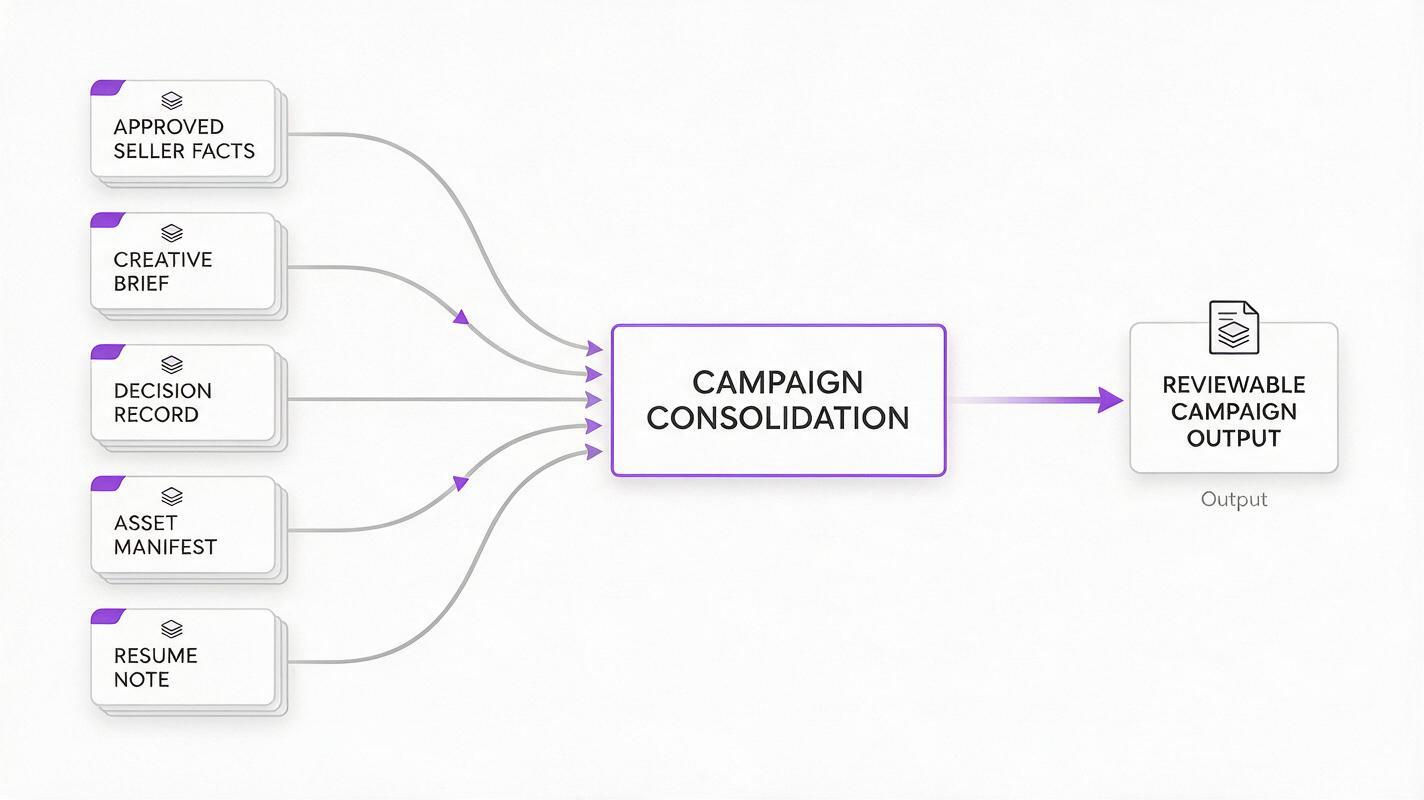
A versioned creative packet is a compact set of artifacts that sits between seller information and generated content. It gives an ai agent bounded, current material while giving reviewers a visible record of what the model was asked to do.
The packet does not need to be complicated. It should contain only what another model or collaborator needs to continue the work safely:
| Artifact | What it preserves | Why it helps recovery |
|---|---|---|
| Approved fact sheet | Product details and permitted claims | Prevents a restart from relying on remembered or inferred facts |
| Creative brief | Audience, objective, tone, format, and constraints | Keeps a replacement model aligned with the original assignment |
| Decision record | Accepted, rejected, and unresolved choices | Stops discarded ideas from returning as if they were new |
| Asset manifest | Available images, footage, copy, and usage notes | Shows what can be used without searching through prior sessions |
| Resume note | Last approved state and next requested output | Allows a clean handoff to a person or another model |
The important distinction is between generation history and production state. A long transcript may contain useful context, abandoned concepts, contradictory instructions, and exploratory language. A production-state packet contains the smaller set of decisions that remain valid.
Teams exploring Claude agent workflows can use this packet as the stable layer around model-generated drafts. The model can change; the campaign’s reviewed state remains legible.
Separate Seller Facts, Creative Choices, and Execution State
One large prompt often mixes source information, brand preferences, speculative ideas, and output instructions. That makes recovery difficult because a new operator cannot easily see which statements are factual and which are creative proposals.
A stronger structure separates three types of information:
Seller facts
These are the supplied details that content may rely on. They should remain distinct from persuasive language written by the model. If a fact changes, the team can identify every downstream asset that may need review.
Creative choices
These include the selected angle, audience framing, tone, visual direction, and call to action. They are decisions, not permanent truths. Recording why a choice was accepted helps another AI assistant continue the concept instead of generating an unrelated replacement.
Execution state
This identifies what currently exists: draft copy, a reviewed concept, a shot list awaiting confirmation, or an ai video workflow ready for asset assembly. The state should also name unresolved questions and the next expected deliverable.
CAMPAIGN STATE

APPROVED FACTS:
- Insert only reviewed seller information

CREATIVE DIRECTION:
- Audience:
- Core message:
- Tone:
- Required format:

CURRENT ASSETS:
- Available source material:
- Reviewed outputs:
- Items requiring revision:

RESUME FROM:
- Last accepted decision:
- Next requested deliverable:
- Questions that require human confirmation:
This template is intentionally model-neutral. It can accompany a prompt, a storyboard, or a campaign review without depending on one assistant’s memory.

Design the Exception Path Before AI Automation Expands
Automation is easiest to trust when the team knows what happens outside the happy path. A recoverable workflow defines where work pauses when information is incomplete, contradictory, or no longer current.
Useful exception categories include:
- Source conflict: two supplied inputs describe the same product differently.
- Unsupported claim: generated copy introduces language that is not present in the approved fact sheet.
- Creative drift: the output follows the facts but departs from the accepted audience or tone.
- Asset mismatch: a visual concept requires footage or imagery that is not available.
- Interrupted execution: the selected model or workflow cannot continue from the current state.
In each case, the agent should not conceal uncertainty with polished output. The workflow should preserve the latest accepted state, identify the unresolved issue, and route the decision to a reviewer. This keeps human judgment attached to claims and creative commitments while still allowing AI automation to handle drafting and variation.
The same principle applies to an ai video workflow. A script, shot plan, visual references, and approved product language should remain separate artifacts. If one scene changes, the team can revise that scene’s requirements without regenerating the entire campaign concept.
Multi-Model Creation Reduces Single-Session Dependency
Model availability and reliability are selection factors for any production workflow. A creative operation becomes fragile when its decisions exist only inside one assistant session or in a format that another model cannot interpret.
A one-account multi-model platform such as MagicBoat gives creators a practical place to approach creation without treating one model as the permanent home of campaign context. The best results still depend on the inputs supplied, but a portable packet makes it easier to compare outputs, continue interrupted work, or assign a different model to a different creative task.
That does not mean switching models casually. Every change can introduce a different interpretation of tone, structure, or constraints. The packet acts as a consistency test: the next output should use the same approved facts and continue from the same creative state.
With a multi-model AI assistant, creators can organize work around durable briefs and reviewable assets rather than around the lifespan of a single chat. The agent becomes a replaceable production participant; the campaign record remains the source of continuity.

What the Amazon–Claude Direction Means for Creative Teams
Amazon opening seller tools to Claude agents is a signal that agent workflows are moving closer to real operational contexts. For creative teams, the strategic response is not simply to generate more seller content. It is to establish a reliable boundary between accessible information, approved information, and publishable output.
The teams that benefit most from agent-connected tools will likely be those that can preserve context without preserving confusion. Their briefs will be portable, their decisions visible, and their campaigns restartable from a known checkpoint.
That approach supports faster experimentation without making every draft irreversible. It also makes collaboration easier: a strategist can review the message, a designer can inspect the visual requirements, and a producer can resume from the approved execution state without reading an entire model conversation.
Key Takeaways
- Amazon opening seller tools to Claude agents makes workflow continuity a central creative concern.
- A versioned creative packet should preserve approved facts, creative decisions, assets, and the next requested action.
- Seller facts, creative choices, and execution state should remain separate so changes are easier to trace.
- Exception paths should pause unsupported claims or conflicting inputs instead of allowing polished uncertainty to continue downstream.
- A model-neutral campaign record helps teams resume work with a person, Claude, or another available model.
Start creating with MagicBoat and build a more flexible AI workflow around portable briefs, reviewable outputs, and multi-model production.
Keywords
claude agents, amazon seller tools, ai workflow, ai automation, ai assistant, creative versioning, multi-model platform