Amazon and Claude Agents: A Smarter Creative Context Boundary
Amazon is opening seller tools to Claude agents, bringing agent access closer to operational business systems. For content teams, the news highlights a critical design choice: give an AI agent enough verified context to create useful campaign assets without turning every creative task into unrestricted account access.

Table of contents
Amazon Opens a New Agent-to-Tool Connection
Amazon is opening seller tools to Claude agents. For creators, the immediate opportunity is a more current AI workflow in which verified business context can inform campaign ideas, copy, and production briefs without relying on repeated manual summaries.
The larger story is not simply that an AI agent can connect to another ecosystem. It is that content teams must decide what context belongs inside a creative task, what should remain outside it, and how information should move between operational systems and generative models.
That decision creates a practical concept for modern content operations: the creative context boundary. It is the controlled package of facts an AI assistant needs to produce relevant work, without treating broad tool access as a substitute for a clear brief.
Why the Amazon–Claude News Matters to Creators
Opening seller tools to Claude agents points toward an environment where agents can work nearer to the information businesses already use. That proximity could reduce one familiar source of friction: copying operational details into a separate chat before every creative request.
But access alone does not guarantee strong content. A model still needs to understand the assignment, audience, channel, constraints, and desired output. Operational context can improve relevance, while an explicit creative brief supplies intent.
The useful question is not “What can the agent access?” but “What is the smallest verified context package that can support this creative decision?”
This distinction matters for product descriptions, campaign concepts, social posts, scripts, and an AI video workflow. Each output may use some shared facts, but it does not require every available detail. A short social caption and a long-form video concept should not automatically receive identical context.
The Creative Context Boundary
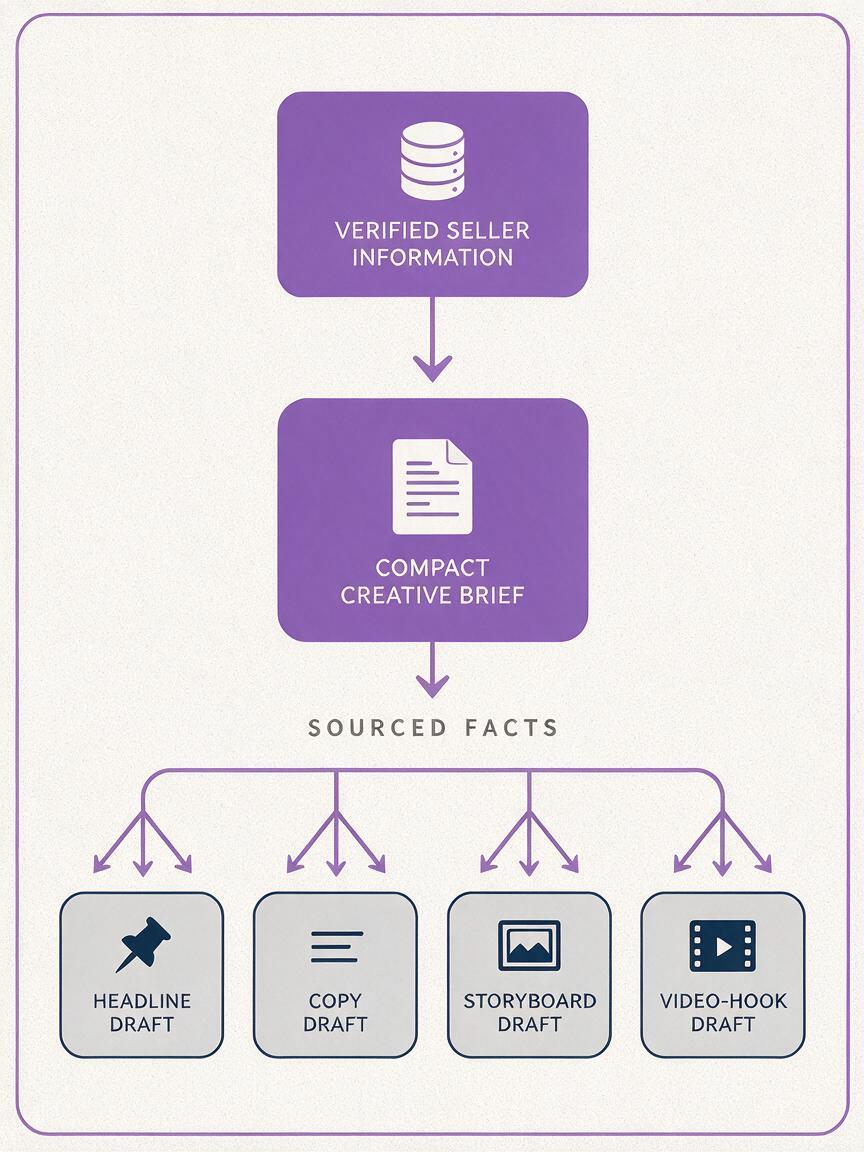
A creative context boundary separates source information from creative interpretation. On one side are approved facts available through business tools. On the other are generated assets such as hooks, headlines, storyboards, narration drafts, and visual directions.
Between them sits a compact brief that defines what the model may use and what it is being asked to make. That boundary can contain:
- Verified inputs: the specific seller information relevant to the assignment.
- Creative objective: the audience response or communication goal.
- Output format: the requested asset, channel, length, and tone.
- Constraints: claims, topics, or assumptions that should not be introduced.
- Review status: a clear distinction between source facts and generated suggestions.
This approach keeps an AI workflow focused. It also makes the output easier for editors to assess because they can compare the draft with a defined source package rather than a vague instruction to “use everything available.”
A Brief Can Be Small Without Being Vague
A minimum-context brief does not need to be complicated. It only needs to make the origin and purpose of each input visible. A reusable structure might look like this:
CREATIVE OBJECTIVE
Produce a campaign concept for the selected audience and channel.

VERIFIED CONTEXT
Use only the seller information supplied for this assignment.

REQUESTED OUTPUT
Return a headline, supporting copy, visual direction, and video hook.

BOUNDARIES
Separate sourced facts from creative suggestions.
Do not add unsupported product claims.
Flag missing information instead of guessing.

EDITORIAL REVIEW
Treat all generated language and visual concepts as drafts.
The value of this format is portability. The brief describes the task independently of the model that receives it, helping teams compare outputs or move a project when availability, reliability, or creative requirements change.
Agent Access Should Not Replace Editorial Intent
An agent may reduce the effort required to retrieve context, but creators still provide the editorial frame. They decide whether a campaign should educate, demonstrate, compare, reassure, or entertain. They also determine which facts deserve emphasis and which visual treatment fits the audience.
Without that frame, AI automation can produce text that is technically connected to source material but creatively unfocused. A useful content operation therefore divides responsibility:
| Layer | Primary role | Expected result |
|---|---|---|
| Business tools | Provide relevant operational context | A defined set of source inputs |
| Creative brief | Express audience, intent, format, and limits | A bounded assignment |
| AI assistant | Transform context into draft options | Copy, concepts, or production directions |
| Human editor | Evaluate accuracy, quality, and fit | An approved or revised asset |
This layered view preserves the benefit of connected tools while preventing the connection itself from becoming the creative strategy.

Why Multi-Model Access Becomes More Important
The Amazon–Claude development also underscores a broader platform consideration. As agents become connected to more business systems, model availability and reliability become production concerns rather than abstract technical preferences.
A campaign may require one model for exploratory ideation and another pass for rewriting, compression, or format variation. A team may also need to continue working when its preferred model is unavailable or does not suit a particular asset.
A stable, one-account multi-model environment such as MagicBoat’s AI assistant platform can help creators keep the brief constant while changing the model used for a task. The goal is not to switch models arbitrarily. It is to avoid binding the entire content process to one access path.
The creative context boundary makes that flexibility practical. When source facts, instructions, and constraints live in a portable brief, a team can preserve continuity across model choices. Editors can then compare drafts against the same assignment instead of reconstructing context for every run.
One Brief, Different Creative Responsibilities
A connected Claude agent may be useful where seller-tool context is central. Another model may be selected for a different creative transformation. The important operational principle is to keep responsibilities explicit:
- Use connected context to assemble a verified input package.
- Use generative models to explore clearly labeled creative options.
- Use editors to resolve ambiguity and approve final language.
- Retain the brief so the project can move between models without losing intent.
This is especially relevant to an AI video workflow, where one campaign can produce several artifacts: a narrative premise, opening hook, scene sequence, voiceover draft, caption set, and visual references. Each artifact can inherit the same approved context while receiving a purpose-specific prompt.

What Content Teams Should Watch Next
The key issue to watch is how agent ecosystems reshape the distance between business information and creative production. Shorter distance can mean less repetitive preparation, but it also increases the importance of context selection.
Teams should evaluate future integrations according to three questions:
- Can the workflow isolate the information required for the current asset?
- Can creators distinguish retrieved facts from generated interpretation?
- Can the assignment remain usable if the team changes models?
These questions are more durable than any single integration. They help content teams benefit from agent connections while maintaining a clear, reviewable production process.
Key Takeaways
- Amazon opening seller tools to Claude agents brings AI agents closer to operational business context.
- Creators still need a bounded brief that defines audience, intent, format, and constraints.
- A creative context boundary separates verified inputs from generated ideas.
- Portable briefs support continuity when teams compare or change models.
- Human editorial review remains the point where draft content becomes publishable work.
- Explore MagicBoat to build a flexible multi-model creation workflow under one account.
Keywords
claude agents, ai agent, ai workflow, ai automation, ai assistant, creative context, ai video workflow