Amazon and Claude Agents: A Portable Brief for Multilingual Campaigns
Amazon opening seller tools to Claude agents highlights a practical question for creative teams: what information should travel with an AI agent when work moves between tools? This article proposes a portable campaign brief that keeps product facts, regional requirements, and output formats clear across multilingual copy and video planning.

Table of contents
Amazon’s agent news points to a more portable creative brief
Amazon is opening seller tools to Claude agents. For creators and agencies, the useful lesson is that a campaign brief should remain understandable and reusable as work moves between an AI agent, a creative model, and a human editor.
The news is about access to seller tools, not a new creative-production feature. But it brings an old agency problem into sharper focus: teams often scatter product facts, approved language, regional requirements, and deliverable instructions across emails and documents. An agent may be able to help with a task, yet it cannot reliably preserve context that was never organized in the first place.
A portable brief offers a better starting point for an AI workflow: define the information once, then adapt it for each market and format without rewriting the underlying facts.
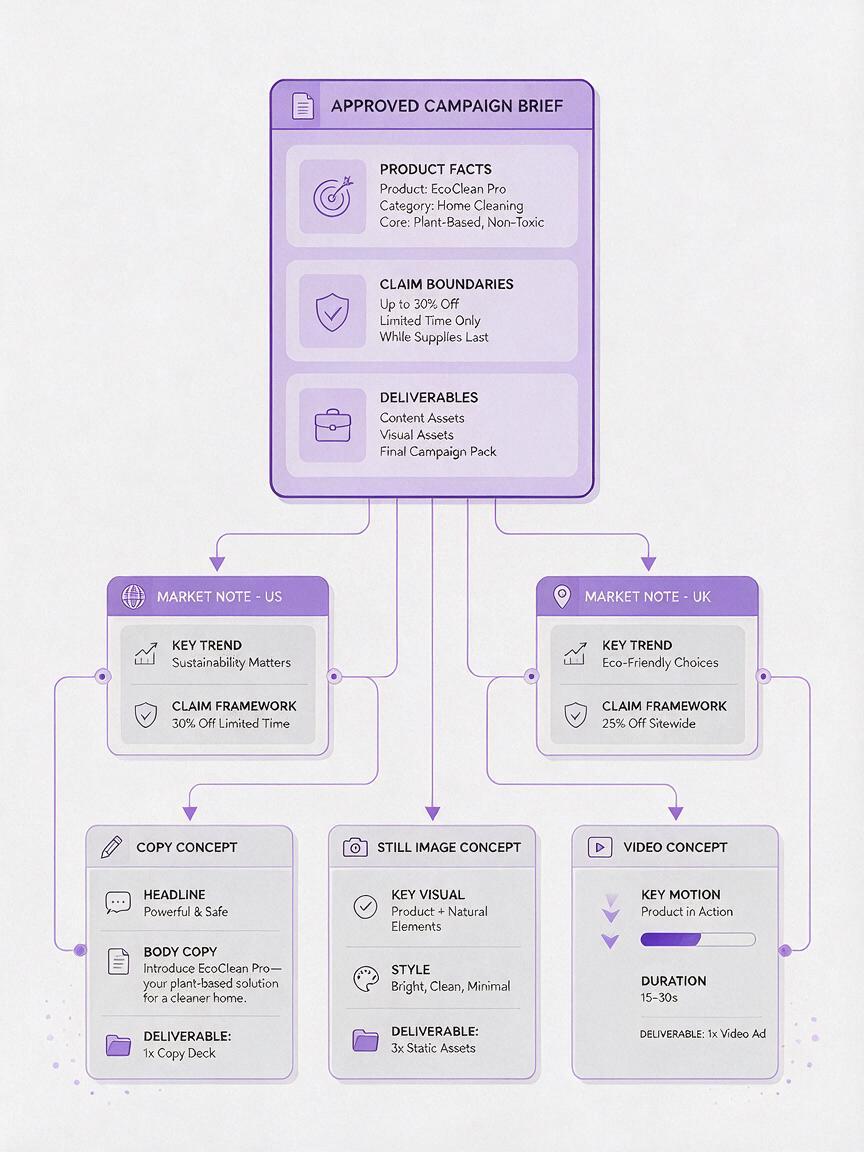
What happened—and what the news does not imply
The relevant development is Amazon opening seller tools to Claude agents. It is an example of an AI assistant moving closer to the systems where business information and actions live. That matters to creative teams because campaign work also crosses systems: a product record informs a brief, the brief informs copy and visuals, and those outputs move through editing and publication.
The announcement should not be read as a claim that Claude automatically produces approved advertising, that Amazon supplies an agency’s creative brief, or that any platform integration removes the need for editorial judgment. Access to a tool and a dependable campaign process are different things.
For agencies, the practical question is therefore not “Which agent writes the whole campaign?” It is “What must our brief contain so a person or AI assistant can pick up the work without guessing?”
The agent-era brief is a reusable source of context
A conventional brief often reads like a presentation: useful to the people who attended the kickoff, but incomplete for anyone joining later. A portable brief is more explicit. It separates facts from creative direction and identifies where an output will be used.
| Brief element | What to record | Why it matters across markets |
|---|---|---|
| Product facts | Approved features, specifications, and descriptions | Prevents a translated concept from quietly changing the offer |
| Claim boundaries | Statements to use, avoid, or confirm with the client | Keeps a persuasive line from becoming an unsupported promise |
| Audience and setting | Who the work addresses and where they will encounter it | Gives the writer a reason to change tone or examples |
| Market notes | Preferred terms, cultural context, and required language | Encourages adaptation rather than word-for-word substitution |
| Deliverables | Requested formats, lengths, and intended placements | Connects one campaign idea to copy, images, and video concepts |
| Open questions | Missing evidence or decisions awaiting an owner | Stops uncertainty from being treated as a product fact |
This structure does not depend on one model. A team can pass the same approved context to different assistants while making each request specific: draft a product caption, suggest a visual scene, or outline a short video. The brief remains the reference point; model output remains a proposal.
Localization starts with decisions, not translation
Imagine a small creative team preparing a product launch for two English-speaking markets. Both versions may use English, yet the audience examples, preferred terms, and visual settings could differ. Copying the first market’s finished ad into a new prompt and asking for a “localized version” hides those differences.
A stronger request names the market, provides the shared product facts, supplies market-specific notes, and asks the assistant to distinguish what stays constant from what should change. For example:
Using the approved product facts and claim boundaries below, draft two short campaign concepts for Market A and Market B. Keep the factual offer consistent. Adapt the audience example and visual setting using the market notes. If a requested claim lacks support, flag it instead of rewriting it as fact.That prompt is not a guarantee of accuracy. Its value is that it gives the editor a clear comparison to inspect: the common offer on one side and the market-specific creative choices on the other. If the source brief changes, the team can revise both concepts from the same updated context.

From one brief to copy, imagery, and video concepts
A portable brief can support an AI video workflow without pretending that a text model has produced a finished film. First, the team uses the brief to explore a message and setting. It then develops a short scene description, suggested on-screen text, and an alternate still-image concept. A human editor checks whether the proposed visuals actually demonstrate the approved product story.
Consider a kitchen product whose approved description emphasizes compact storage. One concept might show the product put away on a narrow shelf after use; another might show it on a spacious countertop. Both could be attractive images, but only the first clearly expresses the chosen benefit. The brief helps the team evaluate that difference before investing in further assets.
- For copy: request variations tied to one audience and one approved benefit.
- For imagery: describe a plausible environment and the product detail that must remain visible.
- For video planning: specify the action, scene order, and intended message before generating visual options.
- For handoff: keep the selected concept, source facts, and unresolved questions together.
This is where AI automation is most useful: reducing repeated setup and making variants easier to compare. It is less useful when the team asks a model to fill missing product information with confident-sounding prose.

Using MagicBoat without tying the brief to one model
MagicBoat offers a free starting point for one-account, multi-model creative work. A team can bring its approved brief into a multi-model creative workflow, explore alternative copy or visual directions, and keep its editorial criteria separate from whichever model generated a draft.
For a multilingual campaign, that means starting each variation from the same product facts while changing the market notes and requested format. Compare the resulting ideas against the brief, not merely against one another. The strongest-sounding line is not necessarily the most accurate, and the most striking scene is not necessarily the one that communicates the benefit.
The Amazon–Claude development makes the broader point visible: as agents gain access to more places where work happens, the quality of the information they receive becomes more consequential. For creative teams, a portable brief is a practical way to make that information usable.
Final checklist
- Separate approved facts from creative suggestions and unanswered questions.
- Record market-specific language and visual context before requesting variants.
- Give copy, image, and video requests a shared campaign reference.
- Compare every output with the brief before choosing a direction.
- Keep the brief reusable when moving between people, agents, and models.
Ready to test a campaign brief across creative formats? Start creating with MagicBoat.
Sources
Public company newsrooms for the organizations discussed: Amazon News and Anthropic News.
Keywords
ai workflow, claude, ai agent, multilingual creative brief, ai automation, ai assistant, ai video workflow