Amazon Reportedly Near Acquiring AI Cloud Startup Decart
Amazon was reportedly close to acquiring AI cloud startup Decart on October 12, 2026, bringing fresh attention to consolidation in AI infrastructure. The report matters to content teams because ownership changes can reinforce the value of portable assets, human review and model-flexible production workflows.

Table of contents
Amazon’s Reported Decart Deal Puts AI Cloud Consolidation in Focus
Amazon was reportedly close to acquiring Decart, an AI cloud startup, on October 12, 2026. The report identified Amazon as the prospective buyer and Decart as the acquisition target, placing the possible transaction at the intersection of cloud infrastructure and the rapidly expanding AI market.
The available report described the companies as nearing an acquisition but did not provide a purchase price, completion date or final deal terms. That distinction matters: this was a report about a prospective transaction, not confirmation that the acquisition had closed. Until the companies announce a completed agreement, the most accurate description remains that Amazon was reportedly near acquiring Decart.
Even with those details unresolved, the report highlights a broader issue for people building with AI. Infrastructure providers, model access and platform ownership can change quickly, so content teams need workflows that preserve prompts, source files and approved outputs independently of any single vendor.
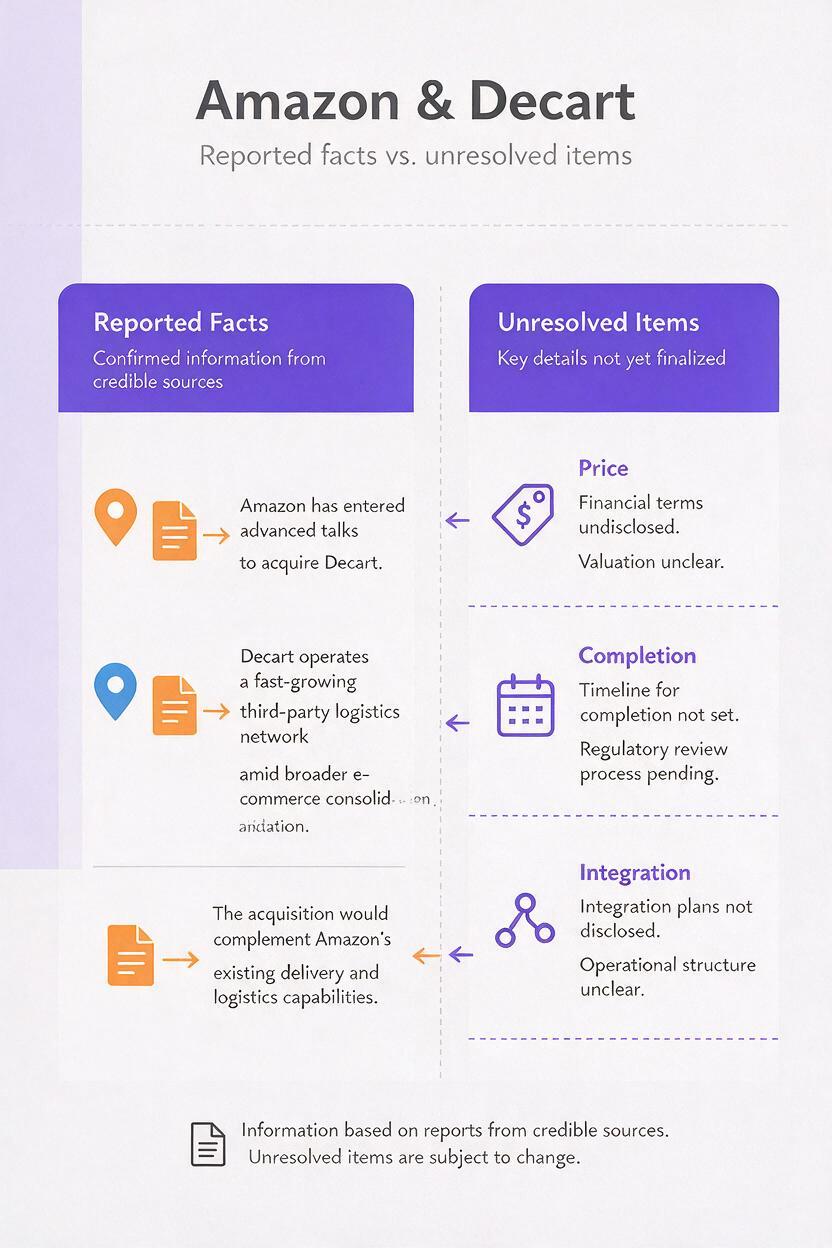
What the Amazon–Decart Report Actually Says
The central news is narrow but significant: Amazon was reportedly approaching the acquisition of an AI cloud startup. The combination would connect one of the largest cloud ecosystem operators with a company identified specifically with AI cloud infrastructure.
The report does not establish what Amazon might do with Decart, whether Decart would continue operating independently or how any transaction would affect existing products. Claims about integration plans, new features or pricing would therefore go beyond the information currently available.
The confirmed scope of the report is limited: Amazon was reportedly near acquiring Decart, and Decart was described as an AI cloud startup. The deal had not been presented as completed in the supplied report.
This careful wording is particularly important for an AI assistant producing fast news coverage. A summary can easily turn “reportedly near acquiring” into “acquired,” but that small linguistic change would convert an emerging report into an unsupported statement of completion.
| Question | What the report establishes | What remains unresolved |
|---|---|---|
| Who is involved? | Amazon and AI cloud startup Decart | Any additional transaction participants |
| What is happening? | Amazon is reportedly near an acquisition | Whether a final agreement has been completed |
| What is the price? | No figure was included in the available report | Purchase price and financial structure |
| What changes next? | No integration plan was specified | Product, staffing and service decisions |
Why AI Cloud Ownership Matters to Content Teams
AI content production may begin with a prompt, but it depends on a larger technical chain. Models require infrastructure, applications rely on service access and production teams need dependable ways to retain work between sessions. A potential acquisition at the cloud layer is therefore relevant even when the report does not announce a new consumer-facing tool.
Ownership changes can also affect how teams evaluate long-term workflow risk. That does not mean a reported transaction will automatically disrupt a service. It means responsible planning should separate durable creative assets from temporary platform access.
For an AI workflow, the durable layer includes:
- Original briefs that record the audience, format and intended message.
- Prompt records that preserve the language used to produce an approved result.
- Source media stored separately from generated variations.
- Review notes documenting factual corrections and publication decisions.
- Exported deliverables that can be reused without reconstructing the entire project.
This discipline is useful whether a team is coordinating an ai agent, building ai automation or running an ai video workflow. The goal is not to predict what Amazon or Decart will announce. It is to ensure that an external change does not erase internal production context.

Consolidation Favors Portable Creative Context
The Amazon–Decart report is another reminder that the AI market is not defined only by model releases. Cloud capacity, platform ownership and access arrangements shape the environment in which AI applications operate.
Content teams can respond by treating creative context as a portable production asset. A concise project record should distinguish verified news facts from commentary, preserve the latest approved copy and note which visual or audio output was selected. If a tool becomes unavailable or a preferred model changes, another system can continue from that record instead of starting from an empty prompt.
Human review remains central. An AI assistant can help draft headlines, summaries and visual directions, but a person should verify whether a transaction is reported, announced or completed. In this case, that review preserves the crucial difference between an acquisition report and a finalized Amazon acquisition.
A More Resilient AI Content Workflow
A multi-model environment can reduce the friction of moving between creative tasks. MagicBoat brings multiple creation capabilities into one account, allowing a team to keep its brief consistent while producing different media formats.
For example, an editor covering the reported deal could develop a neutral visual concept with an ai image generator, retain the approved prompt and then use an ai video generator for a short motion version. The factual boundary should remain identical across formats: Amazon was reportedly near acquiring Decart, while price, completion and integration details were not supplied.
This model-flexible approach is valuable because it separates the creative brief from the tool used for a particular output. The image, video and copy can share one verified fact sheet without implying that every model has the same capabilities or that any unconfirmed corporate plan is settled.
A Compact Editorial Record
Subject: Reported Amazon–Decart transaction
Status: Reportedly near acquisition
Buyer named: Amazon
Target named: Decart
Target description: AI cloud startup
Price: Not specified
Completion: Not confirmed
Editorial rule: Do not describe the deal as closed
A record like this supports consistency across social posts, articles, narration and video captions. It also gives reviewers a clear reference when an ai assistant produces language that sounds more definite than the underlying report.

What to Watch Without Speculating
Future reporting may clarify whether the acquisition proceeds, what terms are attached and how the companies describe their plans. Until then, analysis should remain focused on the information already available rather than assigning Decart capabilities or Amazon integration strategies that have not been stated.
The strongest immediate takeaway is structural. AI production increasingly depends on an ecosystem of models, applications and cloud infrastructure. As companies invest in or acquire parts of that ecosystem, content teams benefit from retaining control over their briefs, prompts and finished assets.
That approach turns infrastructure uncertainty into a manageable editorial concern. Teams do not need to predict every acquisition. They need a reliable method for preserving context, checking factual status and moving approved work between suitable tools.
Key Takeaways
- Amazon was reportedly near acquiring AI cloud startup Decart on October 12, 2026.
- The available report did not specify a purchase price, completion date or integration plan.
- The transaction should not be described as completed unless later confirmation establishes that status.
- AI cloud consolidation reinforces the value of portable prompts, source assets and review records.
- Multi-model production can help teams maintain continuity when platforms or access arrangements change.
Build a flexible, fact-controlled production process and try these models for free on MagicBoat.
Keywords
amazon decart acquisition, decart ai cloud, amazon ai, ai cloud startup, ai workflow, ai automation, ai video workflow