Amazon Market Cap Tops $2 Trillion for the First Time
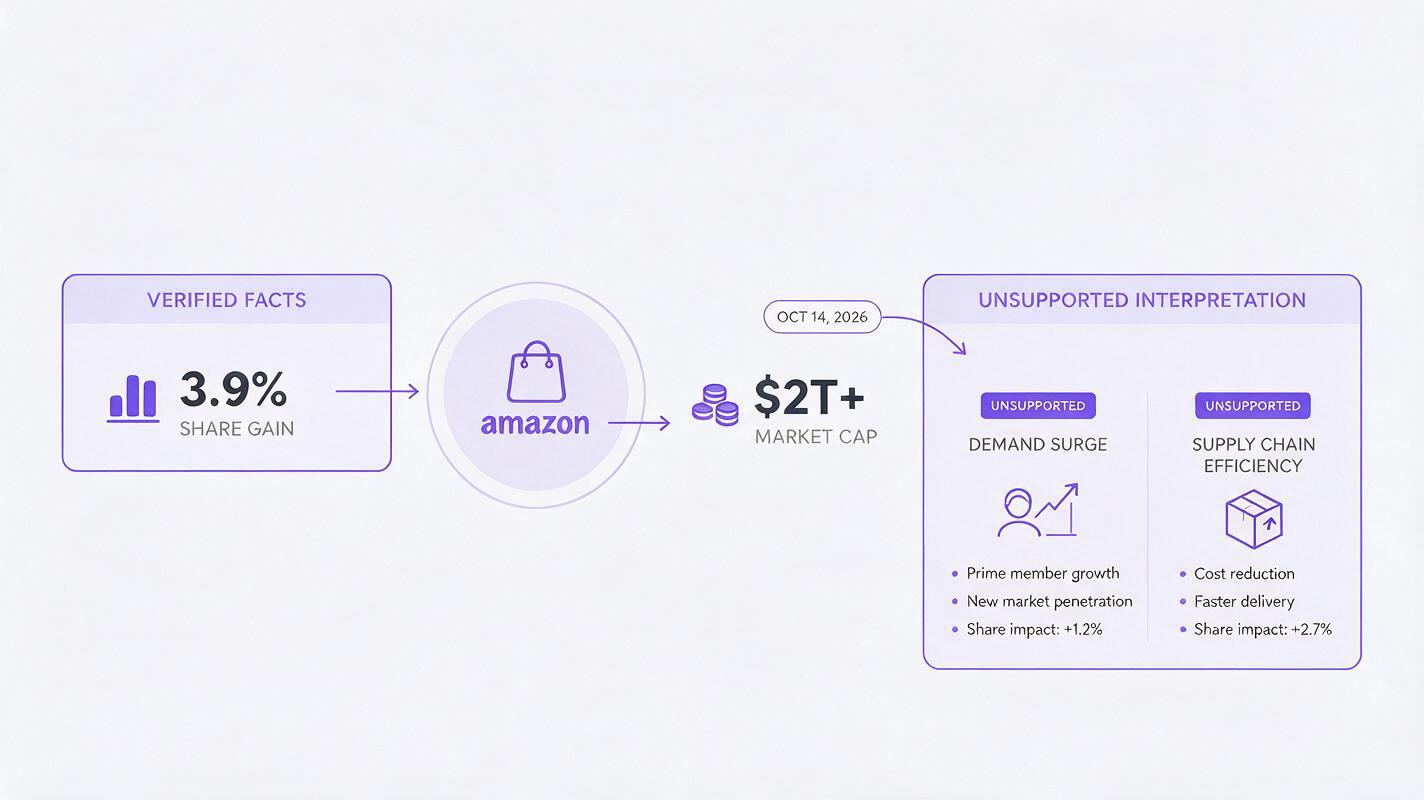
Amazon’s market capitalization crossed $2 trillion for the first time after its shares gained 3.9% on October 14, 2026. The milestone offers a timely lesson in separating verified market facts from speculation while building fast, accurate AI-assisted news content.

Table of contents
Amazon Crosses the $2 Trillion Threshold
Amazon reached a major market milestone after its valuation topped $2 trillion for the first time.
A report published on October 15, 2026 said Amazon’s market capitalization had moved above $2 trillion following a 3.9% share-price gain on October 14. The threshold marked the first time the company had achieved a valuation at that level.
The key facts are concise but significant: the company was Amazon, the market-cap milestone was $2 trillion, the reported daily gain was 3.9%, and the move occurred on October 14. The report establishes the result without supplying a detailed breakdown of the forces behind that trading session. Any explanation of the move therefore needs to remain clearly separated from the confirmed numbers.
For creators, editors and marketing teams, the story demonstrates why financial news demands disciplined attribution. An AI assistant can help transform a short market update into scripts, visuals and social posts, but the workflow should preserve the boundary between reported facts and editorial interpretation.
What the $2 Trillion Milestone Actually Says
Market capitalization represents the market value assigned to a public company through its share price and outstanding shares. In this story, the central news is not a new Amazon product, acquisition or service. It is the company’s arrival above a closely watched valuation threshold.
The distinction matters because a major number can invite broad conclusions that the underlying report does not support. Amazon’s 3.9% gain and first crossing of $2 trillion can be stated directly. Claims about a single product, business division or technology causing that gain would require separate evidence.
The strongest version of this headline is also the most precise: Amazon topped $2 trillion in market capitalization for the first time after gaining 3.9% on October 14.
This fact-first framing gives an audience useful information without turning a market result into an unsupported narrative. It also leaves room for later reporting if additional public evidence explains the movement.
Confirmed Facts and Editorial Boundaries
Fast-moving financial coverage often combines several different kinds of information. A reliable AI workflow should label those categories before generating derivative content.
| Content category | What can be stated here | Editorial treatment |
|---|---|---|
| Company | Amazon | Confirmed subject of the report |
| Market valuation | Above $2 trillion | Use as the primary headline fact |
| Historical significance | Amazon’s first time above the threshold | Include with the valuation figure |
| Share movement | Up 3.9% on October 14 | Retain the percentage and date together |
| Cause of the gain | Not specified in the reported facts | Do not substitute speculation for attribution |
This separation is especially important when one source item is adapted into multiple formats. A headline may emphasize the $2 trillion figure, a short video may lead with the 3.9% rise, and a social caption may focus on the first-time milestone. All three versions should preserve the same factual core.
Why the News Matters Beyond a Large Number
A valuation threshold is partly symbolic, but symbols influence attention. Numbers such as $2 trillion can become reference points in business reporting, investor discussions and public comparisons. They are memorable, compact and easy to reuse across formats.
That visibility also raises the cost of imprecision. Confusing market capitalization with revenue, cash holdings or profit would fundamentally alter the story. Likewise, describing a one-day share gain as permanent growth would go beyond what the reported result establishes.
Content teams can improve accuracy by maintaining a compact fact block for each news item:
- Entity: Amazon
- Event: Market capitalization exceeded $2 trillion for the first time
- Market move: Shares gained 3.9%
- Date of the move: October 14, 2026
- Attribution limit: No specific catalyst is established by the available report
This structure is useful whether a human editor is writing directly or an ai agent is supporting research, drafting and adaptation.
Turning a Market Update Into a Controlled AI Workflow
Financial news can generate many content assets from a small set of verified facts. The challenge is not producing more words; it is preventing those words from becoming more certain than the evidence.
A practical ai automation process can keep immutable facts separate from flexible presentation. The company name, valuation, percentage movement and date should remain locked. Tone, format and length can change according to the publication channel.
Verified facts:
Amazon market capitalization: above $2 trillion
Historical status: first time
Share-price movement: +3.9%
Trading date: October 14, 2026

Permitted output:
Market-news headline, short summary, narration or visual concept

Constraint:
Do not invent a catalyst or confuse valuation with revenue or profit.
That same fact block can guide a newsletter brief, a voiceover script or an infographic. If a visual is needed, an ai image generator can support an editorial concept while the written copy retains the verified numbers. For motion-led coverage, an ai video generator can help adapt the story into a concise market update without changing its factual foundation.
Building Better Financial Visuals
The strongest visual treatment should communicate scale without pretending to show proprietary Amazon data. A clean chart can highlight the reported 3.9% daily move and the crossing of the $2 trillion threshold. An editorial photograph can evoke global commerce or market reporting without fabricating an internal corporate scene.
Visual labels require the same discipline as prose. “Market cap above $2 trillion” is accurate. “Amazon earns $2 trillion” is not. “Shares rose 3.9% on October 14” preserves the time frame, while an unlabeled 3.9% figure could be mistaken for revenue growth or another metric.
Creators should also resist adding unsupported product imagery that implies a particular business unit caused the milestone. The subject is Amazon’s market valuation, so market-scale visuals are more appropriate than an invented product launch scene.

Why Multi-Model Access Helps News Production
A market story may require concise summarization, headline variants, script development, visual ideation and format conversion. Those tasks do not need to depend on one ai assistant or one model configuration.
MagicBoat provides a single environment for exploring multiple AI creation capabilities. That can make an ai video workflow more flexible while helping teams keep one approved fact block at the center of every asset. Editors can compare outputs, select the clearest treatment and retain human approval over financial claims.
The broader lesson from Amazon’s milestone is that speed and accuracy should reinforce each other. AI can accelerate production, but editorial controls determine whether the final work remains trustworthy.

Final Checklist
- State that Amazon exceeded $2 trillion in market capitalization for the first time.
- Keep the reported 3.9% share gain attached to October 14, 2026.
- Do not describe market capitalization as revenue, profit or cash.
- Avoid assigning a catalyst that is not established by the reported facts.
- Reuse one verified fact block across headlines, scripts and visuals.
- Review every AI-generated asset before publication.
Ready to develop accurate visual coverage from a controlled brief? try these models for free and keep verified facts at the center of each format.
Keywords
amazon market cap, amazon stock, two trillion valuation, ai workflow, ai automation, ai assistant, ai video workflow