Anthropic Agrees to Buy 1.7GW of Gas Generation in $3.4B Deal
Anthropic has agreed to acquire about 1.7GW of heavy-duty gas-generation equipment for roughly $3.4 billion by taking over an existing Caterpillar order. The unusually large power commitment highlights how energy availability is becoming a defining constraint for AI infrastructure, model access and the creative workflows built on top of it.
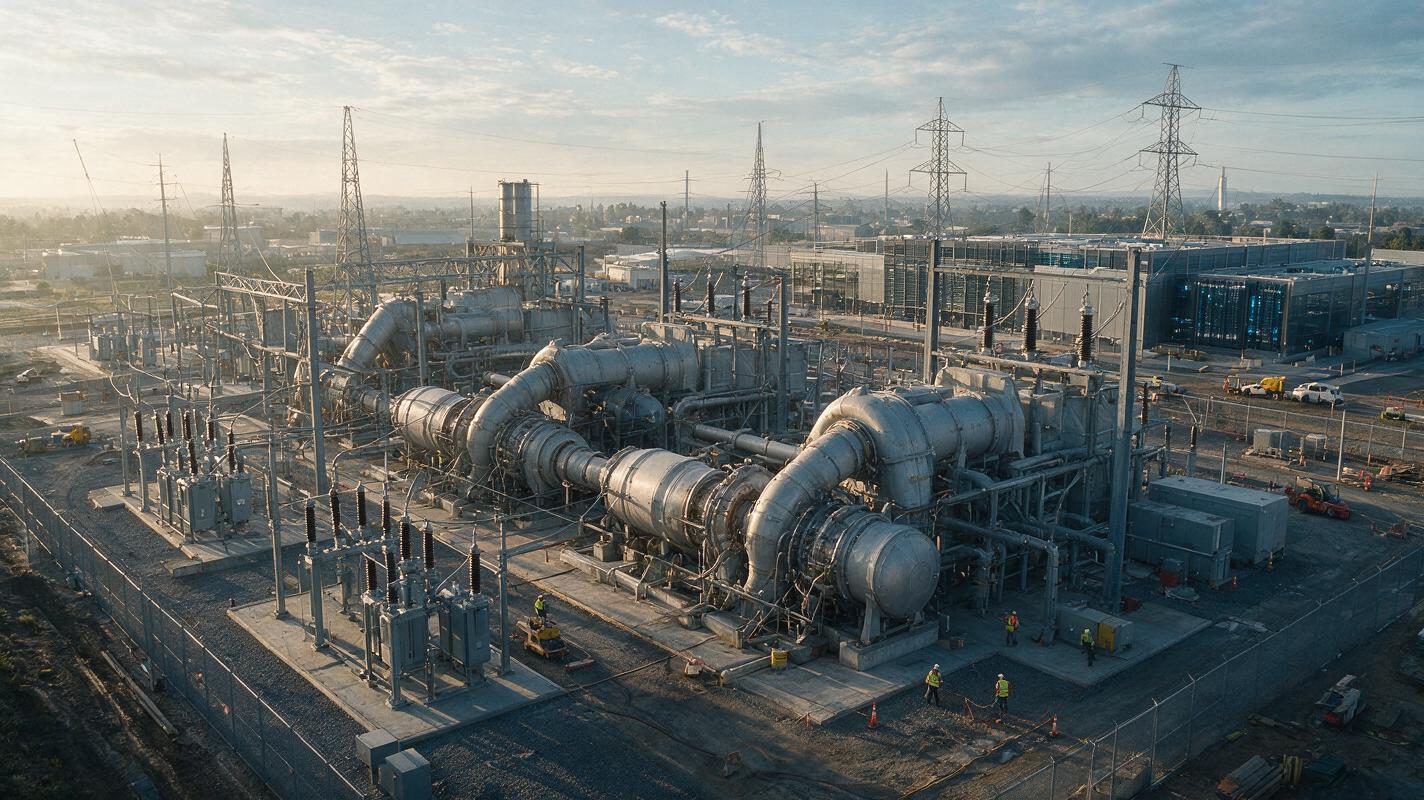
Table of contents
Anthropic’s $3.4 Billion Power Move
Anthropic has agreed to buy approximately 1.7GW of heavy-duty gas generation for roughly $3.4 billion, making it the largest known single power-equipment purchase by an AI lab. Rather than acquiring an energy company, Anthropic is taking over an equipment order that supplier OnePWR Solutions placed with Caterpillar about two years earlier.
The structure matters because new gas-turbine delivery slots now extend into the early 2030s. By assuming an established order, Anthropic gains access to equipment already positioned within a severely constrained manufacturing queue instead of beginning at the back of that queue.
The agreement also sits within a much larger infrastructure commitment. Anthropic’s S-1 shows $895.4 billion in purchase and lease commitments running through 2045. It also discloses monthly payments of $1.25 billion to xAI through May 2029. Together, those figures illustrate the scale of the long-term contracts now supporting frontier AI development.
For content teams, the immediate lesson is not that every creative business needs its own power plant. It is that model availability, reliability and cost increasingly depend on an industrial supply chain extending far beyond software.
Why 1.7GW Is a Significant AI Infrastructure Commitment
A 1.7GW equipment purchase moves Anthropic’s infrastructure strategy into the realm of utility-scale power planning. Frontier AI systems require data centers, chips, cooling, networking and dependable electricity, and weakness in any one of those layers can limit usable computing capacity.
The deal therefore reflects a broader change in how leading AI companies compete. Model research remains important, but access to power equipment and long-term energy capacity is becoming another strategic resource. An AI lab able to secure generation capacity earlier may be better positioned to support future training and inference demand than one relying entirely on crowded regional grids and delayed interconnection schedules.
The key shift: AI competition is no longer confined to model architecture and chip supply. It increasingly includes turbines, generation capacity, construction schedules and long-duration commercial commitments.
The transaction does not establish where every unit will operate or provide a complete deployment timetable. What it does establish is the scale of the equipment commitment and Anthropic’s decision to secure capacity through an existing Caterpillar order.
Caterpillar’s Backlog Shows Why Timing Matters
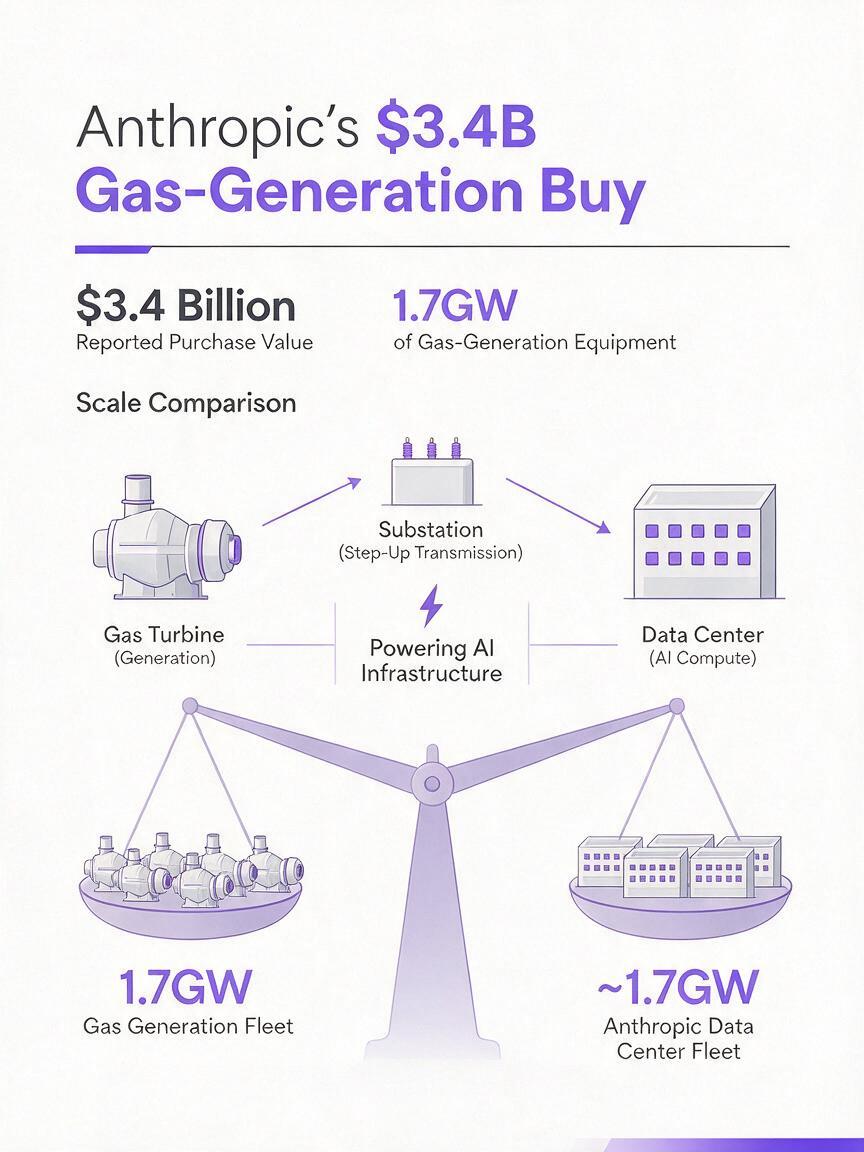
Caterpillar’s power-generation business is already benefiting from the infrastructure race. Its power-generation sales increased 30% to $3.421 billion in the third quarter, while the company’s overall backlog reached a record $78 billion.
With gas-turbine availability stretching into the early 2030s, access to an order placed two years ago may be almost as important as the purchase price. The arrangement demonstrates how an earlier position in the manufacturing queue can become a strategic asset when demand outruns equipment supply.
| Reported metric | Figure | Why it matters |
|---|---|---|
| Anthropic generation purchase | About 1.7GW | Largest known single power-equipment purchase by an AI lab |
| Estimated transaction value | Roughly $3.4B | Shows the capital intensity behind frontier AI infrastructure |
| Anthropic commitments | $895.4B through 2045 | Places the power order within a much larger long-term obligation base |
| Caterpillar Q3 power-generation sales | $3.421B, up 30% | Reflects accelerating demand for generation equipment |
| Caterpillar backlog | Record $78B | Signals constrained manufacturing capacity and long queues |
Data-Center Capacity Forecasts Are Moving Higher
The power purchase arrives as expectations for global data-center growth continue to rise. Goldman Sachs increased its forecast for worldwide data-center capacity in 2030 from 217GW to 273GW. That is a 56GW increase in the forecast itself, reinforcing how rapidly infrastructure assumptions are changing.
Higher capacity projections create pressure throughout the chain. More data centers require additional generation, equipment, grid connections and long-term financing. They also encourage AI companies to secure resources earlier, even when the associated commitments extend for many years.
Anthropic’s deal is notable because it links a frontier AI lab directly to heavy industrial equipment procurement. The physical foundation of an AI assistant or ai agent may be invisible to the user, but electricity and hardware availability ultimately influence how much inference capacity can be delivered and how reliably services can operate.
What the Deal Means for AI Content Production
Creative professionals usually encounter AI infrastructure indirectly. They notice response times, model access, generation queues, usage limits and service interruptions rather than turbine backlogs or power contracts. Yet those user-facing conditions can reflect constraints much deeper in the supply chain.
This is particularly relevant to an ai workflow built around repeated generation and revision. A campaign may combine research, script development, visual exploration, voice work and an ai video workflow. If the entire process depends on one provider, a change in availability can disrupt every connected production task.
The Anthropic agreement does not indicate that Claude is becoming unavailable. Instead, it shows how much physical investment may be required to support continued AI demand. Content teams can respond by designing workflows that remain adaptable rather than assuming any individual model will always have identical access, pricing or capacity.
Model Flexibility Becomes Operational Resilience
A resilient creative process separates the intended outcome from any single model. The objective might be a storyboard, campaign image or short-form video, while the model is the tool selected for the current task. This makes it easier to adjust when availability or production needs change.
For example, teams can use an ai image generator for visual development and an ai video generator when moving those ideas into motion. The value of the workflow comes from keeping the project coherent across formats rather than tying every deliverable to one infrastructure provider.
Why a Multi-Model Platform Fits the Infrastructure Era
Anthropic’s power purchase demonstrates that AI services rest on expensive, capacity-constrained foundations. Even the largest labs must plan around equipment queues, energy supply and contracts lasting well into the future. For individual creators and production teams, duplicating that infrastructure is neither practical nor necessary.
A stable one-account, multi-model platform such as MagicBoat can reduce dependence on a single creative path. Instead of rebuilding a project whenever market conditions or model access changes, teams can keep their attention on the script, visuals, pacing and final output.
This does not eliminate the infrastructure constraints affecting the wider industry. It gives users a more flexible way to work within them. As AI automation expands, the ability to shift tools without abandoning the production concept becomes an increasingly useful form of operational resilience.
Key Takeaways
- Anthropic agreed to buy about 1.7GW of heavy-duty gas-generation equipment for approximately $3.4 billion.
- The company is taking over an order that OnePWR Solutions placed with Caterpillar around two years earlier.
- Anthropic’s S-1 lists $895.4 billion in purchase and lease commitments through 2045.
- Caterpillar reported a 30% increase in Q3 power-generation sales and a record $78 billion backlog.
- Goldman Sachs raised its 2030 global data-center capacity forecast from 217GW to 273GW.
- For content teams, multi-model access can make an ai workflow less dependent on the capacity and availability of one provider.
To build a more adaptable production process across creative formats, try these models for free on MagicBoat.
Keywords
anthropic gas generation, anthropic power deal, ai data center energy, caterpillar power generation, ai infrastructure, ai workflow, ai video workflow