Apple’s Final 2026 Event Reportedly Set for iPad Mini 8 and Three Macs
A report published on October 12 says Apple’s final event of 2026 could take place on October 27 or 28, featuring the iPad mini 8 and three new Macs. The rumored multi-device launch also shows why publishers need disciplined, adaptable AI workflows for covering developing product news without turning speculation into fact.

Table of contents
Apple’s Reported Final Event of 2026 Takes Shape
Apple may be preparing one more major hardware presentation before 2026 comes to an end.
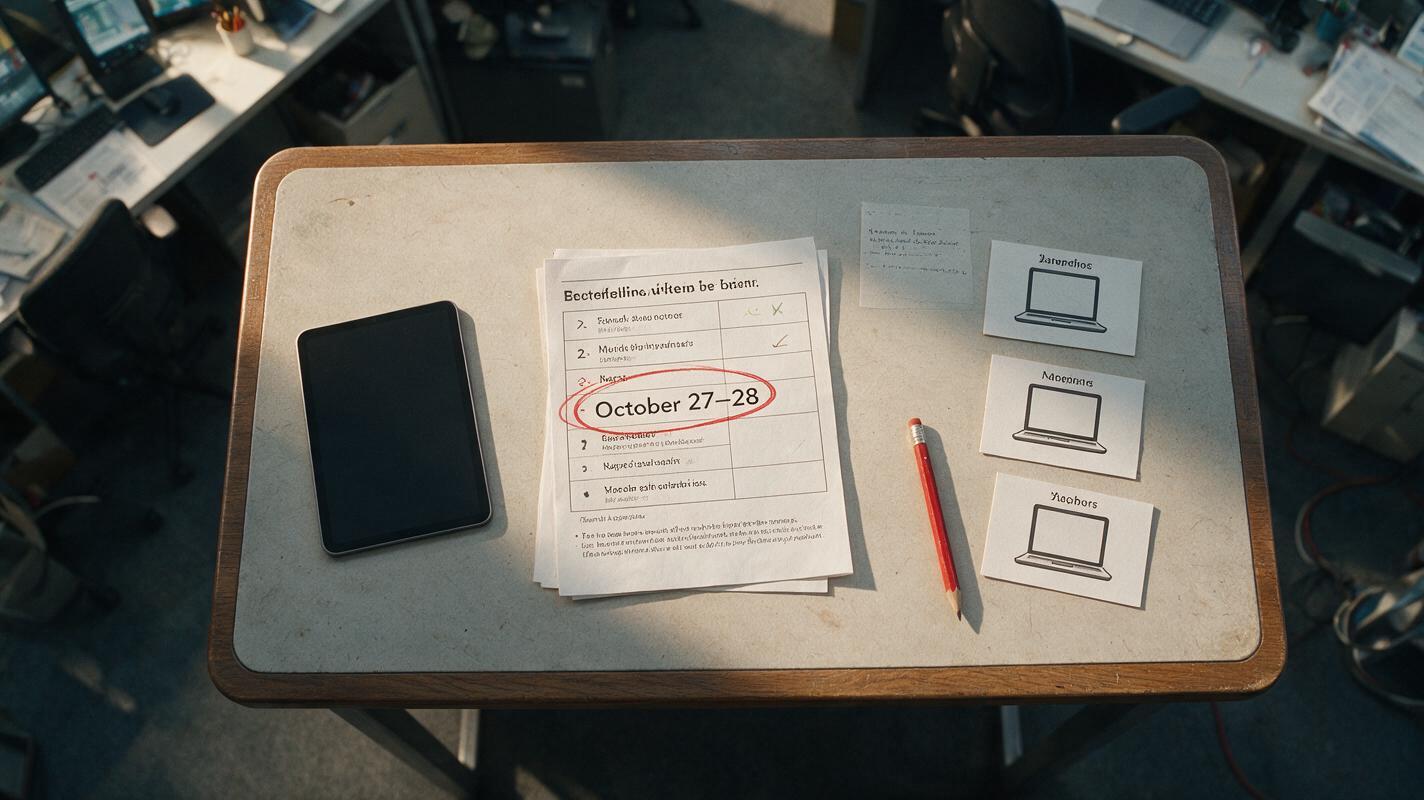
On October 12, a report attributed to Bloomberg’s Mark Gurman said Apple could hold its final event of 2026 on October 27 or October 28. The reported product lineup centers on the iPad mini 8 and three new Macs, making this a potential multi-device launch rather than an announcement focused on a single product category.
The timing is the central news point. If the reported window holds, Apple would use the closing days of October for another coordinated product reveal. The report identifies four expected devices by category and count: one iPad mini 8 and three Macs. It does not establish additional specifications, prices or release schedules for those products, so those details should not be treated as confirmed.
For publishers and creative teams, a concentrated announcement involving several devices can produce demand for news articles, social posts, comparison graphics and short-form videos at the same time. The opportunity is significant, but only when an AI workflow keeps reported facts clearly separated from interpretation.

What the October 12 Report Actually Says
The report provides a compact set of claims that can serve as a reliable editorial baseline:
- Event status: Apple is reportedly planning its final event of 2026.
- Possible timing: The event could be held on October 27 or October 28.
- Tablet subject: The anticipated lineup includes the iPad mini 8.
- Computer lineup: Three new Macs are reportedly expected.
- Source attribution: The information was attributed to Bloomberg’s Mark Gurman and relayed through IT Home.
That is enough information to establish a meaningful news angle without filling the gaps with unsupported predictions. It also creates several legitimate editorial frames: the late-October timing, the combined tablet-and-computer lineup, and Apple’s apparent decision to close the year with a broader hardware event.
A strong breaking-news package says what was reported, names the source of the report and leaves unconfirmed specifications outside the factual core.
Why a Four-Device Report Creates a Complex News Cycle
A report involving the iPad mini 8 and three Macs is more demanding than a single-product headline. Audiences may search for the overall Apple event, the tablet independently, the Mac lineup collectively or individual products after more information emerges.
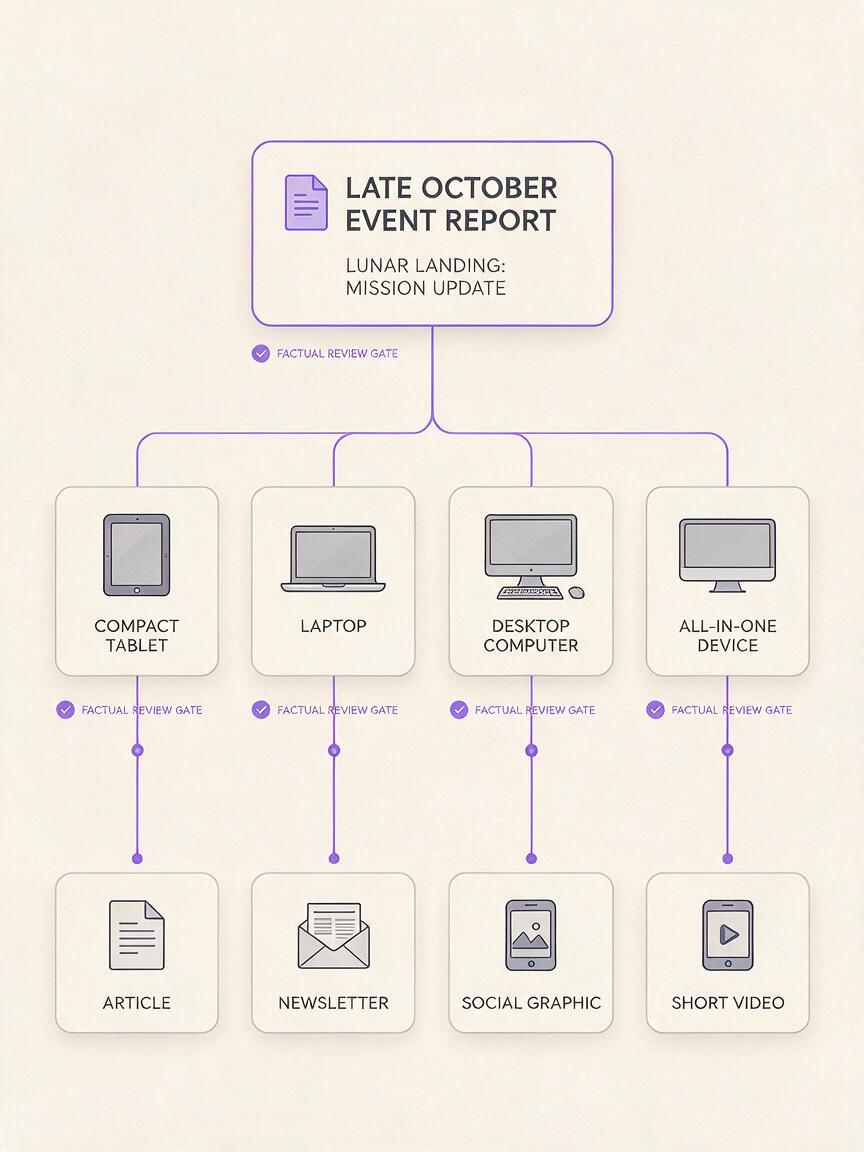
That fragmentation affects production. A newsroom or independent publisher may need a central event article alongside separate assets for mobile feeds, newsletters and video channels. The factual foundation should remain consistent across every format even when the framing changes.
| Content asset | Reliable focus | Main editorial risk |
|---|---|---|
| Breaking-news article | October 27–28 window and reported lineup | Presenting the event as officially confirmed |
| iPad mini 8 post | Its inclusion in the reported event | Adding unreported specifications |
| Mac roundup | The report’s reference to three new Macs | Inventing model identities or configurations |
| Short-form video | The event window and four-device structure | Using visuals that imply confirmed designs |
The safest approach is to maintain one verified fact sheet and derive every asset from it. When the story changes, the fact sheet can be updated before headlines, scripts and visuals are revised.
A Better Editorial Framework for Rumored Apple Launches
Keep reporting and analysis visibly separate
The reported event window, the iPad mini 8 and the count of three Macs belong in the factual layer. Discussion of what a multi-device presentation could mean belongs in analysis. Clear attribution words such as “reportedly,” “could” and “expected” preserve that distinction.
This is especially important when AI automation is involved. An AI assistant can rapidly transform a source brief into multiple formats, but speed can also spread an unsupported detail across an entire campaign. Human review should therefore remain the publication gate for headlines, captions, scripts and graphics.
Build reusable assets around stable facts
The report’s most stable visual structure is not an imagined product design. It is a calendar window paired with one tablet category and three computer categories. That structure can support a neutral timeline graphic, a newsroom explainer or an event-watch video without pretending that unreleased hardware details are known.
A reusable editorial brief might read:
Subject: Apple’s reported final event of 2026
Timing: October 27 or October 28
Reported lineup: iPad mini 8 and three new Macs
Required language: reportedly, could, expected
Exclude: unreported prices, specifications and release dates
Visual direction: neutral device categories and calendar imagery
This kind of brief gives writers, editors and visual teams the same boundaries. It also makes later corrections easier because every asset can be traced to a shared source record.
From Apple Event Coverage to an AI Video Workflow
Product-event reporting often has to move from article to visual story quickly. A publisher might first prepare a concise script, then create a calendar graphic, a four-device lineup card and a short narrated recap. MagicBoat’s ai storyboard can help organize those scenes into a coherent sequence, while an ai video generator can support the transition from an approved brief to a video asset.
The editorial control point should remain the approved fact sheet. The opening scene can establish the reported October 27–28 window. A second scene can identify the iPad mini 8. A third can represent the three-Mac portion of the report without guessing which models Apple might announce. The closing frame can tell viewers that the event remains reported rather than officially established within the available information.
This approach uses AI for format conversion and creative assembly, not as a substitute for sourcing. It also limits the chance that an imaginative visual or generated sentence will quietly become a false product claim.
Why Multi-Model Continuity Matters During Launch Coverage
A tightly scheduled product cycle can expose weaknesses in a tool-dependent production process. Writers may need one type of AI assistance for summarization, another for scripts and another for visual production. If a single service becomes unavailable or produces inconsistent results, the publication schedule can slip at the moment audience interest is highest.
A one-account, multi-model environment helps teams preserve the brief while changing the tool used for a particular asset. The practical advantage is continuity: the event date window, product names and attribution rules remain fixed even as the content moves between writing, visual planning and video generation.
That flexibility should be paired with version control. Editors can retain the source brief, the approved copy and the final production prompts as separate records. If Apple confirms, changes or does not hold the reported event, the content can be revised without reconstructing the entire decision trail.
What to Watch as October 27–28 Approaches
The main question is whether Apple formally confirms an event in the reported window. Beyond that, publishers should watch for authoritative information defining the three expected Macs and providing official details about the iPad mini 8.
Until such information appears, coverage should avoid assumptions about hardware configurations, pricing, availability and product design. Even when readers are eager for predictions, precision creates more durable content than a fast collection of unsupported details.
The broader lesson extends beyond Apple. When a developing technology story includes multiple products, dates or platforms, the strongest AI workflow begins with a narrow factual record. Creative expansion comes afterward, with every article, image and video tied back to that record.
Final Checklist
- Identify the October 27–28 timing as a reported event window.
- Name the iPad mini 8 and three new Macs without inventing specifications.
- Keep factual reporting separate from interpretation and predictions.
- Use neutral imagery that does not imply confirmed product designs.
- Maintain one approved brief across articles, graphics and video assets.
- Preserve human review before any AI-assisted content is published.
- try these models for free to build a flexible production workflow around an approved editorial brief.
Keywords
apple final 2026 event, ipad mini 8, new macs, apple event, ai workflow, ai video workflow, content production