Apple M5 Pro Benchmark Surfaces for 14-Inch MacBook Pro 2026
An Apple M5 Pro benchmark listing has surfaced on Geekbench for a 14-inch MacBook Pro 2026 identified as Mac17,9, with a 15-core CPU and 48GB of RAM. The listing adds momentum ahead of Apple’s late-October hardware event while highlighting why content teams should separate verified specifications from expectations.
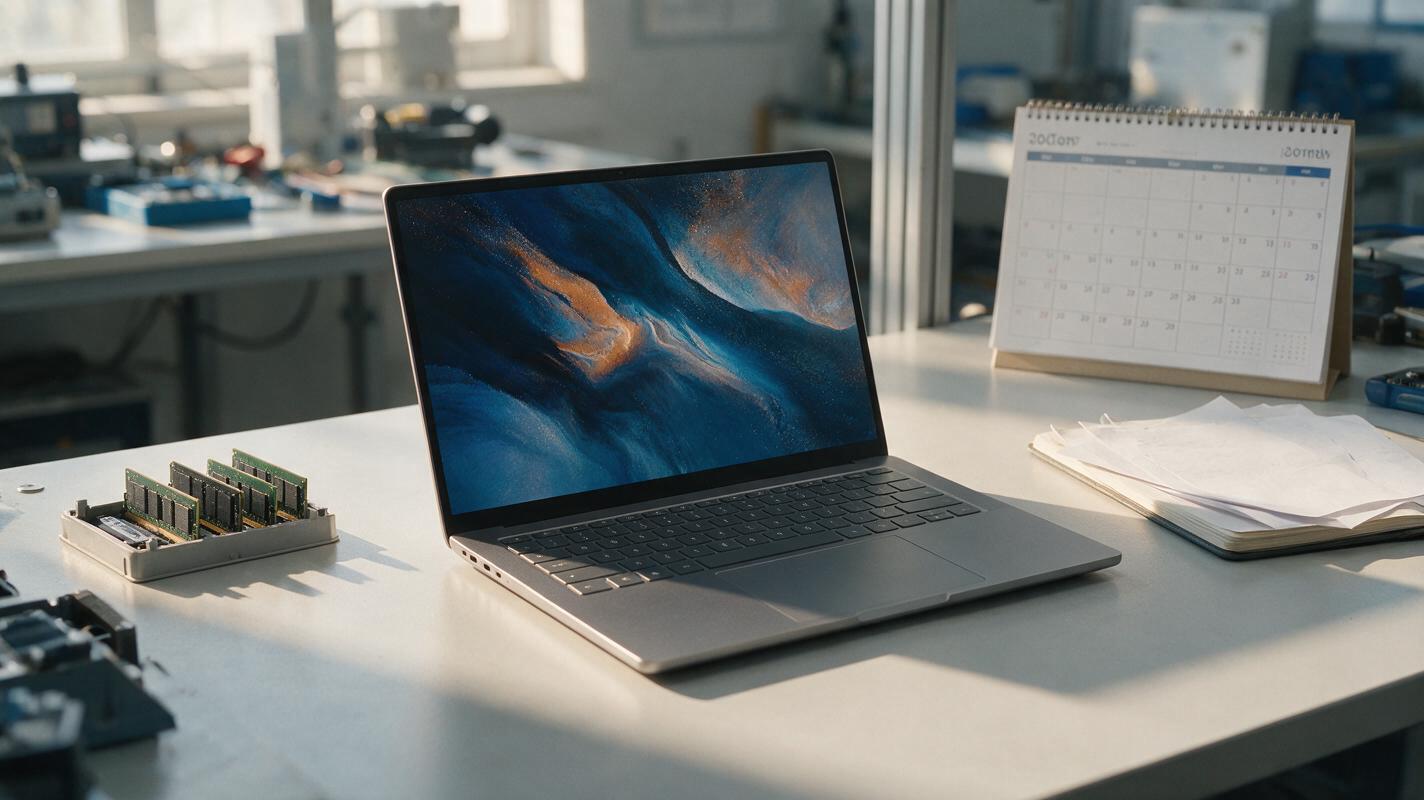
Table of contents
Apple M5 Pro Appears in a New Geekbench Listing
An Apple M5 Pro benchmark surfaced on Geekbench on October 20, 2026, revealing a configuration associated with an upcoming 14-inch MacBook Pro. The listed machine carries the identifier Mac17,9 and pairs a 15-core CPU with 48GB of RAM.
The timing is especially notable because the benchmark appeared ahead of Apple’s late-October hardware event. It offers an early, specification-level glimpse of a possible MacBook Pro 2026 configuration, although the available report does not provide enough information to confirm the complete product lineup, final retail configurations, pricing or availability.
For people producing AI-assisted media, the listing is relevant because computer hardware remains one part of the broader content pipeline. Still, a benchmark appearance is not a complete production review, and the practical value of any machine depends on the software, models and cloud services surrounding it.
The central news: Geekbench has surfaced a 14-inch MacBook Pro 2026 identified as Mac17,9, equipped with an Apple M5 Pro, a 15-core CPU and 48GB of RAM.
What the Mac17,9 Listing Actually Establishes
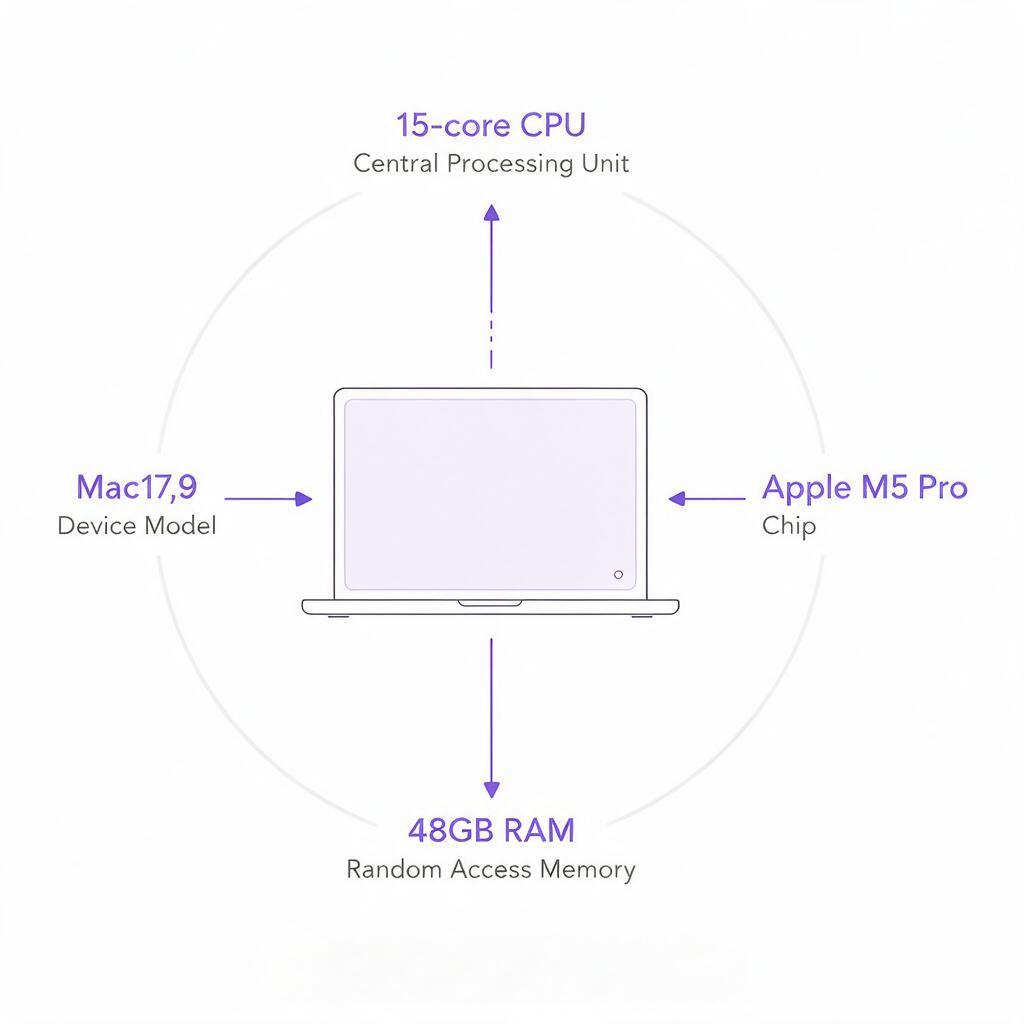
The Geekbench appearance establishes a concise set of reported details. The machine is identified as a 14-inch MacBook Pro 2026, its model identifier is Mac17,9, the processor is described as an Apple M5 Pro with 15 CPU cores, and the listed memory capacity is 48GB.
| Listing detail | Reported information |
|---|---|
| Product | 14-inch MacBook Pro 2026 |
| Model identifier | Mac17,9 |
| Processor | Apple M5 Pro |
| CPU configuration | 15 cores |
| Memory | 48GB RAM |
| Context | Surfaced ahead of Apple’s late-October hardware event |
Those facts make the listing newsworthy without supporting broader conclusions about the full M5 Pro range. The report does not establish every configuration Apple may offer, nor does it confirm that the benchmarked hardware will match a retail unit in every respect.
It is also important not to turn the appearance of a benchmark into an unsupported performance verdict. No benchmark score is included in the supplied report, so there is no factual basis here for a speed comparison with earlier Apple silicon or competing processors. The responsible reading is narrower: an M5 Pro configuration has appeared, and the reported hardware profile includes 15 CPU cores and 48GB of RAM.
Why the Timing Matters Before Apple’s Hardware Event
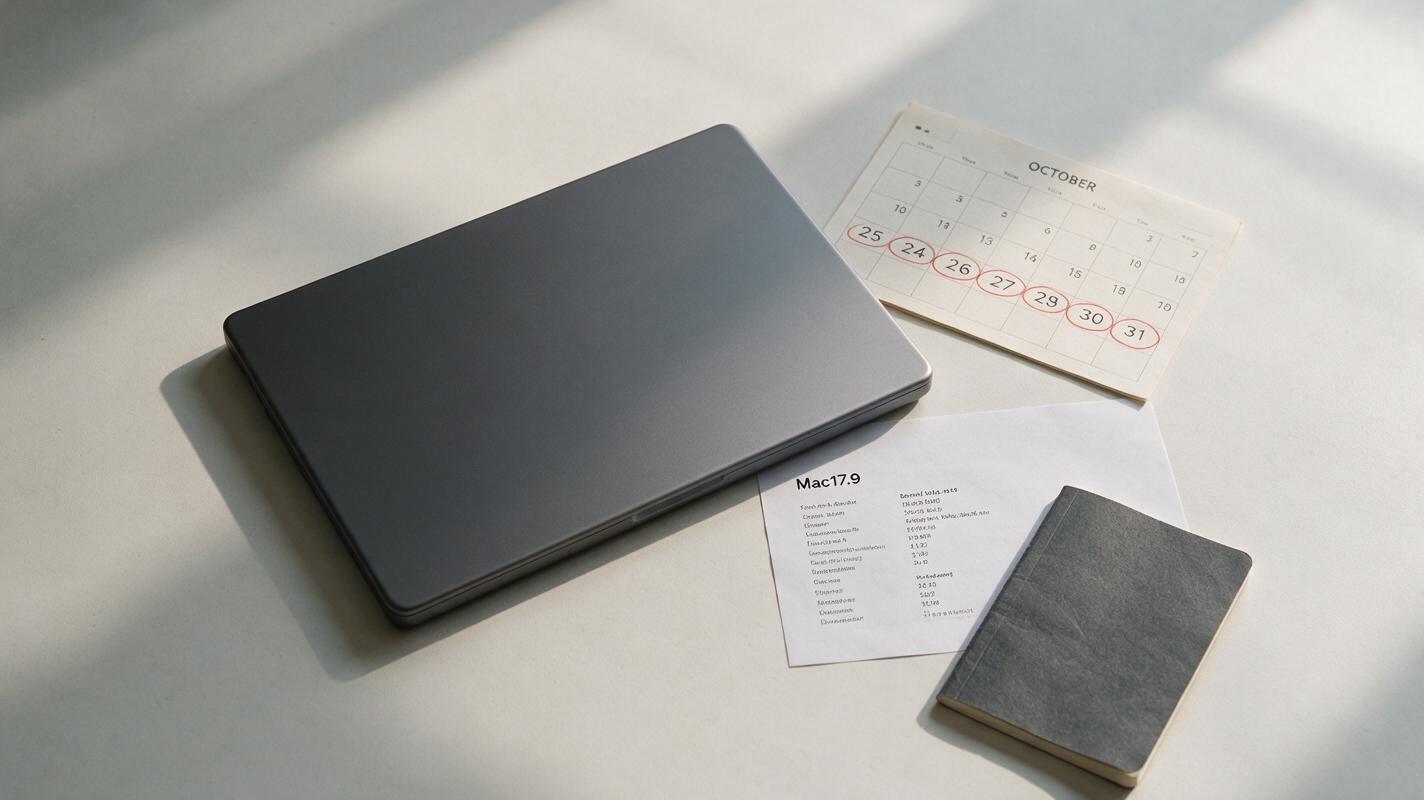
The proximity to Apple’s late-October hardware event gives the Geekbench listing additional significance. Benchmark sightings often attract attention because they place concrete specifications into the conversation before a broader product presentation. In this case, the model identifier and hardware configuration give observers specific terms to watch as Apple’s event approaches.
Even so, the listing should be treated as an early signal rather than a substitute for the event. Important purchasing information remains outside the reported facts, including final prices, shipping dates and the range of available configurations. Anyone planning a hardware upgrade should distinguish between what Geekbench has surfaced and what Apple may formally present.
That distinction is equally valuable for publishers covering fast-moving technology news. A reliable article should preserve attribution, state the known configuration clearly and avoid filling missing details with assumptions. The M5 Pro name may drive search interest, but accuracy depends on keeping the scope of the claim tied to the Mac17,9 listing.
What the M5 Pro Listing Means for AI Content Work
AI content production increasingly combines local hardware with browser-based and cloud-delivered tools. A computer can support writing, asset management, editing and review, while model access may come from online platforms. As a result, a processor announcement or benchmark listing represents only one layer of an AI workflow.
The reported 48GB of RAM and 15-core CPU are useful configuration facts, but they do not by themselves establish how a particular AI assistant, editing application or generation model will perform. Those conclusions require application-specific evidence that is not part of the current report.
For content teams, the more durable question is whether a workflow can remain usable across hardware changes. Projects often include scripts, reference images, generated visuals, video drafts and revisions. Keeping those elements organized at the platform level can make a production process less dependent on a single computer configuration.
MagicBoat brings multiple creation capabilities into one account. A team can develop a concept with an ai script generator and move visual production into an ai video generator without making the entire workflow dependent on one newly reported device.
Hardware Headlines Should Not Dictate the Whole Workflow
The M5 Pro benchmark will naturally prompt interest from video editors, designers and other media professionals. However, buying decisions should be based on confirmed product information and the requirements of the applications that matter to each user. A surfaced configuration can inform a watchlist, but it cannot answer every production question.
This matters especially in AI-assisted production, where model choice and service availability can change independently of a laptop. An adaptable setup separates the creative project from any one hardware cycle. Scripts, visual concepts and production plans can remain portable even when a team delays an upgrade or works across several machines.
A multi-model platform also gives users room to evaluate creative outputs without framing a hardware launch as the only route to a better result. The most useful production system is not simply the newest computer; it is the combination of dependable access, suitable tools and a repeatable process for moving from an idea to finished media.

Reading the Apple M5 Pro News Responsibly
The strongest interpretation of the listing is also the simplest. Geekbench surfaced an Apple M5 Pro configuration for a 14-inch MacBook Pro 2026. The Mac17,9 machine is reported with a 15-core CPU and 48GB of RAM, and its appearance comes ahead of Apple’s late-October hardware event.
Anything beyond those points should wait for additional evidence. There is no need to predict unreported prices, configurations or performance outcomes. For technology publishers and AI media teams, that restraint protects credibility while still allowing timely coverage of a highly searchable hardware development.
Meanwhile, production does not need to pause for the next device announcement. Teams that want to explore flexible AI creation tools can try these models for free and build a workflow that remains useful across changing hardware generations.
Key Takeaways
- An Apple M5 Pro benchmark surfaced on Geekbench on October 20, 2026.
- The listing describes a 14-inch MacBook Pro 2026 with the identifier Mac17,9.
- The reported configuration includes a 15-core CPU and 48GB of RAM.
- The appearance adds momentum ahead of Apple’s late-October hardware event.
- The report does not establish final pricing, availability, the full product lineup or application-specific performance.
- AI content teams can reduce hardware dependence by keeping creative work portable across cloud-based, multi-model tools.
Sources
Keywords
apple m5 pro benchmark, 14-inch macbook pro 2026, mac17,9, 15-core cpu, 48gb ram, apple hardware event, ai content creation