What Is the Apple-Samsung DRAM LTA? Terms, AI Context, and Impact | MagicBoat
What is the Apple-Samsung DRAM long-term agreement? Final talks are underway for a four-to-five-year DRAM supply deal expected to launch in the first half of 2027, setting a volume supply floor with market-linked pricing for Apple. The arrangement reflects a broader industry shift to treating memory as a strategic AI-era material, with implications for AI content creators facing potential supply volatility and cost changes.
Table of contents
Apple and Samsung Electronics are in final negotiations on a multi-year DRAM long-term supply agreement that would lock in a memory supply floor for Apple starting in the first half of 2027, marking a strategic shift for the iPhone maker as AI-driven demand tightens global memory supplies. The deal, first reported on November 17, 2026, would make Apple the last of the large tech companies to secure a formal long-term DRAM arrangement with Samsung, and arrives as AI server demand for HBM and DRAM pushes leading suppliers to lock in multi-year commitments worth hundreds of billions of dollars. For AI content creators, the move is another signal that memory supply will remain a constrained, high-stakes input for AI infrastructure for years to come, with ripple effects on model availability and creative tool costs.
What Happened
On November 17, 2026, industry reports revealed that Samsung Electronics and Apple are in final talks on a long-term agreement (LTA) for DRAM memory chips. The arrangement is expected to take effect in the first half of 2027 and run for four to five years, establishing a minimum supply volume that Samsung will commit to delivering to Apple over the term.
Prior to these talks, Apple was the only large technology company without a formal long-term DRAM supply deal with Samsung, the world’s largest memory chip maker. The shift comes as global demand for DRAM and high-bandwidth memory (HBM) surges alongside the expansion of AI server infrastructure, with major players racing to lock in supply to avoid shortages and volatile spot pricing.
Key Deal Terms and Industry Context
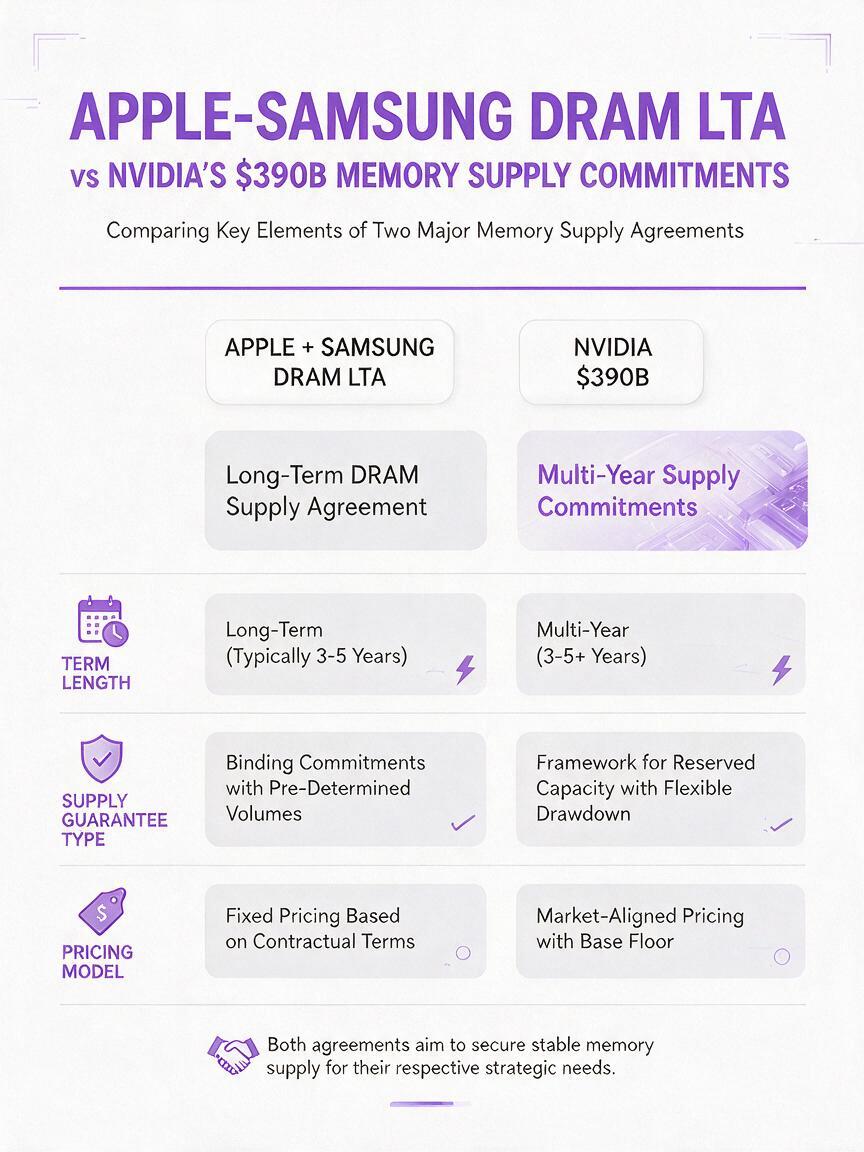
The proposed agreement sets a supply floor for Apple, guaranteeing a minimum volume of DRAM chips from Samsung over the contract term. Pricing, however, will be fixed later based on prevailing market conditions, rather than being locked in at a fixed rate upfront.
| Deal Term | Details |
|---|---|
| Parties | Apple Inc. and Samsung Electronics |
| Expected Effective Date | First half of 2027 |
| Contract Length | Four to five years |
| Supply Guarantee | Minimum volume floor committed |
| Pricing Structure | Market-linked, to be set later based on market conditions |
| Signing Status | Final talks ongoing; not yet signed |
| Current Quarter Impact | No bearing on the current quarter |
Because only volume is guaranteed and pricing remains tied to market conditions, Apple will still be exposed to DRAM price volatility, even as it secures supply certainty. The arrangement reflects a broader industry shift where memory is increasingly treated as a strategic material rather than a cyclical procurement item, particularly as AI server deployments consume growing volumes of both HBM and standard DRAM.
Industry context underscores the urgency of such deals: Nvidia has lifted its future supply commitments to $390 billion, largely through multi-year memory deals tied to its AI accelerator business. Even fast-growing Chinese AI provider DeepSeek, which saw an 801% week-over-week jump in API call volume in late 2026 per industry roundups, competes for the same tight global memory supplies, putting broader upward pressure on AI infrastructure costs. The scale of these commitments and demand signals highlights how tight the global memory supply chain is expected to remain through the end of the decade, as ai capital expenditure continues to rise across the tech sector.
What This Means for AI Content Creators
For independent creators and content teams relying on cloud-hosted ai video generator and ai image generator tools, long-term memory supply deals like this one shape the long-term stability of the services they depend on. DRAM and HBM are critical components of the GPU clusters that power AI model inference and training; when supplies are tight and volatile, smaller AI model providers and neocloud platforms may face capacity constraints or sudden price hikes that get passed down to end users in the form of higher generation costs, longer queue times, or limited access to high-performance model tiers.
For creators building businesses around AI content, supply chain volatility adds unnecessary risk to production planning and budget forecasting. A multi-model platform like MagicBoat spreads supply risk across multiple providers and model families, so creators don’t face disruption if a single provider runs into memory-related capacity issues. You can try these models for free to test how multi-model access fits into your creative workflow, without being locked into a single vendor’s supply chain.
Key Takeaways
- Apple and Samsung are in final talks on a 4–5 year DRAM long-term supply agreement expected to launch in the first half of 2027, making Apple the last large tech firm to secure such a deal with Samsung.
- The agreement guarantees a minimum supply volume (a supply floor) but uses market-linked pricing, leaving Apple exposed to DRAM price volatility.
- The deal reflects a broader industry shift to treating memory as a strategic material, with Nvidia’s $390B in multi-year supply commitments and DeepSeek’s rapid API growth signaling sustained tightness in AI-era memory markets.
- For AI content creators, tight memory supplies can lead to higher generation costs and service instability, making multi-model platforms a valuable risk-mitigation tool.
Keywords
ai industry, ai capital expenditure, apple samsung dram deal, dram supply, ai servers, ai video cost, deepseek