AWS Launches Open-Source Physical AI Toolchain With NVIDIA Integration
AWS has launched an open-source Physical AI Toolchain for robotics and manufacturing that integrates with the NVIDIA stack. The infrastructure announcement highlights the expansion of AI beyond digital content and offers lessons for production teams evaluating availability, reliability, and cost.
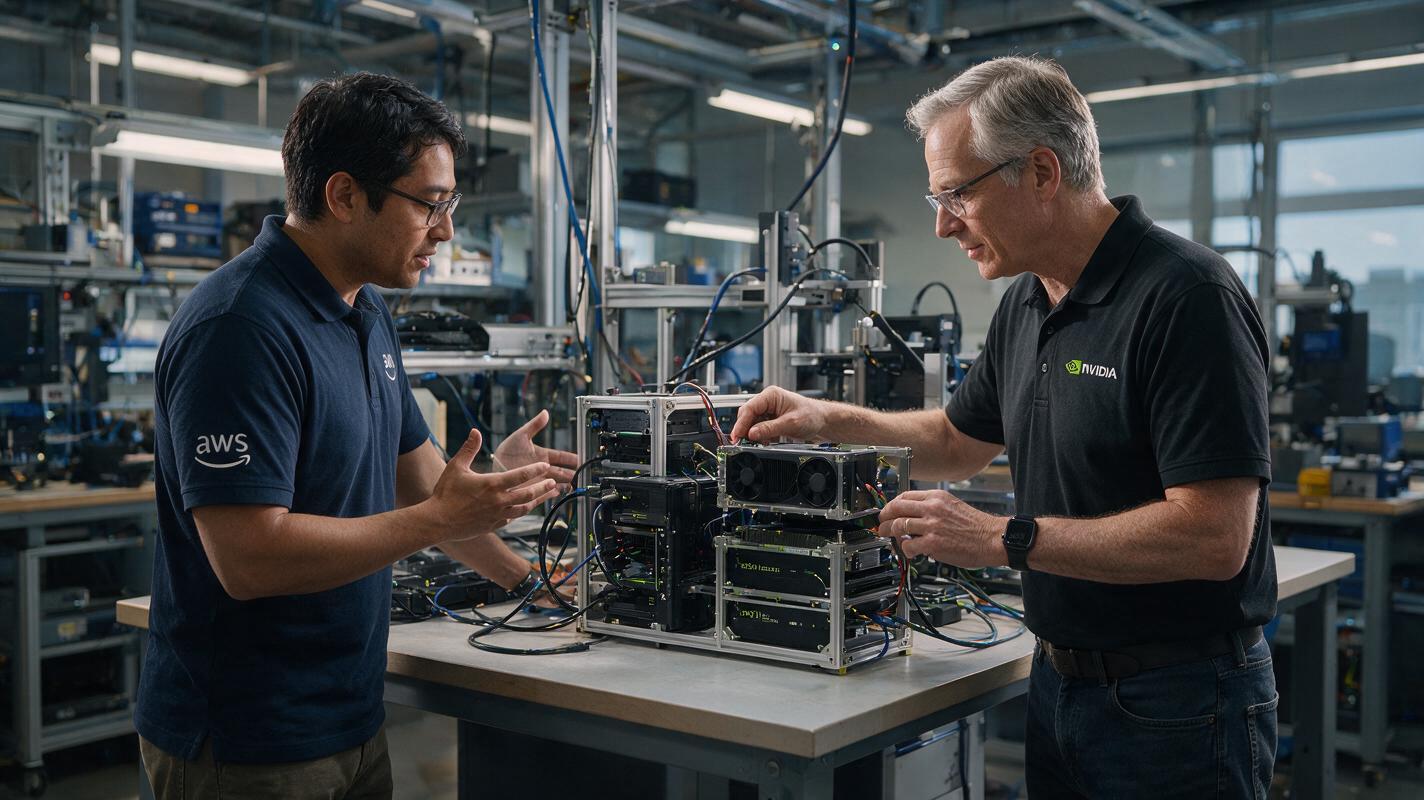
Table of contents
AI Industry News · October 8, 2026
AWS Launches Open-Source Physical AI Toolchain With NVIDIA IntegrationThe AWS Physical AI Toolchain brings an open-source infrastructure initiative to robotics and manufacturing while connecting with NVIDIA’s technology stack.
Amazon Web Services launched an open-source Physical AI Toolchain on October 8, targeting work in robotics and manufacturing. The announcement places AWS more directly inside a branch of the AI industry concerned with systems that interact with physical environments, rather than software that produces only digital responses.
The toolchain integrates with the NVIDIA stack, linking AWS infrastructure with technology from one of the major suppliers supporting modern AI computing. Its open-source status is also central to the announcement: developers and organizations can examine and work with the toolchain rather than treating it solely as a closed AWS product.
The available announcement identifies the target sectors, integration partner, and open-source approach. It does not establish pricing, performance benchmarks, supported hardware lists, deployment requirements, or new content-generation capabilities. Those details should not be inferred from the launch alone.
For content teams, the immediate significance is indirect but important. Physical AI investment shows how AI infrastructure is expanding beyond text, images, and video into robotics and industrial environments, increasing the range of workloads competing for computing capacity and engineering attention.
What AWS Physical AI Toolchain Actually Announces
The term “Physical AI” can invite broad interpretations, but the confirmed scope here is focused: AWS has released an open-source toolchain for robotics and manufacturing, and that toolchain integrates with the NVIDIA stack.
| Announcement element | Confirmed information | Not established by the announcement |
|---|---|---|
| Provider | Amazon Web Services | No additional vendor participation beyond the stated NVIDIA integration |
| Release model | Open source | No claim about support terms or commercial pricing |
| Primary focus | Robotics and manufacturing | No announced consumer or media-production feature set |
| Technology relationship | Integration with the NVIDIA stack | No disclosed benchmark or performance advantage |
The launch is best read as an infrastructure announcement for physical AI development—not as evidence that AWS has introduced a new image, video, or filmmaking model.
Why Open-Source Infrastructure Matters
Open-source releases can influence where developers build, test, and maintain AI systems. In robotics and manufacturing, a shared toolchain can become part of the technical layer connecting development work with the computing environments used to run it.
The NVIDIA integration adds another dimension. It reflects the interconnected structure of the AI industry, where cloud providers, computing suppliers, software frameworks, and application developers often operate as parts of the same production chain. A major infrastructure release is therefore rarely about one company in isolation.
That does not mean every organization needs to adopt the new toolchain. The announcement provides no basis for claiming that it lowers costs, improves performance, or fits every robotics project. Teams assessing it will still need evidence relevant to their own deployment conditions.
Infrastructure Announcements Require Practical Evaluation
AI capital expenditure and technical partnerships often attract attention because they indicate where large vendors expect demand to grow. Yet infrastructure momentum is not the same as a measurable benefit for an individual production team.
A useful evaluation would distinguish between what has been announced and what must still be tested. Relevant questions include:
- Whether the toolchain supports the organization’s actual robotics or manufacturing environment
- How much engineering work is required to integrate and maintain it
- Whether the NVIDIA integration matches existing infrastructure choices
- How reliably the system performs under real production conditions
- What the complete operating cost becomes after computing, labor, and maintenance are included
None of those answers can be supplied by the launch headline alone. Open source creates an avenue for technical inspection, but it does not remove the need for testing, governance, and cost analysis.
Physical AI and Digital Content Production Are Different Layers
Robotics and manufacturing systems operate in a different context from an ai image generator or an ai video generator. Physical AI must address environments involving machines and real-world operations, while creative AI tools help teams produce digital media.
Conflating those categories can lead to inaccurate expectations. The AWS announcement does not say that the Physical AI Toolchain creates campaign images, generates videos, writes scripts, or provides media-editing functions. Its relevance to content production comes from the larger infrastructure trend it represents.
Cloud providers and computing companies are supporting a widening collection of AI workloads. Robotics, manufacturing, model training, inference, image generation, and video generation can all contribute to demand for computing resources. As that demand grows, content teams may experience its effects through service availability, production speed, or changing AI video cost—even when the original investment targets another industry.
What Content Teams Should Take From the Launch
The strongest lesson is that AI production depends on a layered ecosystem. An appealing output may be the visible result, but cloud infrastructure, computing hardware, software integration, and model access all sit behind it.
For a creative department, the practical response is not to adopt every new infrastructure release. It is to avoid building a fragile workflow around assumptions that one vendor, model, or technical route will always remain available on the same terms.
Availability Belongs in the Creative Brief
Content planning normally covers audience, format, visual direction, deadlines, and approval criteria. AI-assisted production also benefits from considering model availability and operational reliability. A concept is difficult to deliver if the selected service is inaccessible, slow, or unsuitable for the required output.
Teams can reduce that exposure by keeping prompts, scripts, reference assets, and review criteria portable. This makes it easier to compare outputs or continue production when one route does not meet the brief.
Cost Should Be Measured Per Approved Asset
Infrastructure announcements can encourage speculation about whether AI will become cheaper or more expensive. A content team needs a narrower measure: the total cost required to produce an approved asset.
That total can include generation attempts, revisions, staff time, rejected outputs, and delays. A low initial generation price may still produce a high final cost if the result requires extensive correction. Conversely, a more expensive attempt can be economical when it reaches approval quickly.
This production-level measurement is more useful than drawing pricing conclusions from the AWS launch, which provides no confirmed cost data for creative AI services.
Where MagicBoat Fits in a Multi-Model Workflow
The AWS Physical AI Toolchain is aimed at robotics and manufacturing. MagicBoat addresses a separate need: giving content teams a unified environment for AI-assisted creative production.
That distinction matters. Most marketing departments and independent production teams do not need to assemble a robotics infrastructure stack to create digital campaigns. They need a practical way to move from an idea to visual assets while retaining flexibility across creative tools.
A multi-model platform can help teams compare results without centering the workflow on one provider. This is valuable as the broader AI industry changes through open-source releases, infrastructure investment, vendor integrations, and shifting model availability.
Instead of treating a single model as a permanent production dependency, teams can organize work around the deliverable:
- A clearly defined narrative or campaign concept
- Reusable source material and visual references
- Output criteria covering format, tone, and consistency
- Alternative model options when the first result is unsuitable
- A review process based on approved assets rather than raw generations
This approach keeps infrastructure news in perspective. Major releases reveal where the market is moving, but creative success still depends on choosing tools according to the asset being produced.
Key Takeaways
- AWS launched an open-source Physical AI Toolchain on October 8.
- The initiative targets robotics and manufacturing.
- The toolchain integrates with the NVIDIA stack.
- The announcement does not provide pricing, benchmarks, hardware requirements, or creative-generation features.
- The launch illustrates the expanding infrastructure footprint of the AI industry.
- Content teams should evaluate AI tools through availability, reliability, revision burden, and cost per approved asset.
- Flexible, multi-model creative workflows can reduce dependence on one provider or technical route.
Explore AI Creation Without Building the Infrastructure
Robotics infrastructure and digital content production solve different problems. For image, video, and story workflows in one creative environment, try these models for free on MagicBoat.
Keywords: AWS Physical AI Toolchain, physical AI, AWS robotics, manufacturing AI, NVIDIA integration, open-source AI, AI industry, AI capital expenditure