Meta Releases Muse Spark Open With 81.6B Parameters and 1M Context
Meta released Muse Spark Open, an 81.6-billion-parameter open-weight MoE model with native multimodality, a one-million-token context window and planned local Mac deployment through Apple.
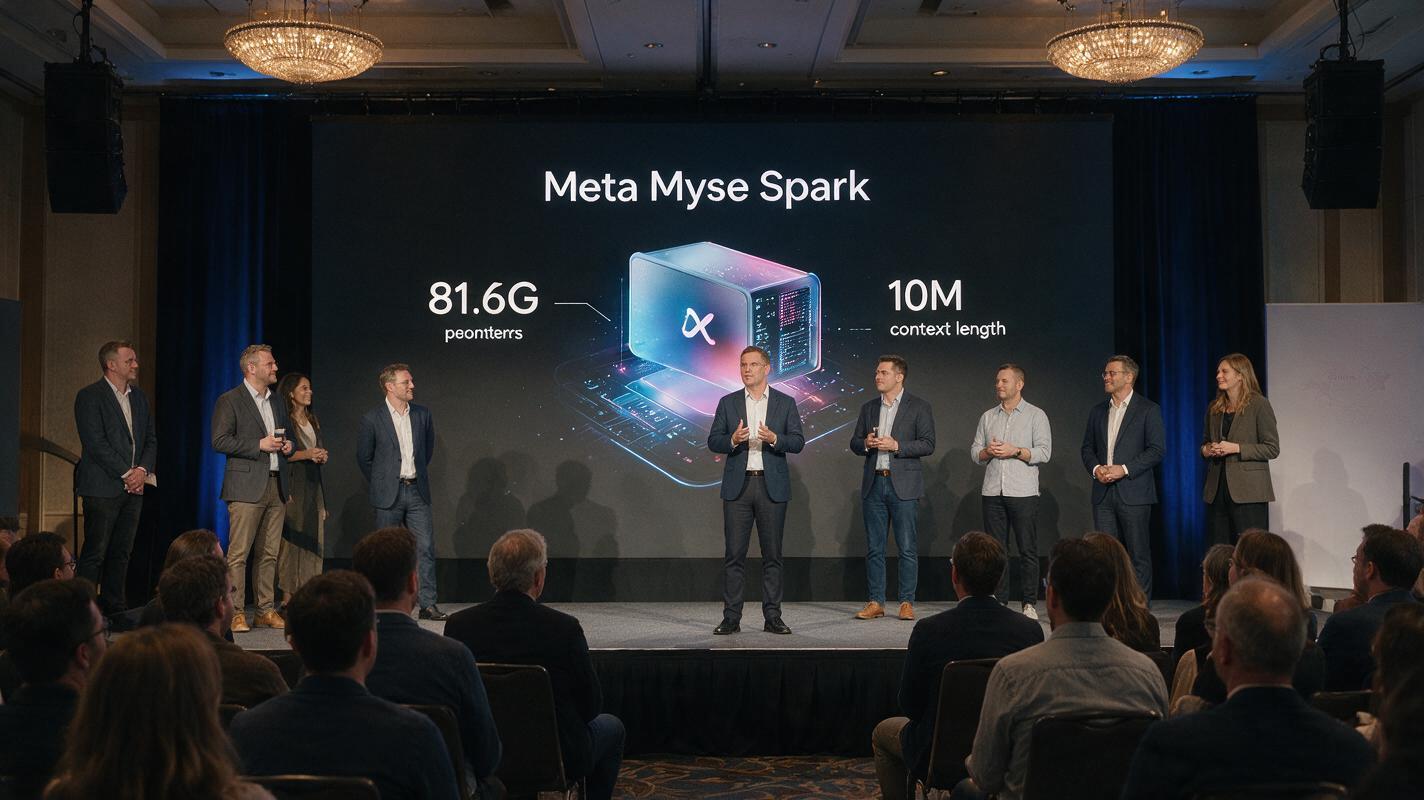
Table of contents
AI Model News
Meta Releases Muse Spark Open With 81.6B Parameters and 1M ContextMeta’s new open-weight model combines a mixture-of-experts architecture, native multimodality and a million-token context window, while an Apple partnership points toward local deployment on Mac hardware.
Meta Introduces Muse Spark Open
Meta released Muse Spark Open on October 16, 2026, adding a substantial new open-weight model to the rapidly expanding frontier-model market. The model has 81.6 billion parameters and uses a mixture-of-experts architecture, commonly abbreviated as MoE. Meta is presenting it as the strongest open-weight model from a United States company.
The release also brings two specifications with direct relevance to demanding AI workflows: native multimodality and a one-million-token context window. Those characteristics position Muse Spark Open as a model built to work across complex inputs and unusually large amounts of context, rather than as a narrowly defined text-only release.
Meta has additionally partnered with Apple for local deployment on Mac hardware. That element makes Muse Spark Open notable not only for its model scale, but also for the direction of its distribution. The announcement connects an open-weight frontier model with a route toward local computing rather than limiting the story to remote services.
The available release details do not provide pricing, benchmark scores or a public comparison methodology supporting Meta’s strongest-model claim. They also do not establish Muse Spark Open as a dedicated text-to-video or image-to-video generator. Native multimodality is significant, but it should not be treated as confirmation of specific visual-generation features that Meta did not state.
For AI video and image creators, the immediate importance lies in model choice, context capacity and deployment flexibility. Muse Spark Open adds another potential intelligence layer for creative production, while its local Mac partnership signals that access models may become as consequential as raw model specifications.
The Confirmed Muse Spark Open Specifications
| Release detail | Confirmed information | Why it attracts attention |
|---|---|---|
| Model name | Muse Spark Open | Expands Meta’s open-weight model portfolio |
| Model size | 81.6 billion parameters | Places the release in the large-model category |
| Architecture | Mixture of experts | Defines the model’s underlying design |
| Input design | Native multimodality | Signals support for workflows involving more than one form of input |
| Context capacity | One million tokens | Supports unusually large working context |
| Deployment direction | Apple partnership for local Mac deployment | Connects the model with local computing |
| Market positioning | Meta claims it is the strongest US open-weight model | Sets a high competitive claim that still requires practical evaluation |
The announcement details do not include benchmark scores, API prices or confirmed dedicated image and video generation functions.
Why the One-Million-Token Context Matters
A one-million-token context window is one of the release’s clearest headline specifications. In creative production, context is the material a model can keep available while handling an assignment. A larger context capacity can matter when a project contains extensive scripts, character notes, visual references, continuity requirements and revision history.
The number alone does not guarantee better output. A model must still use the supplied context effectively, and the Muse Spark Open release details do not include benchmark evidence showing how reliably it performs across the full window. Nevertheless, the specification makes the model relevant to long-form projects where isolated prompts are less useful than maintaining a broad production brief.
Muse Spark Open’s million-token window is best read as workflow capacity, not automatic proof of output quality.
For an AI film project, that distinction is important. A model involved in planning or coordination may need to reference a large creative package even when a separate ai video generator produces the final moving images. Context-oriented models and generation models can occupy different roles within the same production pipeline.
Native Multimodality Does Not Automatically Mean Video Generation
Meta describes Muse Spark Open as natively multimodal, but the announcement does not specify dedicated text-to-video or image-to-video output. That boundary should remain clear when evaluating the release for visual work.
Multimodality can make a model relevant to creative workflows without turning it into a specialized visual generator. A general model may sit around the production process, while an ai image generator handles still-image creation and a dedicated video model handles motion.
This separation helps creative teams avoid selecting tools on labels alone. The practical questions are whether a model fits the intended role, whether access remains dependable and whether the surrounding workflow can move between tools when requirements change.
Local Mac Deployment Changes the Access Conversation
The Apple partnership for local Mac deployment is a defining part of the Muse Spark Open announcement. It points toward a future in which some large-model activity may take place closer to the user’s own hardware instead of depending entirely on a remote endpoint.
The release details do not state which Mac systems will be supported, when local deployment will become available or what performance users should expect. Those omissions make it premature to draw conclusions about speed, hardware requirements or practical production capacity.
Even so, local deployment is strategically relevant. Model selection is increasingly influenced by where a model runs, how it can be accessed and whether it fits into an existing production environment. Muse Spark Open combines an open-weight release with a named local-computing partnership, making distribution part of the core story rather than a secondary technical detail.
What It Means for AI Video and Image Workflows
Muse Spark Open arrives at a time when creative pipelines rarely depend on a single model category. Long-context intelligence, multimodal processing, image generation and video generation can all serve distinct functions. The new Meta model adds another option to the intelligence side of that landscape, but its announcement does not remove the need for purpose-built creative tools.
Creators evaluating it should focus on the confirmed facts:
- Scale: an 81.6-billion-parameter MoE model.
- Context: a one-million-token capacity for large project materials.
- Modality: native multimodality, without a confirmed dedicated visual-generation feature set.
- Access direction: an Apple partnership for local Mac deployment.
- Evidence still needed: pricing, benchmark details and practical deployment requirements were not included in the announcement information.
The broader lesson is that creative teams should build around workflow portability rather than assuming one newly released model will cover planning, imagery and motion equally well. A stable multi-model environment can reduce the friction of moving between different capabilities as projects evolve.
Muse Spark Open’s Place in a Multi-Model Production Stack
Meta’s release expands the range of models available for context-heavy and multimodal work. Its large context window may be attractive for projects with substantial source material, while the planned Mac deployment creates a second reason to watch the model beyond benchmark competition.
For production teams, however, a model announcement is only the beginning of evaluation. Output consistency, access, cost and compatibility determine whether a model becomes a dependable part of daily work. The absence of disclosed pricing and benchmark numbers means Muse Spark Open’s practical position cannot be settled from specifications alone.
MagicBoat provides a one-account, multi-model environment for AI content creation, helping users keep image and video production accessible even as the underlying model market changes. That approach complements releases such as Muse Spark Open by letting creators choose specialized creative capabilities without redesigning an entire workflow around every model announcement.
Key Takeaways
- Meta released Muse Spark Open on October 16, 2026.
- The open-weight MoE model has 81.6 billion parameters.
- It features native multimodality and a one-million-token context window.
- Meta claims it is the strongest US open-weight model.
- Meta is partnering with Apple for local deployment on Mac hardware.
- The disclosed details do not include pricing, benchmark scores or confirmed dedicated image and video generation capabilities.
- Creative teams should judge the model by its intended workflow role rather than treating multimodality as proof of every output format.
Explore a Flexible AI Creation Workflow
Muse Spark Open shows how quickly model architectures, context limits and deployment options are changing. Keep your visual workflow adaptable with MagicBoat and try these models for free.