Cisco, Applied Materials and Cerebras Earnings Beat as Nebius Falls
Cisco, Applied Materials and Cerebras reported strong AI hardware-chain results after the November 12 US close, but Nebius fell despite beating quarterly expectations. The split shows why revenue growth, guidance, capacity commitments and the path to profitability all matter when assessing the infrastructure behind AI workflows.
Table of contents
Three AI Hardware Earnings Beats Land at Once
Three companies serving different parts of the AI hardware chain reported strong results after the US market closed on November 12. Cisco raised its outlook after reporting rapid networking growth, Applied Materials delivered sharply higher semiconductor-equipment revenue and profit, and Cerebras paired expanding cloud services with a large contracted data-center pipeline.
Cisco reported fiscal 2027 first-quarter revenue of $18.5 billion, up 24%, while net income rose about 59% to $4.6 billion. Adjusted earnings per share increased 40% to $1.40. Applied Materials reported fiscal 2026 fourth-quarter revenue of $10.41 billion, up 53%, alongside adjusted earnings per share of $4.16, up 92%. Cerebras reported third-quarter GAAP revenue of $210.8 million, up 55%, while non-GAAP core revenue reached $230.9 million, up 70%.
The market did not reward every AI infrastructure company equally. Nebius also beat quarterly revenue and adjusted EBITDA expectations, but its full-year outlook landed at the low end of its stated range and its pre-tax breakeven target moved to the end of 2027. Its shares fell 16.84%, while CoreWeave declined 6.86% and IREN lost 6.53%.
For content teams, the divergence matters because AI creation depends on a long infrastructure chain rather than a single model or application. Stronger networking, semiconductor manufacturing and inference capacity may support more capable AI services, but financial pressure on individual providers can still affect availability, pricing and the reliability of an AI workflow.
Cisco Raises Its AI Infrastructure Outlook
Cisco's quarter showed particularly strong growth in the hardware categories most closely connected with network expansion. Networking revenue rose 43%, total product revenue increased 32% and services revenue grew 1%.
The company raised its forecast for full-year AI infrastructure revenue from hyperscalers from $7.5 billion to $9 billion. The revised figure is more than double the comparable total from the previous fiscal year. Cisco also lifted its full-year revenue guidance from $72.2 billion–$73.4 billion to $74.8 billion–$75.8 billion, while adjusted earnings-per-share guidance increased to $5.47–$5.53.
Cash generation remained substantial: Cisco reported $4.4 billion in operating cash flow and returned $3.7 billion through dividends and share repurchases. Together, those figures present a company funding AI-related network expansion while continuing to distribute capital to shareholders.
Cisco's updated $9 billion hyperscaler forecast suggests that AI infrastructure demand is reaching beyond processors into the networking systems that connect large computing environments.
Applied Materials Benefits From Semiconductor Expansion
Applied Materials supplied another view of the same infrastructure cycle. Its quarterly revenue rose 53% to $10.41 billion, adjusted earnings per share climbed 92% to $4.16 and adjusted gross margin reached 50.6%, an increase of 2.5 percentage points.
Semiconductor systems contributed about $8 billion. Foundry and logic represented 58% of that segment, DRAM accounted for 33% and flash represented 9%. The mix highlights how AI infrastructure investment reaches both processing and memory manufacturing.
For the following quarter, Applied Materials guided to revenue of $11 billion, plus or minus $500 million, and adjusted earnings per share of $4.35, plus or minus $0.20. Those forward figures indicate that the reported quarter was not presented as an isolated surge.
| Company | Reported revenue | Key growth figure | Forward signal |
|---|---|---|---|
| Cisco | $18.5B | Revenue up 24% | Full-year revenue guidance raised to $74.8B–$75.8B |
| Applied Materials | $10.41B | Revenue up 53% | Next-quarter revenue guided to $11B ± $0.5B |
| Cerebras | $210.8M GAAP | Core revenue up 70% | Q4 core revenue guided to $310M–$330M |
| Nebius | $980.8M | Revenue up 571% | Full-year guidance at low end of $3.0B–$3.4B |
Cerebras Expands Cloud Revenue and Contracted Capacity
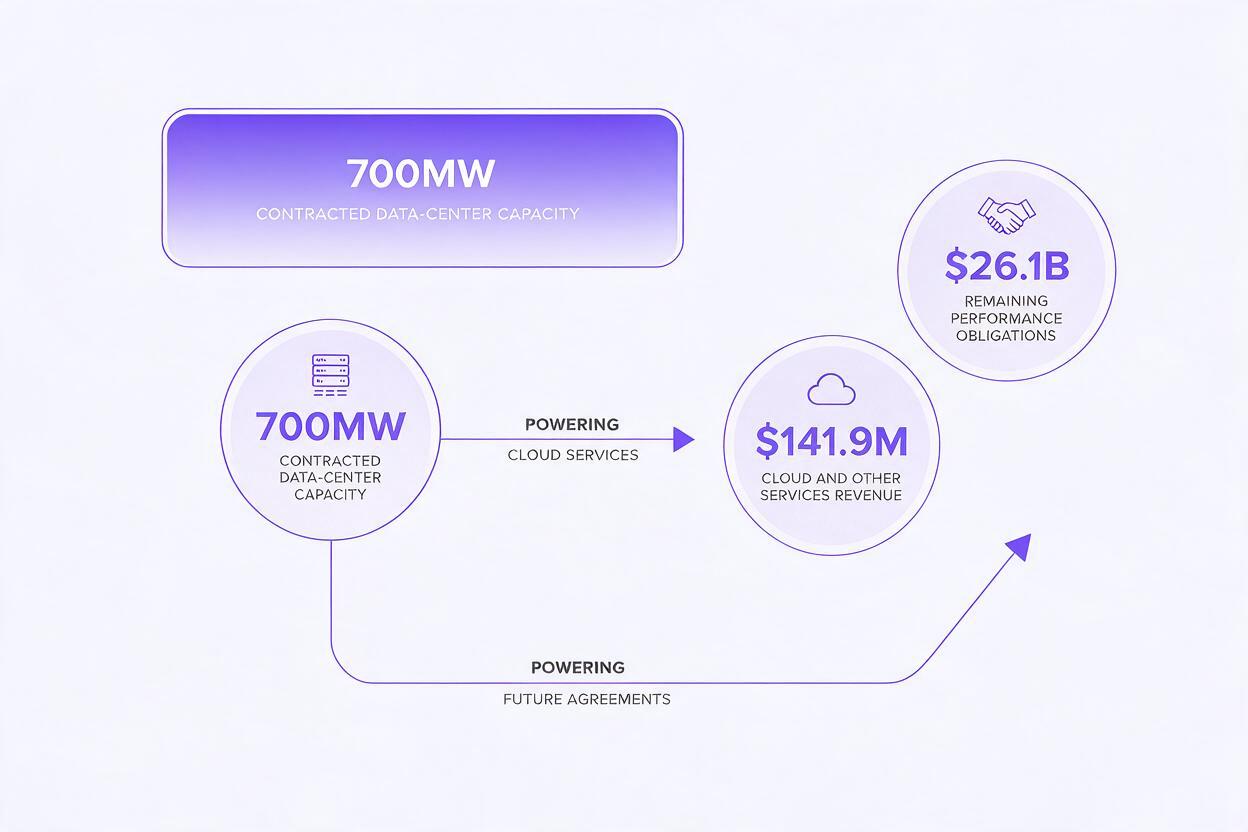
Cerebras delivered the smallest absolute revenue total of the three companies, but its service growth and contracted pipeline drew attention. Cloud and other services revenue reached $141.9 million, up 265%, and represented about 67% of total revenue. Non-GAAP core net income was $29.82 million.
The company reported 700 megawatts of contracted data-center capacity and $26.1 billion in remaining performance obligations. It also disclosed two new hyperscaler agreements, including one involving Oracle in 2027.
Cerebras guided fourth-quarter core revenue to $310 million–$330 million and raised full-year core revenue guidance to $940 million–$960 million. Its chief executive also targeted 2027 revenue at three times the 2026 level. Shares rose more than 18% in after-hours trading.
The combination of current service growth, contracted capacity and remaining obligations offered investors several ways to evaluate future demand. However, targets and contracted pipelines remain forward-looking indicators rather than completed revenue.
Why Nebius Moved in the Opposite Direction
Nebius demonstrated that an earnings beat alone was not enough to satisfy the market. Third-quarter revenue reached $980.8 million, up 571%, and adjusted EBITDA was $465.8 million. Both figures exceeded expectations.
The reaction turned negative because full-year guidance came in at the low end of the company's $3.0 billion–$3.4 billion range, compared with an expectation of roughly $3.37 billion. Nebius also pushed its pre-tax breakeven target to the end of 2027.
The stock fell 16.84%, and the pressure spread to other infrastructure names. CoreWeave declined 6.86% and IREN fell 6.53%. The contrast with Cerebras suggests that investors were weighing not only growth but also guidance, obligations, financing demands and the timing of profitability.
What the Results Mean for AI Content Production
AI content tools sit above multiple infrastructure layers. Semiconductor equipment supports chip production, networking links computing systems, and inference providers turn capacity into accessible services. A disruption or financial constraint in any layer can affect the tools used for AI automation, an AI assistant or an ai video workflow.
That does not mean a strong hardware quarter automatically produces faster or cheaper creative applications. It does show that demand for AI infrastructure is appearing across distinct parts of the supply chain. Content teams should therefore evaluate creative services by more than headline model performance. Availability, predictable access and the ability to change tools without rebuilding an entire production process are also important.
A resilient production plan separates the creative objective from dependence on one infrastructure provider. A team producing campaign visuals might use an ai image generator for concept frames and an ai video generator for motion output while keeping scripts, references and approvals portable across the broader workflow.

Where MagicBoat Fits Into a Changing Infrastructure Market
The earnings split reinforces the value of accessing creative capabilities through a unified environment rather than building every project around one provider. MagicBoat brings AI creation tools into one account, helping teams move among formats while maintaining a more consistent production process.
This approach cannot remove infrastructure risk from the AI market, but it can reduce the operational friction of working across separate tools. When providers change capacity, economics or availability, a flexible creative environment gives teams more room to preserve deadlines and adapt their output.
Explore MagicBoat and try these models for free to build a more adaptable content workflow across images, video and story development.
Key Takeaways
- Cisco reported $18.5 billion in revenue and raised its full-year hyperscaler AI infrastructure forecast to $9 billion.
- Applied Materials posted $10.41 billion in revenue, with semiconductor systems contributing about $8 billion.
- Cerebras reported rapid cloud-services growth, 700MW of contracted capacity and $26.1 billion in remaining performance obligations.
- Nebius beat quarterly expectations but fell after weaker forward signals and a delayed pre-tax breakeven target.
- The market is distinguishing between current growth, future guidance, contracted demand and the path to profitability.
- AI content teams benefit from flexible workflows that are not tightly bound to one infrastructure or model provider.
Keywords
ai hardware earnings, Cisco earnings, Applied Materials earnings, Cerebras earnings, Nebius earnings, AI infrastructure, ai workflow